The short answer
Start from your street shoe size, then read the maker’s chart. Simms, Orvis and Korkers’ men’s charts list a boot one size up for the neoprene stocking foot. Korkers’ women’s chart keeps your street size, and Patagonia’s Foot Tractor matches men’s street size with neoprene booties. Try boots on with your waders.
A wading boot goes on over the stocking foot of your waders, plus the socks inside them. That extra layer is why boot numbers and shoe numbers often differ, and each maker handles it in its own chart.
Related guide: 2 Person vs 3 Person Tent: What the Extra Size Gets You
Below, one street size is traced through four makers’ charts so you can see where they agree and where they split. For the rest of the kit, see our fishing gear section.
Wading boot size vs street shoe size, maker by maker
Each row comes from that maker’s own chart. Sizes are US.
| Maker and boot | Worn over | Men’s street 9 | Women’s street 8 | What the maker says |
|---|---|---|---|---|
| Simms | Neoprene stockingfoot | Men’s 10 | Women’s 9 or men’s 7 | Street size to 1 full size larger (men) |
| Orvis | Waders | Men’s 10 | Women’s 9 | “Start one size up” |
| Korkers | Neoprene stocking foot | Men’s 10 | Women’s 8 | Men’s chart one up; women’s chart same number |
| Patagonia River Salt | Neoprene wader booties | 10 | 7 | “Size up from street shoe sizing” |
| Patagonia River Salt | Wading sock or packable bootie | 9 | 6 | Same as men’s street size |
| Patagonia Foot Tractor | Neoprene wader booties | 9 | 6 | Same as men’s street size |
| Patagonia Foot Tractor | Wading sock or packable bootie | 8 | 5 | “Size down from street shoe sizing” |
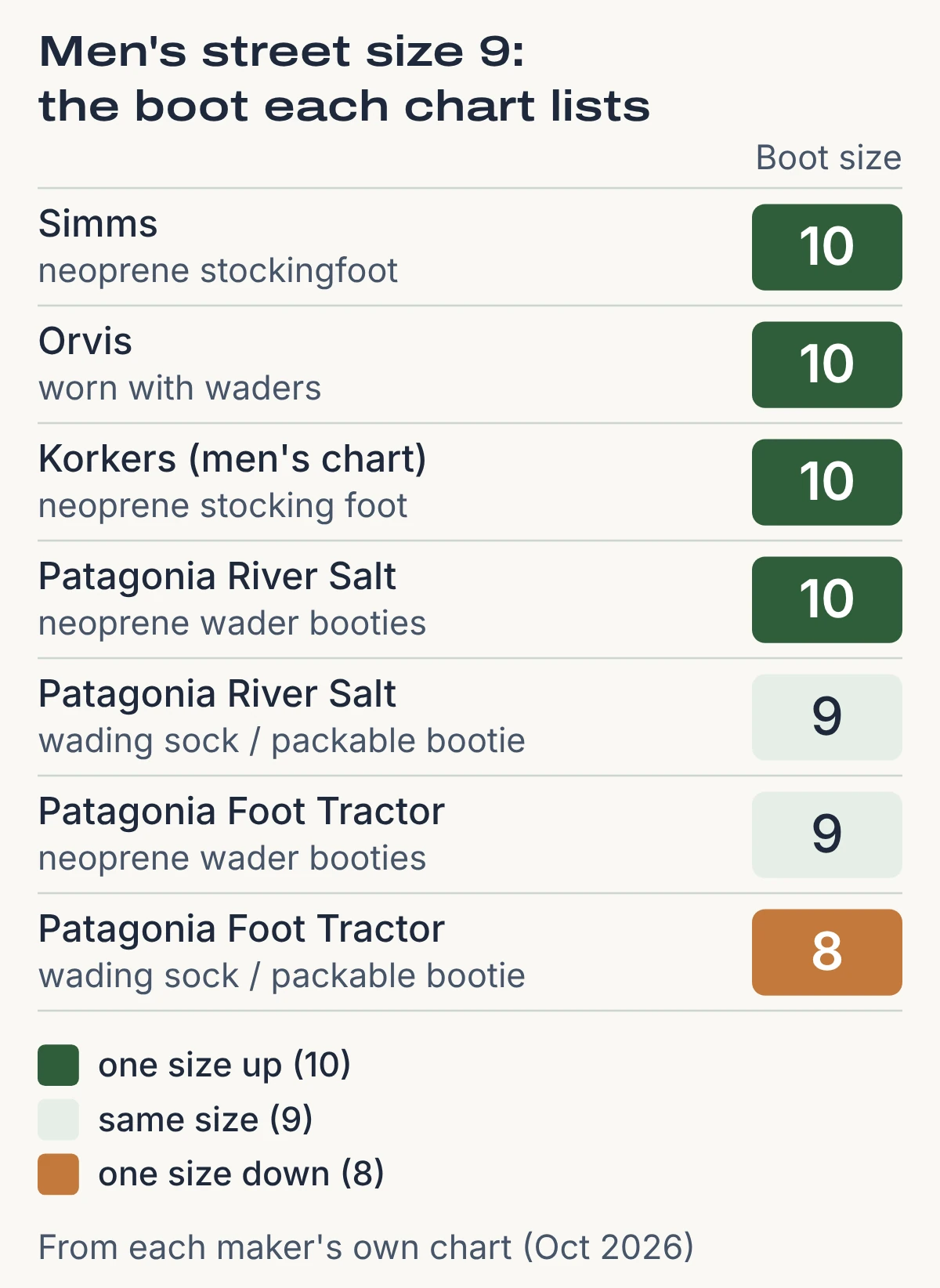
Simms. The Simms size and fit guide says: “To allow proper room for the neoprene stockingfoot, find your regular shoe size in the right-hand columns and order the corresponding Simms Wading Boot in the first column.” Every row of its men’s and women’s boot charts puts the boot one size above the street size. In words, Simms is a little looser: “We’ve found most people size their wading boots between their street shoe size and 1 full size larger (for men).” Simms also notes: “Not all styles available in all sizes; see individual boot pages for specifics.”
Orvis. Orvis, which makes and sells its own boots, says on its wader and boot sizing page: “When sizing for wading boots, typically we like to start one size up from your normal shoe size.” Its chart gives the example: “Men’s US size 10 would take an ORVIS Men’s Wading Boot size 11/Women’s US size 7 would take an ORVIS Women’s Wading Boot size 8.” Orvis’s boot-buying article reads differently on its own: “Wading boots are sized to accommodate stockingfoot waders, so you should not need to size up in your wading boots.” Read together, the boot number on the chart is already one up, so order from the chart and don’t add another size on top.
Related guide: What Size Trolling Motor Do I Need? Thrust, Shaft Length and Battery by Boat
Korkers. Korkers’ sizing guide, on each boot’s product page, asks you to find your street size on the left and order the boot in the right-hand column, because neoprene stocking feet vary in fit and thickness. Its men’s chart lists a boot one size up (street 9 takes a 10). Its women’s chart, on boots such as the Women’s Darkhorse, keeps the same number (street 8 takes an 8). Korkers also asks you to try the boots on before you use them on the water.
Patagonia. Patagonia’s boots, made by Danner, have two columns per model on Patagonia’s size charts (read on its New Zealand site, which gives US street sizes), one for each foot layer. For the River Salt with neoprene wader booties the chart says “Suggested: size up from street shoe sizing.” For the Foot Tractor with a wading sock or packable booties it says “Suggested: size down from street shoe sizing.” The other two columns match your men’s street size. Patagonia numbers these boots on one scale and lists a women’s street size beside each one.
Why the same foot gets a 10, a 9 or an 8
Two things decide it: the maker’s chart, and what you wear inside the boot. With neoprene booties, Simms, Orvis, Korkers’ men’s chart and the River Salt list a 10, while the Foot Tractor lists a 9. Within one model, Patagonia’s charts show the layer effect plainly: on both boots, the column for a wading sock or packable bootie is one size smaller than the column for neoprene wader booties. A thick neoprene stocking foot takes more room than a thin sock.
Two more cases change the room you need:
- Wet wading. Orvis says: “If you plan to mostly wet-wade without waders in your wading boots, try on your wading boots with the neoprene socks you wear with them.”
- Winter socks. Orvis’s winter clothing guide suggests a liner sock under “a heavyweight wool or nylon-blended sock” and adds: “If you fish often in the winter, purchase a pair of larger-sized wading boots to accommodate the added bulk.” If you are choosing socks for inside the waders, our roundup of women’s merino wool socks compares wool socks for women.
How to work out your size
Find your US street shoe size
All four makers’ charts start from it. If you know only your Euro or UK size, the Simms and Orvis charts list those too, and Simms adds a centimeter column.
Open the chart for the exact boot
Makers differ, and Patagonia differs by model, so a size from one brand does not carry over to another. Pick the column for what you will wear inside the boot.
Try them on with your real layers
Orvis says: “Try on wading boots while wearing socks and the stockingfoot waders you plan to wear with the boots.”
Lace up and move
Orvis: “Lace the boots all the way up. Then walk around and go through a range of motions.” It also says: “Make sure there’s ample ankle support.”
Check toe room and circulation
Orvis: “Be sure you have enough room to wiggle your toes and keep blood circulating.” It warns: “If the boots are too tight, your feet may numb and get cold.” Frogg Toggs, a maker of waders and wading boots, says: “Boots should comfortably accommodate wader booties and insulating socks without restricting circulation, as restricted blood flow can accelerate heat loss in cold conditions.”
Test indoors first
Wear them around the house before the river, and check the seller’s return terms before you get them wet or muddy.
Between sizes and half sizes
Makers answer this differently, so go by the boot you are buying:
- Simms is clear: “If you are a half size, then you should size up to the next full size.”
- Korkers’ men’s chart puts a half size on the next whole boot size up (street 9.5 takes a 10, the same as a 9). Korkers’ women’s chart goes the other way (street 9.5 takes a 9).
- Orvis and Patagonia list whole sizes only on the charts above and give no separate half-size rule there.
If you fish in winter and wear thick socks, Orvis’s advice above applies: a larger boot for the bulk. Whatever the chart says, Orvis warns: “At all costs, avoid layers that make your wading boots feel too tight.”
Women’s wading boot sizes
Women have more options to compare, because some boots come in women’s sizes and some only in men’s or unisex sizes:
- Simms gives both: “Example: women’s USA size 8 → women’s wading boot size 9 or men’s wading boot size 7.”
- Orvis women’s boots run one size up, like the men’s (street 7 takes an 8).
- Korkers women’s boots keep your street number.
- Patagonia lists a women’s street size beside each boot size on the same scale (women’s 8 takes a 7 in the River Salt with neoprene booties).
Before you wade in new boots
A boot that fits is not a safety plan. The National Park Service’s fishing safety list says:
Safety
“Always wear your U.S. Coast Guard approved life jacket when you are on, in, or near the water.” The NPS also says: “Be aware of unseen water hazards – use caution when walking or wading in the water”, “Assess swift water before entering or crossing” and “Check the water temperature; get out of the water if you get cold.” If you fall in, Frogg Toggs says that in shallow water: “If you are in shallow, calm water and can safely plant your feet, do not rush. Regain your balance slowly, then exit the water.” In deeper or moving water, citing swiftwater safety guidance, it says to “Assume a defensive float position: Roll onto your back, stay horizontal, and keep your head above water,” to “Point your feet downstream,” and: “Do not stand too early: Standing in fast-moving water increases the risk of foot entrapment. Wait until you reach calm, shallow water with secure footing.” It adds: “Use your arms to steer toward slower water: Angle toward the bank or an eddy rather than trying to overpower the current.”
The sole matters too. Orvis says “Felt soles are tough in winter conditions because they hold water, freeze, and collect snow and ice.” Rubber soles, it says, are “a little slicker than felt-soled boots when wading,” but Orvis rates them the better all-round choice when you also hike to and from the water. Studs add grip, but Orvis adds: “You’ll still want to take as much care when wading in studded boots as you would without them.” For the shoes and boots you wear on the trail itself, see our hiking footwear and packs section.
Frequently Asked Questions
Q. Should I size up or down for wading boots?
Go by the chart. Simms, Orvis and Korkers’ men’s charts already list a boot one size up from your street size; Patagonia’s Foot Tractor matches men’s street size with neoprene booties and goes down one with a wading sock; on its women’s chart, a street 8 takes a 6 with booties and a 5 with a wading sock.
Q. Is wader size the same as shoe size?
Not quite. Wader stocking feet are matched to shoe size (Simms’ wader chart has a “Stockingfoot Size (Shoe Size)” column), but the boot over them has its own chart, which often lists a different number from your street shoe.
Q. Can I use normal boots as wading boots?
Orvis describes what a wading boot needs: “Make sure the boots you select are made of a rigid, strong material. When wet, your wading boots should remain solid and strong.” It also asks for ample ankle support, and describes wading soles (felt, or rubber with a tread designed for wading and hiking) that street boots lack.
Q. What size wading boots in inches?
Makers chart wading boots by shoe size, not inches. Simms’ chart adds Euro, UK and centimeter street sizes, and Orvis’s adds UK and Euro.
Q. What size Simms wading boots should I get?
Simms’ chart lists the boot one size above your US street size. Women can choose a women’s boot one size up or a men’s boot one size down.
Q. Do I need a different size for wet wading?
Possibly. Orvis says to try the boots on with the neoprene socks you will wear, and Patagonia’s charts list a smaller boot for a thin wading sock than for neoprene booties.
Sources (11)
- Simms, Size and fit guides
- Simms, Wading boot size chart
- Orvis, Waders size and fit guide
- Orvis, How do I pick a pair of wading boots?
- Orvis, What should I wear for winter fly fishing?
- Korkers, Greenback wading boot (Sizing Guide tab)
- Korkers, Women’s Darkhorse wading boot (Sizing Guide tab)
- Patagonia, Foot Tractor wading boot size chart
- Patagonia, River Salt wading boot size chart
- Frogg Toggs, Wading safety tips for cold water fishing
- National Park Service, Reel It In: Be Prepared for a Successful Fishing Day