The short answer
CleverHiker says many hikers size up to a 3-person tent for two people who want room; a 2-person suits pairs who put weight first and accept a tight fit. In Big Agnes’s Copper Spur UL line, the 3-person adds 12 sq ft of floor and 12 oz of trail weight (worked out from Big Agnes’s specs).
A tent’s number says how many sleeping pads fit on the floor, not how comfortable that many people will be. So the useful question is how much floor, height and storage the next size up adds, and what it costs in weight.
Related guide: What Is a Rainfly on a Tent?
This guide compares two sizes of the same model, from two makers, so the figures are like for like. It then covers the neighbouring pairs, from a one-person tent against a bivy to a six-person against an eight-person.
Same tent, two sizes: what the numbers show
The cleanest test is one model in both sizes. The table uses the Big Agnes Copper Spur UL and the MSR Hubba Hubba LT, with every figure taken from the maker’s own product page.
| Spec | Copper Spur UL2 | Copper Spur UL3 | Hubba Hubba LT 2 | Hubba Hubba LT 3 |
|---|---|---|---|---|
| Floor area | 29 sq ft | 41 sq ft | 32 sq ft | 47 sq ft |
| Floor size, wide end to narrow end | 88 x 52-42 in | 90 x 70-62 in | not listed | not listed |
| Peak height | 40 in | 43 in | 40 in | 42 in |
| Listed weight (Big Agnes trail, MSR minimum) | 2 lb 10 oz | 3 lb 6 oz | 3 lb | 4 lb 6 oz |
| Vestibule area | 9 + 9 sq ft | 9 + 9 sq ft | 16 sq ft (as listed) | 16 sq ft (as listed) |
Basis: Big Agnes lists “trail weight” and “head height”; MSR lists “minimum weight” and “interior peak height”. The two are defined differently, so compare within a brand, not across. Big Agnes lists the floor as length x wide end – narrow end because the floor tapers. MSR describes its Hubba Hubba LT floor as having “no taper” and gives floor area only, so its 2P and 3P widths are not compared here.
Worked out from those figures:
- Floor: the 3-person adds 12 sq ft (41 against 29) in the Big Agnes and 15 sq ft (47 against 32) in the MSR. That is about 41% and 47% more floor.
- Weight: the 3-person adds 12 oz in the Big Agnes (3 lb 6 oz against 2 lb 10 oz) and 22 oz in the MSR (4 lb 6 oz against 3 lb).
- Height: only 2 to 3 inches (40 to 43 in, 40 to 42 in).
- Vestibule space does not grow. Both makers list the same vestibule area on the 2P and the 3P. The extra size buys interior room, not more covered storage outside.
- Floor per rated person: 14.5 sq ft for the Big Agnes 2P, 13.7 for its 3P; 16.0 and 15.7 for the MSR pair. A 3P with three people inside has no more room per head than a 2P with two.
MSR’s 3P page says “The interior is a grand 47 sq. feet”, and its 2P page says “The interior is a roomy 32 sq. feet”.
Do two pads fit? The floor plan
Pad width decides a lot of 2P-or-3P choices. CleverHiker, a gear-review publication, says “Two regular width sleeping pads (20 inches) will fill most of the floor space of a lightweight 2-person backpacking tent.” For wide pads it says “If you want space for two wide sleeping pads (25 in), you usually need to bump up to a 3-person lightweight backpacking tent.” Its summary: “Two wide pads usually won’t fit in a 2P.” It adds that “The most common solution for wide pad users is to bump up to a 3-person tent or to find a model that has a little extra width for wide pad users.”
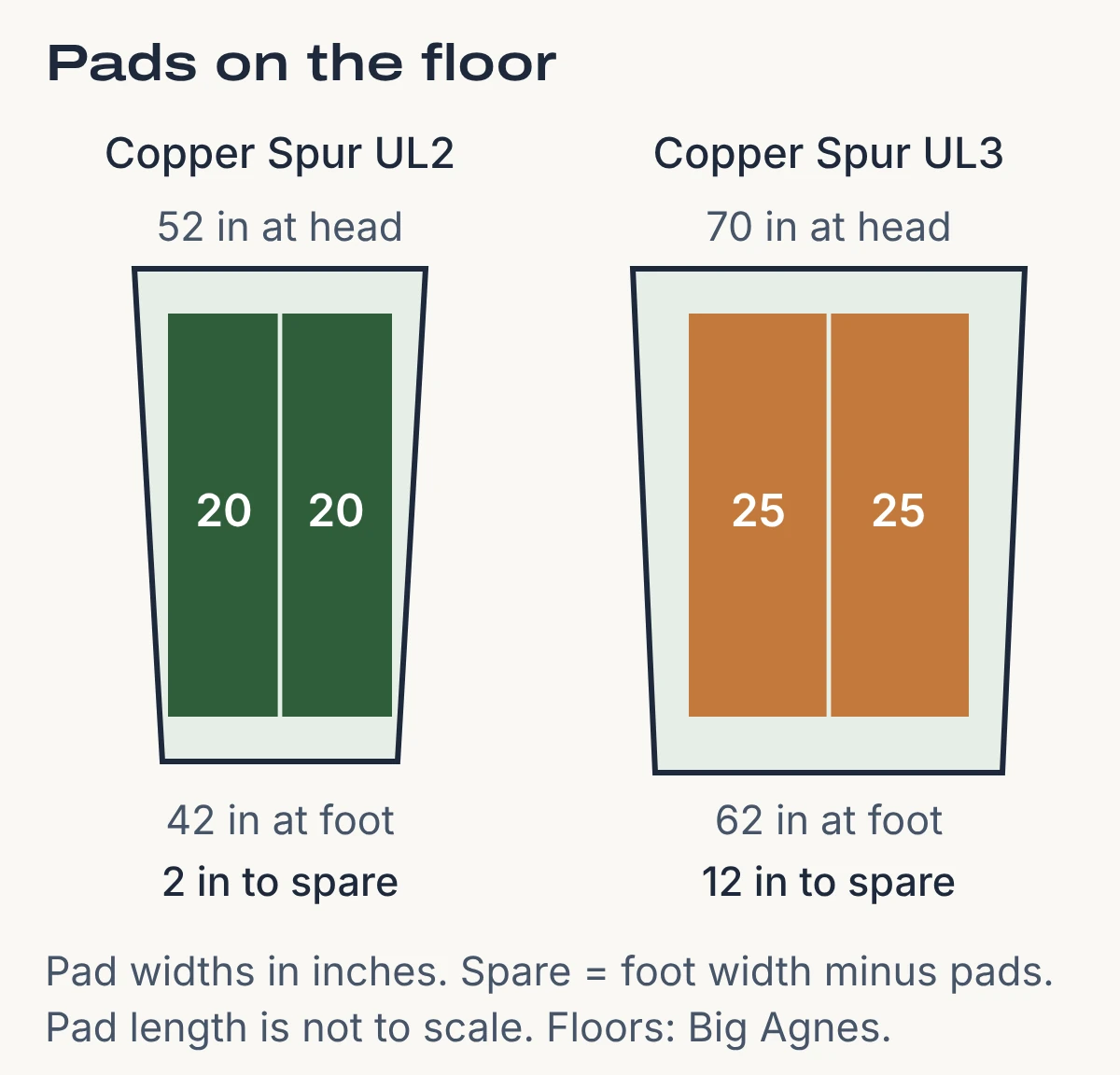
The diagram agrees with CleverHiker. Two 20 in pads (40 in) sit inside the 2P’s 42 in foot with 2 in to spare. Two 25 in pads (50 in) would be wider than that foot, and fit in this pair only because the 3P’s foot is 62 in. Three 20 in pads would be 60 in, which just fits the 3P’s foot and leaves no room between sleepers.
Tip
Read the pad widths and the floor width on the maker’s spec page before you buy. Tapered floors, like the Big Agnes ones above, are narrowest at the foot.
Choose a 2-person tent if… or a 3-person if…
CleverHiker describes how each size feels: a 2P is “Luxurious for 1 person with interior gear storage space. A tight fit for 2 with gear stored in the vestibule(s). Will fit 2 regular width sleeping pads (not wide pads).” A 3P is “Luxurious for 2 people with interior gear storage space. Will fit two wide sleeping pads. Comfortable for 2 people plus a small child or dog. A very tight fit for 3 average adults.”
Choose a 2-person tent if:
- You camp alone and want spare room for gear. It is also the lighter choice for solo trips.
- You are two people on a weight-first trip, use regular 20 in pads and accept a tight fit.
- You are a pair where one of you uses a wide pad and you accept that it fills the floor. CleverHiker says “One wide pad (25in) and one regular pad (20in) will completely fill the floor width of most lightweight 2-person backpacking tents.” An r/CampingGear owner who shares a Copper Spur HV UL2 (an earlier version) and a Zpacks Duplex with a 25 in and a 20 in pad says “while it’s not roomy, we don’t see the need to upgrade”.
- You expect settled weather and will mostly lie down to sleep.
Choose a 3-person tent if:
- You are two people who want room to sit, change and keep gear inside. CleverHiker says “Most 2-person backpacking tents fit tight for two regular-size adults”.
- Either of you uses a 25 in wide pad, unless you pick a 2P with extra width for wide pads, the other fix CleverHiker names. MSR’s Hubba Hubba LT 2 is described as having “no taper”; MSR does not say it fits two wide pads.
- You bring a dog or a small child.
- Storms or bugs are likely. CleverHiker says “it often makes sense to consider a slightly larger, more spacious tent” in areas with frequent storms or abundant mosquitos.
- You are car camping. CleverHiker notes “weight is less of an issue” there.
Neither fits three adults well. CleverHiker’s wording for a 3P is “A very tight fit for 3 average adults”, so three adults are better in a 4-person tent (see below).
One thing is easy to miss: doors. An r/CampingGear owner writes “having two doors makes a huge difference. each person is able to get up in the middle of the night without crawling over the other.” Big Agnes describes the Copper Spur UL as a “dual-door design” and MSR lists 2 doors on the Hubba Hubba LT. If two of you share a tent, check that it has two doors.
Related guide: Pop-Up Tent vs Dome Tent: Which One Fits How You Camp
Ready to buy?
Our roundup of the best 2-man backpacking tents puts the two-person options side by side.
The weight cost of each size up
Big Agnes lists the whole Copper Spur UL family, so one table shows the step from 1 to 4 people.
| Size | Floor area | Trail weight | Added weight | Floor per rated person |
|---|---|---|---|---|
| UL1 | 20 sq ft | 2 lb | n/a | 20.0 sq ft |
| UL2 | 29 sq ft | 2 lb 10 oz | 10 oz | 14.5 sq ft |
| UL3 | 41 sq ft | 3 lb 6 oz | 12 oz | 13.7 sq ft |
| UL4 | 57 sq ft | 5 lb | 26 oz | 14.3 sq ft |
Source: Big Agnes product pages for each size. The “added weight” and “floor per rated person” columns are worked out from them.
The jump from 3P to 4P is the steepest: 16 sq ft more floor for 26 oz more, about twice the weight of the 2P-to-3P step. For two people on foot that is a lot of extra weight for room CleverHiker already calls “Luxurious for 2 people” in a 3P. CleverHiker describes a 4P as “Luxurious for 2-3 people with interior gear storage space. Tight but possible to fit 3 people and a child or dog. A very tight fit for 4 average adults.”
One-person tent vs two-person tent, and vs a bivy
The 1P is the lightest and has the smallest floor (20 sq ft), though with one person inside that is more floor per head than any larger size gives at its rating. CleverHiker calls a 1P “Usually comfortable for 1 person with gear stored in the vestibule”, and a 2P used solo “Luxurious”, at a cost of 10 oz in this family. An r/CampingGear member writes “it took me far too long to realize my favorite 1 person tent was pretty much any 2 person tent.”
A bivy is a lighter step down. MSR, a tent maker, says traditional bivy bags “weigh less than a one-person tent” and puts its Pro Bivy at “283g (10-oz)”, against 2 lb of trail weight for the Copper Spur UL1 (a comparison across two makers). The trade is shelter. MSR says “bivies are far more enjoyable when the weather is fair—most will offer little protection in a nasty Cascades or Rockies storm blitz.” The upside is that “Requiring only the length and width of your sleep system, bivies open up new campsite possibilities.” Pick the bivy for fast, fair-weather trips and a tent when you will spend hours inside it. Whichever you choose, fabric matters as much as size; our guide to tent materials explains the options, and our walkthrough on sealing tent seams helps a tent last.
Bigger camping tents: 4 vs 6 vs 8 person
Weight stops mattering when the car carries the tent, so the question becomes room. CORE, a camping-gear maker, explains that “capacity ratings are based on how many standard sleeping pads can fit on the floor without overlapping” and the ratings “don’t account for gear storage, taller campers, air mattresses, pets, or simply wanting a bit of personal space.”
CleverHiker’s descriptions for the larger sizes:
| Size | CleverHiker’s description |
|---|---|
| 4P | Luxurious for 2-3 people with interior gear storage space. |
| 6P | Comfortable for 4 plus gear. Tight for 5 or 6. |
| 8P | Luxurious for 4 plus gear. Comfortable for 6 if some are children or dogs. |
Two sizing rules are in circulation, and they do not match. A guideline CORE describes, the “Rule of Two”, is “Number of campers x 2 = Ideal tent capacity”, so four campers get an 8-person tent. CleverHiker’s is “to subtract two people from the capacity rating of any given tent”, so a family of four takes a 6-person. Treat each as a rule of thumb from one outlet. Compare the floor area and wall shape of the exact tent instead. Our guide to backpacking tents versus camping tents explains why the two types size differently, and our waterproof family tent roundup covers the larger sizes.
CleverHiker adds: “Just keep in mind that most users think those tent capacity ratings exaggerate their true size.”
Frequently Asked Questions
Q. Should I get a 3-person tent for 2 people?
Many do, according to CleverHiker, which also says two wide pads usually need one unless you choose a 2P built wider. The price in the Copper Spur UL line is 12 oz of trail weight (worked out). If weight matters more than room, a 2P still works.
Q. Can a 3-person tent actually fit 3 people?
Only tightly. CleverHiker calls it “A very tight fit for 3 average adults”, and the Big Agnes UL3’s floor works out to 13.7 sq ft per rated person.
Q. Does a 2-person tent fit a full-size mattress?
Ratings are built around sleeping pads, not mattresses. CORE says they “don’t account for gear storage, taller campers, air mattresses, pets, or simply wanting a bit of personal space.” Compare the mattress’s width with the tent’s floor width on its spec page; the Copper Spur UL2 is 52 in across at its widest end. Our roundup of air mattresses for camping covers the options.
Q. How big is a 2-person tent in feet?
The Big Agnes Copper Spur UL2 floor is 88 in long (7 ft 4 in, 224 cm) and 52 in wide at the wide end (4 ft 4 in, 132 cm), narrowing to 42 in (107 cm). Other models differ, so check the floor size on the spec page.
Q. Should I get a one-person or two-person tent?
For solo trips, a 2P is the roomier choice and costs 10 oz more in the Big Agnes line; a 1P saves weight and has a 20 sq ft floor. See the one-person section above for the bivy alternative.
Q. Does it matter how many doors a tent has?
Owners say so. An r/CampingGear owner, quoted above, credits two doors with letting each person get out at night without crawling over the other.
Sources (10)
- Big Agnes, Copper Spur UL2 Ultralight Tent
- Big Agnes, Copper Spur UL3 Ultralight Tent
- Big Agnes, Copper Spur UL1 Ultralight Tent
- Big Agnes, Copper Spur UL4 Ultralight Tent
- MSR, Hubba Hubba LT 2-Person Backpacking Tent
- MSR, Hubba Hubba LT 3-Person Backpacking Tent
- MSR, The Art of the Bivy: When a Bivy Sack is Better Than a Tent
- CleverHiker, Backpacking & Camping Tent Size Guide
- CORE, How to Choose the Right Tent Size for Camping
- r/CampingGear, 2 person vs 3 person tent (forum thread)
