The short answer
Size the motor by your boat’s loaded weight, not its length alone. Bass Pro Shops’ thrust chart puts boats up to 1,599 lb (about 14 ft) at 30 to 40 lb of thrust on 12 volts, and 1,600 to 2,599 lb at 40 to 55 lb. Heavier boats move to 24V or 36V. Add thrust for wind or current.
Thrust is only the first of three numbers. The shaft has to be long enough to keep the propeller under water, and the battery bank has to match the motor’s voltage and last as long as your fishing day.
Start by working out the boat’s total weight with everything aboard. Bass Pro Shops, the retailer, counts in its 1Source trolling-motor guide the boat, outboard motor, fuel, batteries, passengers and gear.
Thrust by boat weight: the chart
The basis for this chart is Bass Pro Shops’ trolling-motor guide, which sets a minimum thrust for each band of total boat weight. The figures below are as Bass Pro prints them. Minn Kota publishes its own selection guide (linked in the sources); check it if you are buying a Minn Kota.
| Total boat weight | Boat length | Minimum thrust | Voltage |
|---|---|---|---|
| Up to 1,599 lb | Up to 14 ft | 30 to 40 lb | 12V |
| 1,600 to 2,599 lb | 16 to 17 ft | 40 to 55 lb | 12V |
| 2,600 to 3,599 lb | 17 to 18 ft | 70 to 80 lb | 24V |
| 3,600 to 4,599 lb | 18 to 19 ft | 80 to 90 lb | 24V |
| 4,600 to 5,599 lb | 20 to 23 ft | 112 to 115 lb | 36V |
| 5,600 to 15,000 lb | 24 to 35 ft | 112 to 115+ lb | 36V |
Read the weight column first. Length is only a rough guide; if your loaded weight and your length fall in different rows, go by the weight. Bass Pro adds: “These are minimum recommendations. If you fish in strong wind, heavy current, or rough water, choose more thrust.”
Do not look up the boat’s weight in a listing and stop there. TrollingMotors.net, a trolling-motor dealer, warns that “the listed weights on JD Power are the dry weight of the boat and not the max weight.” Add the motor, batteries, fuel, people and gear.
Do the rules of thumb agree with the chart?
Bass Pro says “Use 5 pounds of thrust for every 200 pounds of total boat weight.” TrollingMotors.net suggests “an absolute minimum of 2-3 lbs of thrust for every 100lbs.” We worked both out across each row of the chart (row weight × rate), using 2 lb, the low end of the dealer’s range:
| Chart row | Chart minimum | 2 lb per 100 lb | 5 lb per 200 lb |
|---|---|---|---|
| Up to 1,599 lb | 30 to 40 lb | up to 32 lb | up to 40 lb |
| 1,600 to 2,599 lb | 40 to 55 lb | 32 to 52 lb | 40 to 65 lb |
| 2,600 to 3,599 lb | 70 to 80 lb | 52 to 72 lb | 65 to 90 lb |
| 3,600 to 4,599 lb | 80 to 90 lb | 72 to 92 lb | 90 to 115 lb |
| 4,600 to 5,599 lb | 112 to 115 lb | 92 to 112 lb | 115 to 140 lb |
| 5,600 to 15,000 lb | 112 to 115+ lb | 112 to 300 lb | 140 to 375 lb |
What the worked numbers show:
- Light boats: both rules come in under the chart. Below 1,500 lb the 2 lb rule gives less than the chart’s 30 lb minimum, and below 1,200 lb the 5-per-200 rule does too; a 1,000 lb boat works out to 20 and 25 lb. Use the chart’s 30 lb floor.
- The 2 lb rule mostly runs short. It reaches the chart’s minimum only near the top of each row: 1,500 to 1,599 lb, 2,000 to 2,599 lb, 3,500 to 3,599 lb, 4,000 to 4,599 lb (just over the 90 lb top past 4,500 lb) and 5,600 to 5,750 lb. From 4,600 to 5,599 lb it stays under the 112 lb minimum. A 2,600 lb boat works out to 52 lb, but the chart asks for 70 to 80 lb on 24V.
- The 5-per-200 rule fits from 1,200 to 2,200 lb, then mostly runs high. From 2,201 to 2,599 lb it goes above the chart’s 55 lb top. Just past the jump to 24V it runs short: at 2,600 to 2,799 lb it gives 65 to 70 lb, under the chart’s 70 lb minimum. It fits again from 2,800 to 3,200 lb, and above 3,200 lb it runs higher than the chart, touching the top of the range only at exactly 3,600 and 4,600 lb.
- Neither rule sizes a big boat. Past about 5,750 lb both call for more thrust (up to 300 or 375 lb) than the chart’s 112 to 115+ lb top row. Go by the chart.
Sizing by boat: kayak, jon boat, pontoon
Each case still comes back to loaded weight and the chart, but each has its own catch.
- Kayak or canoe. Bass Pro’s advice is to “Choose lighter motors with lower thrust ratings that match the craft size.” More is not better here: TrollingMotors.net warns that “Installing a 36v motor on a kayak for instance could be dangerous,” because an overpowered motor turns a small boat very quickly. Follow the kayak maker’s limits for any motor mount.
- Jon boat. Bass Pro lists transom-mount motors as common on small boats and jon boats.
- 14 ft jon boat. On the chart a 14 ft boat sits in the first row, 30 to 40 lb on 12V, but only while the loaded total stays at or under 1,599 lb (worked from the chart). Weigh it with everyone and everything aboard; past 1,599 lb, the chart’s next row asks for 40 to 55 lb.
- Pontoon. Wind is the catch. TrollingMotors.net notes that “when on the water in a breeze, a pontoon can be very tough to keep in a fixed position,” which is why the chart’s minimum is a floor, not a target.
12, 24 or 36 volts, and how many batteries
Higher thrust comes with higher voltage. TrollingMotors.net gives the bands as 12V motors at 55 lb or less, 24V motors at 70 to 90 lb, and 36V motors at 112 to 115 lb, which lines up with the chart’s voltage column.
- How many batteries: Bass Pro says “You need one battery for every 12 volts in your system.” That means one battery for 12V, two for 24V and three for 36V.
- A 36V setup with one battery: single lithium batteries are sold in 24V and 36V, so, as TrollingMotors.net puts it, you can use “one 36v lithium battery instead of three 12v lead-acid or AGM batteries.”
- Wiring: with lead-acid or AGM, TrollingMotors.net says “24 or 36v motors running lead acid or AGM batteries must be wired in series.” The connections themselves come from your motor’s manual. The same dealer’s advice is to “follow the trolling motor manufacturer wiring recommendations,” and it warns: “Never mix battery types or old batteries with new batteries.”
- When to step up to 24V: “If you fish long days or run a 16 foot boat or larger, 24V is often a better choice,” according to Bass Pro.
Battery size, as Bass Pro grades 12V deep-cycle batteries for run time:
| Run time | Group size | Amp hours (12V) |
|---|---|---|
| Good | 24 | 70 to 85 Ah |
| Better | 27 | 85 to 110 Ah |
| Best | 31 | 95 to 125 Ah |
TrollingMotors.net sets a similar floor for lead-acid and AGM: “AT LEAST a 100 amp hour rating, a Group 27 rating and 175 minutes of Reserve Capacity (RC).” For lithium (LiFePO4) it says “we recommend 50 amp hour rating or higher.” A car battery is the wrong tool; the dealer says “Using a standard automotive starting battery for a trolling motor is not recommended.”
How long a trolling motor battery lasts
Bass Pro gives the formula: “Battery amp hours ÷ Motor amp draw = Approximate runtime.” Its own example is a 100Ah battery at a 20 amp draw for 5 hours, and it adds: “Running at lower speeds increases battery life.”
Worked examples (our arithmetic, from the sources’ figures):
- Full draw on a 12V, 44 lb motor. Bass Pro says such a motor “may draw 36 amps.” On a 100 Ah battery that works out to about 2.8 hours (100 ÷ 36).
- Keeping a lead-acid battery healthy. Trojan Battery, a battery maker, says “50% (or less) discharges are recommended.” Stopping at half, the same example gives about 1.4 hours of full draw. TrollingMotors.net notes that lithium batteries can use their full capacity, so the 2.8 hour figure is closer for lithium of the same amp-hour rating.
Shaft length: how to measure
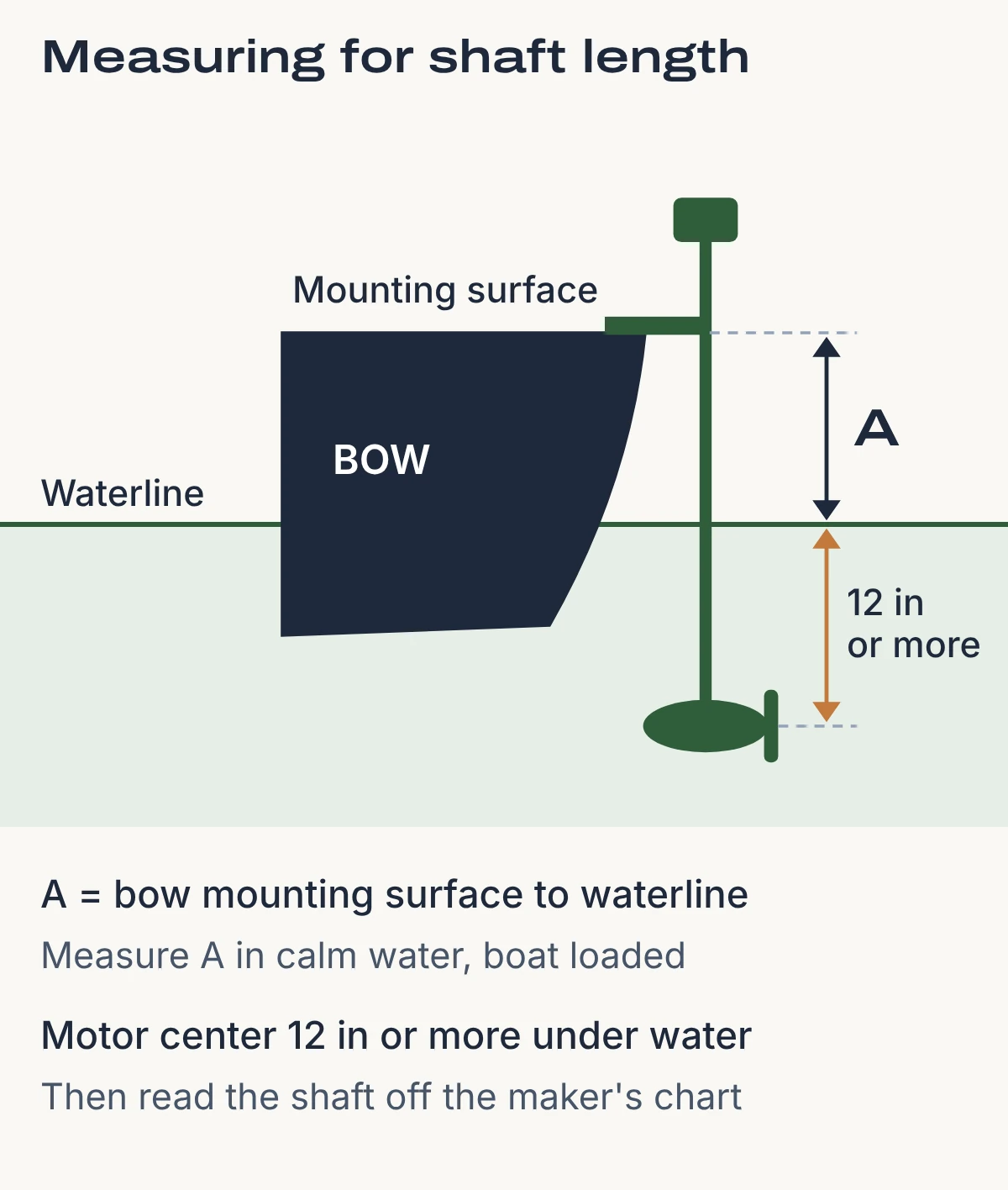
Shaft length matters as much as thrust. Bass Pro explains: “If it is too short, the prop comes out of the water and causes cavitation,” which costs thrust and adds noise. Its working rule is that “The center of the motor section should be submerged at least 12 inches below the waterline during operation.”
Load the boat the way you fish
TrollingMotors.net says to measure “while the boat is full laden (gear, fuel, people etc.) in your normal fishing conditions,” and to “Measure in calm water to get an accurate read.”
Measure from the mounting surface to the water
Garmin’s method, word for word: “Measure the distance from the boat’s bow mounting surface to the waterline under calm conditions.”
Add for big water if you fish it
Rough-water allowances differ by maker and go with that maker’s own table. For its Force motors, in places where large waves are common, Garmin says to “Add 8 in. (20 cm) to the measured distance before using the table to select a shaft length.” Check the chart of the motor you buy for its own allowance.
Read the chart for your mount
Use the bow or transom table below, or the chart of the motor you are buying.
Go longer between sizes
Bass Pro: “If you are between sizes, choose the longer shaft.” Garmin says the same for its overlapping ranges.
Bow-mount chart (Bass Pro’s figures):
| Bow to waterline | Recommended shaft |
|---|---|
| 0 to 10 in | 36 in |
| 16 to 22 in | 42 to 45 in |
| 22 to 28 in | 48 to 52 in |
| 28 to 34 in | 54 to 60 in |
| 34 to 52 in | 72 to 87 in |
| 52 to 72 in | 100 in |
The chart has no row for 10 to 16 inches. Our reading of Bass Pro’s between-sizes advice is that a measurement there points to the next longer row, 42 to 45 inches.
Related guide: 2 Person vs 3 Person Tent: What the Extra Size Gets You
Transom-mount chart (Bass Pro: “Measure from the transom mounting point to the waterline.”):
| Transom to waterline | Recommended shaft |
|---|---|
| 0 to 10 in | 30 in |
| 10 to 16 in | 36 in |
| 16 to 22 in | 42 in |
| 22 to 28 in | 55 in |
Note
Makers’ shaft charts differ. Garmin’s Force and Force Pro chart recommends a 50 in. shaft for 0 to 19 in. from bow to waterline and 57 in. for 15 to 26 in., longer than the Bass Pro figures above for the same boats. TrollingMotors.net takes a third approach and recommends adding 23 to 25 inches to your measurement for most small and midsize boats in calm water. Use the chart for the motor you buy.
Measuring the shaft you already have. TrollingMotors.net says shaft measurements are generally taken “from the base of the control head (the housing on top of the motor) to the top of the lower unit (motor housing),” and warns this only approximates the rated length. Not every maker measures that way: Garmin says “The Force Kraken trolling motor is measured from the bottom of the shaft cap to the top of the prop drive.” When you can, use the rated length printed by the maker.
Spot lock: why it needs enough thrust
Spot-Lock is Minn Kota’s name for GPS anchoring; Garmin calls its version Anchor Lock. TrollingMotors.net describes features like Spot Lock as “designed to keep your boat in a fixed position or on a steady course.” They only work as well as the motor’s thrust allows. Without enough, the dealer says, “Trolling motors equipped with GPS will not be able to accurately hold a spot or heading.”
Charging and wiring: what the makers say
These are the makers’ own lines. For your setup, the motor’s manual and the battery’s label are the final word; Garmin’s Force manual adds that “installation by a qualified marine installer is recommended.”
Safety
Trojan Battery, a battery maker, says in its lead-acid care guide: “CAUTION: ALWAYS WEAR PROTECTIVE CLOTHING, GLOVES AND GOGGLES, WHEN HANDLING BATTERIES, ELECTROLYTE, AND CHARGING YOUR BATTERY.” It also says: “Charge only in well-ventilated areas. Keep sparks or flames away from a charging battery.”
- Charge lead-acid batteries after every trip. Trojan: “Batteries should be charged after each period of use.”
- Match the charger. Trojan says to “Become familiar with and follow the instructions issued by the charger manufacturer” and to “Verify charger voltage settings are correct.” For AGM batteries it adds: “Verify charger has necessary VRLA setting.” It also says to “Correct the charging voltage to compensate for temperatures above or below 77°F (25°C).” A lithium battery’s charging needs come from that battery’s maker.
- Check the temperature before you charge. Trojan: “Do not charge a frozen battery.” And: “Avoid charging at temperatures above 120° F (48.8° C).”
- Prepare a flooded battery. Trojan says to “Tighten all vent caps before charging.”
- Do not over- or undercharge. Trojan: “Prevent overcharging the batteries. Overcharging causes excessive gassing (water breakdown), heat buildup, and battery aging.” And: “Prevent undercharging the batteries.” For AGM: “Do not overcharge VRLA batteries.”
- Fit a circuit breaker if your motor’s manual specifies one. Garmin’s Force manual, for example, says “You must connect to the power source through a circuit breaker rated for continuous 60 A (not included),” and warns that “the circuit breaker must be in the off position before you connect the power cables from the trolling motor.” That rating is for the Force; your motor’s manual gives its own breaker size and wire gauge.
- Keep the prop in the water. Garmin’s manual warns: “Do not run the motor when the propeller is out of the water. Contact with the rotating propeller may result in severe injury.”
How fast does a trolling motor go?
Discover Boating, run by the National Marine Manufacturers Association, says “Most electric trolling motors can move a small to medium boat at about 3 to 5 mph at top speed.”
No maker chart cited here lists speed by thrust, so a 55 lb motor is best judged against that same 3 to 5 mph range. Owners on the GON forum argued over whether more thrust means more speed; one put it plainly: “Hull design determines maximum nonplaning speed.”
For the rest of the day on the water, see our bass fishing tips for beginners, our comparison of beginner fishing reels and our fishing gear roundups. More plain-language guides like this one are in our Outdoors Explained section.
Frequently Asked Questions
Q. Is there a trolling motor size calculator?
The weight chart is the calculator: add up the boat, motor, batteries, fuel, people and gear, then read the row. Bass Pro’s quick version is 5 lb of thrust per 200 lb, which lands inside the chart’s range only from about 1,200 to 2,200 lb and from 2,800 to 3,200 lb (worked out above).
Q. How big a boat will a 55 lb thrust trolling motor push?
On Bass Pro’s chart, 55 lb is the top of the 1,600 to 2,599 lb row, usually boats of 16 to 17 ft, on 12V. Past 2,599 lb loaded, the chart moves to 70 to 80 lb on 24V.
Q. Would a 62 lb thrust motor push a 16 foot boat?
It depends on the loaded weight. A 16 ft boat at or under 2,599 lb needs 40 to 55 lb by the chart, so 62 lb clears it; a heavier 16 ft boat falls in the 70 to 80 lb row, so 62 lb falls short there.
Q. Do I need to register a kayak with a trolling motor?
Often, yes. Paddling Magazine says “Adding an electric trolling motor almost always means you need to register your kayak or canoe.” The magazine adds that it also depends on “the length of your kayak”. Rules vary by state, so check with your state’s boating agency before you launch; the National Association of State Boating Law Administrators keeps a directory of state boating contacts, including those for boat registration.
Q. What exactly is a trolling motor for?
Discover Boating defines it as “a compact, electric, or gas-powered motor used for low-speed maneuvering,” built for quiet operation and fine control rather than speed.
Sources (12)
- Minn Kota, Trolling Motor Selection and Boat Size Guide
- Bass Pro Shops (retailer) 1Source, How to Choose the Right Trolling Motor
- TrollingMotors.net (dealer), Trolling Motor Thrust Guide
- TrollingMotors.net (dealer), Trolling Motor Shaft Length Guide
- TrollingMotors.net (dealer), Picking a Trolling Motor Battery
- Garmin Support, Choosing the Appropriate Force Trolling Motor Shaft Length
- Garmin, Force Trolling Motor Installation Instructions (PDF)
- Trojan Battery, Battery Maintenance
- Discover Boating (NMMA), How to Use a Trolling Motor
- NASBLA, State Boating Contacts
- Paddling Magazine, How To Register Your Kayak In Your State
- GON forum, Trolling motor speed (owner discussion)
