The short answer
Walk the site first and pick level, durable ground away from hazards and about 200 feet (60 m) from water where you choose your own spot. Split camp into tent, cooking and eating areas. Inside, give sleeping gear, night essentials and shoes fixed spots. Keep food, stoves, heaters and fire out of the tent.
A good setup is mostly a layout decision, made before the first stake goes in. Most of it applies whatever tent you own, and the cozy touches come last.
This guide starts once you are ready to pitch. Rigging guy lines, driving stakes and stringing a tarp over the tent are separate skills, so they are not covered here. If you are still deciding which kind of tent to bring, see our comparison of backpacking tents and camping tents.
What you need
- Your tent, its footprint or a waterproof ground cloth, and the sleeping pads and bags
- A headlamp for each person, plus a battery or solar lantern if you want ambient light
- A shallow bin or tote for the tent entrance, and a small mat for outside the door
- A hanging organizer or small storage clips, if your tent has no gear loops
- Sealed food containers or a bear box, bag or canister where the park requires one
- A trash bag, and daylight: NPS advises “Make camp before dark.”
Steps
Walk the site and spot the hazards
The National Park Service says to “walk the boundaries of your campsite to identify the best locations for your tent, cooking station, and eating station.” It also says to “be aware of potential hazards like flash flooding, lightning, wind and dead trees/branches around your campsite” and, “Look up; if you see dead branches overhead, you should not camp under them.” NPS also says to find out before you go: “Are campfires allowed, and where?” Follow any fire restrictions posted for the park or campground, and local regulations on where you may camp; Leave No Trace adds that “Good campsites are found, not made.”
Choose durable ground about 200 feet from water
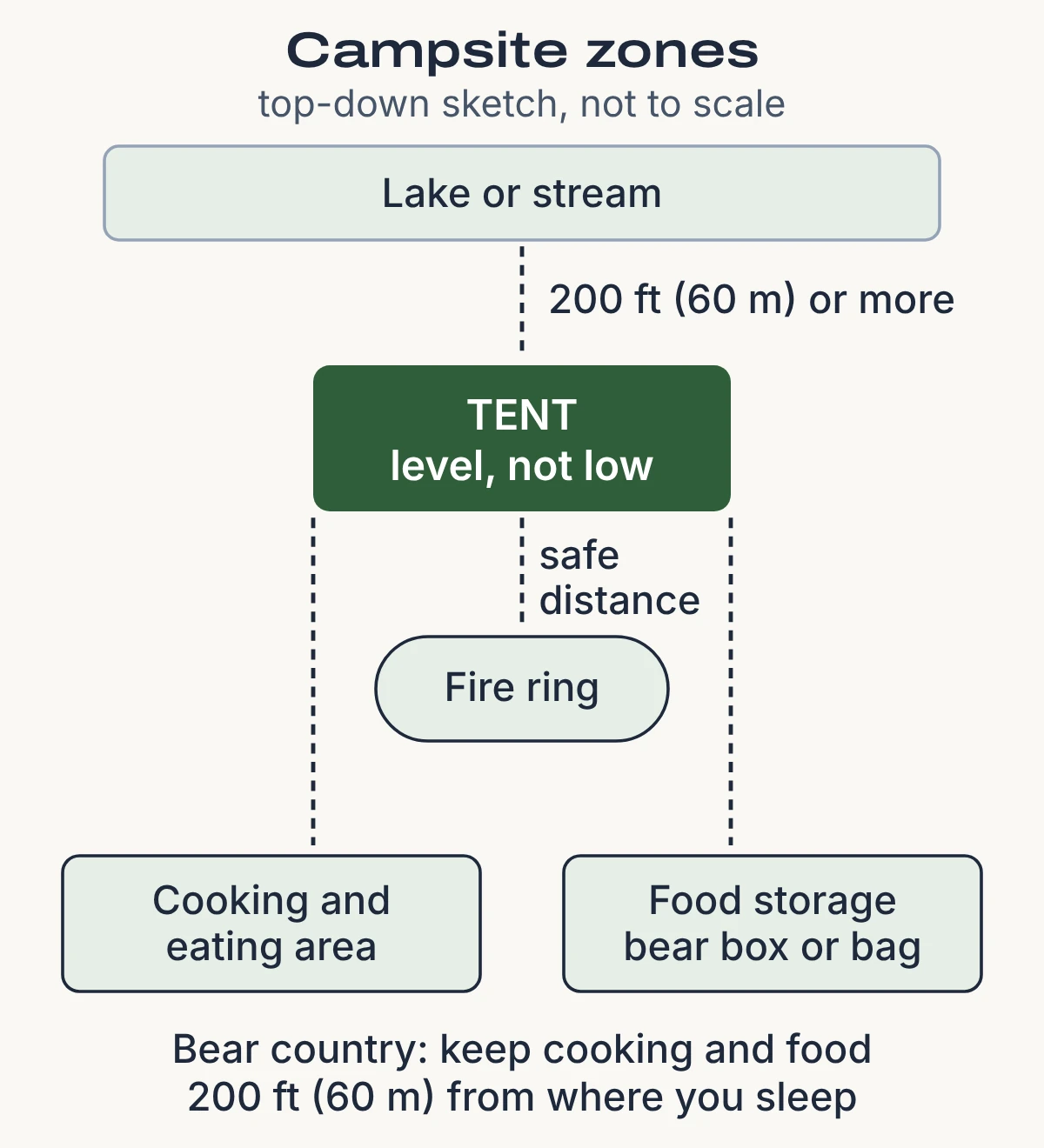
Leave No Trace says to protect riparian areas “by camping at least 200 feet from lakes and streams”, and calls “camping 200 feet (70 to 80 adult steps) from water” a good rule of thumb, always subject to local regulations. Where a campground has marked sites, use them. Where it does not, Leave No Trace lists “established trails, campsites, rock, gravel, and dry grasses or snow” as durable surfaces and says to “Keep campsites small.”
Pick the tent spot and clear it
The NPS calls level ground that is not a low place ideal, “a safe distance from your fire ring and cooking area”, because “Sparks from your fire could melt holes in your tent (or ignite it altogether).” Remove “sticks, rocks, pinecones, or other debris” before the ground cloth goes down, and avoid low spots, which NPS says “can become extremely wet when it rains.” NPS also says to orient the tent “so that your head will be on the uphill side while you are sleeping.”
Lay out three zones
Place the tent, the cooking station and the eating station apart, with the walking routes between them clear of stakes and lines; NPS warns that those lines “could become tripping hazards” near a high-traffic area. In bear country, NPS says to “Keep 200 feet between a cooking space and sleeping space” and to “Always store food at least 200 feet from your sleeping space.” Check park rules for storage, because “many parks require a bear box or bag.” The first diagram below the steps shows the layout. Rules vary by park and campground, so follow the posted food-storage rules.
Set up the sleeping zone along the far edge
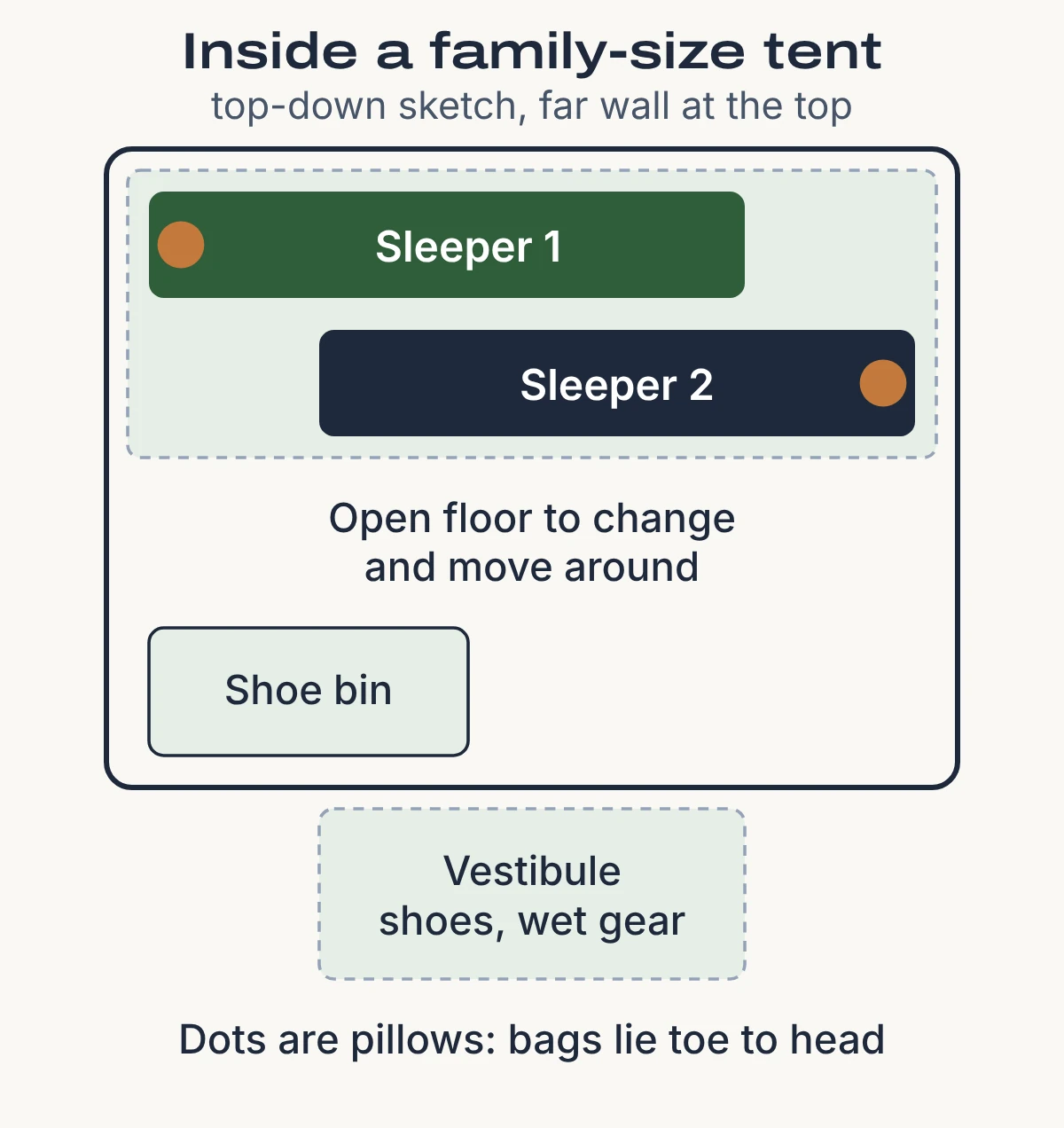
Beyond The Tent, a camping blog, suggests putting your sleeping space “as close to the edge of the tent as possible”, starting with the edge furthest from the door, to leave open floor for changing and moving around. For two sleepers it suggests laying bags “toe to head instead of lining them up next to each other”, so a night-time exit does not mean stepping over a tentmate. NEMO, a sleeping-gear maker, says to orient the tent “so you have the best exit path” for night trips. Inflate pads to taste; NEMO says to “leave a bit of cushion, or a lot of cushion, depending on your preference.” In a small backpacking tent the pads fill the floor, so use the vestibule for shoes and gear and skip the bin. For air mattress options, see our roundup of air mattresses for camping.
Give your night essentials a fixed home
NEMO recommends setting “things that you might need in the middle of the night” in predictable spots, with glasses, a headlamp and a water bottle as its examples. Hang small items from the tent’s gear loops, since Beyond The Tent notes that “Many tents have loops inside that can be used to hang things.”
Stage shoes and wet gear at the door
NEMO says to stage shoes or sandals “in your tent vestibule in foot position and ready to do their job”, after you “Check your vestibule area to make sure your gear in the vestibule will be safe from pooling water.” Beyond The Tent keeps “a large, shallow bin right inside the entrance of your tent to keep shoes wrangled and dirt contained.” Gossamer Gear, a shelter maker, advises you to “Remove wet clothes, shoes, or other gear from your tent at night.”
Add light you can control
Beyond The Tent describes headlamps as “great for focused lighting” and suggests a lantern or solar string lights for the room. The CPSC and CDC warnings in step 10 are about fuel-burning lanterns, so battery or solar lights are the ones to bring into the tent. NEMO also advises you to “Be vigilant with your tent zipper, especially at night with a light on in your tent.”
Keep food, trash and scented items out of the tent
Beyond The Tent says to “keep the food out of your tent for your safety”, and to hang the trash bag overnight “to keep unwanted guests away.” In bear country, NPS’s food-storage page says to “Secure your food, garbage, and other scented items immediately upon arriving at your campsite” and to “Treat food wrappers and other garbage the same as food”, so trash goes into the bear box, canister or bag with the food, not onto a hook by the tent. NPS also says: “Do not sleep in clothes used during cooking.” NEMO suggests a set of clean clothes reserved for sleeping, which also helps here.
Keep heat, stoves and fire out of the tent
The CPSC says “Never use fuel-burning portable heaters or lanterns while sleeping in enclosed areas such as tents, campers and vehicles”, and warns that “People die every year from carbon monoxide poisoning from the use of portable camping heaters, lanterns, or stoves inside tents, campers, and vehicles.” A CDC report on two fatal Georgia incidents says “fuel-burning equipment such as camping stoves, camping heaters, lanterns, and charcoal grills should never be used inside a tent, camper, or other enclosed shelter” and that “Opening tent flaps, doors, or windows is insufficient to prevent build-up of CO concentrations from these devices.” The CPSC adds that this is “especially important at high altitudes, where the risk of carbon monoxide poisoning is increased.” It lists the symptoms: “headache, dizziness, weakness, nausea, vomiting, sleepiness, and confusion.” Then: “See a doctor if you or a member of your family develops cold or flu-like symptoms while camping. Carbon monoxide poisoning, which can easily be mistaken for a cold or flu, is often detected too late.” The CDC report adds: “Rather than relying on fuel-burning appliances to supply heat, campers should leave home with adequate bedding and clothing and should consume extra calories and fluids during the outing to prevent hypothermia.”
Do a dusk walk-through
Before dark, walk the routes from the tent to the toilet, water and kitchen once, and check that food is stored and the headlamp is in its spot. NPS advises that if you have to leave camp after dark you “stay in areas you have seen in daylight”, go with a companion and use a headlamp.
The layout at a glance
Cozy touches that earn their space
- Lighting: Solar string lights, which Beyond The Tent says “add a little pizazz to a tent”, or a battery lantern.
- Entry mat: A small mat outside the door catches “some dirt and moisture before it comes inside”, according to Beyond The Tent.
- Pillows: NEMO calls a pillow “perhaps the most overlooked piece of gear” and suggests an extra for side sleepers.
- A sleeping-only clothes set: NEMO recommends it for a cleaner night.
- Airflow: Gossamer Gear advises you to “position your tent doors toward a gentle breeze” (unless you want to stay warmer) and to roll up vestibule doors when weather allows, since condensation is “impossible to eliminate completely.”
- Walls: Gossamer Gear says “Try not to touch the sides of your tent, including with your gear”, and NEMO says to move clothing away from the walls.
Decorating for parties, graduations or tailgates is a different job. These ideas are about a place to sleep.
Common mistakes
- Pitching under dead branches or in a dip. NPS names both hazards.
- Cooking in or beside the vestibule. Gossamer Gear advises you to “cook and boil water away from your tent, including outside of the vestibule”, and NPS wants a safe distance between the tent and the cooking area.
- Leaving food or scented items in the tent. See step 9.
- Bringing in a heater or stove for warmth. See step 10.
- Letting the site creep. Leave No Trace says to “Avoid site creep by ensuring plenty of durable surfaces for all tents and communal camping or cooking gear.”
Ready to buy?
If you are setting up for backpacking trips and need a lighter two-person tent, see our roundup of 2-person backpacking tents. These tents are close-fitting by design. For car camping with more gear, a larger camping tent gives you the open floor this guide describes.
More planning guides are in our trip planning section.
Frequently Asked Questions
Q. What are the must-haves for tent camping?
The short kit for this setup is in the “What you need” list above. For everything else you might pack, see our camping packing list.
Q. What is the 200 rule for camping?
Leave No Trace says to camp “at least 200 feet from lakes and streams” (about 60 m), and to check local regulations. NPS also uses 200 feet in bear country, between cooking and sleeping spaces and between stored food and where you sleep.
Q. How far should the tent be from the fire?
NPS says a “safe distance” and warns that sparks could melt holes in a tent or ignite it. It gives no number, so use the fire ring’s layout and any park rule.
Q. Can I use a camping heater or stove in my tent?
No. The CPSC says not to use fuel-burning heaters or lanterns in a tent while sleeping, and the CDC adds stoves and charcoal grills.
Q. Where should the kitchen go?
Away from the tent. NPS names the cooking station as its own area, kept a safe distance from the tent and the eating spot. In bear country NPS says to keep 200 feet (60 m) between cooking and sleeping spaces.
Q. Where do shoes and wet gear go?
At the tent entrance, in the vestibule or a bin, ready for a night trip. Keep wet items out of the sleeping area when you can.
Sources (7)
- National Park Service, Finding and Setting Up a Campsite
- Leave No Trace Center for Outdoor Ethics, Principle 2: Travel & Camp on Durable Surfaces
- US Consumer Product Safety Commission, Portable Heaters & Camping Equipment
- CDC MMWR, Carbon Monoxide Poisoning Deaths Associated with Camping, Georgia, March 1999
- NEMO Equipment, How to Get Good Sleep While Camping
- Gossamer Gear, Tips & Tricks for Alleviating Condensation in Your Tent
- Beyond The Tent, 13 Awesome Ideas for Setting Things Up Inside Your Tent