The short answer
No single camo pattern wins everywhere. Hunting camo works by hiding your outline from animals that see color differently than you do: deer have two cone types and see orange as a muted tone, while turkeys see color and UV well. Match the pattern type and its lightness to what is behind you, then sit still.
Camo makers each say their own pattern is the answer, which is why the choice feels hard. It gets easier once you know what each pattern type is trying to do, and what the animal on the other end can actually see.
This guide draws on a 1994 deer vision study with University of Georgia co-authors, Outdoor Life’s reporting on the UGA Deer Lab, the National Wild Turkey Federation, three state agencies, and the makers’ own pattern guides. Brand claims are labelled as the brand’s.
The three kinds of hunting camo
FORLOH, a hunting apparel maker, sorts camo into “traditional (based on military designs), 3D or leafy (realistic environmental patterns), and digital (pixelated designs developed using scientific imagery analysis)”. SITKA’s pattern guide tells the same story by how each type hides you. Put simply, there are three jobs a pattern can do.
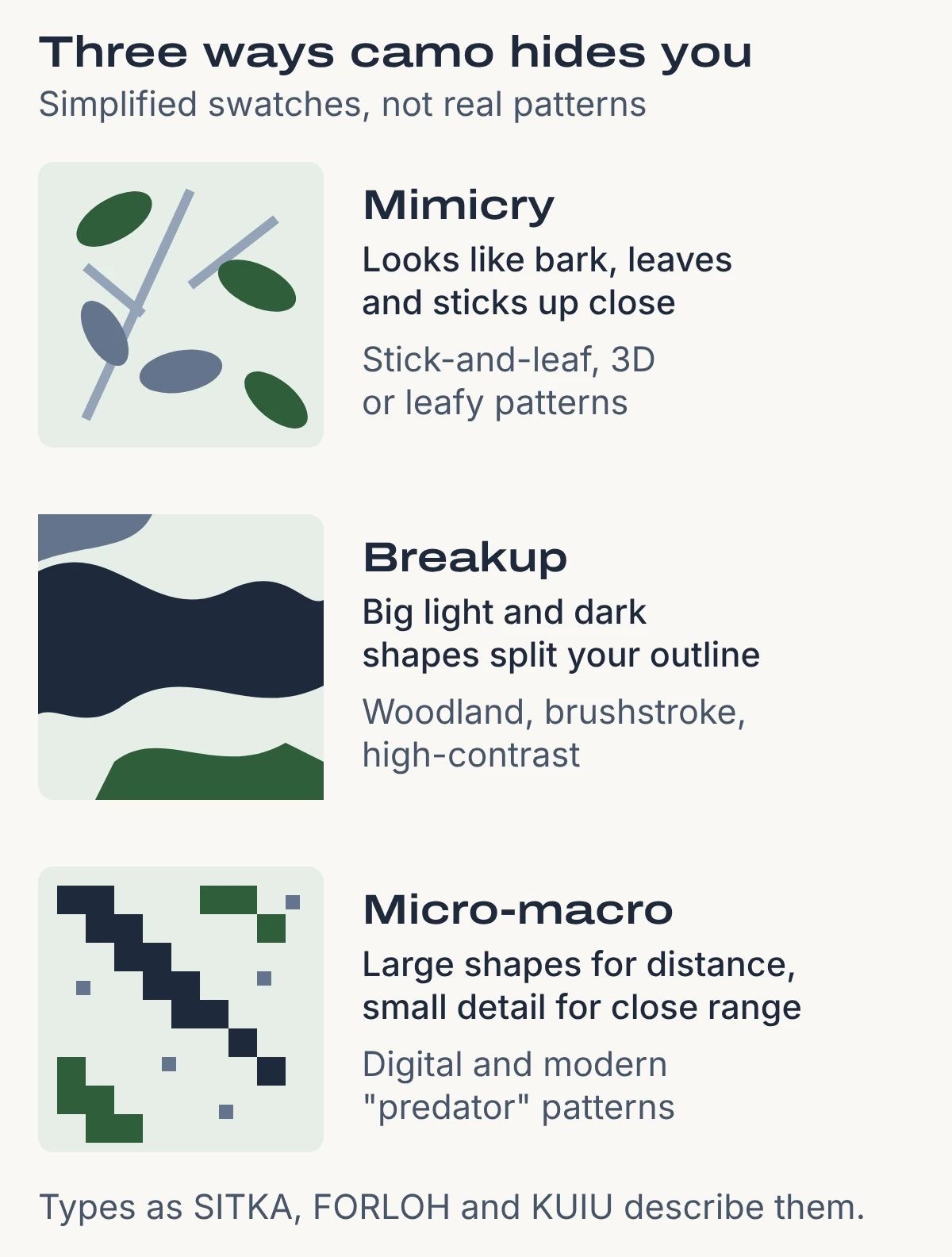
- Mimicry (stick-and-leaf). The print copies bark, leaves and branches. SITKA describes these as “hyper-realistic stick-and-leaf patterns” made for specific environments. They look convincing to a person a few feet away.
- Breakup (woodland, brushstroke, high-contrast). Large light and dark shapes cut your body into pieces. SITKA describes classic woodland camo as “earth-tone splotches of greens and browns to break up the wearer’s silhouette”. KUIU, another maker, says of its own patterns “we don’t clutter our patterns with sticks and leaves”.
- Micro-macro and digital. A large pattern breaks your outline at distance, and smaller detail inside it blends at close range. SITKA says its Optifade patterns copy predators: “Stalking predators, like tigers, have a macro pattern of stripes that break up their body symmetry”, while “Ambush predators, like spotted leopards, utilize micro patterns”.
| Type | How it hides you | Works at | Watch out for |
|---|---|---|---|
| Mimicry | Looks like local bark and leaves | Close range, matching cover | Fine detail can blur into one dark shape at distance |
| Breakup | Big contrast shapes split your outline | Mid to long range | Too dark or too light for the background |
| Micro-macro / digital | Large shapes plus small texture | Close and far, by design | Brand claims about range are the brand’s own |
What deer, turkeys and ducks actually see
Deer. A 1994 paper by G. H. Jacobs and colleagues, with co-authors at the University of Georgia, measured the cones in white-tailed deer retinas. They found a short-wavelength cone peaking “at about 450 to 460 nm” and a middle-wavelength cone at about 537 nm, which gives deer “the requisite retinal basis for dichromatic color vision”. People have three cone types, so deer see a narrower range of colors.
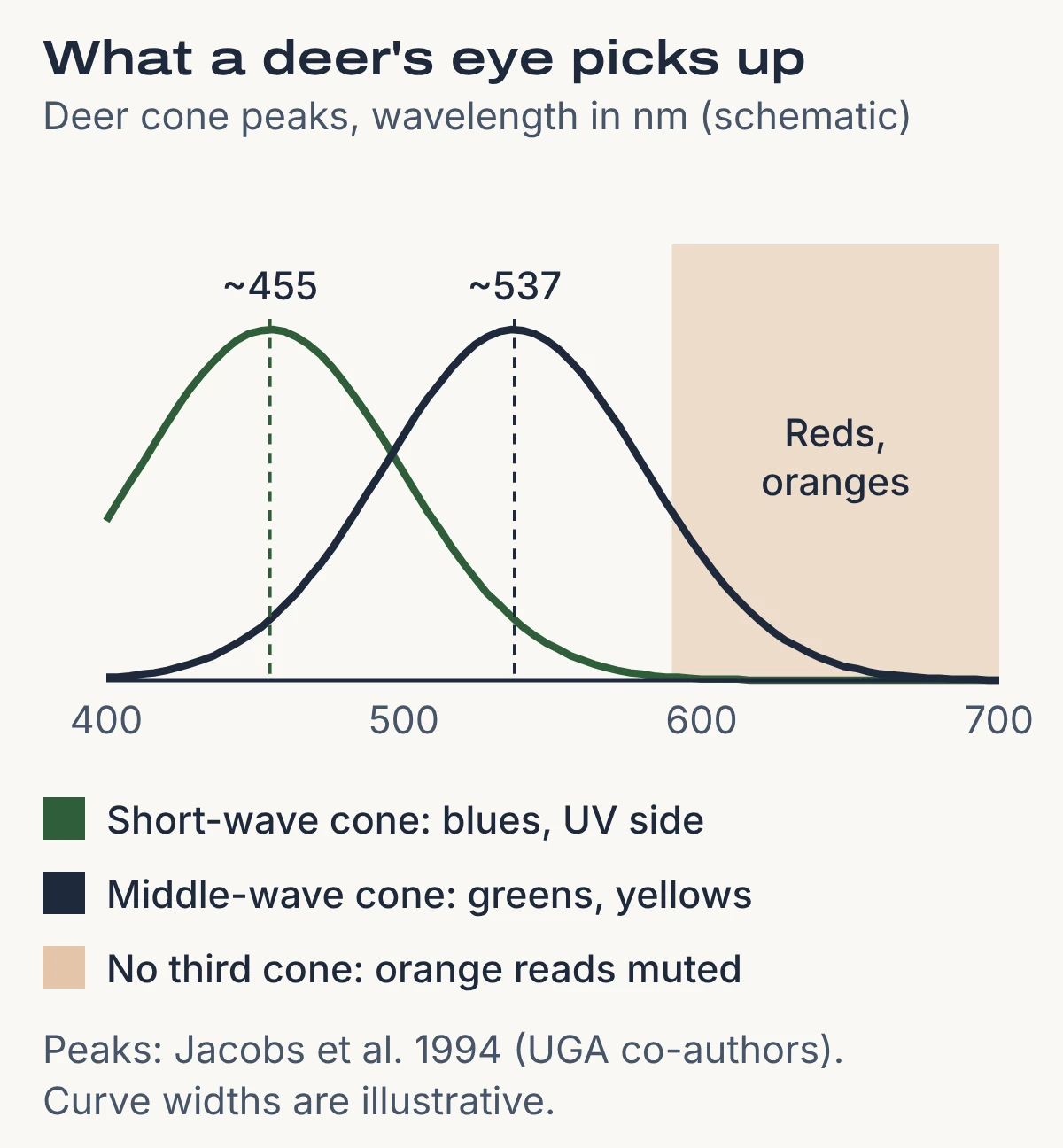
Outdoor Life’s report on the UGA Deer Lab explains what that means in the field. It says “a deer’s retina only has two photopigments” and “their eyes aren’t designed to see longer wavelength colors like red and orange”. UGA researcher Gino D’Angelo, quoted there, says deer see oranges and reds “more like a muted yellow or a muted brown”. The same article says “deer can see blues far better than humans can”, so “a white shirt or a pair of blue jeans might stick out more than a blaze orange vest”. It also reports that in UGA PhD student Blaise Newman’s tests, “deer were most sensitive to light and movement under twilight conditions”.
Note
Outdoor Life states that Newman’s “research in the Deer Lab is being sponsored by Sitka gear”, a camo maker. SITKA’s own pattern guide also names UGA Deer Lab researcher Dr. Karl Miller as a “partner on Optifade Cover”. Keep that in mind when a brand cites deer-vision science.
Turkeys. The National Wild Turkey Federation says: “Not only do turkeys see many of the colors we see on the spectrum, but they also see UV light.” SITKA makes the same point for its turkey pattern: “Turkeys are particularly adept at distinguishing color and UV light”. For turkeys, then, the colors in a pattern matter more than they do for deer.
Ducks and geese. FORLOH says “Waterfowl, for example, possess superior eyesight”, which is why waterfowl patterns are built for the marsh, timber or field the birds look down on.
Why this changes how you choose
Because deer read shape, brightness and movement more than fine color detail, the sources here put a pattern’s large-scale structure first. The archeryhunting.com author, an independent bowhunting blogger, sums up his rule as “macro breaks up your outline; color keeps you from standing out; micro helps when the deer gets close”. He warns against judging camo by looking at a jacket from arm’s length in a store: “That’s judging camo for humans.”
Newman made a similar point to Outdoor Life: “A lot of the micro-camos that we like to wear are actually too ‘micro’ for deer, and they fuse together so that you end up looking like a blob.” SITKA, a maker of macro-micro patterns, argues that “the concealment pattern is far more important than matching the specific color of leaves on any given day in the woods”. That is a brand view, but it fits the vision research above.
Three practical checks follow from this:
- Lightness against the background. The archeryhunting.com author asks, “Is the hunter much lighter or darker than the surrounding background?”
- Distance. The archeryhunting.com author asks, “Does the contrast still break the body apart at 20, 30 or 40 yards?” (18 to 37 m), not at arm’s length.
- Stillness. Outdoor Life’s closing takeaway is that “the best camouflage is sitting perfectly still”. KUIU agrees that “Plenty of hunters succeed without camo.”
Matching a pattern to your setup and ground
The archeryhunting.com author writes, “There is no camouflage pattern that’s the best in every hunting situation”. Start from where you hunt and what is behind you. Each line below names its source; pattern names are examples the makers give, not picks we have checked.
| Your setup or ground | What to look for | Who says so |
|---|---|---|
| Treestand | A pattern that matches the sky and canopy behind you, not the trunk | archeryhunting.com; FORLOH |
| Leaf-off hardwoods | Lighter, open breakup | SITKA says Elevated II “excels in sparse foliage after most of the leaves are gone” |
| Ground blind | Darker patterns that match the shadows inside | FORLOH |
| Early-season green cover | Greener patterns early, browner ones in fall | FORLOH, on seasonal foliage |
| Dark timber, river bottoms | Dark, vertical breakup | KUIU, for its Veros pattern |
| Open, dry country | Light, bigger-shape patterns | KUIU, for Valo; TIDEWE |
| Marsh and fields (waterfowl) | Waterfowl-specific patterns | FORLOH; SITKA |
| Spring turkey | Patterns built for color-seeing birds; no red, white, blue or black | NWTF; Pennsylvania Game Commission |
Treestand hunting. The archeryhunting.com author puts it plainly: “The background behind your body matters more than the tree trunk at ground level.” FORLOH adds that “tree stand hunters should choose patterns that match the surrounding canopy”. For leaf-off stands, the same author favors lighter patterns that fit “the brighter background behind an elevated hunter”.
Ground blinds. FORLOH notes that “Hunters using ground blinds might opt for darker patterns to blend with the interior shadows”.
Texas. TIDEWE, a hunting apparel maker, splits the state by region. In its words, “East Texas timber wants a darker woodland pattern”, “Hill Country and South Texas brush call for something muted and low-contrast”, and “West Texas open ground rewards tan and olive with bigger shapes”. It also warns that in a brown Southern winter “a snow-white pattern will stand out more than it hides you”. KUIU lists “prairie, grasslands, sagebrush, desert terrain” among the places for its lighter Valo pattern.
An all-around pattern. If you can only own one, pick for the ground you hunt most. The archeryhunting.com author names First Lite Specter as “My one-pattern choice for typical whitetail hunting.” KUIU calls Valo “Our Most Versatile Pattern”. Both are opinions for their own scope: the first for whitetail woods, the second from the maker.
Ready to buy?
Our deer hunting camo roundup compares eight picks. For spotting deer before they spot you, our binoculars for bow hunting roundup covers the glass.
Hunting camo vs military camo
UF PRO, a maker of military and tactical clothing, explains the difference by who is looking. Military patterns such as MultiCam are made to hide a soldier on the move across many settings, and its article says MultiCam “is designed to work against human perception”. UF PRO lists near-infrared and thermal sensors among the ways soldiers are found; hunters mostly have to beat an animal’s eyes, ears and nose, and UF PRO notes that “hunting camouflage only has to work at point A”, the spot where you sit still.
UF PRO itself says military camo is not better just because it is labelled military, and makers such as SITKA say their hunting patterns are designed around animal vision.
Blaze orange comes first
Where your state requires hunter orange, the law decides what you wear on top, and camo comes second. The rules differ by state, season and land type, so read your own state wildlife agency’s current rules before you go. Three examples:
Safety
Pennsylvania Game Commission: “Generally, when orange is required, hunters must wear 250 square inches of fluorescent orange that’s visible from 360 degrees on the head, chest, and back.” It also says: “When using a blind or enclosed tree stand during firearms deer, bear, or elk seasons, a minimum of 100 square inches of fluorescent orange material must be displayed within 15 feet of the blind or stand and visible from 360 degrees.” Wisconsin DNR, during any open statewide firearm season: “Hunters must be wearing at least 50% blaze orange or fluorescent pink from the waist up. Any hats or hoodies worn must also be at least 50% blaze orange or fluorescent pink.” Texas Parks and Wildlife: “All persons on public hunting lands (state, national forests, and grasslands) during daylight hours when hunting with firearms is permitted must wear at least 400 square inches of hunter orange material with orange headgear, and at least 144 square inches appearing on both chest and back.” It adds: “Exempt from these requirements are: persons hunting turkey, migratory birds, alligators, or desert bighorn sheep; persons within the enclosed passenger compartment of a motor vehicle; or persons within a designated campground, designated vehicle parking area, designated boat launching facility, or departmental check station.” Check your own state’s rules every season.
Texas also states that “Hunter orange is recommended for hunter safety but is not required while hunting on private property.” Pennsylvania adds: “Even when not required, the use of orange is strongly recommended, especially while moving.”
Wearing orange does not undo your camo as much as you might fear. Because deer see orange as a muted tone, Newman’s advice in Outdoor Life is that “if you can get blaze orange breakup, that’s always a good selection”. Orange camo keeps you visible to people while still breaking up your outline for deer, if your state counts it toward the required orange.
Turkey hunters have a different color tip. The Pennsylvania Game Commission says: “Never wear red, white, blue or black clothing. These are the colors found on mature gobblers.”
Mistakes that give you away
- Choosing by eye in the store. The archeryhunting.com author found that some realistic patterns still turn into “a dark human-shaped blob at hunting distance”.
- Washing camo with brighteners. Outdoor Life warns that deer are sensitive to “clothes washed with detergent containing UV brighteners”. Look for a detergent without brighteners and follow the garment’s care label.
- Matching the wrong background. Bark-dark camo in a treestand against the sky, or snow camo on bare brown ground, stands out.
- Moving at dawn and dusk. Deer eyes are most sensitive in twilight, per the UGA work Outdoor Life reports, which is when many hunters fidget.
- Forgetting layers. SITKA, though it sells patterns, writes that “A far more important seasonal consideration than pattern is having the appropriate layers”. Our cold-weather hiking pants roundup compares fleece-lined and softshell pants for cold days, and a binocular tripod for hunting lets you glass with less arm movement.
Frequently Asked Questions
Q. Which camo pattern is the most effective for hunting?
There is no single answer. The sources agree that the pattern that fits the background behind you, at the distance animals see you, works better than any one brand. Sitting still matters more than the print.
Q. What color is hardest for deer to see?
Deer have no cone for long wavelengths, so reds and oranges look muted to them, per the UGA research Outdoor Life reports. Outdoor Life notes that a white shirt or blue jeans can stand out more than an orange vest.
Q. Does camo actually help when deer hunting?
It helps break up your outline, but it does not replace stillness. KUIU itself says many hunters succeed without camo.
Q. Can deer see blaze orange?
Not the way you do. Researchers describe it as a muted yellow or brown to deer.
Q. Is military camo good for hunting?
It can be, if its colors and contrast fit your ground. UF PRO explains that military patterns must work against people and sensors while the wearer moves, while hunting camo only has to work where you sit.
Q. What camo works in Texas?
It depends on the region: darker woodland for East Texas timber, muted low-contrast for brush country, and lighter tan and olive with bigger shapes for West Texas, according to TIDEWE, a hunting apparel maker. Check the orange rule if you hunt public land.
Sources (13)
- Jacobs, Deegan, Neitz, Murphy, Miller and Marchinton, Electrophysiological measurements of spectral mechanisms in the retinas of two cervids (J Comp Physiol A, 1994)
- Outdoor Life (publication), Do Hunters Really Need to Wear Camouflage? Here Are the Colors Deer Can See
- National Wild Turkey Federation (nonprofit), How Turkeys Perceive Their Environment
- Pennsylvania Game Commission (state agency), Safe Hunting Tips
- Wisconsin DNR (state agency), news release on hunting season safety
- Texas Parks and Wildlife Department (state agency), Texas Blaze Orange Laws
- Texas Parks and Wildlife Department (state agency), Hunting Laws, Penalties and Restitution
- SITKA Gear (maker), Types of Camo for Hunting: Camouflage Patterns 101
- KUIU (maker), Choosing the Right Camo for Any Hunt
- FORLOH (maker), The Ultimate Guide to Hunting Camo Patterns
- TIDEWE (maker), Best Camo Patterns for Hunting, Guns, and Every Terrain
- UF PRO (tactical clothing maker), Hunting vs Military Camouflage
- archeryhunting.com (independent bowhunting blog), Best Camo for Deer Hunting: What Actually Works and Why