The short answer
Most freshwater fishing needs a size 1000 to 3000 spinning reel: a 1000 for panfish and trout, a 2500 for bass and walleye, and a 3000 if you fish 10-12 lb line. Bigger catfish, pike and inshore saltwater fish call for a 4000 or 5000. Sizes differ between brands, so choose by the line the maker rates each size for.
The size number tells you roughly how much line a reel holds and how heavy that line can be. It does not mean the same thing from brand to brand: a Penn 2500 and a Shimano 2500 are rated for different amounts of 8 lb line, and Daiwa renumbered its range when it introduced its LT reels.
Below is a size chart built from one maker’s published ratings, a three-check method that works with any brand, and the sizes that reel makers and fishing publications give for common fish.
Related guide: How Does a Fishing Reel Work? Spinning, Baitcasting and Spincast Explained
What the number on a spinning reel means
Daiwa’s guide to choosing a spinning reel puts it simply: “The higher the number, the larger and stronger the reel, with more line capacity and drag power.” The number is a size class, not a measurement.
Related guide: What Is a Light Spinning Rod and What Is It Good For?
There are two common ways of writing it:
- Thousands: Shimano, Daiwa, Penn and KastKing number their spinning reels 1000, 2500, 4000 and so on.
- Two digits: Pflueger sells its President in sizes 20, 25, 30, 35 and 40, and KastKing’s sizing guide says brands like Pflueger and Abu Garcia “classify their reels with two fewer zeros.” By the number alone a 30 reads as the 3000 class, but Pflueger’s own capacities put its sizes lower (see the brand quirks below), so treat the number as a starting point and compare capacity.
Even within one style, the classes are not fixed. In-Fisherman’s guide to catfish spinning reels says “there is no industry standard for sizing spinning reels,” and that “what one manufacturer calls a size-5 reel might be a 50 or 5000 to another manufacturer.” That is why the rest of this page leans on line ratings rather than the number alone.
Spinning reel size chart
This chart uses one maker’s figures, so the rows compare like with like. The basis is Penn’s Battle IV, which Penn sells in nine sizes from 1000 to 10000. The line column is the range of monofilament tests Penn lists capacity for at each size, and capacity is Penn’s figure for the middle test (step 1 below explains how to read these figures). The last column is Outdoor Life’s size guide, which lists sizes 500 to 3000 for freshwater and 4000 and up for saltwater.
| Size | Mono tests Penn lists | Capacity at the middle test | Max drag | Typical use, per Outdoor Life |
|---|---|---|---|---|
| 1000 | 4-8 lb | 110 yd of 6 lb | 10.8 lb | Panfish |
| 2000 | 4-8 lb | 180 yd of 6 lb | 10 lb | Bass |
| 2500 | 6-10 lb | 175 yd of 8 lb | 12 lb | Bass and walleye |
| 3000 | 8-12 lb | 165 yd of 10 lb | 15 lb | Walleye, catfish, lake trout, pike |
| 4000 | 8-12 lb | 220 yd of 10 lb | 15 lb | Surf: flounder, sheepshead, small sharks |
| 5000 | 12-20 lb | 200 yd of 15 lb | 25 lb | Surf: striped bass, redfish, larger sharks |
| 6000 | 15-25 lb | 230 yd of 20 lb | 25 lb | Offshore: snapper, grouper, big stripers |
| 8000 | 20-30 lb | 310 yd of 25 lb | 30 lb | Offshore fish over 100 lb |
| 10000 | 30-50 lb | 330 yd of 40 lb | 40 lb | Sailfish and tuna |
For metric readers: 100 yd is about 91 m, and 10 lb is about 4.5 kg.
Two things stand out. First, Penn lists its 3000 and 4000 for the same 8-12 lb mono; the 4000 simply holds more of it (220 against 165 yd of 10 lb). Second, Outdoor Life notes that “for most freshwater applications, your reel size will be anywhere from a 500 size to 3000.” Its 500 size is for ice fishing; our ice fishing rod roundup covers the short rods those small reels go on.
How to work out your size: three checks
You do not need to measure anything. Three numbers decide the size: the line you will use, the fish you expect and the rod you will put the reel on.
Related guide: How to Use a Fly Rod: How It Works, and How to Fish It
Start with the line you will fish most
The retailer Bass Pro Shops’ spinning reel buying guide says “the lighter the line you intend to use, the smaller the reel you should purchase.” Find the size whose rating includes that line. The guide also explains how to read a rating: the chart usually shows the middle line, so a reel marked 6 lb/90 yd “is also well suited for 4 and 8 pound line.”
Check the weight of the fish
For saltwater, Outdoor Life sizes reels by fish weight: a 4000 for fish “in the five to ten pound range,” a 5000 for “the ten to thirty pound range,” and a 6000 for “the thirty to one hundred pound range.” In freshwater, its list tops out at 3000 for everything short of very large catfish or sturgeon.
Match the reel to the rod
Outdoor Life says the rod and reel “should be made for the same range of lines and lures,” so the line rating printed on your rod should overlap the reel’s. Daiwa adds that “longer rods benefit from a slightly larger or heavier reel, while shorter rods work better with a smaller or lighter reel.” As a rough length guide, the blog of Reel Coquina Fishing Charters, a St. Petersburg, Florida charter business, pairs 1000-2500 reels with “a 6-7 feet rod” and 3000-4000 reels with “a 7-8.5 feet rod.” If you are still choosing a rod, our spinning rods under $100 roundup lists each pick’s line rating.
Quick check
To find the class of a reel you already own, read the line capacity on its spool and match it to the chart. Bass Pro’s guide points to the same place: “check the line capacity information found on the spool of the reel.”
Once you have the reel, fill it to the right level; our guide to putting line on a reel covers spooling without twist.
Same number, different reel: brand quirks to check
The chart above holds for Penn. Other brands put a different amount of line behind the same number, so compare capacity, not the size printed on the side.
| Size on the reel | Penn Battle IV, 8 lb mono | Shimano Sedona FJ, 8 lb mono |
|---|---|---|
| 2500 | 175 yd (160 m) | 140 yd (128 m) |
| 3000 (Shimano: C3000) | 200 yd (183 m) | 170 yd (155 m) |
Figures are each maker’s published capacity: Penn’s own table, and Shimano’s model table as published by the retailer Scheels.
Three naming quirks explain most of the confusion:
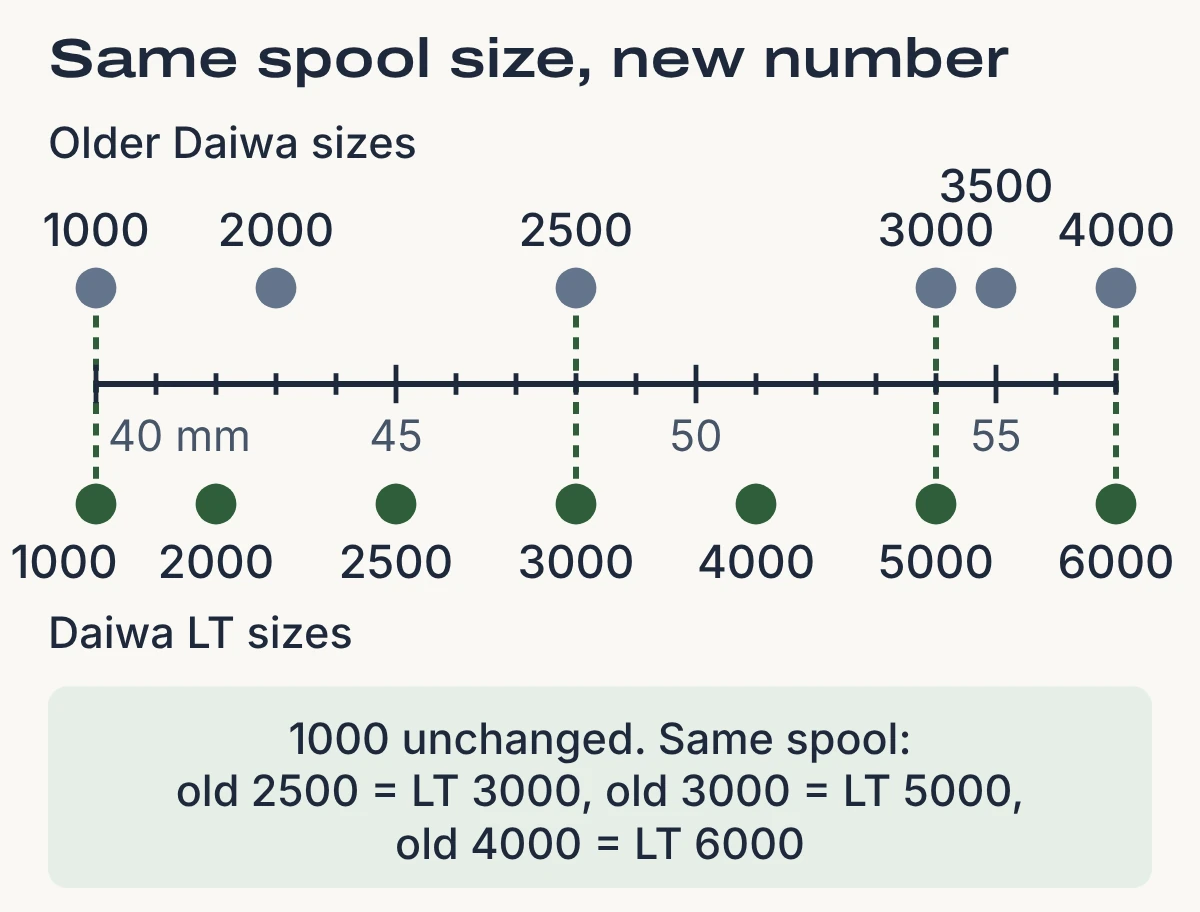
- From the 2500 up, Daiwa LT numbers are higher than older Daiwa numbers for the same spool. When Daiwa introduced its LT (Light & Tough) reels, it renumbered the range. On Daiwa Australia’s LT table, the old 2500 matches the LT 3000, the old 3000 the LT 5000 and the old 4000 the LT 6000; the 1000 is unchanged, and the old 2000 (43 mm) sits next to the LT 2000 (42 mm). The old 2500 and the LT 3000 share the same 1.9-inch (48 mm) spool, and Daiwa says the new sizing “standardises the spool diameters.” A secondhand Daiwa 2500 from before LT is closer to a current LT 3000. When you replace an older Daiwa, match the spool diameter, not the number (the diagram below gives both sets of diameters from Daiwa’s table).
- A C before a Shimano size means a compact body. UK Bass’s guide to Shimano model codes explains that “a c5000 is the same size as a 4000 reel, but with the spool capacity of a 5000 reel.” Shimano’s figures are consistent with that: the Sedona C3000 is rated for 30 yd more 8 lb mono than the Sedona 2500.
- Two-digit sizes are their own scale. By the two-zero rule a Pflueger 25 reads as a 2500, but Pflueger rates it in meters of line by diameter: 100 m of 0.20 mm mono for the President 25. Stren lists its 4 lb mono at 0.20 mm (0.008 in), per our trout line roundup, so that is roughly 110 yd of 4 lb mono, less than the 140 yd of 4 lb that Penn lists for its 1000. The President 30 works out the same way: 135 m of 0.23 mm, roughly 148 yd of 6 lb mono (Berkley’s 6 lb Trilene XL is 0.009 in), between the 110 and 180 yd of 6 lb that Penn lists for its 1000 and 2000. Treat the conversion as a starting point and compare capacity.
2500 or 3000? Choosing between two sizes
The 2500 against 3000 question comes down to line. On Penn’s figures, the 2500 is listed for 6-10 lb mono with 12 lb of maximum drag, and the 3000 for 8-12 lb with 15 lb. So:
- Choose the 2500 if you will mostly fish 6 or 8 lb line for bass, walleye or trout. Rapala’s reel guide calls a 2500 “all-around” for a first spinning reel.
- Choose the 3000 if you will fish 10 or 12 lb line or want spare line for longer runs (Penn’s 3000 holds 165 yd of 10 lb, its 2500 140 yd). A Shimano C3000 splits the difference: the 2500 body with the bigger spool.
- Choose a 2000 over a 2500 only for light line: Penn lists its 2000 for 4-8 lb, the same as its 1000, with more of it on the spool.
Braid changes the math because it is thinner than mono of the same strength. Daiwa says braided line “has totally revolutionised fishing so anglers can use smaller reels much more effectively than they could before.” If you spool braid, check the braid capacity the maker lists before you size up; the smaller reel may hold all you need.
Three spinning reels from our beginner fishing reel roundup show the steps in practice. Shimano rates the Sahara FJ 1000 for 160 yd of 4 lb mono, Daiwa rates the Revros LT 2500 for 110 yd of 8 lb fluorocarbon (an LT size, so a smaller spool than an older Daiwa 2500), and Shimano rates the Sedona FJ C3000HG for 170 yd of 8 lb mono. The roundup has the full specs and who each one suits.
| # | Preview | Product | Price | Link |
|---|---|---|---|---|
| 1 |  | Shimano Sahara FJ Spinning Reels (SH1000FJ) Fishing1000 size: light line | $104.99 | Check on Amazon |
| 2 |  | Daiwa REVROS LT Spinning Reel REVRLT2500, 4BB + 1, 5.2 : 12500 size: all-round | $69.99 Prime | Check on Amazon |
| 3 |  | Shimano Sedona FJ Spinning Reels (SEC3000HGFJ) FishingC3000 size: heavier line | $89.99 | Check on Amazon |
Spinning reel sizes by fish
Size advice varies between sources, so each row names where it comes from. Where two sources disagree, the line you plan to use is the tiebreaker.
| Fish | Size range | Source and what it says |
|---|---|---|
| Panfish, crappie, stream trout | 500-1000 (up to 2500 for trout) | Outdoor Life lists the 1000 for panfish; Daiwa calls 1000-2500 “ideal for light freshwater fishing” |
| Bass | 2000-2500 (3000 for 10-12 lb line) | Outdoor Life: 2000 for bass, 2500 for “bass and walleye”; Penn lists its 3000 for 8-12 lb |
| Walleye | 2500-3000 | Outdoor Life lists both sizes for walleye |
| Catfish | 3000 and up; 4000-6000 for big cats | Outdoor Life lists the 3000 for “catfish, walleye, lake trout, pike”; In-Fisherman says the Shimano Baitrunners catfish anglers favor are 4000 to 6000 |
| Pike and salmon | 3500-5000 | Rapala: “a 3500 to 5000 sized spinning reel is the choice if you are aiming for bigger predators” |
| Musky | Usually a baitcaster | Field & Stream: “most muskie presentations are designed for baitcasting reels” |
| Redfish, striped bass from the surf | 5000 | Outdoor Life’s saltwater list |
| Tarpon | 7000-8000 | Mercury Marine’s tarpon guide: a reel that holds “at least 250 yards of 50-pound-test braided main line” |
For the small end of the chart, our trout fishing line roundup compares lines from 4 lb stream mono to 10 lb trolling line.
Ready to buy?
Our beginner fishing reel roundup compares eight reels, with spinning picks from size 1000 to 3000 and the size of each one listed.
Frequently Asked Questions
Q. What is a size 30, 40 or 50 spinning reel?
It is a reel from a brand that numbers in two digits, such as Pflueger. The number reads as the 3000, 4000 or 5000 class, but two-digit reels can hold much less: Pflueger’s President 30 works out to roughly 148 yd of 6 lb mono, between Penn’s 1000 and 2000. Compare the line capacity, not the number.
Q. What size is an ultralight spinning reel?
The 500 and 1000 sizes. Rapala suggests 500 to 1000 for streams, small ponds and creeks, Shimano rates its Sedona 500 for 100 yd (91 m) of 4 lb mono, and Outdoor Life lists the 500 for ice fishing.
Q. What size spinning reel should a beginner buy?
A 2500 suits most first reels for freshwater, and Rapala calls that size “all-around.” Go smaller only if you will mostly fish panfish and stream trout.
Q. Can a spinning reel be too big for the rod?
Yes. Outdoor Life warns that “a massive reel on an ultralight rod won’t work,” and Daiwa notes that a badly matched rod and reel can feel “tip-heavy or awkward to hold.”
Q. What is a 20000 size spinning reel for?
Very large saltwater fish. Daiwa says reels from 8000 up are “typically used for bluewater fishing,” and its Saltiga saltwater range now runs up to size 20000.
Sources (14)
- Penn, Battle IV spinning reel specifications
- Shimano Sedona FJ model table, as published by Scheels
- Daiwa Australia, Light & Tough (LT) concept and sizing guide
- Daiwa, How to choose the right spinning reel
- Pflueger, President spinning reel specifications
- In-Fisherman, Spinning reels for catfish
- Outdoor Life, How to cast a spinning reel (reel size guide)
- Bass Pro Shops 1Source, Buying guide: picking the best spinning reel
- Rapala, How to choose a spinning reel
- Field & Stream, Best musky reels
- Mercury Marine, Tarpon fishing 101: choosing spinning gear
- UK Bass, A rough guide to Shimano reels
- KastKing, How to choose spinning reel size
- Reel Coquina Fishing Charters (blog), Spinning reel sizes
Product prices and availability are accurate as of the date/time indicated and are subject to change. Any price and availability information displayed on Amazon.com at the time of purchase will apply to the purchase of this product.