The short answer
None of the line makers we checked (Berkley, Seaguar, Sunline, Sufix, Stren) publishes a shelf life in years. Makers agree braid and fluorocarbon outlast nylon mono, and Sunline says line stored out of light at room temperature can last “a very long time”. Berkley recommends respooling mono at least once a year; Mercury Marine says braid can last several seasons.
The years you see quoted online come from shops and forums, and they disagree. Below are what the makers actually say about each line type, what shortens its life, how often to respool for how much you fish, and how to check a spool you are unsure about.
Storage life by line type: what the makers say
The basis for this chart is the makers’ own pages: Sunline, Seaguar and Berkley, which all make line. Sunline’s storage guide sums up the order: “Nylon can be the line most impacted if not stored properly. While braid and fluorocarbon will maintain performance the longest in proper storage.”
| Line | Life in storage (maker) | Light and UV (maker) | Heat and cold (maker) |
|---|---|---|---|
| Monofilament (nylon) | Most affected if stored badly (Sunline) | Sunline: 500 hours of UV, “approximately six weeks of daylight”, left fractures inside nylon. Berkley: “hundreds of hours” for appreciable damage | Sunline: “Both extreme heat and extreme cold can have an impact on nylon.” |
| Fluorocarbon | Seaguar: “usable over a much longer period of time than nylon monofilaments” | Seaguar: not affected by UV or fluorescent light. Berkley: “shrugs off UV” | Sunline: handles “short-term exposure to heat and cold, but continuous exposure will also impact its performance”. Seaguar: a hot car “should have no effect”, though it does “not recommend” leaving gear there |
| Braid | Keeps performance longest, with fluorocarbon (Sunline) | Sunline: “many thousands of hours of light exposure” to be affected. Berkley: “high resistance to UV damage” | Sunline: “not impacted by extreme heat or cold” |
None of these makers gives a number of years, and we found none on the Sufix FAQ page or Stren’s site. PowerPro’s maker pages would not load for us, so we could not check them. The year figures that circulate come from other kinds of businesses and do not agree with each other:
| Who says it | Monofilament | Fluorocarbon | Braid |
|---|---|---|---|
| Angling Sports (Canadian tackle retailer) | Throw out after 2 to 3 years unused | Shelf life of about 7 to 10 years | No figure |
| Outrig (Texas boat and RV storage company) | 1 to 3 years | 2 to 3 years | Up to 10 years stored correctly |
| Line makers above | No figure | No figure | No figure |
The two fluorocarbon figures are years apart, and neither page cites a test. Treat any year figure as a prompt to check the spool, not as a use-by date.
What shortens line life on the shelf
Sunline’s storage guide names three things: light, temperature and physical damage. Water and salt come into play mostly once the line is fished.
- Light, including indoor light. Sunline’s storage advice covers sunlight, “but it also includes fluorescent light.” Its 500-hour UV test left nylon “with fractures developing inside the line that cause premature breakage”. The fix is cheap: “Something as simple as a cardboard box can protect line from UV rays.”
- Heat and cold swings. Sunline warns that garages and boat sheds without heating or cooling hurt nylon first, and says “A much better choice would be a basement with stable temps and lower amounts of UV light.” Kevin VanDam wrote in his Bassmaster column that he keeps “bulk spools and spooled reels in a house closet to extend their shelf life.”
- Cracked spools. A broken spool edge rubbing the line as you wind it “can weaken your line, particularly nylon and fluorocarbon,” Sunline says. A padded bag, cooler or box protects the spools.
- Water and salt. Berkley says water absorption “may compromise abrasion resistance and overall strength” in mono, while “Unlike mono and some superlines, fluoro doesn’t absorb water.” MeatEater notes that in salt water “Salt crystals form along the line as water evaporates,” which “acts like sandpaper on your fishing line.”
- Chemicals. Seaguar says bug sprays and sunblocks “will have no effect on fluorocarbon.” We found no maker statement on other chemicals, or on mono and braid.
Note
The makers disagree on light for fluorocarbon. Seaguar’s FAQ says “Fluorocarbon is not affected by fluorescent lighting or other forms of UV rays,” while Sunline tells you to keep all line out of light, “fluorescent light” included. On heat they mostly agree: Sunline says fluorocarbon can handle short spells of heat and cold but not continuous exposure. Greg Meunier, president of the line maker Vicious Fishing, told Mercury Marine’s Dockline: “Braid and fluorocarbon are more resistant, but store all line out of the sun whenever possible.” Storing every spool dark and at room temperature costs nothing and satisfies all three.
How often to change line on the reel
Line on a reel faces sun, water, rod guides and snags that boxed line never meets. The chart’s basis is the makers where they give guidance, then named publications, then one retailer’s schedule by how much you fish. Berkley’s line guide puts the general rule as “once or twice per year for the average angler should do the trick.”
| Line | Makers say | Publications and pros say | Retailer schedule by use (Angling Sports) |
|---|---|---|---|
| Monofilament | Berkley: “at least once a year” | MeatEater: heavy use, about once per season. Salt Strong: every 6 months to 1 year | Weekend: once a year. Moderate: 2 to 3 times. Heavy: 3 to 4 times |
| Fluorocarbon | Seaguar: you can “re-spool less” than nylon | Mercury’s Dockline: start each season fresh. Salt Strong: every 6 months to 1 year | At least once a year; heavy use up to 3 times |
| Braid | Berkley: “Braid often lasts longer on your reel” | Mercury’s Dockline: “several seasons”. Salt Strong: “no reason to replace it within a year” | Heavy use: once or twice a year |
The sources differ on heavy use of mono: MeatEater’s once per season is far less often than the retailer’s 3 to 4 times a year. Tony Acevedo of Salt Strong gives 6 months to a year for both mono and fluorocarbon. For braid, MeatEater sums up the shared view: with braid, wear “matters more than age.” Charter Fishing Destin, a charter service, says the fraying that ends a braid’s life “can take a year to three years to occur.”
Work out your own interval
Start from your line’s row
Read the line type on the spool label. For mono, Berkley’s at-least-once-a-year is the floor; braid and fluorocarbon start longer.
Count your days on the water
Angling Sports’ schedule scales with use, from once a year for a weekend angler to 3 or 4 times for a heavy one. Pick the band nearest your season.
Shorten it for sun and heat
Kevin VanDam warns that “Anyone who leaves mono-spooled reels on the deck through the hot periods of summer is taking a chance on line failure.” Reels stored in a truck or hot garage count too.
Shorten it for salt and rough cover
Salt Strong says mono and fluoro “weaken when they’re exposed to saltwater and UV rays,” and MeatEater says fluorocarbon fished around rocks, shell beds or heavy structure may need changing more often. Seaguar, a fluorocarbon maker, disagrees for its line: “Although various water types will have no effect on fluorocarbon, you should always rinse off your gear, especially when fishing in salt or brackish water.” So salt clearly matters for mono; for fluorocarbon the sources differ, and rinsing is advised either way.
Respool before a trip that matters
Mercury’s Dockline says “Some scenarios just call for fresh line,” such as a trophy lake or a long-awaited trip. If you are spooling up for a first season, our bass fishing tips for beginners cover the rest of the setup.
If you fall between two bands
Let the line decide. Kevin VanDam’s answer to whether last year’s line should go is that it “depends upon how much you fished last year and the techniques you used.” Run the checks in the next section. If the line passes, Mercury’s Dockline says that after an outing or two “you can probably cut off a cast’s length of line to remove any potentially damaged sections” and fish on. If you suspect damage deeper in the spool, the same article says replace it. A middle path is to replace only the top part of the line, covered below.
Ready to buy?
Our trout fishing line roundup compares nine monofilament, fluorocarbon and braided lines, with the makers’ published diameters where they give one.
How to test old line
No test tells you the exact strength left, but these checks, each from a named source, help you spot worn line. Do them on the part of the line you cast and fish.
Look and feel along the line
Berkley lists the signs: “Signs old line should be replaced include dryness, fraying, too much memory, and reduced casting distance.” MeatEater’s method: “Run your fingers over it. Look for rough spots, fraying, discoloration, or excessive memory.”
Find nicks with a wet finger
Jim Kalkofen, writing in MidWest Outdoors: “To check line for nicks, run it between a wet finger and thumb. If any roughness is felt, clip the line and re-tie.”
On braid, tell fuzz from fade
Salt Strong’s Tony Acevedo says “don’t confuse the color fading with your line fraying,” and “If it’s just color faded, you don’t need to change it.” Kevin VanDam counts color loss on its own as a warning sign, as well as fuzz: “if you notice it’s starting to fuzz up or lose its original color.” They agree on fuzz and differ on fading; treat fading alone as a reason to look closer.
Pull-test a length
Angling Sports, a tackle retailer, suggests you “tie your fishing line to a fixed and solid object that can handle the stress you will be putting on a fishing line,” let out about 25 feet, pull, and toss the line if it breaks before it reaches the force it should handle. Take any hook or lure off first.
Check the memory
Coils that stay in the line make casting hard; Mercury’s Dockline says that even lightly used line with bad memory is worth replacing. For mono on a spinning reel, the Oklahoma Department of Wildlife Conservation’s tip starts with taking the spool off the reel, so water stays out of the reel body: “Unscrew the drag clip off the top of the reel and pop the spool off the reel.” Then “Hold the spool under warm to hot running water and rotate to make sure all of the line is getting some direct contact from the water.”
Use conditioner for handling, not repair
Vicious Fishing’s Greg Meunier says “Line conditioner can help with that, as it refreshes the line and improves casting.” Follow the product label; Mercury’s Dockline notes that “line conditioner will not repair damaged line.”
Check how much is left
Acevedo says to replace braid when you have lost enough that there is a big gap between the edge of the spool and the line, because it costs casting distance and capacity for a big fish.
Can you reverse braid or replace only part of it?
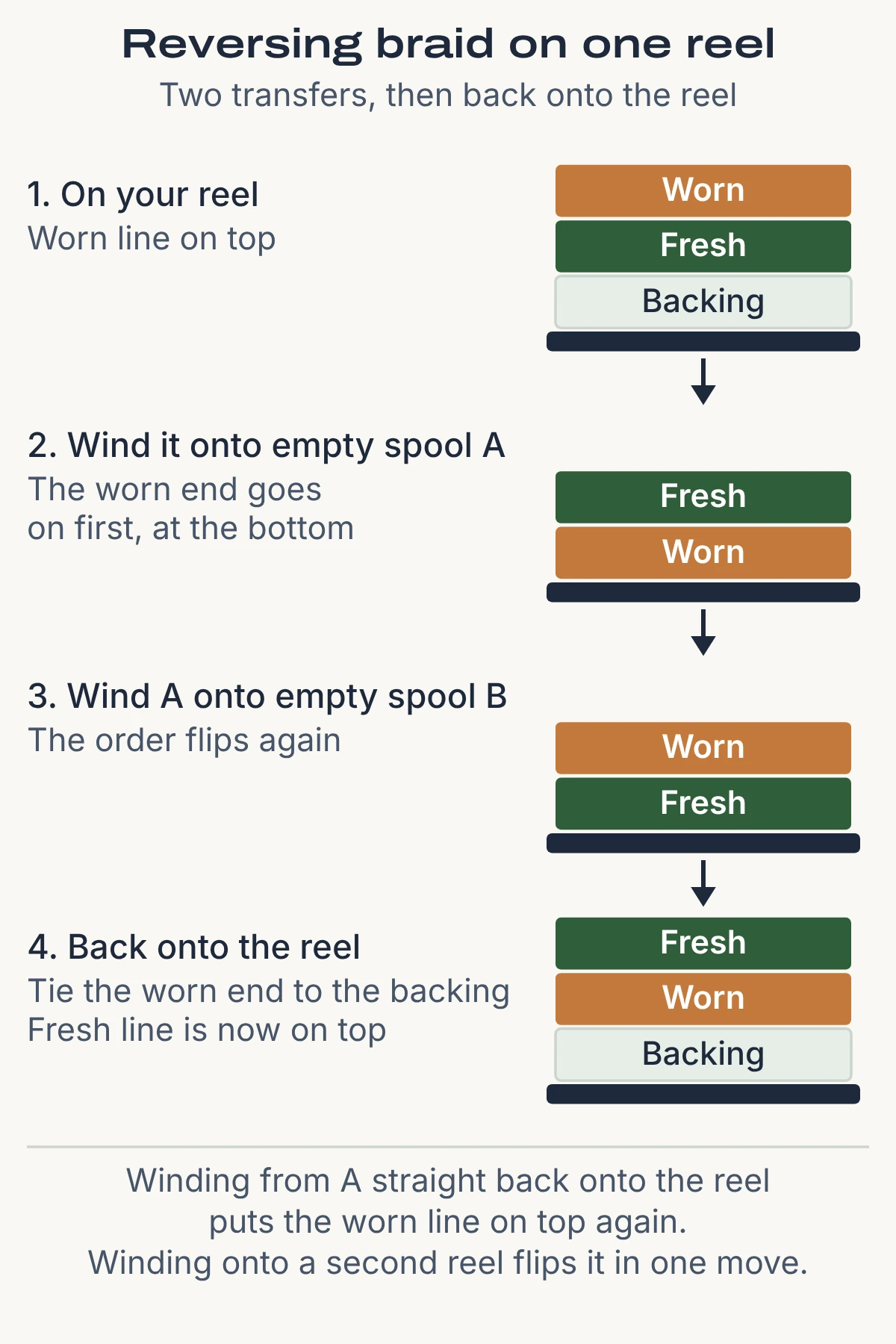
Yes, and pros do both. Kevin VanDam’s Bassmaster advice for braid that is starting to fuzz is to “strip it off the reel in an organized manner then reattach it with the end you’ve been fishing with tied onto the spool.” The unused line from deep in the spool becomes the working end. The easiest way, in his words, is to “spool old braid from one reel onto another,” which “puts the used portion on the bottom of the new spool and the unused portion on top.”
Related guide: How to Clean a Fishing Reel: Rinse, Dry, Lubricate, and When to Send It In
On a single reel there is a trap. Henry Gilbey, a UK fishing guide, points out that “you obviously can’t just wind the braid off a reel and then wind it back on to get a reversal.” Each transfer flips the order, so it takes two transfers before the line goes back on.
For mono and fluorocarbon, replacing just the top of the spool saves line. Kevin VanDam says “I only replace the top 75 yards on most of my reels,” except his crankbait reels, which cast farther. He marks the 75-yard point on the backing with tape so he knows where to stop stripping. In another Bassmaster column he ties fresh line to old backing with an Albright knot, and sizes a nightly top-off by walking off his longest cast and adding another 20 to 30 yards. Check your reel’s capacity before you add backing; our spinning reel size guide shows how to read it.
Joining braid to braid in the working part of the line is another matter. Acevedo says “Some anglers will splice on more line but I do not recommend that because that’s just another weak point in your line.”
What line costs and where old line goes
Prices vary by brand, test and spool length, so here are the relative costs from makers and an agency. Berkley calls mono known “for its affordability” and says “fluorocarbon is typically the most expensive.” The Oklahoma Department of Wildlife Conservation puts fluorocarbon at “about twice as expensive as monofilament line.” Kevin VanDam argues the gap narrows over a season: because braid and fluorocarbon need changing less often, “the cost is similar because you don’t go through as much line in a season.” For live spool prices, see the comparison table in our roundup of trout fishing lines.
Old line should not go loose in the trash or the water. The Washington Department of Fish and Wildlife says “It is estimated that monofilament line takes 600 years to break down once discarded!” The BoatUS Foundation points anglers to recycling bins at ramps, marinas and tackle shops, and where there are none, says to cut the line into small pieces, “six inches or less”, over a trash can.
Frequently Asked Questions
Q. Is 15- or 20-year-old fishing line still good?
None of the makers we checked gives a cutoff, and the non-maker figures disagree. Run the feel, nick and pull checks above; for mono, Sunline says nylon is the type most hurt by light and temperature, so old mono needs the closest look.
Q. Does braided fishing line go bad in storage?
Sunline says braid would take “many thousands of hours of light exposure” to be affected and is “not impacted by extreme heat or cold.” It wears with use instead: Jeff Knapp, a guide writing for Bass Pro Shops, says “The slick coating will eventually wear down.”
Q. How long does fluorocarbon last in storage?
Seaguar says only that it is usable much longer than nylon; it gives no years. The non-maker figures range from 2 to 3 years (Outrig) to 7 to 10 years (Angling Sports).
Q. Does braided line have memory?
Very little. Salt Strong describes braid as having “little to no memory,” and MeatEater says braid “has little memory”.
Q. How long does fishing line last on a reel?
For most anglers, Berkley’s guide says once or twice a year is enough, and its mono page says at least once a year. Braid can last several seasons, per Mercury’s Dockline, if it is not frayed or low on the spool.
Q. Does saltwater shorten line life?
Yes for mono, per Salt Strong and MeatEater, which says dried salt crystals act like sandpaper on line. For fluorocarbon the sources differ: Salt Strong says it weakens, while Seaguar says water types have no effect on it. Rinse your gear after salt either way.
Sources (23)
- Sunline America, How long does fishing line last? The best way to store fishing line
- Seaguar, Understanding Fluorocarbon & FAQs
- Berkley, Why Monofilament is the Best All-Around Fishing Line
- Berkley, Benefits of Fluorocarbon Lines
- Berkley, Why Braid is Perfect for Freshwater Fishing
- Berkley, Choose the Right Line for Your Fishing Needs
- Berkley, Freshwater Line Guide: Fluorocarbon
- Sufix, Sufix FAQs
- Mercury Marine Dockline, How Often Should I Change My Fishing Line?
- MeatEater, You Should Change Your Fishing Line More Often
- Oklahoma Department of Wildlife Conservation, Choosing the Right Fishing Line
- Bassmaster, Kevin VanDam: Cost saving tips for keeping line fresh
- Bassmaster, Kevin VanDam: Put your line to work for you
- Salt Strong, This Is When You Should Replace Your Fishing Line
- Salt Strong, When To Change Out Your Braided Fishing Line
- Henry Gilbey, How I reverse braid on a spinning reel
- Bass Pro Shops 1Source, Jeff Knapp: Tips for Using Braided Fishing Line
- MidWest Outdoors, Jim Kalkofen: I Tried Something Old, and It Still Worked
- Angling Sports (retailer), When Should I Change My Fishing Line
- Outrig (storage company), How Long Does A Fishing Line Last In Storage?
- Charter Fishing Destin, How Long Does Fishing Line Last?
- Washington Department of Fish and Wildlife, Monofilament recovery and recycling program
- BoatUS Foundation, Fishing Line Recycling