The short answer
Rest your thumb on the spool, press the release button, swing the rod back and forward in one smooth motion, and let the spool run as the lure launches. Ride it lightly while the lure flies, then press down to stop it as the lure lands. Practise with a heavier lure first.
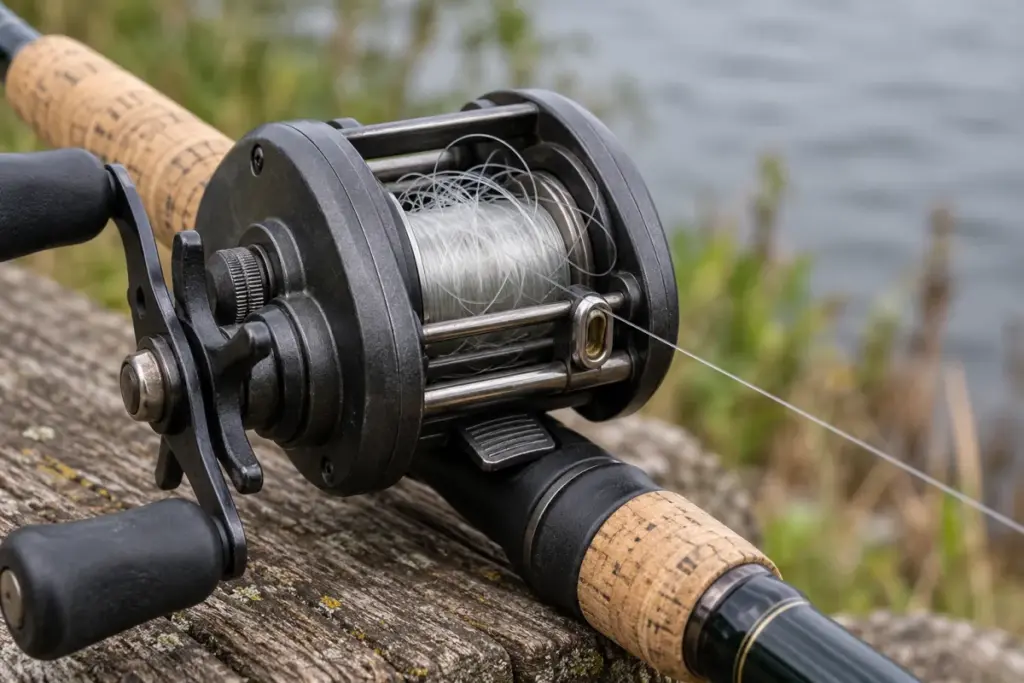
A baitcaster’s spool turns during the cast, so it can keep turning after the lure has stopped. That overrun is a backlash, or bird’s nest, and your thumb is what prevents it. Abu Garcia’s manual says plainly that “It is normal to experience backlashes when learning how to cast a low profile reel.”
Every step is credited to the maker or angler it comes from, and where they disagree the article says so.
What you need
- A baitcasting reel, already spooled and set up on a casting rod. If you still need a rod, our roundup of baitcasting rods for bass compares eight.
- A lure of about 1/2 ounce, or a practice plug with no hook. Piscifun, a reel brand, says to “Use a practice plug instead of a hooked lure.”
- Monofilament line to learn on. Piscifun says “Start with a 15 to 17-pound monofilament line.”
- Open ground with nobody in front of you or behind you.
Note
A fishing licence comes before the first real cast. The U.S. Fish and Wildlife Service says “First, you’ll need a fishing license.” and “Every state has slightly different rules, so look up your state for state-specific requirements.”
Cast it in four moves
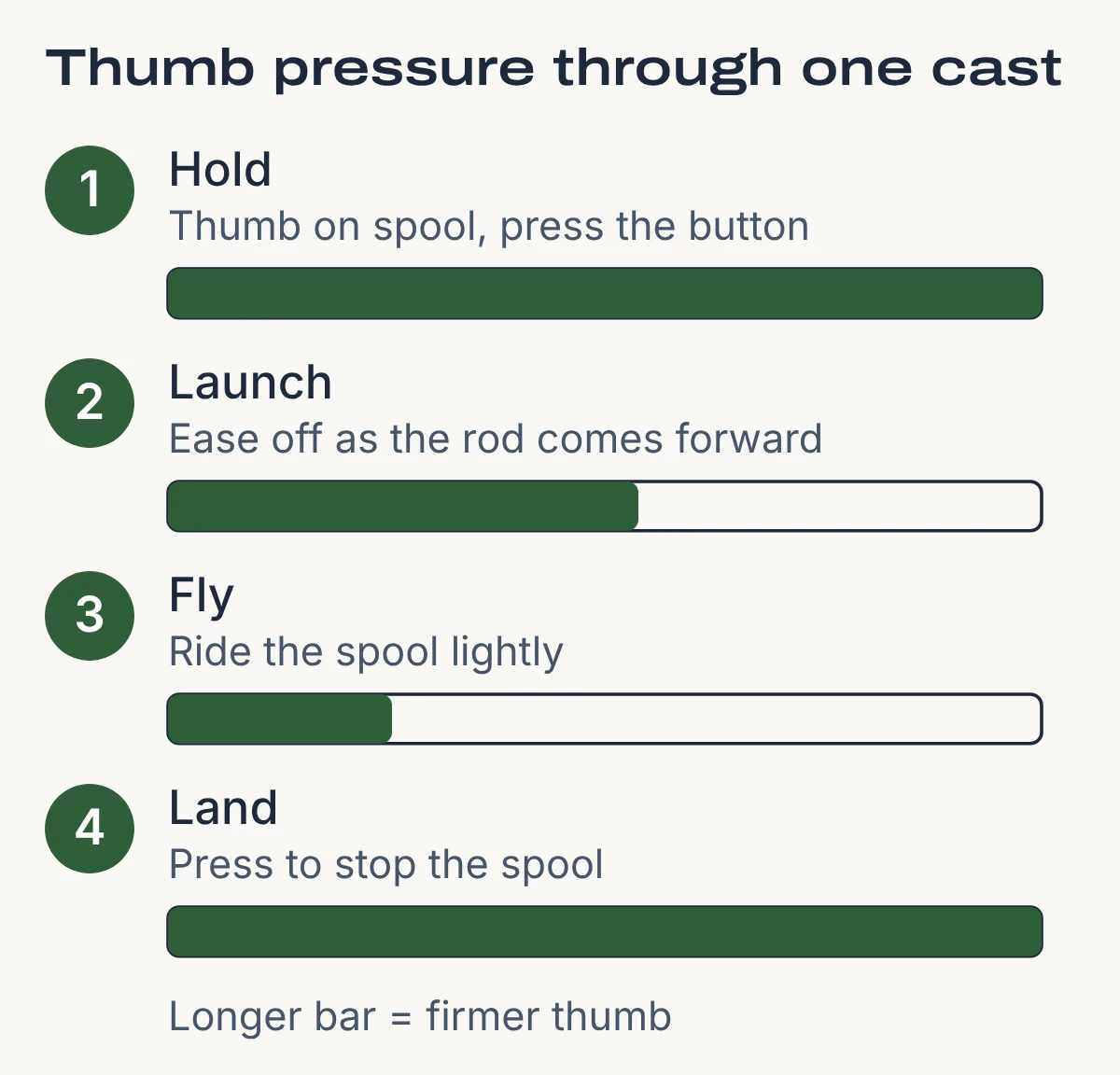
Lew’s describes the thumb’s job in four parts: hold the spool, ease off, ride it lightly, then press to stop it.
Cast a baitcaster step by step
Check the reel with a drop test
Tie on the lure, hold the rod out and press the release button. Lew’s says to adjust the spool tension knob “so that the lure falls in free spool and the spool stops spinning when the lure hits the ground.” Jordan Lee, in a Bassmaster.com column, says to “Make your adjustments a little tight if you’re a novice or new to baitcasting tackle.” For the brake, Field & Stream says to start “a little above the midway point, then back off slightly as you get more comfortable”. Makers differ on which control to set first and on the brake number; a separate baitcaster set-up guide compares them in full.
Put your thumb on the spool and your hand on the grip
Lew’s says to hold the rod “with the reel handle facing up” and to “press on the spool to hold it in place and push down the reel’s thumbar to disengage the spool.” Abu Garcia’s manual says to depress the thumb bar “while keeping the tip of the thumb on the spool to control the lure.” Norrik, an online fishing guide, adds “Remember to keep your thumb rested over the spool, so it does not unwind.” Lew’s notes that “Many anglers, including pros, use two hands when casting, one on the reel and the other below it.” Field & Stream says to reel up “so the lure is about a foot from the rod tip”.
Look behind you, then swing the rod back and forward
The Oklahoma Department of Wildlife Conservation, writing about a spincast lesson, says “The key thing to remember when casting is SAFETY! Remember you have a hook swinging from the other end of the line!” and, mid-cast, “Now look behind you to make sure nobody is standing there or that no objects are in the way before you finish your cast.” The National Park Service lists “Only cast where fishing is permitted” among its fishing safety tips, and “Don’t get hooked, prevent and treat fishing hook related injuries” is another. Lew’s says “Learn the overhand cast first” and “Your wrist and forearm, not your shoulder, are the main drivers when casting.” Abu Garcia’s manual says to bring the rod back so the tip reaches “a point above and behind the shoulder”, then forward “in a single motion without stopping”. Mercury Marine’s write-up of Pro Team angler Andy Montgomery’s tips says “Don’t muscle it. Let the rod do the work.”
Ease your thumb off as the rod comes forward, but not all the way
Abu Garcia says to release the thumb “as the rod is brought forward so that the lure is launched slightly upward and outward toward your target.” Lew’s says to “Back off thumb pressure in the middle of the forward cast but not completely” and adds “It will take practice to determine precisely when to do this.” Abu Garcia’s manual lifts the thumb fully here, while Lew’s keeps light contact. Field & Stream says to apply “just enough thumb pressure to keep the spool from over-spinning”. Realtree’s Joe Balog suggests that on your very first casts you skip thumb work: “just cast”. Balog warns that with his settings (magnetic brake at half, knob set so the lure drops slowly) the lure “will not travel very far”.
Ride the spool, then press to stop it as the lure lands
Lew’s says to “Ride the spool lightly with your thumb as the lure sails to the target. Increase thumb pressure to snub the spool at the end of the cast.” Abu Garcia says that as the lure approaches the water you should stop the spool with your thumb, because otherwise “the spool will continue to rotate causing a backlash”. Realtree says the pressure should be “an applied pressure more than an all out stop, right at the end of the cast.” Mercury’s write-up of Montgomery’s roll cast says that slowing the spool as the lure nears the surface lets it land “without a big splash”. Then turn the handle until the reel engages.
Try the sidearm cast once the overhand cast works
Mercury Marine’s article on Montgomery’s three basic casts calls the overhand cast “the most basic cast” and the sidearm “roll cast” the one for “less splash and more accuracy”. For the roll cast, Mercury says to “bring the rod to the side, using your wrists to swing the lure back slightly over the rod tip. Then propel it forward under the rod tip.” Lew’s says “Turn the spool up when making the sidearm roll cast.” Piscifun and Norrik both say the sidearm cast helps in wind: Piscifun says “In windy conditions, sidearm casts are often more effective than overhead casts”, and Norrik says “Use sidearm casts when throwing into the wind”. Norrik calls it “one step up in complexity” from the overhand cast. Mercury’s third basic cast, the pitch, is a short-range cast for later. Keep the thumb routine from steps 4 and 5.
Back the settings off a little at a time as you improve
Field & Stream says to begin “slowly backing off of the spool-tension knob to increase your casting distance” and that for the brake “you will never really need to go below 40 percent”. Abu Garcia says to reduce the spool tension a quarter turn at a time to maximize casting distance. Lew’s says the better your thumb control, the more you can back off the brakes.
Ready to buy?
If a baitcaster feels like too much to start on, our roundup of beginner fishing reels compares eight spinning and spincast picks.
Practise with a heavier weight first
Several sources suggest an easier start. Field & Stream’s combo guide says to spool a reel with “15lb or 20lb mono and practice casting a weight on the front lawn”, with the brake all the way up and the tension set so the weight falls slowly. Realtree’s Balog uses “a 1/2-ounce bass jig” for the drop test and the first casts, and Sporting Classics Daily writer Michael M. DeWitt Jr. says “a beginner should also start practicing with a heavier lure” and that “Baitcasting tackle and lures less than a quarter ounce in weight are not ideal for rookies”. Piscifun suggests a hookless practice plug, and KastKing says “Whenever you switch to a significantly lighter or heavier bait, check the spool tension again.”
Balog’s practice method: make a dozen or so casts in a session, turn the tension back a little, and keep adding thumb pressure until the overrun stops. Once the casting feels steady, our bass fishing tips for beginners cover gear, rigs and a first day on the water.
Why a baitcaster backlashes
The makers and pros name the same few causes.
- The spool is not stopped at the end. Abu Garcia’s manual says the spool keeps rotating if you do not stop it as the lure hits the water. Realtree’s Balog puts splashdown first; his own guess is that “the leading factor is splashdown of the lure itself”.
- Tension too loose. KastKing’s Craig Smith says “your spool will spin too fast, which causes backlashes the most when using a baitcaster”. Lew’s says “If the pressure is too light, backlashes are inevitable.”
- Brake too low, or a hard throw. Smith says a magnetic brake keeps the spool at a good speed early in the cast, and that early blowups are best avoided by understanding you do not have to throw the bait so hard: “You want to let your rod load up”.
- Wind in your face. Abu Garcia says to try “casting with the wind” until you are comfortable. USAngler says more friction from your thumb or the tension knob means “less trouble you’ll have with backlashes when casting into the wind”. Piscifun says “increase your brake settings” in wind.
- Line and lure. Balog says “Nothing backlashes like braided line” and “lighter lines backlash easier, and worse, than heavier pound-tests”. The sources disagree on braid: DeWitt, writing as a beginner and telling readers to “take this bit of advice with a grain of salt”, finds braid “easier to untangle”, with “less backlash”. Ott DeFoe, below, agrees on untangling.
| Problem | Source says | Try |
|---|---|---|
| Tangle at the start | KastKing: brake low, hard throw | Raise the brake, let the rod load |
| Spool spins too fast | KastKing, Lew’s: tension loose | Tighten tension a little |
| Tangle at landing | Abu Garcia: spool not stopped | Press the spool earlier |
| Short casts | Lew’s: tension too tight | Back off a little at a time |
| Tangle in a headwind | Abu Garcia, USAngler | Cast with the wind, add friction |
| Small loops in the spool | DeFoe | Make a long cast to clear them |
How to pick out a backlash
Mercury Pro Team angler and 2019 Bassmaster Classic champion Ott DeFoe gives a three-step method, as reported by Mercury Marine, and adds advice on finishing the job. Mercury’s article says the method works for monofilament and fluorocarbon.
Stop and stay calm; do not thumb the spool and yank
DeFoe says “Most people immediately engage the spool, put their thumb on the spool and start pulling on the line. That’s not the best way to get out a backlash”. Mercury’s article adds “That method often makes the line bind back up even worse.” The lure is still tied on. As the Oklahoma Department of Wildlife Conservation puts it, “Remember you have a hook swinging from the other end of the line!”
Tighten the spool tension knob
DeFoe says to tighten it “tighter than you ever would if you were going to cast”.
Press the thumb bar and pull the line off slowly and steadily
DeFoe says “The spool tension knob being tight will keep the line from getting locked up underneath itself”. He adds “A lot of times, this process is all you need, and you can pull all the tangles out.” Mercury’s article adds that slow, steady pulls are “critical to avoid creating a hard kink or cinch in the line, which can create a weak spot.”
If the line locks up, press your thumb on the spool and turn the handle
DeFoe says to apply thumb pressure to the spool “in line with where the line is jammed”, tighten the drag, engage the handle and “slowly turn the handle two complete revolutions while maintaining thumb pressure”. Then press the thumb bar and pull the line off slowly again. He says of this third step “Step 3 will sometimes need repeating, but usually the first or second time will do the trick”.
Check the line, then reel it back under tension
Mercury’s article says the line should look “like when it was initially spooled, with no lines crossed underneath and no loops”. Reel it back by passing it through the thumb and index finger of your off hand, and pull slowly at any kink. On the water, he suggests pulling the line out and letting it fall in the water before reeling in.
Reset the knob and the drag
Mercury’s article says to loosen the tension knob back to where it was, and to consider adjusting it to avoid the next backlash. The tightened star drag also needs setting back, which the Mercury page does not mention: Lew’s rule of thumb is to tighten the star drag “until the resistance is about 25 percent of the line’s strength”.
Braid is different. DeFoe says “With braid, a backlash isn’t usually as hard to get loose if you don’t pull too hard” and “Always pull where the line goes under itself.” If small loops form in the spool while fishing, he says to make a long cast that clears the line, or to tighten the knob and pull slowly.
Shimano, saltwater and salmon
Shimano. Shimano’s own site was not available when this was written, so this comes from USAngler, a fishing publication. Its description of casting is not brand specific: “place your thumb directly on the spool, free the spool to turn by depressing the thumb bar, and load your rod.” For some Shimano reels with SVS Infinity brakes, USAngler’s editor recommends that “new anglers start with all four brakes on”. Check your model’s manual for its brake.
Saltwater and salmon. The sources above are freshwater bass guides, and none of them gives a different casting motion for saltwater or salmon. This article does not add steps for them. The sources describe freshwater bass tackle; check your reel’s manual for saltwater or salmon gear.
Frequently Asked Questions
Q. Are baitcasters hard to cast?
They take practice. USAngler says “it takes some practice to train your thumb and reflexes”, and Abu Garcia calls backlashes normal while you learn.
Q. How can I cast a baitcaster without backlash?
No setting removes it, but tight tension, a high brake and a thumb that stops the spool as the lure lands cut it down. Practise with a heavier lure first.
Q. Why can’t I cast far with a baitcaster?
Lew’s says too much tension reduces distance greatly, and USAngler says “the tighter the tension, the shorter the cast”. Field & Stream says to back the knob off slowly as you get comfortable.
Q. Can I cast a baitcaster without using my thumb?
KastKing says casting without the thumb “is possible, especially when the brakes are turned up significantly, but it also limits casting distance and overall performance.”
Q. How do I cast a baitcaster with braid?
Braid backlashes more easily, according to Realtree’s Balog, so he suggests starting on monofilament. DeFoe says a braid backlash is usually easier to loosen if you do not pull too hard.
Q. Do I cast a Shimano baitcaster differently?
The thumb routine is the same. USAngler says some Shimano reels use SVS Infinity centrifugal brakes, so check your model’s manual for its brake setting.
Sources (17)
- Abu Garcia, Revo Low Profile Instruction Manual (maker)
- Lew’s, How to Adjust and Cast a Lew’s Baitcaster (maker)
- Mercury Marine, How to Make the 3 Basic Casts with a Baitcasting Rod and Reel (boat-engine maker’s blog, pro angler Andy Montgomery)
- Mercury Marine, Ott DeFoe’s Trick for Removing a Backlash (boat-engine maker’s blog, New Zealand edition; the US page has been removed; pro angler Ott DeFoe)
- KastKing, How To Use A Baitcaster (maker)
- KastKing, How to Use Your Thumb When Casting a Baitcasting Reel (maker)
- Piscifun, The Ultimate Guide to Cast a Baitcaster (maker)
- Field & Stream, How to Cast a Baitcaster (publication)
- Field & Stream, The Best Baitcaster Combos (publication)
- Realtree, Why You Suck at Throwing a Baitcaster (camo brand’s editorial site)
- Bassmaster, Spool Your Reels Correctly by Jordan Lee (publication)
- Sporting Classics Daily, Baitcasting: Teach Me, Oh Jedi Bassmaster (publication)
- USAngler, How To Set-Up a Baitcasting Reel (publication)
- Norrik, Fishing with a Baitcaster Rod & Reel (online fishing guide)
- Oklahoma Department of Wildlife Conservation, Knots and Casting Techniques (agency)
- National Park Service, Fishing Safety (agency)
- U.S. Fish and Wildlife Service, Purchase a Fishing License (agency)