The short answer
Mount the reel in the rod’s seat. Thread the line through the guides from the tip to the reel, open the bail and tie it on with an arbor knot. Close the bail and wind on line swirling off the filler spool counterclockwise, stopping about 1/8 inch (3 mm) short of the rim. Then set the drag.
A spinning reel hangs under the rod and holds its line on a fixed spool. The US Fish and Wildlife Service describes the type this way: “Open-Bail Spinning Reels use a rod with a straight handle and a reel that’s mounted under the handle.”
This guide covers the reel: seat, handle side, bail, spooling and drag. Where makers disagree, it says so and names who says what. Sources are named at each step, and the types are labelled: makers, a retailer, publications and agencies.
What you need
- A rod with a reel seat and a spinning reel. Our spinning reel size guide explains how reel size matches line and fish.
- New line on a filler spool, matched to the line rating printed on your reel’s spool. For bass spinning gear, Lew’s, a maker, says “Spinning reels perform at their best with fluorocarbon and monofilament lines no heavier than 8-pound test.” Heavier gear takes heavier line, as the saltwater section shows.
- Scissors or line clippers, and a flat surface or a helper to hold the filler spool.
- A small piece of electrical tape if you are spooling braid. Tackle Warehouse, a retailer, says: “Add a small piece of electrical tape to the spool to further secure the line to the reel.”
- A fishing license, if your state requires one. The US Fish and Wildlife Service says: “First, you’ll need a fishing license.” It adds: “Every state has slightly different rules, so look up your state for state-specific requirements.”
Which way the line comes off the filler spool
Five sources spell out the direction, and they agree. Field & Stream, a publication, says the filler spool lies flat with its label up, “as long as the line comes off in a counter-clockwise direction, you’re good.” Berkley, a maker, says: “I prefer that the line come off the spool counter-clockwise.” Lew’s says to lay the spool on whichever side makes the line come off counterclockwise (it says either side can be up): “If the line comes off clockwise it will twist.” Wired2Fish, a publication, says to have the line come off “in a counterclockwise motion”, and says the label is up in many cases but not always.
Tackle Warehouse gives the reason: “The oscillation on most spinning reels turns clockwise so you want the line coming off the feeder spool counterclockwise.” Field & Stream puts it simply: “you want to put the line on a reel the same way it will come off the reel.”
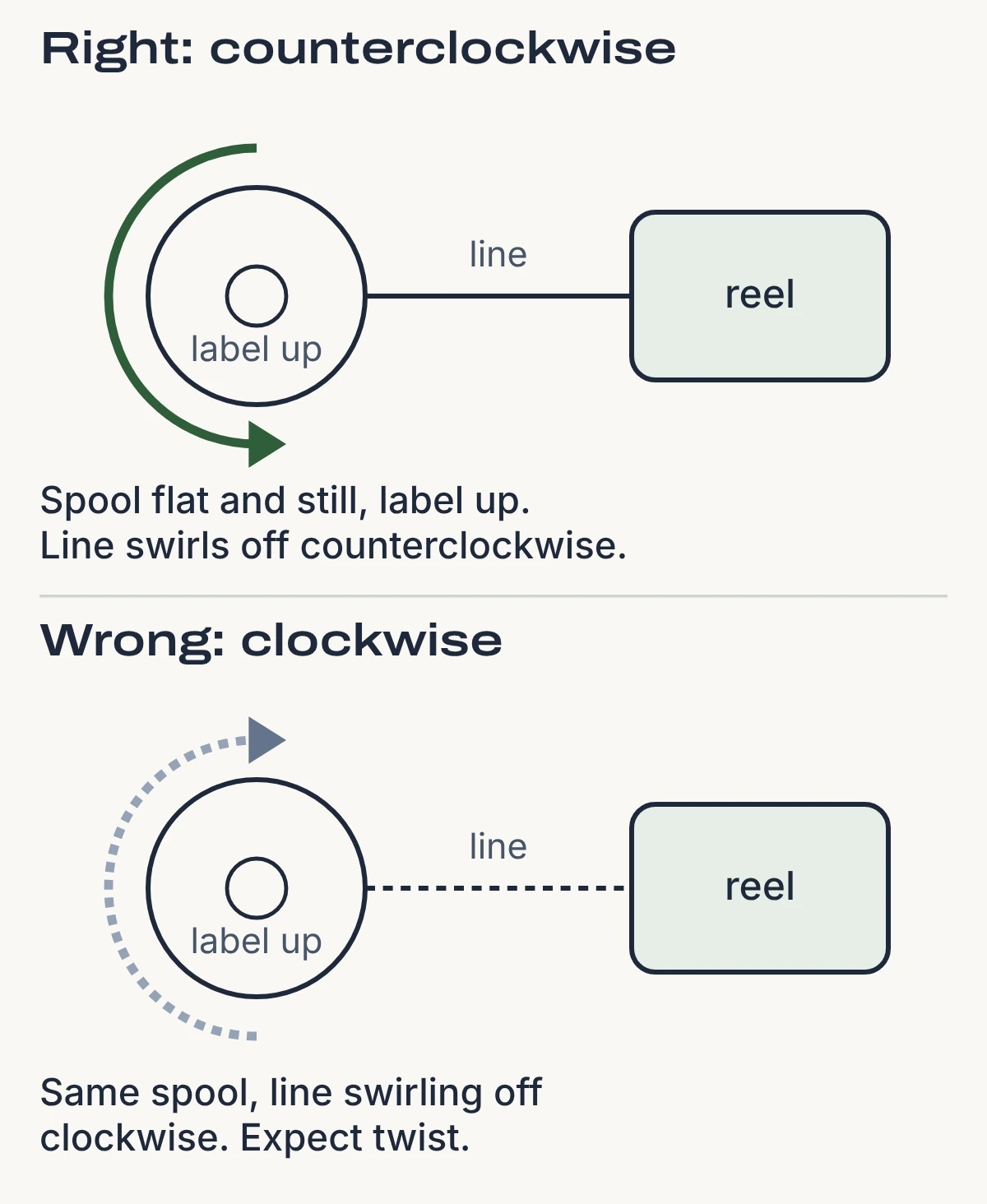
The spool does not turn: the line leaves over its rim in coils, and the direction is the way those coils swirl around the spool as you wind. If you are unsure, Lew’s gives a check in step 6.
Set up the reel, step by step
Mount the reel on the rod’s seat
Zebco’s spinning-reel manual says to loosen the reel seat on the rod, put the foot of the reel into the seat slots and tighten until the reel is securely attached. On a spinning rod the reel goes under the handle, as the US Fish and Wildlife Service describes above. A spincast reel mounts on top, as covered below.
Put the handle on the side you will reel with
Most spinning-reel handles move. Okuma, a maker, says “most have a simple screw in pin system that is easy to swap over”. Lew’s says that on some of its reels the handle shaft screws into a cap on the opposite side of the body: unscrew the cap, pull the shaft out, fit it on the other side and screw the cap back on. Pflueger lists its President spinning reel as right or left retrieve in every size shown. No maker page read for this guide says which side is correct, so choose the side that puts the handle under the hand you want turning it.
Lay the filler spool so the line comes off counterclockwise
Put the spool flat with its label up, as Field & Stream does, and check the direction before you tie anything. Field & Stream says to keep the spool still: “you want to keep the filler spool in a fixed position with the label facing you, so it comes off in coils as you wind”. Lew’s also describes an upright method, with the spool on its edge in a holder and the line coming off the top. Field & Stream advises against letting the filler spool turn, saying “you don’t want to run a rod or dowel through the spool and allow the spool to spin” and “This creates twist.” If you use a holder, run Lew’s twist check in step 6.
Thread the line through the rod guides, tip first
Zebco says: “MUST open bail. Thread line through each of the guides starting at the tip until reaching the reel.” Field & Stream agrees: “Thread the line through all of the guides, from top to bottom, all the way down to the reel.” Not every source goes that far. Lew’s says to run the line “through the first guide above the reel”, and Wired2Fish says to run it “through the first guide of the rod, down to your reel.” Field & Stream calls the first-guide-only shortcut a common mistake: “Lot’s of people make the mistake putting line on straight from the filler spool or threading it only through the first guide.” It says threading every guide helps the line lay evenly and avoids a cone-shaped fill on the spool.
Open the bail and tie the line to the spool with an arbor knot
Field & Stream says: “Don’t forget to open the bail before you tie the line to the spool”. Animated Knots, a knot reference site, gives the knot: “Pass the fishing line round the arbor. With the free end, tie an overhand knot around the line. Then tie a second overhand knot in the free end to act as a stopper. Finally, slide the knots down tight against the arbor.” Berkley wraps the tag end around the spool twice before its overhand knots, so makers vary a little here. Zebco says to trim the tag end of the line once the line is tied on.
Close the bail and wind on the line under steady tension
Zebco says: “Close the bail wire. Pinch the line to add tension while turning reel handle and filling the spool with line.” Daiwa’s Tech Tips, voiced by rock-and-beach guide Alex Bellissimo, says: “Very, very important to wind it under tension.” Lew’s says to “apply firm pressure”, Berkley says to “keep plenty of tension on the line”, and Tackle Warehouse says to “apply light even pressure”, so sources differ on how much. Lew’s checks for twist as it goes: “Stop after 15 cranks or so and release the line in your fingers. If the line is limp and without twist, continue winding.” Lew’s adds: “If the line twists around itself, the wrong side of the spool is facing up. Flip the spool over and resume cranking.”
Stop a little short of the rim
Field & Stream says: “Leave about an 1/8th of an inch from the spooled line and the very outer edge of the reel’s spool.” Lew’s warns: “If you fill the reel to the very edge of the spool, bird’s nests are inevitable.” The table below shows how the sources compare.
Cut the line from the filler spool and finish the end
Tie on your hook or lure, or tuck the end into the reel’s line keeper if you will not fish soon, as Field & Stream describes. Once a hook is on, the US Fish and Wildlife Service’s safety list says: “Be careful when handling sharp hooks”. Before the first cast, it says: “Don’t cast near other people, and always look around before making a cast.”
Set the drag
On most spinning reels the drag knob is on the front of the spool, as Field & Stream describes; rear-drag reels put it at the back. Zebco’s manual says turning it clockwise tightens the drag and counterclockwise loosens it. Field & Stream gives a starting method: “Starting with the drag knob loose, make four tightening turns and then pull some line off the reel by hand.” Field & Stream says drag works when the bail arm is closed. Zebco’s advice for a fight is: “When you hear the drag clicking as the fish pulls line out, stop turning the handle.”
Tip
Closing the bail is where sources split. Field & Stream says: “Turn the handle to close the bail after the lure lands.” Cadence Fishing, a tackle brand that sells rods and reels, says in an article on wind knots with braid: “closing the bail by hand drastically reduces the number of wind knots.” That is one brand’s blog post, so try both and see which tangles less for you.
How full is full?
Sources give a gap between the line and the spool’s lip. Inches are as each source states them, and the millimetre figures are worked out from the inches (1/16 inch is about 2 mm, 1/8 inch is about 3 mm, 3/16 inch is about 5 mm).
| Source | Gap from the rim | Type |
|---|---|---|
| Zebco spinning manual | 1/16 inch | Maker |
| Tackle Warehouse | 1/8 to 1/16 inch | Retailer |
| Berkley | 1/8 to 3/16 inch | Maker |
| Lew’s | about 1/8 inch | Maker |
| Field & Stream | about 1/8 inch | Publication |
| Wired2Fish | 1/8 inch or more | Publication |
| Daiwa Tech Tips (guide Alex Bellissimo) | about 1 to 3 mm | Maker video, guide |
Most sources fall between 1/16 and 3/16 inch (2 to 5 mm). Wired2Fish’s “1/8-inch of space or more” allows a wider gap (a less full spool), and Daiwa’s guide goes closest to the rim, first saying “one or two millimeters” and later “2 mils, 3 mils”. Daiwa’s guide says a spool filled close to the lip gives more casting distance than a half-full one.
For braid, Lew’s says “braided line is so slick that it will slip on the reel’s spool regardless of the knot you use.” Zebco says that failure to properly spool braided line “will result in line slippage”, and that a reel without a braid band should first take at least 20 revolutions of monofilament. Tackle Warehouse says: “Yes, you should utilize a backing when spooling your spinning reel.”
If the reel already has line
Zebco’s manual covers a reel that is already spooled. Open the bail, take the line from behind the line keeper on the side of the reel, then thread the loose end through each guide on the same side of the rod up to the tip. Zebco says any wraps around the rod will cause trouble. Then set the drag as in step 9.
If you have a spincast reel
A spincast reel is the push-button, closed-face type. The US Fish and Wildlife Service says: “Closed Spin-Casting Reels use a rod with a pistol-like grip and a reel that’s mounted on the top of the rod’s handle.” It adds: “Line is released using a push button on the reel.” and “This is the easiest rod and reel for beginners.” So step 1’s “under the handle” applies to spinning reels only.
The line path is different from a spinning reel’s, because the cover has to go back on over the line. Order it like this: thread the guides from the tip down to the reel, as in step 4; pass the line through the hole in the front cover; then tie it to the spool; then refit the cover. Zebco’s troubleshooting page gives the cover steps: remove the front cover, “Thread the new line through the front cover”, tie an arbor knot around the spool arbor, and reattach the cover. Zebco’s spincast setup page names a line anchor (a small hole or post on the spool) and an overhand knot instead, so makers vary on the knot.
Zebco’s setup page says: “Have someone hold the line spool so it unwinds off the face — not off the side — and reel slowly while keeping light tension on the line with your fingers.” That is the same principle as the spinning advice above: the filler spool stays still and the line comes off over it. Zebco’s spincast pages name no clockwise or counterclockwise direction. Zebco says to fill to “about an eighth of an inch from the rim” and that “most spincast reels are designed for 6 to 12 pound monofilament”. Our roundup of Zebco 33 reels compares six.
Inshore and saltwater
The steps are the same for a heavier reel; the line is heavier and the rinse matters. Field & Stream’s line chart for spinning gear lists “Inshore Saltwater: 15- to 20-pound test”. Our spinning reel size guide covers sizing a reel to heavier line.
After saltwater, makers agree to rinse with fresh water and differ on the rest. Zebco says: “After use in saltwater, the reel and spool should be rinsed off with fresh water.” Shimano says: “Lightly rinse your reel under a faucet or hose. Do not use high pressure to rinse the reel.” Penn Australia’s page, which shares the washdown routine of charter operators Vic and Zane Levett, adds a drag step: it starts by tightening the drag knob so water does not enter the drag system, uses a light fresh-water spray rather than high pressure, and ends by wiping the reel dry and loosening the drag tension.
Common problems and quick fixes
| Problem | Likely cause | Fix |
|---|---|---|
| Line twists and wind knots | Spooled the wrong way or without tension, or a binding line roller | Respool counterclockwise under steady tension |
| Bird’s nests on the cast | Spool overfilled | Take line off to the gap in the table |
| Braid slips on the spool | Braid is slick | Add monofilament backing or tape |
| Line lies in a cone | Guides skipped | Thread every guide, tip first |
| Reel will not pick up line | Bail is open | Close the bail |
| Handle spins backwards | Anti-reverse is off, on models that have the switch | Flip the switch to ON |
Shimano’s own FAQ gives several causes for twist: “Line was not wound on the spool correctly.” It also lists a binding line roller bearing or bushing. Zebco says for a reel that will not retrieve: “Make sure bail is in the closed position.” For a handle that spins both ways, Zebco lists this under some models only and says: “If rotor is moving freely in both directions around the spool, flip the anti-reverse switch to the ON position.”
Ready to buy?
Our best beginner fishing reels roundup compares eight reels that are simple to set up.
Frequently Asked Questions
Q. Which way should line come off the spool when filling a spinning reel?
Counterclockwise. Field & Stream, Berkley, Lew’s, Wired2Fish and Tackle Warehouse all say so. Field & Stream lays the spool flat with its label up. Wired2Fish notes the label is not always up when the direction is right, so check for twist and flip the spool if needed.
Q. Which hand turns the handle on a spinning reel?
Either one. Most spinning-reel handles move to the other side, as Okuma and Lew’s describe. No maker page read for this guide sets one side as correct.
Q. How much line goes on a spinning reel?
Most sources land between 1/16 and 3/16 inch (2 to 5 mm) from the rim, and Wired2Fish allows 1/8 inch or more. The table above compares them.
Q. How tight should the drag be?
Sources differ on the number. Sport Fishing magazine quotes a Shimano representative, Capt. Bryan Williams: “The old standard of setting the drag to between 25 percent and a third of the line’s rated strength still holds true”. Mercury Marine, an outboard-motor maker, says on its blog: “The general rule is to set your spinning reel’s drag at 20% to 30% of the breaking strength of your line.” Mercury also says: “always err on the side of your drag being a little looser rather than tighter.”
Q. Do I thread the rod guides before or after spooling?
Before. Zebco and Field & Stream thread every guide first. Lew’s and Wired2Fish thread the first guide only.
Q. What is the easiest reel for a first-time angler?
The US Fish and Wildlife Service calls a spincast reel “the easiest rod and reel for beginners”. A spinning reel adds an open bail and a finger-release cast.
Sources (21)
- US Fish & Wildlife Service, A Guide to Fishing for the First Time
- US Fish & Wildlife Service, Purchase a Fishing License
- Zebco, Spinning Manual (PDF)
- Zebco, Troubleshooting: Spincast Reels
- Zebco, How To Set Up Your Spincast Combo
- Field & Stream, How to Spool a Spinning Reel
- Field & Stream, How to Cast a Spinning Reel
- Tackle Warehouse, How-To Spool a Spinning Reel
- Berkley, Spooling a Spinning Reel
- Lew’s, How to Spool a Spinning Reel
- Lew’s, How to Switch the Handle on a Lew’s Spinning Reel
- Okuma, Tune-Up Tuesday: Switching your Reel from Left to Right Hand Retrieve
- Wired2Fish, How to Spool a Spinning Reel
- Daiwa, How to Spool a Spin Reel – Daiwa Tech Tips
- Shimano, FAQ
- Penn Australia, Reel Maintenance
- Pflueger, President Spinning Reel
- Animated Knots, Arbor Knot
- Cadence Fishing, Taming Wind Knots
- Sport Fishing, How to Set and Use Reel Drag
- Mercury Marine, The Most Precise Way to Set Your Spinning Reel’s Drag