The short answer
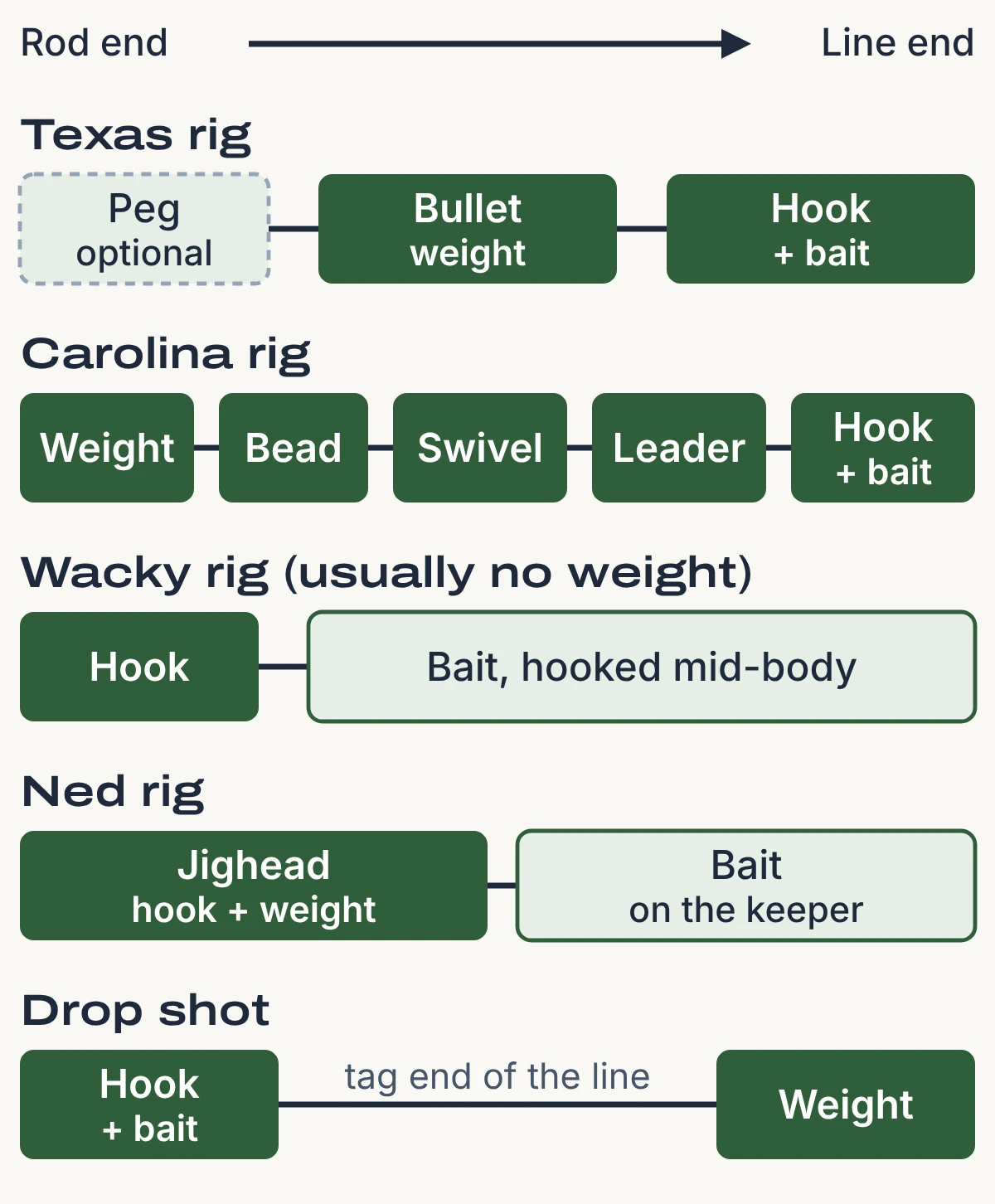
To rig a soft-plastic bass lure, slide the weight onto the line first on the sliding-weight rigs (Texas and Carolina), tie on the hook, then thread the plastic on so it hangs straight. A drop shot gets its weight last, on the tag end below the hook. The hook entry point differs by rig.
Field & Stream’s late fishing editor John Merwin wrote that “The four soft-bait rigs every bass angler needs are the Wacky Rig, Carolina Rig, Texas Rig, and Tube Rig.” Other sources add the Ned rig and the drop shot. This guide rigs five, with the weights and hook sizes each named source uses, and says where they disagree. Hard lures such as crankbaits and poppers are tied on rather than rigged, so they are not covered.
Related guide: How to Choose a Bass Lure: Water Temperature, Clarity, Light and Cover
Related guide: How to Rig a Fishing Rod: Bobber, Split-Shot, Sliding-Sinker and Surf Rigs
Related guide: How to Put a Worm on a Hook: Texas Rig, Wacky Rig and Live Worms
What you need
- A soft plastic. Outdoor Life’s Derek Horner names four to start with: “a stick bait, a ribbontail worm, a creature bait, or a crawfish imitator.”
- A hook that fits the rig. The sizes each source uses are in the table further down.
- A weight, or a jighead. A bullet weight for the Texas rig, an egg, bullet or barrel weight for the Carolina rig, a drop shot weight, or a Ned jighead that carries its own weight. The wacky rig usually has none.
- Carolina extras. A bead and a barrel swivel.
- Optional extras. A rubber peg (also called a bobber stopper) for the Texas rig, and an O-ring and its tool for the wacky rig.
- The knot: the Palomar. Double about 4 inches of line, pass the loop through the hook eye, tie a loose overhand knot, pass the loop over the hook, then hold the hook carefully, wet it and pull slowly. The U.S. Fish & Wildlife Service’s beginner pamphlet shows it with pictures (linked under Sources), and it is the knot Outdoor Life’s Texas-rig and drop-shot guides use.
Note
The U.S. Fish & Wildlife Service’s beginner pamphlet says: “Depending on your age and your state, you may need one to fish legally.” Check your state wildlife agency for the license and for rules on the weights you plan to use (see the lead note in the Texas steps).
Choose a rig by water and cover
| Rig | Where the weight sits | Where the hook goes | When the source suggests it |
|---|---|---|---|
| Texas | On the line above the hook, sliding (a peg is optional) | In the nose and out the underside, point buried | Horner: it “truly shines in and around underwater vegetation or in laydowns along the bank” |
| Carolina | On the main line above a bead and swivel, with a leader to the hook | In the nose, out the bottom, then back through the plastic | Baker: “works best in more than 10 feet of water after bass are done spawning” |
| Wacky | None in most cases | Across the middle of the bait | Baker: “better suited for shallow water when the fish are in a finicky mood” |
| Ned | In the mushroom jighead | Point through the nose and out the body, head pushed onto the keeper | Baker: “primarily meant to be fished in more than 10 feet of water” |
| Drop shot | At the end of the line, below the hook | Through the nose, point up | Horner: it “can be fished vertically, or cast out and slowly worked back” |
Rig a Texas rig
Horner says “The hardest part will be rigging your soft plastic straight and weedless on the hook.”
Pick a hook and a bullet weight
Horner suggests “Typically, a 2/0 or 3/0 EWG hook” and a lead or tungsten bullet weight “from ⅛-ounce to ½-ounce” (3.5 to 14 g). Merwin uses a 3/0 Gamakatsu offset-shank worm hook “for a typical 6- or 7-inch worm” (15 to 18 cm). Rules on lead weights are set by each state. For example, the Maine Department of Inland Fisheries and Wildlife says “It is unlawful to use, sell, or offer for sale lead sinkers and unpainted lead jigs measuring 2.5 inches or less in length or weighing one ounce or less.” The same page adds: “Effective September 1, 2026, the use of painted lead jigs measuring 2.5 inches or less in length or weighing 1 ounce or less will be prohibited.” Those are Maine’s rules; check your own state agency’s current rules before you buy lead weights or jigs.
Decide on a peg, and put it on first
A peg, or bobber stopper, is a small rubber stop that holds the weight against the bait. Horner says: “If you’re using a bobber stopper, thread that onto your line prior to adding the bullet weight.” He prefers the rig unpegged “to maximize the action of my soft plastic.” Tackle Warehouse says to add one for heavy cover.
Slide the bullet weight onto the line
Merwin’s order is “first put a conical worm weight on the line, then attach the hook.” Mister Twister, a soft-plastic maker, says “The bullet weight rests on the head” of the worm and “slides up the line to reduce weight when the worm is picked-up by a fish.”
Tie the hook to the line with a Palomar knot
Horner ties the Texas-rig hook with a Palomar. Hooks are sharp: the U.S. Fish & Wildlife Service’s beginner pamphlet says “Be careful when handling sharp hooks.” Trim the tag end.
Put the hook point into the nose and out the underside
Merwin threads the hook point “into the worm’s head and then through the worm’s underside.” Tackle Warehouse gives the distance: “bring the point back out about 1/4 of an inch on the underside of the lure” (6 mm).
Slide the bait up and turn the hook
Merwin: “Slide the worm up the hook shank so it just covers the hook eye. Rotate the hook until it faces upward toward the worm’s body.”
Bury the point
Merwin: “Grab the worm right behind the hook bend, push its body slightly forward, then bring it back down on the hook point until the point is almost but not quite all the way through the plastic. The bait should now lie straight.” With a straight-shank hook, Tackle Warehouse says to stop “just short of passing the hook point through the body.” Merwin says the rig “keeps the hook point nearly buried in the plastic, making it weedless.”
Rig a Carolina rig
Field & Stream’s Shaye Baker lists the parts as “a weight, a bead, a swivel, a leader, a hook, and a soft-plastic lure.” Wired2Fish gives the same order.
Slide the weight onto the main line
Baker says bullet, egg or barrel weights work, “as light as a 1/4-ounce if you’re fishing in 2 feet of water” (7 g in 0.6 m) and “as heavy as a full ounce in 25 feet or more” (28 g in 7.6 m). He adds: “If you can’t feel the bottom, go a little heavier; if you’re constantly getting hung up, go a little lighter.” Wired2Fish says “The most popular weight for a Carolina rig is 1/2 ounce to 3/4 ounce egg sinker” (14 to 21 g). The lead note above applies here too.
Slide a bead on below the weight
Baker says the bead “creates a little rattle as it bumps into the weight, and it protects the knot you’re about to tie.” Wired2Fish warns that tungsten weights “break the glass beads,” so tungsten needs a magnetic bead.
Tie the main line to one eye of a barrel swivel
Merwin calls for a “small barrel swivel.” Wired2Fish prefers “a little bit larger size,” a No. 10 up to a No. 6.
Tie the leader to the other eye of the swivel
Baker: monofilament or fluorocarbon, “typically 2 to 3 feet works best” (0.6 to 0.9 m). Merwin ties “about 18 inches of clear leader” (46 cm). Wired2Fish says a longer leader, especially in clear water, gives the bait more freedom.
Tie the hook to the end of the leader
Handle the point with care (“Be careful when handling sharp hooks,” per the U.S. Fish & Wildlife Service). Baker says offset worm hooks suit thin baits such as finesse worms and EWG hooks suit thicker grubs and creature baits.
Rig the bait on the hook
Baker: “Insert the hook point into the nose of the soft-plastic bait about 1/2 to 3/4 of an inch, then run the point out of the bottom. Bend the bait slightly, then run the hook back through the plastic so the bait lies straight.” (13 to 19 mm.) Merwin instead says to Texas-rig the worm and “leave the hook eye exposed,” where the Texas steps above slide the bait up to cover the eye.
Rig a wacky rig
Merwin: the wacky rig “hooks a soft plastic through the middle, leaving both ends free to wiggle with no added weight.”
Pick the bait and a wacky hook
Baker suggests a Neko or wacky hook, “1/0 is a good all-around size.” In 2016 Ehrler used a “1/0 Gamakatsu B10S Stinger hook” and a “standard 5-inch Yamamoto Senko” (13 cm).
Tie the hook to the line
Baker says to tie it “using your favorite knot.” Trim the tag end and keep your fingers clear of the point (“Be careful when handling sharp hooks,” U.S. Fish & Wildlife Service).
Find the balance point of the bait
Baker: “locate its center of gravity,” and “Typically, the bait will be a little heavier towards the head than the tail.” Ehrler puts the hook through a Senko’s “smooth area” located “about 1/3 of the way down.”
Run the hook through the bait
Baker runs the hook point “through the center of the bait, which will orient it perpendicular to the length of the worm.”
Test the fall
Baker: “toss your worm in the water. If your bait falls horizontally, you’ve rigged it well.” If one end falls faster, “slip the hook out of the bait and adjust it.”
Optionally use an O-ring
Baker rolls an O-ring onto the worm to its center of gravity and runs the hook through the ring, in line with the bait, still catching “a little of the material of the bait.” For a weighted version, Ehrler pushes “a 3/32 nail weight” (about 2.7 g if ounces) into the head and says “The important thing with a nail weight rig is to use an O-ring on the Senko.”
Rig a Ned rig
Baker describes it as “a 2- to 3-inch-long soft-plastic stick bait threaded on a flat or mushroom jig head with an exposed hook.” Baker’s steps, with the tie-on added as step 3:
Choose the jighead
Baker: “Select either a weedless Ned head or one with an exposed hook.” Z-Man, which makes the Finesse ShroomZ jighead, lists it in “1/20 oz” through “1/5 oz” weights (1.4 to 5.7 g; also 1/15, 1/10 and 1/6) with “custom light wire size 1 and 2 hooks.” Ned jigheads are lead jigs, so the lead note in the Texas steps applies; check your state’s rules before you buy. Tackle Warehouse says “Typically anywhere between a 1/16 to 1/8oz jig head.”
Choose a short stick bait
Baker says there are “hundreds of options” and the classic is a bait that “looks like the tail end of a normal soft plastic stick bait.”
Tie the jighead to the line
Use your usual knot and trim the tag end; the hook is exposed on this rig, so keep fingers clear (“Be careful when handling sharp hooks,” U.S. Fish & Wildlife Service).
Hold the bait beside the hook
Baker: “Place the soft-plastic bait beside the hook to gauge where the point should come out.” The bait should stand up with “the hook bend and point exposed.”
Thread the bait on
Baker: “Run the hook point through the center of the nose of the soft-plastic body. Then slide the bait onto the hook until you reach the predetermined extrusion spot in the midsection.” Then “Push the hook point back out of the bait. Then push the head of the bait up onto the bait keeper.”
Check that it is straight
If it is not, Baker says to “start over by removing the bait” and thread it again. Tackle Warehouse says a twisted bait “has a greater tendency to spiral on the fall and introduce twist into your line.” Z-Man says its welded keeper holds ElaZtech baits “securely without the need for gluing.”
Rig a drop shot
Mister Twister, a soft-plastic maker, says to “attach your hook to your line with a Palomar knot leaving an extra long tag end to attach a drop shot weight.”
Pick the hook and weight
In a 2015 Bassmaster report, pro Brandon Palaniuk used “a No. 1 VMC drop shot hook and a 3/8ths-ounce Eco Pro tungsten weight” (10.6 g). In 2017 Kevin VanDam wrote: “use enough to gain good tension but not so much it hangs up in cover.” Horner says “most anglers choose light wire circle-style hooks.” The lead-weight note in the Texas steps applies to lead drop shot weights too.
Tie the hook on, leaving a long tag end
Horner: “Thread your hook 8 to 12 inches above the bottom of your fluorocarbon leader, then using a Palomar knot, tie on the hook.” (The bottom is the end of your line, or of the fluorocarbon leader if you fish braid.) Handle the hook point with care (“Be careful when handling sharp hooks,” U.S. Fish & Wildlife Service).
Pass the tag end back through the eye
Horner: “thread the end of the leader back through the eye of the hook (top to bottom) before putting on the weight. This will keep the hook straight up and down.”
Attach the weight to the end of the tag
Horner: “Using the line clip, or a simple clinch knot, attach your drop shot weight to the bottom of the line.” Sources set the distance from hook to weight differently: Horner and Palaniuk say about 8 to 12 inches (20 to 30 cm) and 10 to 12 inches (25 to 30 cm), Ehrler uses a 14-inch (36 cm) leader with a wacky-rigged Senko, and VanDam gives an 18-inch (46 cm) leader as an example.
Hook the bait through the nose
Horner: “Nose hook your soft plastic lure.” Palaniuk goes from the bottom of the lure and out the nose rather than the top, because “when a lure is nose-hooked the usual way, it can pivot and spin around the hook bend.” VanDam says he prefers to nose hook with a drop-shot hook, but it “can be deadly by wacky rigging it in the middle of the bait.”
Troubleshooting a rig
| Problem | What a source suggests | Source |
|---|---|---|
| Plastic is bent or twisted on the hook | Remove it and rig it again until it lies straight | Merwin, Baker |
| Wacky bait falls with one end first | Slip the hook out and move it toward the middle | Baker |
| Drop shot bait spins on the hook | Hook it out of the nose, not the top | Palaniuk |
| Drop shot line twists | Add a barrel swivel “about 2 or 3 feet between the main line and the leader” | VanDam |
Ready to buy?
Our roundup of the best bass lures for winter includes a Ned-rig craw and a drop-shot worm among its picks. For the rod that goes with finesse rigs, see our spinning rods for bass roundup, and for Texas and Carolina rigs our baitcasting rods for bass roundup. Browse more skills and how-to guides.
Frequently Asked Questions
Q. What is a good bass rig for beginners?
Horner calls the Texas rig “a go-to for beginner anglers.” Baker says the wacky rig is “simple enough for the beginner to pick up” and calls the Ned rig “an excellent choice for beginners.”
Q. Do you use swivels with lures?
Of the rigs here, only the Carolina rig needs one: Baker ties the main line to a swivel and the leader to its other end. VanDam also adds a barrel swivel on drop shot line to reduce twist. These sources do not cover swivels on hard lures.
Q. What hook size should I use for a Texas rig?
Horner typically uses a 2/0 or 3/0 EWG hook. Merwin uses a 3/0 offset-shank worm hook for a 6- or 7-inch worm.
Q. Does the rig change if I fish from the bank?
These sources choose rigs by water depth, cover and how the fish are feeding. Baker’s wacky-rig guide covers working the bait back “to the bank if you’re fishing from shore.”
Sources (16)
- Field & Stream, John Merwin, “The Only 4 Bass Fishing Rigs You Need to Know”
- Field & Stream, Shaye Baker, “Carolina Rig Fishing for Bass: How to Land More Lunkers”
- Field & Stream, Shaye Baker, “How to Fish a Wacky Rig: A Beginner’s Guide”
- Field & Stream, Shaye Baker, “Ned Rig Fishing for Bass: A Complete Guide”
- Outdoor Life, Derek Horner, “How to Fish a Texas Rig”
- Outdoor Life, Derek Horner, “How to Fish a Drop Shot Rig”
- Bassmaster, 2016, “Brent Ehrler’s 5 favorite Senko rigs”
- Bassmaster, 2015, Steve Wright, “Drop shot tips from the pros”
- Bassmaster, 2017, Kevin VanDam, “Rigging considerations for drop shotting”
- Wired2Fish, “The Carolina Rig | How to Rig and Fish”
- Tackle Warehouse (retailer), “How-To Rig a Texas Rig”
- Tackle Warehouse (retailer), Ned rig gear guide
- Z-Man Fishing Products (maker), Finesse ShroomZ jigheads
- Mister Twister (maker), “Rigging Soft Plastic Lures”
- U.S. Fish & Wildlife Service, “Fishing Is Fun for Everyone” pamphlet (PDF)
- Maine Department of Inland Fisheries and Wildlife, General Fishing Laws and Definitions