The short answer
With the reel on and the line threaded, tie one of four rigs on. A bobber rig hangs bait off the bottom for panfish and pond trout. A split-shot rig drifts bait low in slow or moving water. A sliding-sinker rig sits bait on the bottom for catfish. A fish-finder rig does it on the beach.
Rigging means choosing what goes on the line below the rod tip, and in what order. The Missouri Department of Conservation puts the choice simply: “How you rig depends partly on the kind of fish you hope to catch.”
This guide covers the terminal rig only, so mount the reel and thread the line through every guide first. The order of parts on each rig below comes from one named source per rig, with a second source named where one exists.
Pick the rig for the fish and the water
| Rig | Fish it suits | Where the bait rides | Order from the rod |
|---|---|---|---|
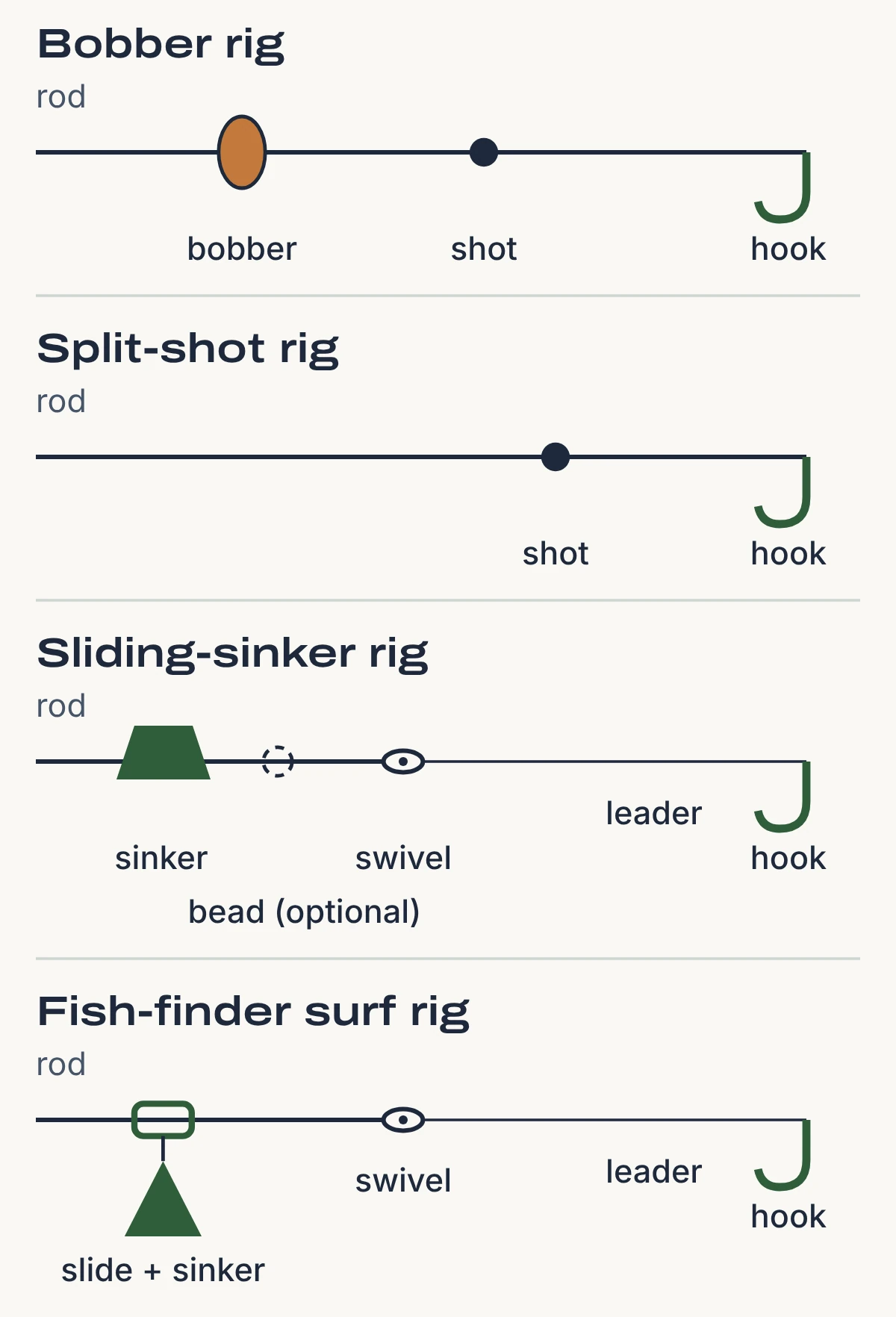
| Bobber | Panfish, pond trout | Hangs off the bottom | Bobber, shot, hook |
| Split shot | Trout, panfish | Low, slow or moving water | Shot, hook |
| Sliding sinker | Catfish, walleye | On the bottom | Sinker, swivel, leader, hook |
| Fish-finder | Striped bass, redfish | On the bottom | Slide, swivel, leader, hook |
Fish and water come from the sources named in each section below. A bead is optional on the sliding-sinker rig. The fish-finder row is the surf rig.
If you are still choosing a rod, our roundup of spinning rods under $100 compares eight. Reel size matters for the line you rig, which our spinning reel size guide covers. These rigs also take artificial lures on the hook end; our guide to the types of fishing lures explains what each one does.
What you need
- A rod with the reel mounted and the line threaded through every guide.
- A fishing license, if your state requires one. The US Fish and Wildlife Service says: “First, you’ll need a fishing license.” It adds: “Every state has slightly different rules, so look up your state for state-specific requirements.”
- Hooks, sized for the fish.
- Split shot and pliers. Some states ban small lead sinkers; the lead note in the split-shot steps explains.
- A bobber, for the bobber rig.
- Sliding sinkers, such as egg or bank sinkers, and barrel swivels. Check the lead note in the split-shot steps first.
- Leader line and small plastic beads.
- For the surf rig: a sinker slide clip and a pyramid or bank sinker.
The order on the line
Bobber rig: panfish and pond trout
Vermont Fish & Wildlife, a state agency, says “the basic bobber rig may be the most widely used rig in all of fishing”. It lists the primary setup as “a properly selected hook tied to the end of the fishing line”, split shot “pinched on the line about 6 to 12 inches above the hook”, and a fixed or sliding bobber “several feet above the hook”. Missouri’s agency notes that panfish “often swim a few feet beneath the surface, and a bobber will hold your bait up where the fish can see it.” Maryland’s Department of Natural Resources says that in a stocked pond you can fish “with your bait several feet below the bobber”.
Tie the hook to the end of the line
Maryland DNR ties its trout hook on with “an improved clinch knot”. Seat the hook point in a rod eyelet or hook keeper as soon as it is on; the carry step below gives South Dakota’s rule.
Pinch split shot 6 to 12 inches above the hook
Texas Parks and Wildlife warns: “Don’t pinch the weight too tightly. Pinching too tightly may weaken the line.” Squeeze it just enough to hold. If the shot is lead, read the lead-sinker rule in the split-shot steps first.
Attach the bobber several feet above the hook
Set the distance to the depth you want the bait to hang. Vermont says the rig “is typically arranged so that the bait suspends off the bottom”. Our guide to putting a bobber on a fishing line has the clip-on and slip-bobber steps, so they are not repeated here.
Bait up and cast
Vermont’s advice: “cast the rig out and let it sit until the bobber indicates a biting fish.”
Split-shot rig: trout and panfish in slow or moving water
Vermont calls split shot “an extremely versatile rig for catching everything from trout and bass to walleyes, panfish and even catfish”. There is no bobber and no swivel: just a hook with weight pinched above it.
Tie the hook to the end of the line
Maryland DNR suggests “a number 8 or 10 short shank bait hook” for recently stocked trout. Keep the point seated in the hook keeper when you stop.
Pinch split shot on above the hook
Vermont places it 8 to 18 inches up the main line. Maryland puts a small shot “about 2 feet above the hook” for stocked trout, so the two agencies differ. Treat either as a starting point and adjust. Texas Parks and Wildlife warns: “Don’t pinch the weight too tightly. Pinching too tightly may weaken the line.” Lead shot is banned in some states. Vermont law says: “A person shall not use a lead sinker for taking of fish in any State waters.” It defines a sinker as “any device that weighs one-half ounce or less and is attached to a fishing line”, which covers ordinary split shot. Outdoor Life lists lead substitutes “made of steel, tin, tungsten, and alloys”. Check your own state’s fishing regulations before you buy shot or sinkers.
Add just enough shot for the depth and feel
Vermont says: “Add just enough split-shot to control the desired depth and feel.” In a stream or river, Vermont says to “add just enough weight to occasionally make bottom contact”; too much weight keeps the rig hanging up.
Cast and keep the line tight
For stocked trout, Maryland says to look for “pools and slow moving water” and to “keep a tight line as your rig moves in the current.”
Sliding-sinker rig: catfish and bottom feeders
The sliding-sinker rig lets a fish take the bait without pulling against the weight. Vermont says it suits “primarily walleye, catfish, and trout”. Missouri’s agency adds: “Catfish usually search for food near the bottom, so you need weight to keep your bait near the fish.” Zebco, a rod and reel maker, calls it “the most reliable all-around catfish setup”.
Outdoor Life, a publication, in a guide by Bob McNally, lays out the parts. Vermont’s sliding-sinker page, and the Carolina rig that Texas Parks and Wildlife describes for soft plastics, list the same order without the bead.
Thread the sinker onto the main line first
Vermont describes a weight “threaded on to the main fishing line before the line is tied to one end of a barrel swivel”. Pick a weight that matches the depth and the bottom. For catfish, Zebco says: “In still water, one to two ounces holds bottom without over-anchoring the bait. In strong current, go heavier”, and it starts with “a two-ounce egg sinker”. Texas Parks and Wildlife’s half-ounce start is for bass soft plastics. A lead sinker of one-half ounce or less falls under the Vermont rule in the split-shot steps, so check your state’s rules. Outdoor Life says barrel and egg sinkers should have “just enough weight to get to the bottom”.
Slide on a bead, if you use one
Outdoor Life says “Often a plastic bead is fitted on the line between the weight and swivel to prevent the sinker from fraying a knot during fishing.” Vermont’s page and Texas’s Carolina rig leave the bead out.
Tie the main line to one eye of a barrel swivel
Tie the leader to the other eye
Zebco says: “Thread a sliding egg sinker onto your main line, tie on a swivel, then add a 12 to 18 inch leader to your hook.”
Tie the hook on the leader and bait it
Zebco says “A 4/0 to 7/0 circle hook covers most situations” for catfish. Seat the hook point in the hook keeper when you stop.
The Carolina rig is a close cousin. Zebco describes it as “a variation of the slip sinker that adds a bead between the sinker and swivel to protect the knot”, and Outdoor Life calls the sliding sinker “in essence, a deadly and simple fish-finder or Carolina rig”. Texas Parks and Wildlife says the Carolina rig “is generally more effective in deeper water and is a good setup for novice anglers” fishing soft plastics for bass.
Fish-finder rig: surf fishing
Wired2Fish, a fishing publication, describes the fish-finder slide rig in a guide by Nick Honachefsky, whom the site names as host of Saltwater Underground. He says: “the slide function of the rig allows a fish to pick up the bait and run freely without any resistance from the sinker.” He names striped bass and redfish as “more wary fish” it suits, and pompano and whiting in the southern states with “shrimp, clams or sandfleas”. This is one writer’s build. Sizes below are his.
Slide a sinker slide clip onto the running line
He builds the rig with “a braid-resistant size #6 duolock sinker slide clip on the running line”. With braided line he uses a heavy-duty slide, because “the braid will rip through most flimsy plastic black slides.”
Clip on a bank or pyramid sinker
He pairs the slide with “a 2- to 8-ounce bank or pyramid sinker”. The sinker is clipped to the slide clip.
Tie on a barrel swivel
His build uses “a 75-pound barrel swivel”.
Tie the leader to the swivel
His leader is “a 20- to 28-inch piece of 20- to 40-pound fluorocarbon”. He says: “Make sure the leader is at least a foot long”, but not so long that you cannot make a solid cast.
Tie the hook on the leader
His build lists a “size 2/0 to 8/0 octopus hook”. For smaller fish such as whiting and pompano he says to “scale down to size #8 to 2/0” baitholder hooks.
Cast and set the rod in a sand spike
He says to “put your rod in a sand spike with your drag set appropriately”, and to grab the rod and set the hook when the tip bounces. Expect shorter casts: the rig “tends to helicopter a little bit during the cast”.
Note
Wired2Fish’s article lists no bead on this rig, and Outdoor Life’s sliding-sinker rig often has one. Both are one writer’s build, so follow the one you start with part for part.
Carry, cast and set the hook
Keep the hook in a rod eyelet or keeper when you walk
South Dakota Game, Fish & Parks says: “Always have the hook attached to an eyelet when carrying the pole to a new place.” The same sheet says to “Carry the pole pointing straight up”.
Check around you, then cast
South Dakota Game, Fish & Parks’ safety rules say to keep a “Circle of Safety” where “no one should be around you when you cast”, and: “Always wear eye protection (sunglasses). Wear a hat.” The same sheet tells leaders to remind kids that “no one should be within a 2 rods of them”
Set the hook the way the rig tells you
On a bobber rig, Vermont says to let the rig sit “until the bobber indicates a biting fish”. On a catfish rig with a circle hook, Zebco says to “just reel down and apply steady pressure”. On the surf rig, grab the rod when the tip bounces. With live bait, Vermont says to cut the chance of a swallowed hook by “continuously watching the line and setting the hook as soon as possible”.
Land the fish and release it with care
Vermont says: “Land a fish as quickly as possible.” It says to keep the fish in the water as much as possible while unhooking it, and: “Never rip the hook out of a fish.” For its hook-shake method, you “grasp the hook shank with fingers or pliers. Lift the fish and rotate the hook shank down and shake gently, allowing the fish to slide off the hook.” If a fish is hooked in the gills, throat or stomach, Vermont says to “cut the line close to the hook and leave the hook in the fish”. Vermont also says “Using barbless hooks increases fish survival, particularly when fishing with bait. Pinch barbs flat with pliers.”
Mistakes that cost you bites
- Too much weight in current. Vermont warns that too much weight keeps the rig hanging up on the bottom.
- Too tight a pinch on the split shot. Texas Parks and Wildlife says this “may weaken the line”.
- A line that pulls back on a catfish. Zebco says a rig that pulls back when a catfish mouths the bait “will cause it to drop it before you ever feel the bite”.
- Braid through a flimsy slide. Wired2Fish’s Nick Honachefsky says braid can rip through a plastic slide.
Frequently Asked Questions
Q. How do I rig a fishing rod for beginners?
Start with a bobber rig or a split-shot rig. Vermont calls the basic bobber rig one that is “frequently used by novice anglers due to its ease of use”. Mount the reel and thread the line first, then tie on the hook and add the shot and bobber.
Q. What goes first, the hook or the weight?
It depends on the rig. On a bobber or split-shot rig, the hook is at the end of the line and the shot sits above it. On a sliding-sinker rig, the sinker goes onto the line before the swivel, and the hook comes last on the leader.
Q. How do I rig a fishing rod for bass?
Outdoor Life says “Walleye and smallmouth bass anglers commonly use such rigs” for working live bait along the bottom. Texas Parks and Wildlife calls its soft-plastic Carolina rig “a good setup for novice anglers”. Vermont says a bobber rig suits all species. Our bass fishing tips for beginners cover gear, rigs and a first day.
Q. How do I rig a fishing rod for trout?
Use a hook and split shot for recently stocked trout, which is what Maryland DNR recommends. In a stocked pond, add a bobber with the bait several feet below it.
Q. How do I rig a fishing rod for catfish?
Use a sliding-sinker rig. Zebco suggests a 12 to 18 inch leader and a circle hook, and Missouri says catfish feed near the bottom.
Q. How do I rig a surf fishing rod?
Use a fish-finder rig: slide clip with a bank or pyramid sinker, barrel swivel, fluorocarbon leader and hook, as Wired2Fish’s Nick Honachefsky builds it.
Ready to buy?
Our best spinning rods under $100 roundup compares eight rods that suit these rigs.
Sources (13)
- Vermont Fish & Wildlife, Mid-Depth Lures and Rigs: Basic Bobber Rig
- Vermont Fish & Wildlife, Bottom Lures: Split-Shot Rig
- Vermont Fish & Wildlife, Bottom Lures: Sliding Sinker Rig
- Vermont Fish & Wildlife, Releasing Your Catch
- Texas Parks and Wildlife, Rigging Up, Not Wigging Out (Texas Fishing 2013)
- Missouri Department of Conservation, Rigging Your Pole
- Maryland DNR, The ABCs of Trout Fishing
- Outdoor Life, The Complete Guide To Using Fishing Sinkers
- Zebco, How to Rig For Catfish
- Wired2Fish, How to Fish and Tie the Fish Finder Rig
- South Dakota Game, Fish & Parks, Fishing Fun
- Vermont Statutes, 10 V.S.A. § 4606 (lead sinkers)
- US Fish and Wildlife Service, Purchase a Fishing License