The short answer
The fly line’s weight, not the fly’s, loads a fly rod, so match line weight to rod. With the fly on the water, keep a hand on the line, mend or strip, lift to set the hook on small dry flies and nymphs, strip-set on big streamers, and land fish quickly.
Much of the skill in fly fishing comes after the cast: controlling the line, feeling the take, setting the hook and bringing the fish in. This guide starts where the fly lands. If you are weighing fly gear against spinning gear, our fishing gear hub has the rest of our fishing coverage.
What you need
- A fly rod, reel and line that are already set up. Rod, reel, line, leader and fly all have to be rigged before the steps below make sense. Setting the outfit up is a separate job.
- Eye protection. Orvis News lists “Eye protection” as one of the jobs of fly-fishing sunglasses, and a guide writing for Gink and Gasoline wears them “to protect my eyes from projectiles of the fly kind.”
- A landing net. The Missouri Department of Conservation (MDC), in a 2002 Missouri Conservationist magazine article, lists a “Small landing net” among its useful items for a new fly angler, and the National Park Service (NPS) says “Landing nets with small, soft, or knotless mesh are best.”
- A hook remover. MDC’s list includes a “Hemostat to remove hooks from fish.” NPS says “Needle-nosed pliers or hemostats are an essential tool for quick and efficient hook removal.”
- A fishing license, before you go to the water. Check your state’s wildlife agency for license rules. Washington’s wildlife department says “All fishers age 16 and older need a fishing license,” and Florida’s says “If you cast a line or catch and release, you need a fishing license.” Those are two states’ rules, not a national one, and ages vary by state.
Safety
The fly is a hook, and a hook set can fling it back toward you. For a hook in the eye, MedlinePlus (National Library of Medicine) says: “Leave the object in place. Do not try to remove the object. Do not touch it or apply any pressure to it.” and “Get medical help right away. Do not delay.” NPS lists “Don’t get hooked, prevent and treat fishing hook related injuries” among its fishing safety tips.
How a fly rod works
On a spinning rod, the lure has the weight. On a fly rod, the line does. Orvis puts it this way: “In fly fishing, the weight of the tapered fly line and leader is what propels the weightless fly to its target.” Orvis adds that “you can’t cast a fly with a spin fishing set up, and you can’t cast a lure with a fly fishing set up.” If you would rather start with a spinning outfit, our roundup of spinning rods under $100, our trout spinning rods and our beginner rod-and-reel combos cover that route.
Related guide: Which Fly Rod Weight Should a Beginner Start With?
Related guide: What Is a Light Spinning Rod and What Is It Good For?
The line’s weight loads the rod
Fly lines are sized by weight. MDC explains: “The weight, in grains, of the first 30 feet of a fly line designates its size.” Its example is a 5-weight line, whose “first 30-feet of this line weighs 140 grains, plus or minus 6 grains.” MDC says experienced anglers choose a rod by its rated line weight, its action and its length, and that a medium rod will load “(flex the rod) with its matched line at short to medium ranges.” A weight-forward line puts the weight at the front: “The weight that loads the rod and drives the line forward is up front, while the running portion trails behind,” MDC says.
Related guide: What Is a Medium-Light Rod and What Is It Good For?
In plain terms, a rod rated for a 5-weight line is built to flex under about that much line, so check the weight your rod is rated for against the weight of the line on your reel. Makers can differ, so follow the rod maker’s line-weight rating.
Action: where and how much the rod bends
Action describes how the rod flexes. MDC says “As rods progress from the most flexible to the fastest, they become stiffer,” and advises that “A new fly caster should look for a rod in the medium range.” Redington, a fly-rod maker, describes three actions in its “Fly Rod Basics” post:
| Action | What Redington says | Where it helps |
|---|---|---|
| Slow | “Slower action rod will flex deeper in the blank, which allows for easier loading of the rod and protection of lighter tippet.” | Easier loading, light tippet |
| Moderate | “These rods tend to be easier to load than faster rods, but have enough blank recovery to generate line speed.” | A wide range of flies; the maker says they “will struggle” with larger flies, and the load is harder to feel on short casts |
| Fast | “Fast action rods are for those needing to generate high line speed for those longer casts or turnover flies in tougher conditions.” | Distance, tougher conditions; the maker warns they “can amplify casting errors for some anglers” |
How to work a fly rod once the fly is on the water
The steps below follow the sequence of a drift or retrieve, from the moment the fly lands to the moment the fish swims off. Each one names its source.
Stand where you can fish and land a fish safely
Pick your spot before the fly is out. If it means wading, NPS lists these among its fishing safety tips: “Be aware of unseen water hazards – use caution when walking or wading in the water,” “Assess swift water before entering or crossing,” and “Check the water temperature; get out of the water if you get cold.” NPS also says “Always wear your U.S. Coast Guard approved life jacket when you are on, in, or near the water.”
Get into ready position
Fix.com’s blog, written by Charlie Robinton, whose author profile calls him “a custom fly tyer, fly fishing instructor, and writer,” defines ready position: “Ready position is simply pulling the slack out of the line after a cast and pinching the line against the cork grip and your index finger on your rod hand.” In that position you are ready to set the hook when you detect a strike. Hatch Magazine’s George Daniel, who writes about guiding clients and teaching “my Penn State fly fishing students,” puts the reason bluntly: “Slack is a killer for any good hook set.”
Choose the job for the fly: mend it or strip it
Orvis says that unless you are swinging wet flies or stripping streamers, you should aim for a drag-free presentation with nymphs and dry flies. For those flies you mend (step 4). For streamers and other flies you animate, you strip (step 5).
For a drifting fly, mend the line
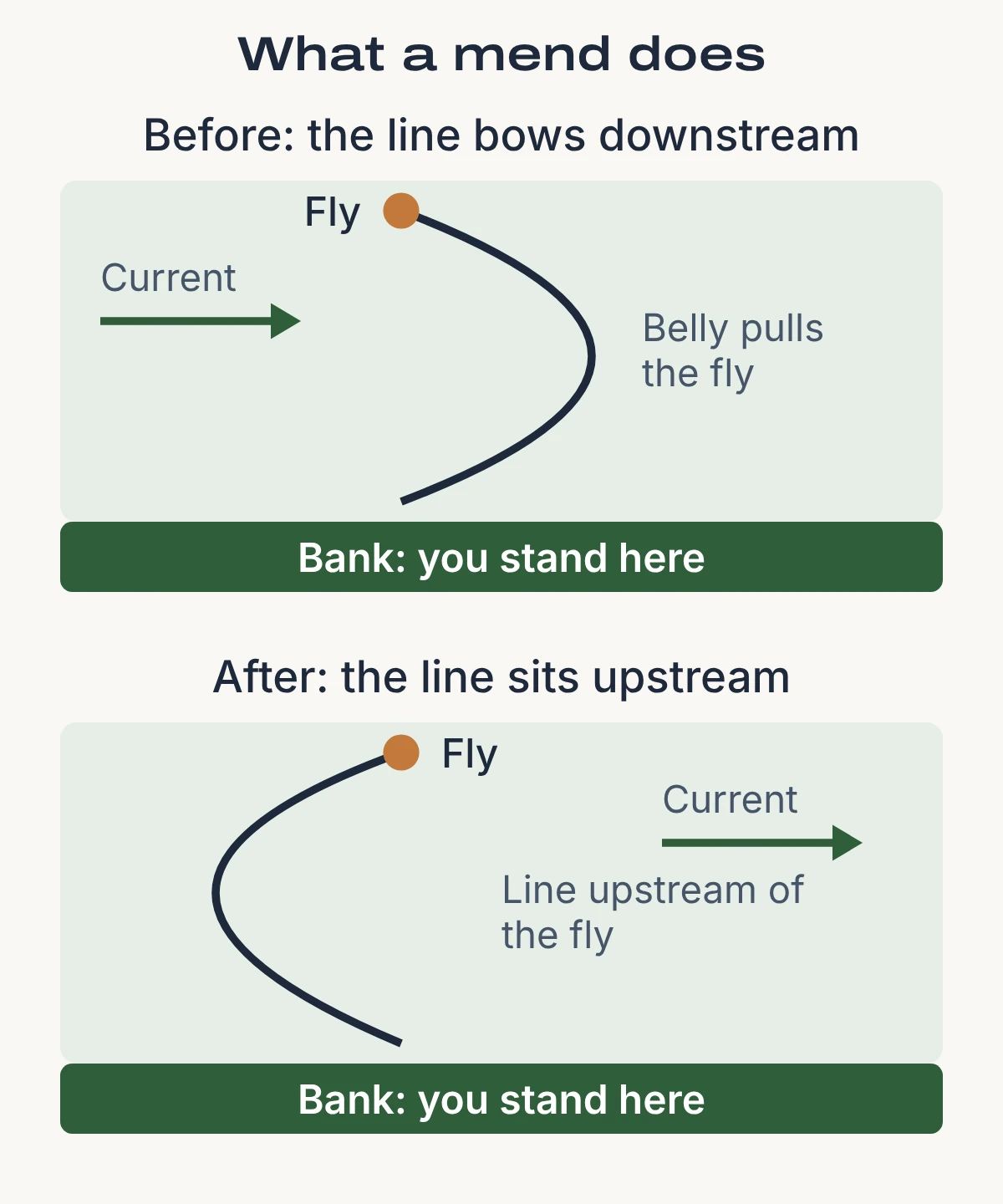
In an Orvis Learning Center video, Tom Rosenbauer explains that “A mend is merely flipping your line upstream or downstream with the tip of your rod,” and that “The object here is to keep your fly line either upstream or even with your fly.” Orvis’s drag page says that “When presenting flies downstream to fish, always mend your line upstream” and that “When you are fishing for trout, almost all your fly casts should be immediately followed by a mend in the line to prevent drag.” MidCurrent’s mending primer adds three details: mend soon after landing, “before the line has time to bond to the water”; begin “with your rod tip close to the surface of the water”; and “Mend with authority. A half-hearted mend rarely moves enough line.” Rosenbauer says you may need more than one: “If you see a belly of line starting to bow downstream, then just make another quick mend.”
For a fly you animate, strip it with the line hand
Outdoor Canada’s Scott Gardner gives the basics: “continue holding the rod in your casting hand and run the line over your index finger. Use your other hand to grasp the line near the rod handle, and retrieve the fly by tugging line over the index finger of your casting hand.” He says there are three things to vary: “the length of the pull (long or short), the speed of the pull and the pace of the pulls.” Gardner’s warning for anglers coming from other tackle is not to twitch the rod tip: it “puts slack in the fly line and typically leaves the rod in a poor position to set the hook.” Hatch’s Ben Kryzinski, who says he has been “on the business end of a fly rod for some four decades,” writes that trout often hit between strips, when only a pinch of the rod hand holds the line, which “makes a strip-set impossible.” A guide told him to do “a strip-and-pause move, and do it three times in a row, all while keeping your left hand on the line.”
Set the hook with the right set for the fly
The two sets are in the table below. Wear your eye protection: the fly is a hook, and a set that misses can send it back toward you.
Play the fish with steady pressure
Fix.com’s post advises “Practice keeping the line tight at all times” and “If the fish swims straight at you, strip by hand or reel to recover the line quickly.” Robinton notes that fly fishers “often use small, barbless hooks,” so with slack in the line “the fish can easily shake the hook.” Both sources say not to keep the rod tip high. Robinton says “A high rod tip puts very little pressure on the fish” and that fighting “with the rod at a 45-degree angle or less will help you land more fish.” Kirk Deeter, writing in Trout Unlimited’s Trout Talk, notes that anglers are often told “keep that tip up!” and says “Side-pressure the fish and fight with the line, not just the tip of the rod,” and “Fact: the faster you land a fish, the better the odds of survival.” Low and sideways are compatible: both aim at a quicker landing.
Land the fish in the net, in water that is safe to stand in
Murray’s Fly Shop, a fly shop, says for a large trout: “As quickly as possible get downstream of the trout so he has to fight the force of the current as well as the pressure from the rod” (if you can move there safely), and to hold the net “tilted back about 30 degrees from perpendicular.” Fix.com’s post says “bring it in close and raise the rod to lift its head out of the water” once it tires. Deeter adds: “When the fish breaks the surface with its head, it loses leverage.” If the net or the fish is in moving water, re-read NPS’s line: “Assess swift water before entering or crossing.” Net the fish from where you are standing safely.
Unhook and release the fish if you are not keeping it
NPS’s catch-and-release page, compiled from sources that include Trout Unlimited, says “Avoid playing fish to exhaustion,” “Use a landing net,” “Keep your fish in deep water until it is netted or released,” and “Use wet hands or wet gloves.” NPS’s heading for reviving is “Avoid early release. Hold until revived”: “Revive your fish by holding it upright underwater,” then “Orient into the current, but avoid too fast or turbulent areas,” and “Hold the fish until it swims forcefully away on its own.” For a deeply hooked fish NPS says “If necessary, leave the hook!” If you are keeping the fish, check your state’s size and bag limits with its wildlife agency. NPS also says “Avoid removal from water,” and for a photo, “Keep your fish wet and calm until you are ready for the photograph.”
Which hook set to use
MidCurrent’s Q&A says a trout set, “also known as” raising the rod, “is the traditional method for setting the hook when fly fishing for trout.” A strip set means “using your line hand to pull the fly line sharply.”
| Situation | Set | How (source) |
|---|---|---|
| Dry flies and nymphs on small hooks, trout or panfish | Trout set | Keep the line tight, rod tip down, then lift the tip “up and back” (MidCurrent). Daniel: enough for “most dry fly and nymph hooks.” |
| Streamers; for trout on streamers or wet flies, a shorter, quicker strip | Strip set | Rod tip “pointed directly at the fly” with “minimal bend” (MidCurrent). For trout, MidCurrent says “a modified strip set with a shorter, quicker pull may be more effective than a full trout set” |
| Big bass, pike, saltwater fish | Strip set | MidCurrent: “Big bass, pike, and saltwater fish require a strip set for solid hookups.” |
| A fly drifting below you in the current | Sideways sweep | Fix.com: “setting the hook directly upward can often pull the fly away from the fish. Instead, sweep the rod sideways toward the bank in a downstream direction.” |
MidCurrent: “When you feel or see a strike, quickly lift your rod tip up and back.” For a strip set, Daniel says “streamer hooks are thicker and will require more hook set force, which is the reason using a strip set (i.e. pulling straight on the line with the line hand) is usually a better tactic for burying a hook into a fish.” And for the trout set he says it “is all that is needed when fishing most dry fly and nymph hooks.”
MidCurrent says the trout set suits “lighter tippets that could break under aggressive strip sets,” so on light trout tippet keep a strip set short.
Hook size is the rule of thumb. MidCurrent says smaller hooks, “such as those commonly used for dry flies and nymphs (sizes 12-20),” usually call for a trout set. For “larger hooks, such as those found on streamers and saltwater flies (sizes 2-4/0),” it says a strip set is more appropriate. It also says a combination can help: “Sometimes a combination of a trout set followed by a strip set can help ensure a solid hook up.”
Mistakes and fixes
| What goes wrong | Why, according to the source | Fix |
|---|---|---|
| The fly skates or leaves a wake | Orvis: the line makes “a belly, pulls tight” and the fly “will create a wake” | Mend upstream right after the cast |
| Missed strikes on a streamer | Gardner: twitching the rod tip adds slack and leaves the rod “in a poor position” | Strip with the line hand, tip at the fly |
| Fish hit between strips | Kryzinski: the strip hand is off the line | Strip-and-pause with the hand still on the line |
| Lifting the rod on a streamer take | Daniel: the word “set” makes anglers lift | Say “keep stripping” and strip-set (short and quick on light trout tippet) |
| Fish shakes the hook during the fight | Robinton: slack in the line | Keep the line tight; strip or reel to take up slack |
| Fish is tired and handled too long | NPS: “Long struggles may significantly increase mortality rate” (a rod, reel and line “of sufficient strength to quickly land the fish”) | Use a rod, reel and line strong enough to land it quickly, as NPS advises |
Frequently Asked Questions
Q. How is using a fly rod different from using a spinning rod?
The line is the weight you cast. Orvis says “the weight of the tapered fly line and leader is what propels the weightless fly,” while a spinning outfit casts the lure. A fly angler also works the line by hand, with mends and strips.
Q. Is a fast-action fly rod better?
Not for every angler. Redington says fast rods suit longer casts and tougher conditions but “can amplify casting errors for some anglers,” and MDC advises a new caster to look at the medium range.
Q. Do I lift the rod or strip when a fish takes the fly?
It depends on the fly. MidCurrent says to lift (trout set) for dry flies and nymphs on small hooks, and strip-set for streamers, larger hooks and fish with hard mouths such as pike and saltwater species. For trout on streamers, it says “a modified strip set with a shorter, quicker pull may be more effective.”
Q. How do I handle a fish I plan to release?
Follow NPS: “Use wet hands or wet gloves,” “Revive your fish by holding it upright underwater,” “Orient into the current, but avoid too fast or turbulent areas,” and “Hold the fish until it swims forcefully away on its own.” For a photo, NPS says to “Crouch down near the water surface to avoid lifting the fish far from the water.”
Q. Should I keep the rod tip high while playing a fish?
No. Fix.com’s Robinton says “A high rod tip puts very little pressure on the fish” and to fight “with the rod at a 45-degree angle or less”; Trout Unlimited’s Deeter says “Side-pressure the fish and fight with the line, not just the tip of the rod.”
Sources (18)
- Orvis, How Does Fly Fishing Differ From Spin Fishing?
- Orvis, What Is Drag & Why Is It Bad?
- Orvis Fly Fishing Learning Center, How to Mend Your Line
- Missouri Conservationist (Missouri Department of Conservation), An Introduction to Fly Fishing, 2002
- Redington (Far Bank), In the Loop – Fly Rod Basics
- MidCurrent, Ask MidCurrent: Trout Setting Vs. Strip Setting
- MidCurrent, A Mending Primer
- Hatch Magazine, Sealing the deal: 5 tips for better hook sets
- Hatch Magazine, How to be a better stripper
- Outdoor Canada, Why seductive strippers make the best fly anglers
- Fix.com blog, How to Land More Fish With a Fly Rod
- Trout Unlimited, Trout Talk by Kirk Deeter
- Murray’s Fly Shop, How To Land That Large Trout Part 1
- National Park Service, Important Elements of Catch and Release Fishing
- National Park Service, Reel It In: Be Prepared for a Successful Fishing Day
- MedlinePlus, Eye – foreign object in
- Washington Department of Fish and Wildlife, Fishing licenses
- Florida Fish and Wildlife Conservation Commission, Do I need a license?