The short answer
Size a fly reel to the rod first: pick a reel whose line rating includes your rod’s weight, such as a 5/6 for a 5-weight trout rod. Then let the fish decide the rest: check that the reel holds the backing that species needs on the maker’s capacity chart, and that its drag suits how hard the fish runs.
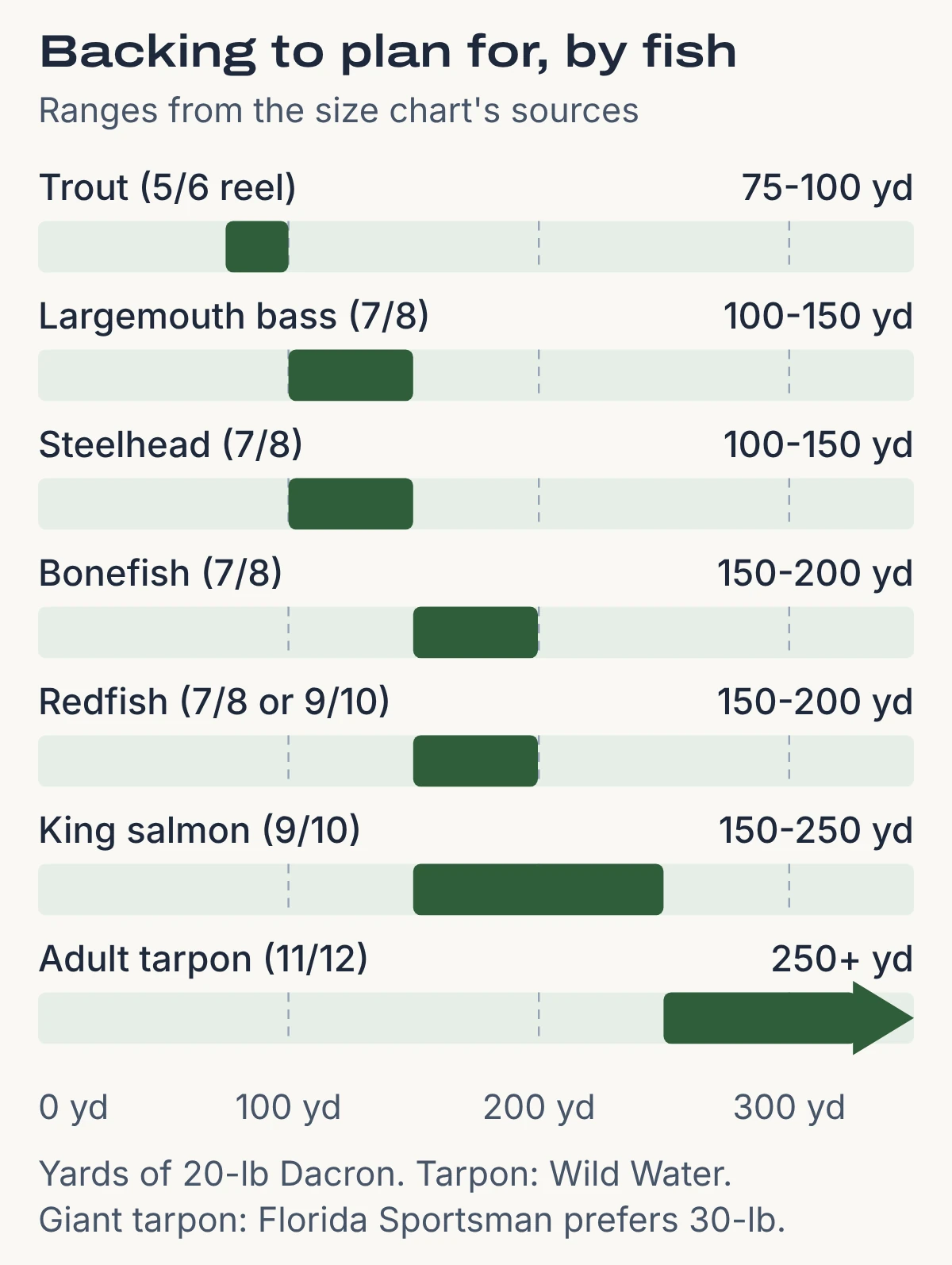
The rod sets the reel’s number, and the fish sets everything the number does not tell you. Wild Water Fly Fishing says “Most trout will never pull enough line to reach your backing”, yet tarpon “can strip 100 yards of line in a single run.” The chart below puts the common target species side by side, with the reel size, backing and drag that named shops, makers and publications give for each, and it says where they disagree.
Related guide: Stout Waders Size Chart: What Stout Means, Brand by Brand
Fly reel size chart by species
Every row follows one rule: the reel’s rating includes the line weight of the rod you would use for that fish. The rod weights come from the same sources as the reel sizes. Backing is 20-lb Dacron unless the row says otherwise.
| Fish and typical rod | Reel size | Backing to plan for | Drag need | Who says so |
|---|---|---|---|---|
| Small-stream trout, panfish; 3- or 4-wt | 3/4 | 50-75 yd | Light; a click-and-pawl reel works | Wild Water; Orvis |
| Trout, smallmouth bass; 5- or 6-wt | 5/6 | 75-100 yd | Light; any smooth drag | Wild Water; Orvis |
| Largemouth bass; 7- or 8-wt | 7/8 | 100-150 yd | Light | Wild Water; Lamson; Orvis |
| Bonefish; 8-wt | 7/8 (Lamson: M8) | 150-200 yd | Strong, sealed | Orvis; Wild Water; The Fish Hawk; Lamson; Fly Fishing Basics |
| Redfish; 8- or 9-wt | 7/8 or 9/10 (sources differ) | 150-200 yd | Smooth start-up, sealed | The Fish Hawk; Wild Water; Lamson; Orvis |
| Steelhead; 7- or 8-wt | 7/8 (8/9 also fits an 8-wt) | 100-150 yd | Solid, smooth start-up | Wild Water; Orvis; MidCurrent; Fly Fishing Basics |
| Smaller salmon (Atlantic, pink); 7- or 8-wt | 7/8 | 100-150 yd | Solid | Orvis; Wild Water |
| Big Chinook (king) salmon; 9- or 10-wt | 9/10 | 150-250 yd | Strong | Orvis; Wild Water |
| Juvenile tarpon (15-60 lb); 10-wt | 9/10 | About 200 yd (Florida Sportsman’s “medium tarpon”) | Strong, sealed | Fishwest; The Fish Hawk; Florida Sportsman; Orvis |
| Adult tarpon (60-140 lb); 12-wt | 11/12 | 250+ yd of 20-lb (Wild Water); 30-lb for giant tarpon (Florida Sportsman) | Strong, smooth, sealed | Fishwest; Wild Water; Florida Sportsman |
The backing column follows Wild Water Fly Fishing’s “Fly Reel Backing Capacity by Size” table (its quick-reference chart gives wider ranges for the 3/4 and 5/6), except for the saltwater flats rows (Orvis and The Fish Hawk) and juvenile tarpon, where the figure is Florida Sportsman’s for “medium tarpon” on a 9-weight. Florida Sportsman gives no yardage for its 30-lb advice on giant tarpon; a thicker backing fits fewer yards on the same reel. Wild Water, a fly shop that also sells its own reels, says its figures are approximate and that capacity “varies by reel manufacturer and arbor size.” The tarpon weight bands and their rod weights come from Fishwest, a fly shop; the trout and saltwater drag notes come from Orvis, a fly-fishing maker and retailer.
Where the sources disagree
Sizing charts look tidy, but shops and makers place some fish in different sizes. These are the rows where it matters.
Redfish and bonefish
Wild Water puts redfish and bonefish in a 7/8. The Fish Hawk, an Atlanta fly shop, puts bonefish in a 7/8 but redfish with permit in a 9/10. Its own redfish setup guide splits the difference: an 8-weight rod for most slot fish, and a 9-weight for wind, heavy flies and bull reds. Lamson, a reel maker, uses its own saltwater sizes and calls its M8 “the Saltwater Do-It-All size”, ready for “Bonefish, Permit, Red Fish etc.”
Orvis’s saltwater lesson gives the reason the backing jumps on the flats. Saltwater reels need to “handle at least 150 to 200 yards of backing”, and Orvis matches an 8-weight rod to fish “up to about 10 pounds”, such as smaller bonefish and redfish. The Fish Hawk’s redfish guide also gives “150–200 yards of 20 lb” as common, and says to go heavier if you expect bull reds.
Steelhead and salmon
Steelhead sit in the 7/8 class in Wild Water’s chart. Fly Fishing Basics, a how-to site by fly angler Clint Losee, pairs an 8-weight with a 7/8 or 8/9 reel for setups that include steelhead, with “More capacity; often 150+ yd of 20-30 lb”. Lamson names its -9+ as “good size for steelhead and salmon”, a size up from the -7+ it lists for big trout and bass.
Salmon split by size. Orvis’s steelhead and salmon lesson suggests a 7- or 8-weight for smaller Atlantic salmon, and for “big Chenookan and Coho” (the transcript’s spelling of Chinook) “a 9 or even a 10 weight”. Wild Water lists coho with pink salmon as a 7/8 fish, so coho is the one species these two place a size apart. Size for the biggest fish the river holds.
Tarpon
Tarpon need the widest range because the fish do. Fishwest splits them into baby tarpon of 5-15 lb on an 8-weight rod, juveniles of 15-60 lb on a 10-weight and adults of 60-140 lb on a 12-weight. Wild Water and The Fish Hawk both put “tarpon” in an 11/12, and The Fish Hawk’s summary says “tarpon and big saltwater need 9/10 or larger”. Lamson names its M10 for “hard fighting species like Tarpon”.
Mike Conner, a longtime Florida fly-fishing guide and former staff editor of Florida Sportsman, gives the backing side. He writes that 200 yards “on a suitable reel paired to a 9-weight rod, is plenty for bonefish, permit, or medium tarpon”, and that for giant tarpon on reels for 11- or 12-weight rods “30-pound-test Dacron is a better choice”.
Going too light is a fish-welfare problem, not only a lost fish. Fishwest quotes the Bonefish & Tarpon Trust, a conservation group: “The first goal is to match the tackle to the fish.” Its example is a 130-pound tarpon on an 8-weight rod, where the fight runs long and “the fish will be exhausted”.
How to work out your reel size
Start from the rod’s line weight
It is printed on the rod. If you have not bought the rod yet, choose it for the fish first; the reel follows.
Find reels whose rating includes that weight
A reel’s “weight” is the band of fly lines it is built for, not its ounces: Orvis says pairing “a 5WT rod with a 4/5 WT reel or a 5/6WT reel is a good strategy.” Makers label sizes differently (Lamson uses -5+ and M8, Orvis uses Roman numerals), so read the line range each maker prints.
Check the capacity chart at your line weight
Look up how much backing the reel holds with the exact line you will use, then compare it with the backing row for your fish in the chart above. The next section shows how one maker’s chart reads.
Match the drag to the fish
Trout and most bass need little drag; bonefish, redfish, steelhead, salmon and tarpon need a smooth, strong drag, and saltwater reels need a sealed one. The drag section below gives the sources.
Check the balance with the rod rigged
Rest the rod on one finger near the grip, as The Fish Hawk suggests: “A level balance means the reel size is right.” Wild Water warns that a reel that is too large “Creates poor balance and adds casting fatigue.”
Reading a maker’s capacity chart
Here is the capacity chart from Orvis’s Hydros reel manual, one maker’s figures for one reel series. Each size lists its capacity with three line weights. Within each size the backing shrinks as the line gets heavier, since a heavier line is thicker and takes more of the spool.
| Hydros size | Lines in its capacity chart | Backing with the lightest line | Backing with the heaviest line |
|---|---|---|---|
| I | WF1-WF3 | 100 yd | 50 yd |
| II | WF3-WF5 | 150 yd | 100 yd |
| III | WF5-WF7 | 150 yd | 100 yd |
| IV | WF7-WF9 | 225 yd | 175 yd |
| V | WF9-WF11 | 250 yd (30-lb) | 200 yd (30-lb) |
| VI | WF11-WF13 | 350 yd (30-lb) | 300 yd (30-lb) |
The manual says “All capacities are quoted using 20-lb Dacron” and that “Hydros V & VI reels are quoted using 30-lb Dacron”. The current Hydros comes in sizes II to IV, for line weights 3-5, 5-7 and 7-9, and Orvis’s current “Hydros Reel Backing Capacity Chart” gives the same II to IV figures as the manual. Sizes I, V and VI come from the earlier manual only, so check the chart for the reel you buy.
Read against the species chart, the figures work out like this (our reading of the two tables, not an Orvis recommendation):
- A size III with a WF5 line holds 150 yards, 50 yards more than the 100 yards at the top of the trout row.
- A size IV with a WF8 line holds 200 yards, which meets the “at least 150 to 200 yards of backing” Orvis asks of a saltwater reel, with nothing to spare. For salt, Orvis also says to “think about over sizing it a bit”.
- A size VI with a WF12 line holds 325 yards of 30-lb Dacron, above Wild Water’s 250+ yards of 20-lb for adult tarpon (the thicker 30-lb takes more room, so the margin is larger than the numbers show).
The same reel holds less with a heavier line. A size II holds 150 yards with a WF3 but 100 yards with a WF5, so the line you buy changes the answer.
Thinner backing is the other lever. Wild Water says gel-spun “is thinner than Dacron”, so the same reel holds more of it. Thin braid has a cost that Mike Conner spells out: “it can cut your hands if you are careless when a running fish has it under tension.” Keep your fingers off the running backing.
How much drag each fish needs
The sources split drag needs by how hard the fish runs. For trout and freshwater bass, Orvis says: “Because the fish are smaller, powerful drag settings aren’t crucial.” Fly Fishing Basics says the same for trout, adding that “An inexpensive drag system will not hold up to hard running fish such as saltwater bonefish.”
For steelhead and salmon, Orvis’s lesson calls for “a good quality reel, with a solid drag” because “These fish are explosive and will test your drag system to the max.” MidCurrent, a fly-fishing publication, points out in its steelhead drag article that a 10-pound steelhead on a 10-pound leader, “with drag set at the standard one-third of tippet strength”, means fishing about 3 pounds of tension. Its point is that start-up smoothness matters more than the maximum drag on the box.
On the flats and for tarpon, the drag also has to survive salt. Orvis calls a sealed drag “One of the most important variables in choosing a saltwater reel”. Fishwest calls the reel “The most important piece of gear” for tarpon and says “A jerky drag can break you off”. The Fish Hawk makes the same point for redfish: “A quality disc drag with a smooth startup is more important than extreme drag strength.”
Tip
Cheeky Fishing, a reel maker, says that with big fish far into the backing “it may even be necessary to back off of the drag”, because the drag of the line in the water adds pressure and “can cause knot failure and breakage.”
Rinse a saltwater reel after every trip. Orvis’s advice is “Wash your saltwater reels after every use to help keep the parts moving.”
When you fall between two sizes
In most of these cases the sources lean toward the larger reel, with limits:
- More backing or a big river: Lamson says “it’s usually better to have a larger reel than a smaller one”, because a lighter line on a bigger reel leaves room for backing. Its example is a 6-weight rod: choose its -5+ for a lighter setup, or its -7+ for “max arbor size + more backing.”
- Streamers and sinking tips: Orvis says “Go with a size larger if you’re fishing streamers and have a streamer-specific line or you will be adding longer sink tips.”
- Saltwater: Orvis says to match the reel to the rod but “think about over sizing it a bit”, for more backing on long runs.
- Delicate dry-fly fishing: The Fish Hawk suggests the smaller end of a reel’s range for dry flies and the larger end for streamers or wind.
- Not more than one class: Wild Water warns, “Avoid sizing up more than one weight class unless you need extra backing.”
Going too small has its own cost. Wild Water says an undersized reel “leads to insufficient backing and limited drag strength”, and Lamson says that putting “a 7wt line on a 5wt reel causes crowding”, so you may have to give up backing.
Fly reel sizes are not spinning reel sizes
A 5/6 fly reel and a 2500 spinning reel use different scales. A fly reel’s number names the fly line weights it holds. Our spinning reel size guide explains that a spinning reel’s number “tells you roughly how much line a reel holds and how heavy that line can be”, and lists a 1000 for panfish and trout. If you would rather start with spinning or push-button gear, our roundup of beginner spinning and spincast reels covers those reels, not fly reels. Bass anglers on conventional tackle can start with our bass fishing tips for beginners, and the rest of our rod and reel coverage is in the fishing gear section.
Frequently Asked Questions
Q. What size fly reel do I need for a 5-weight rod?
A reel rated for 5-weight line, usually a 5/6 or 4/5. Orvis names both, and Wild Water says 75-100 yards of 20-lb backing is plenty for trout on a 5/6.
Q. What size fly reel for bass?
A 5/6 for smallmouth on a 5- or 6-weight rod, and a 7/8 for largemouth on a 7- or 8-weight, per Wild Water. Lamson names its -7+ for bass and carp.
Q. What size fly reel for tarpon?
It depends on the fish: a 9/10 on a 10-weight for juveniles, and an 11/12 on a 12-weight for adults, with 250 yards or more of 20-lb backing per Wild Water. Fishwest gives the rod weights by tarpon size.
Q. What does 7/8 mean on a fly reel?
The reel is built for 7- and 8-weight fly lines and the rods that cast them. It is not the reel’s weight in ounces.
Q. Is a 2500 reel too big for trout?
A 2500 is a spinning-reel size, not a fly-reel size. Our spinning reel size guide lists a 1000 for panfish and trout and a 2500 for bass and walleye.
Q. Can I use a saltwater reel for steelhead or trout?
Yes, if its rating matches the rod. Lamson says its saltwater reels can be fished in freshwater “for big trout, steelhead, salmon, or anytime line pickup and drag protection matter.”
Sources (15)
- Orvis, How Do I Choose A Fly Reel?
- Orvis Learning Center, Rods and Other Equipment for Salt Water
- Orvis Learning Center, Single-Handed Rods for Steelhead and Salmon
- Orvis, Hydros reel manual and capacity chart (PDF)
- Orvis, Hydros Reel product page
- Orvis, Hydros Reel Backing Capacity Chart
- Lamson, How to Choose the Right Fly Reel
- Wild Water Fly Fishing, Fly Fishing Reel Size Chart
- The Fish Hawk, Fly Reel Size Chart
- The Fish Hawk, Complete Redfish Fly Fishing Setup
- Fishwest, Fly Fishing for Tarpon: A 101 Guide
- Florida Sportsman, Fly Fishing: How Important Is Backing Line? (Mike Conner)
- MidCurrent, Steelhead Reel Drag Systems: What You Actually Need for Spring Fish
- Cheeky Fishing, The Complete Guide to Buying a Fly Reel
- Fly Fishing Basics, Choosing a Fly Reel (Clint Losee)