The short answer
Most anglers sort flies into four basic types: dry flies, wet flies, nymphs and streamers. Dry flies float on the surface, wet flies and nymphs fish underwater, and streamers imitate baitfish, leeches or crayfish. Emergers (hatching insects in the surface film) and terrestrials (land insects) are common extra groups.
A fly is a hook dressed to look like something a fish eats, so every type below is really an answer to one question: what are the fish eating right now, and where in the water? Learn that, and a wall of flies in a shop stops being a wall of names.
This guide uses trout water for its examples, because that is where most of the fly types and the advice around them come from. It names the simple rigs each fly goes on, but leaves casting and knots to other guides.
The main types at a glance
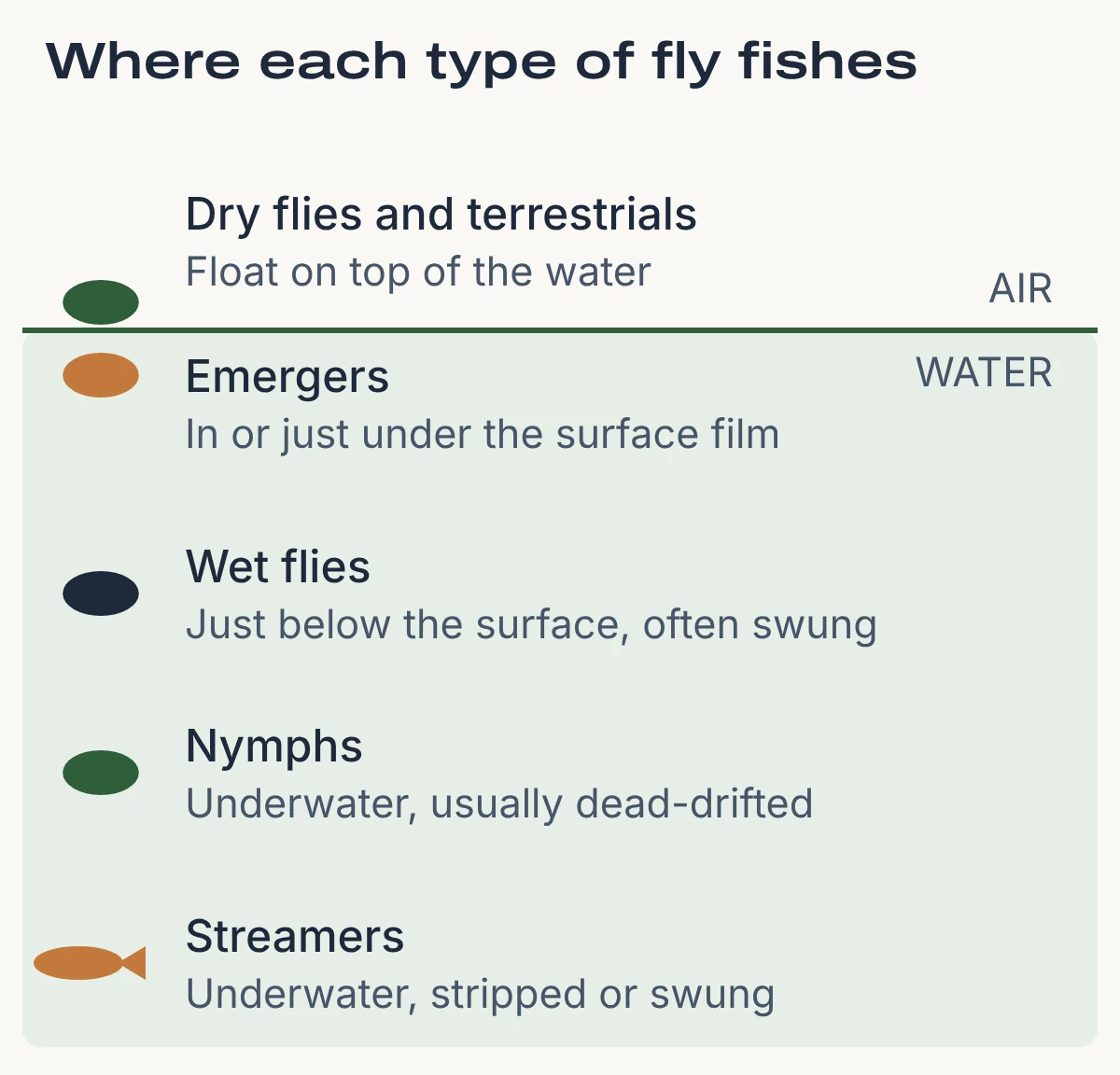
Orvis, a fly-fishing maker and retailer, says “Fly fishing flies fall into four basic categories: dry flies, wet flies, streamers, and nymphs.” Emergers and terrestrials are not separate headings in that sentence, but anglers treat them as their own groups because they are fished differently. The table puts all six side by side.
| Type | Where it fishes | What it imitates | How it is usually fished |
|---|---|---|---|
| Dry fly | On the surface | Adult aquatic insects such as mayflies | Dead drift on top, no drag |
| Terrestrial | On the surface | Land insects such as ants, beetles and grasshoppers | Cast close to banks, often with a “plop” |
| Emerger | In or just under the surface film | An insect changing from nymph or pupa to winged adult | Dead drift in the film, or swung as a soft hackle |
| Wet fly | Just below the surface | Insects rising or swept along | Swung across the current, or dead-drifted |
| Nymph | Underwater | Insects in their underwater life stages | Dead-drifted, often under an indicator |
| Streamer | Underwater | Baitfish, leeches, crayfish and other small prey | Stripped back or swung |
The columns follow the Orvis, MidCurrent and Field & Stream descriptions quoted in the sections below.
Dry flies: for fish that are looking up
Orvis says “Dry flies float on the surface and are used when fish are feeding on top.” Orvis’s Learning Center adds the conditions: you need fish “feeding on the surface or, at least, looking up at the surface for food,” and “As long as the water temperature is above 50 degrees” and the water is relatively clear and not very fast, you can catch fish on dry flies almost any time.
The same lesson lists when dries work best: during hatches, when insects return to lay eggs, when land insects fall in on windy days, and when the water is low and clear.
Tip
Fish rising does not always mean fish eating the adult insect. If trout keep ignoring a dry fly that matches the bugs you can see, the next section is usually the answer.
Emergers: the in-between stage
MidCurrent, a fly-fishing publication, defines an emerger as “a fly pattern that imitates an aquatic insect transitioning from its immature form (nymph or pupa) to a winged subadult.” The insect is stuck half in and half out of the water, which is why it is an easy meal.
MidCurrent’s staff say many rising fish ignore high-floating adults and take emergers instead, and they list quiet, dimpled rises with no splash as a clue. Some emergers ride in the film like a dry fly; others, such as soft hackles, are fished just under the surface and swung. If you fish an emerger behind a larger dry fly, MidCurrent suggests attaching it “12–18 inches off the bend of a larger dry fly,” so the dry fly shows you where the drift is and when to set the hook.
Terrestrials: land insects that end up in the water
Terrestrials imitate ants, beetles, grasshoppers and other insects that live on land and fall in. Orvis’s dry-fly lesson names them as a reason dry flies work “especially on windy days.” Field & Stream’s guide roundup shows how different the presentation is. Guide Chad Jacques says he casts “with a little more velocity so that fly lands with a distinct plop,” because, as the article puts it, “terrestrials are clumsy in the water” and “the surface commotion they make” often gets a trout to commit. Field & Stream’s profile of guide Paul Weamer adds that a trout may move far off a bank to eat a hopper, but you are “always better off landing it as tight to the bank as possible.”
Terrestrial fishing is mostly a summer and late-summer game. Field & Stream’s guides describe hoppers, ants, beetles, cicadas and even dragonflies, with local favorites on each river.
Wet flies and nymphs: where trout do most of their eating
Orvis’s Learning Center says “Trout do most of their feeding underwater, and day in and day out you’ll catch more trout on wet flies and nymphs.” The two types overlap more than most guides admit. Orvis’s lesson says the nymph is “really just another kind of wet fly, but usually without wings,” and that “we fish wet flies and nymphs interchangeably, but wet flies are more often swung in the current than fished dead drift.”
In practice:
- Wet flies fish just below the surface and often carry soft hackles that wiggle in the current. Orvis describes them as imitating insects “rising through the water or getting swept along.”
- Nymphs imitate insects’ underwater life stages. Orvis’s lesson says artificial nymphs can imitate the larvae of mayflies, caddisflies, stoneflies and midges, and also scuds, crayfish and aquatic worms. They are most often dead-drifted, sometimes under a strike indicator and sometimes with added weight.
Orvis’s lesson also says feeding trout “seldom pass up a well presented nymph” and will accept nymphs “more readily than dries or streamers in most cases.” That is Orvis’s view as a fly-fishing company; it explains why nymphs are the usual first choice when no fish are rising.
Streamers: the big meal
A streamer is a fly meant to look like a small fish or other large prey rather than an insect. Orvis says streamers are “fished underwater on the swing or retrieve” and “meant to look like baitfish, leeches, crayfish, or other small prey.” Its Learning Center says “Bigger trout eat big prey,” and that streamers are especially appealing to anglers looking for big fish.
The Orvis lesson on retrieves gives the basic method: cast the streamer perpendicular to the bank “and strip it back toward you in six inch strips.” It also says a streamer can be swung like a wet fly, and that streamers are often very effective “when the water is so high and dirty that you can’t fish with any other kind of fly.” For that dirty water, the lesson suggests a fly with a deer hair head, such as a muddler minnow, or one with lots of hackle, such as a woolly bugger, because “the rougher the fly looks, the more vibrations it will produce.”
Hook sizes: a bigger number is a smaller hook
Flies are sold by pattern name and hook size, and the size number runs backward. Orvis’s hook video says “The larger the number, the smaller the hook,” and warns that what determines hook size “is rather relative and often differs between manufacturers and even hook models.” A size 12 from one maker can look a little different from a size 12 from another.
For orientation, here is what a few sources suggest for trout flies. These are starting points those sources name, not rules.
| Fly | Size suggested | Who says so |
|---|---|---|
| Woolly Bugger (streamer) | 6 | Trout Unlimited magazine, for new fly tiers |
| Woolly Bugger, black or olive | 6 to 10 | Flydeal, an online fly shop |
| Parachute Adams (dry fly) | 14 to 18 | Flydeal |
| Flying ant (terrestrial) | 20 | Delaware River guide Joe Demalderis, in Field & Stream |
| Small blue-winged olive mayfly imitation | about 20 | Trout Unlimited magazine |
Trout Unlimited’s magazine puts the range new tiers need at “from a size 6 for a traditional Woolly Bugger to maybe a size 20.” Hooks larger than a size 1 are written with a slash and a zero, like 2/0. Orvis says these larger hooks go “all the way up to a 20/0 big game hook.”
The simple trout rigs these flies go on
A rig is just the flies and the line system that carries them. Four are enough to know by name:
- Single dry fly. One floating fly on the end of the leader or tippet.
- Dry-dropper. A high-floating dry fly with a length of tippet tied to its bend and a small nymph or emerger on the end. Orvis’s lesson says that if the dry fly “does anything weird, anything that doesn’t look right, set the hook.”
- Nymph rig. One or two nymphs, sometimes with weight and a strike indicator. Orvis’s Learning Center covers how to rig indicators and weight and how to fish two nymphs at once.
- Streamer on a stripped or swung line. One larger fly, moved by the angler rather than by the current alone.
Rules on how many flies, what hooks and what weight you may use are set by your state and sometimes by the individual water, so read your state wildlife agency’s fishing regulations before you rig up. Maine’s Department of Inland Fisheries and Wildlife, for example, says: “No more than 3 unbaited artificial flies individually attached to a line may be used.” Maine also states: “It is unlawful to use, sell, or offer for sale lead sinkers and unpainted lead jigs measuring 2.5 inches or less in length or weighing one ounce or less,” and some of its waters are restricted to fly fishing only. Those are Maine’s rules; other states set their own.
Another way to sort a fly box
Besides type, some instructors sort flies by how literally they copy a bug. The Catch and the Hatch, an online fly-tying education site, uses four groups:
- Search patterns that imitate as many bugs as possible, to find where fish are feeding.
- Attractor patterns: in the site’s words, an attractor pattern “imitates nothing and attracts everything” to get a fish’s attention.
- Impressionistic patterns that copy a few similar insects or stages closely.
- Imitative patterns that copy one real insect as precisely as possible.
This is one site’s framework, not an industry standard, but it explains why one fly can sit in two boxes: a flashy nymph such as the Rainbow Warrior the site describes can be both a nymph and an attractor.
Flies are not only for trout
The same types carry over to other fish. Orvis’s fly page notes that the Clouser Minnow “still gets eaten by saltwater species everywhere they swim” and that the Crazy Charlie “has been fooling bonefish for decades.” Its catalog also lists a Bass Popper, for fishing bass.
If you fish both fly and spinning gear, the same logic applies to lures. Our roundups of bass topwater lures and river smallmouth lures cover the lure side of surface and baitfish fishing, and our guide to baits for stocked trout covers the other way trout are commonly caught. The fishing gear hub lists the rest of our fishing guides.
Which type to tie on first
| What you see | Try first | Why |
|---|---|---|
| Fish rising and taking things off the top | Dry fly, then an emerger if they refuse it | Fish are looking up |
| Bugs on the water and quiet, dimpled rises with no splash | Emerger | Fish may be taking hatching insects in the film |
| Windy day beside grass, brush or trees | Terrestrial | Land insects get blown in |
| Nothing rising | Nymph or wet fly | Trout do most of their feeding underwater |
| High or dirty water, or you want a big fish | Streamer | Large prey; in dirty water Orvis says fish pick up vibrations |
Good to know
A fly shop’s starter list is a fair first shopping list. Flydeal, an online fly shop, names a Parachute Adams, an Elk Hair Caddis, a Pheasant Tail Nymph, a Hare’s Ear and a Woolly Bugger and says “These five patterns should be the foundation of any fly box.” That is one shop’s view, and local hatches vary.
Frequently Asked Questions
Q. What are the four main types of flies used in fly fishing?
Dry flies, wet flies, streamers and nymphs, according to Orvis. Emergers and terrestrials are usually added as extra groups because they are fished differently.
Q. What is a streamer in fly fishing?
A streamer is a fly tied to look like baitfish, a leech, a crayfish or other small prey. It is fished underwater by stripping it back or swinging it across the current.
Q. What is the difference between a wet fly and a nymph?
Very little, by Orvis’s account: the nymph is “really just another kind of wet fly,” usually without wings. Wet flies are more often swung, and nymphs more often dead-drifted.
Q. What is the difference between a nymph and a dry fly?
A dry fly floats and imitates adult insects. A nymph sinks and imitates the underwater stage, so it is fished below the surface.
Q. What size fly should a beginner start with?
Flydeal, an online fly shop, says “Sizes 14 to 16 are the most versatile starting points for trout.” Trout Unlimited’s magazine gives the wider span a new tier needs, from a size 6 Woolly Bugger to about a size 20. A smaller number means a bigger hook, and sizes vary by maker.
Q. Do I need to match the hatch every time?
Not always. Flydeal says a close match in size and profile usually matters more than an exact species, and that attractor patterns can catch fish even when they look like nothing specific. That is one shop’s view.
Sources (15)
- Orvis, Fly Fishing Flies
- Orvis Fly Fishing Learning Center, The Basics of Fly Fishing
- Orvis Learning Center, Introduction to Streamers
- Orvis Learning Center, Streamer Retrieves
- Orvis Learning Center, When Dry Flies Work
- Orvis Learning Center, Fishing a Dry Dropper Combination
- Orvis Learning Center, Wet Flies vs. Nymphs
- Orvis Learning Center, Selecting Nymphs
- Orvis Learning Center, Hook Basics: Hook Sizes
- MidCurrent, When Should You Use an Emerger Instead of a Dry Fly?
- Field & Stream, Fly Fishing Tips for Catching Late-Summer Trout on Terrestrials
- Maine Department of Inland Fisheries & Wildlife, General Fishing Laws and Definitions
- Trout Unlimited, Video Spotlight: Hook Sizes
- The Catch and the Hatch, The Four Kinds of Fishing Flies
- Flydeal, Fly Fishing Flies Guide