The short answer
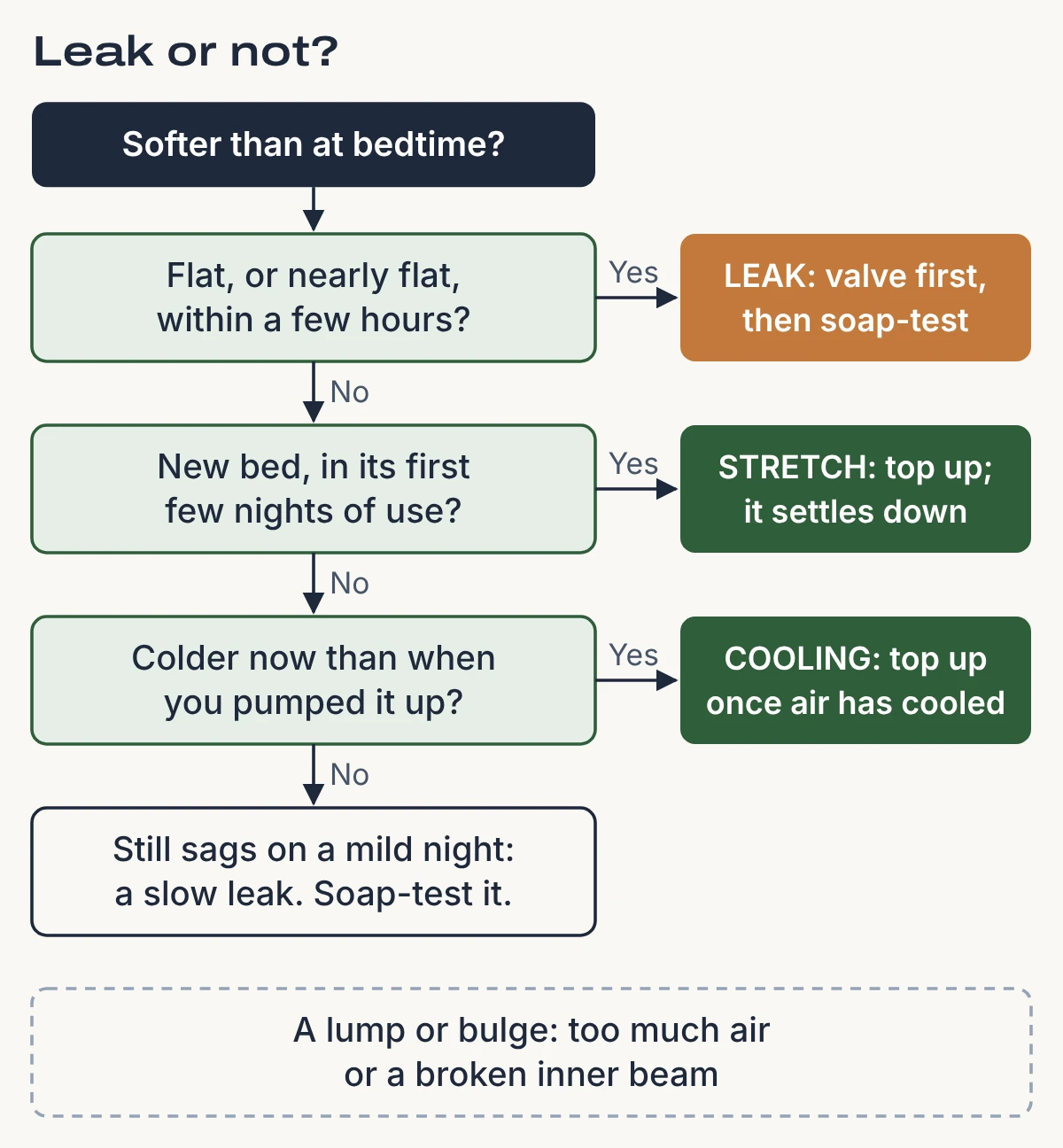
Often an air mattress that is soft by morning isn’t leaking: the air inside shrinks as it cools, and new vinyl stretches at first. A bed that goes flat within a few hours has a real leak, usually at the valve, a puncture or a seam. A lump means too much air or a broken internal beam.
The pattern is the clue. How fast the bed goes soft, how new it is and how cold the night got will usually tell you whether you are dealing with cooling air, a break-in period or a hole.
That matters because each has a different fix. Hunting for a puncture in a bed that is only stretching wastes an evening, and topping up a bed with a split seam only delays the next flat night.
Leak or not? How fast it goes soft tells you
Start with what you actually saw. This table sorts the common patterns; the sections below explain each one and where the advice comes from.
| What you notice | Likely cause | How to confirm | What to do |
|---|---|---|---|
| Firm at bedtime, softer by morning, firm again after a top-up | The air cooled and shrank | Worse on cold nights or a cold floor; holds on a mild, steady night | Inflate after the room or tent has cooled, then top up |
| A new bed that is softer each of its first few nights | New vinyl stretching under your weight | Improves night by night | Top it up; inflate it well before you need it |
| Flat, or nearly flat, within a few hours | A leak at the valve, a puncture or a seam | A hiss, or bubbles in a soapy-water test | Close or clean the valve, patch a hole; a split seam can’t be patched |
| A bulge or lump, often in the middle | Too much air, or a broken internal beam | The lump stays after you let some air out | Release air while pressing the lump; warranty claim if it stays |
| Hard and tight on a hot day | The air expanded in the heat | Bed left in a sunny tent or a parked car | Let some air out before you leave it |
Why a bed with no hole still goes soft overnight
Air takes up less room as it cools
The air you pump in at bedtime is usually warmer than the air at 3 a.m. NASA’s explanation of Charles’s law puts the rule plainly: if the pressure is held constant, “the volume V is equal to a constant times the temperature T”, with temperature measured from absolute zero. Worked from that law, a drop from a 75°F (24°C) evening to a 55°F (13°C) night takes about 4 percent off the volume of the air inside, roughly 2 percent for every 10°F (5.6°C).
That sounds small, but an air bed keeps its shape only because the air pushes back against your weight, so air that takes up a few percent less room shows up as a sag where you lie. Intex’s airbed manual says the same in plain terms: air inside the bed “may expand and contract with varying temperature”, and the fix is simply to add more air with the pump.
Camping makes it worse in two ways. A bed pumped up in a warm afternoon tent meets a cold night, and an air bed sits right on the ground or a cold floor, which keeps drawing heat out of the air inside. Therm-a-Rest’s support team describes the same thing with its pads: one that is “not flat, but not as full as you inflated it” has often just cooled, and the company adds that barometric pressure and big weather changes affect inflation too.
New vinyl stretches
Intex’s airbed FAQ calls stretching “a natural characteristic of new vinyl”: under your body weight, a new bed stretches during its first few uses, and that feels like lost air. When New Zealand’s Fair Go consumer programme left three budget beds inflated over a weekend, “each holding 20kg of paper weight” (about 44 lb), all three stayed up. The one that felt squishier had not lost air; its maker, Bestway, said it was “just getting bigger as the fabric stretched”, which happens to most beds on first use.
Fair Go reported in 2022 that Bestway had started putting stickers on its beds advising owners to pump them up in advance, so they stretch to full size before the first real night.
Heat works the other way
Warm air expands, so a bed that felt right in the evening can be drum-tight in a sunny tent or a parked car. Therm-a-Rest warns that a full mattress “can actually burst from the extra pressure” if it warms enough in a hot tent or car all day, and tells owners to let some air out before leaving it. Intex gave Fair Go the same advice for warm weather: release some air to avoid damaging the bed.
Related guide: How to Fold an Air Mattress: Deflate, Fold, Roll and Store
Finding a real leak
If the bed goes flat in hours, or keeps sagging on mild, steady nights once the first week is over, look for the leak in this order.
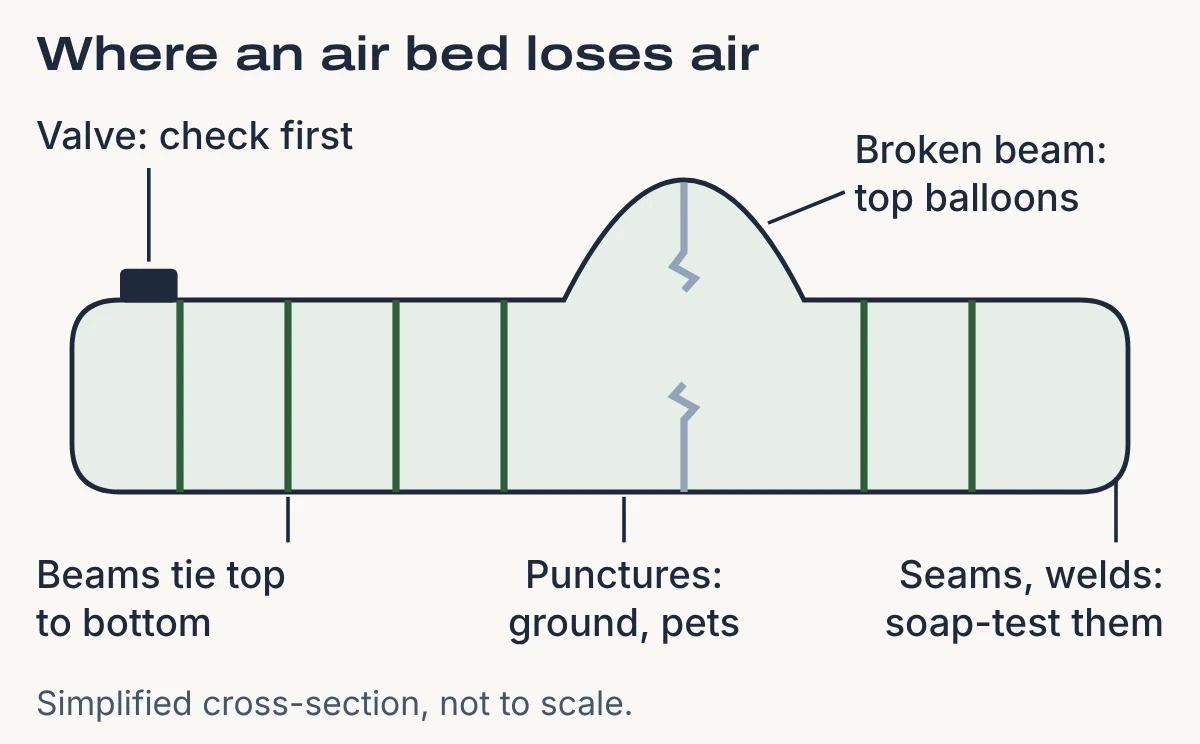
Check the valve first
Intex’s leak advice starts with making sure the valves are secure. Push caps and plugs fully home, wipe grit off the seal, and on a bed with a built-in pump make sure the control is back in its closed or off position, as your model’s manual shows. A cracked valve or a cap that won’t seal can be replaced: Intex’s FAQ lists its valves by part number and sells replacement parts.
Inflate it to normal firmness and listen
Use the bed’s own pump, or the air-bed pump you normally use, and stop at normal firmness, not rock-hard, and never use a compressor: Intex’s manual warns that over-inflating or using a high-pressure air compressor can burst the bed. Then, in a quiet room, listen and run your hand slowly over the surface. Therm-a-Rest’s leak-finding guide notes that the little hiss of escaping air can give a leak away before any bubbles do.
Spray soapy water on the seams and valve
Intex suggests liquid soap and water in a spray bottle; a leak blows bubbles. Use plain liquid soap: Intex says laundry detergent and dishwasher detergent will not work, because they don’t bubble. Give each section time, since Therm-a-Rest notes a pinhole can take ten minutes or more to show.
Turn it over and check the underside
Therm-a-Rest’s repair shop says punctures are the most common problem it sees, many of them caused by pets, and it recommends a foam pad underneath to stop things pricking a pad from below.
Mark it, dry it and patch it
Circle the spot, let the air out, dry it, and apply the patch that came with the bed. On a flocked (velvety) top, Intex says to rub the flocking off with fine sandpaper or an emery board and wipe the area with nail polish remover first, because the patch only sticks to bare vinyl. Do that in a ventilated room away from flames, and let the patch set as its kit directs before you reinflate.
Know when a patch won’t work
If the bubbles come from a seam, Intex’s FAQ is blunt: a leak in the seam “cannot be repaired”. A new bed that leaks at a seam is a warranty question instead; a puncture usually isn’t covered. Therm-a-Rest, for one, says the vast majority of leaks it sees are punctures and that its warranty doesn’t cover them. Intex’s airbed warranties run from 90 days to one year depending on the series, some types carry none, and a claim needs the receipt.
Lumps, bubbles and bulges
An air bed is held flat by internal walls or beams; Intex describes its own construction as I-beams welded to the top and bottom of the bed. When one of those beams or its weld lets go, nothing holds that part of the top down, and it balloons. Hunker’s repair guide, by Chris Deziel, says bubbles and lumps form when “an internal seam ruptures” and lets air pass between sections, and names over-inflation as the most common cause. It also lists a factory defect, age and exceeding the weight limit.
What to try, in order:
- Let some air out while pressing on the lump. Hunker’s guide notes that a bulge often just means too much air, and pressing it down while air escapes slowly can flatten it.
- Reinflate slowly and stop early. Pump while watching the spot, and stop as soon as the bulge starts to come back.
- If it won’t go, the beam is broken. Hunker says there’s no way to fix ruptured internal seams yourself. On a newer bed, that is a warranty claim, not a patch job.
- Check the weight rating before the next night. Intex, for example, lists 300 lb (136 kg) for its twin beds and 600 lb (272 kg) for full, queen and king; other makers’ ratings differ, so look at yours.
How to keep an air mattress from deflating
None of this needs special gear. Most of it is about when you pump, how much, and what the bed sits on.
- Break a new bed in early. Pump it up in advance, as Bestway’s stickers suggest, so the vinyl stretches before guests or a trip, and top it up before the first night.
- Top up at bedtime, not just at setup. If you inflate in the warm afternoon, expect to add air once the tent or room has cooled.
- Stop short of drum-tight. Intex told Fair Go that overfilling puts seams under stress, which may lead to leaking or bursting, and one Intex manual says to inflate to “approximately 80% of desired firmness”.
- Use a pump made for the bed. Intex recommends its own pumps and says other pumps may reduce performance or even damage its beds, and its manual warns against high-pressure air compressors.
- Protect the underside. Sweep the tent floor, then lay a tarp, as Fair Go suggests, or a closed-cell foam pad under the bed. Therm-a-Rest says foam underneath both adds warmth and stops things pricking the pad from below. Our comparison of sleeping pads and air mattresses explains why an air bed needs that insulation on cold nights.
- Keep pets off it. Therm-a-Rest’s repair shop says pets puncture “a remarkable amount” of the pads it sees, often while the pad is laid out at home.
- Let air out before a hot day. Don’t leave a full bed in a closed car or a tent in the sun.
- At home, give it a solid base. Intex says its beds perform best on solid foundations and warns that old or damaged bedsprings can diminish performance and may even damage the bed.
- Pack it dry. Fair Go warns that vinyl packed away wet can stick to itself and tear when you next unfold it. Keep the repair patch with the bed; it belongs on any camping packing list.
What it means for your next bed
Some of the nightly softening is built into the design. A classic blow-up air bed is a bag of air, so it softens a little whenever the air inside cools, and with no insulation of its own it sits on whatever cold the ground holds. A self-inflating camping mattress has open-cell foam inside an airtight shell. Its air cools too: Therm-a-Rest’s leak-finding guide says a pad that is softer by morning has often just lost air pressure “as your mattress cools”, so it can still need a top-up. The difference is that the foam core insulates you from the ground: in our camping roundup, every self-inflating mattress publishes an R-value, a rating of how well it blocks cold from below, and neither queen air bed does.
Related guide: How to Find a Small Hole in an Air Mattress (and Patch It)
If your current bed has a split seam or a broken beam, it is worth comparing the two kinds before you replace it.
Ready to buy?
Our guide to the best air mattresses for camping compares eight beds of both kinds, from queen air beds with rechargeable pumps to self-inflating foam mattresses with published R-values.
Frequently Asked Questions
Q. How long should an air mattress stay inflated?
Long enough to get through the night with only a little softening. When Fair Go left three budget beds inflated over a weekend under 44 lb (20 kg) each, all three stayed up, and it reported that Bestway and Intex inflation-test every bed for 24 hours in production. A bed that goes flat within a few hours has a leak to find.
Q. Is it normal for an air mattress to lose some air?
Some loss of firmness is normal, especially in a new bed or on a cold night. Sinking until you touch the floor is not; that is a leak.
Q. Why does my air mattress only go down when someone sleeps on it?
Body weight is what stretches new vinyl, which is why Intex describes early softening as stretching under your weight. On an older bed, weight also squeezes air out of a small hole faster, so soap-test it.
Q. Can heat or cold deflate an air mattress?
Neither lets air out, but cold makes the air take up less room, so the bed feels softer, and heat makes it expand, which strains the seams of a full bed. Top up on a cold evening and release some air before a hot day.
Q. Can you fix a bubble or lump in an air mattress?
Only if it comes from too much air, in which case letting some out while pressing the lump can flatten it. A broken internal beam can’t be repaired at home, so check the warranty.
Q. Why does my air mattress keep getting holes?
Look at what is under it and who walks on it. Therm-a-Rest’s repair shop says punctures are the most common problem it sees and blames many on pets, so sweep the floor, put a tarp or foam pad underneath and keep pets off.
Sources (7)
- Intex, Airbeds frequently asked questions (Intex’s FAQ data file)
- Intex, Prestige airbed with built-in pump owner’s manual (ManualsDir copy)
- Therm-a-Rest (Cascade Designs), How do I find an air leak in my Therm-a-Rest sleeping pad?
- Therm-a-Rest (Cascade Designs), How can I prevent my sleeping pad from getting a puncture?
- NASA Glenn Research Center, Charles and Gay-Lussac’s Law
- Fair Go (1News, TVNZ), Summer essentials: Fair Go’s air bed tips
- Hunker, How To Fix An Air Mattress With A Big Bubble In The Middle
