The short answer
Size a canvas tent by floor area, not its person rating. Life inTents advises 30-40 sq ft (2.8-3.7 m²) per person, plus a little for gear; Elk Mountain Tents adds 35-40 sq ft (3.3-3.7 m²) for a wood stove. Round up. With a stove, a 4 m (13 ft) bell or 10 x 12 ft wall tent suits two cots.
The person rating on a canvas tent is each maker’s own call, and makers call it very differently. A 13 ft (4 m) bell tent is a 1-3 person tent on Stout Tent’s chart, a two-person tent with a stove on Elk Mountain Tents’ chart and a 4-6 person tent on Life inTents’ chart.
Why the person rating is not a size
A headline capacity usually counts bodies on the floor. White Duck Outdoors lists its Alpha wall tents from 6 people on 80 sq ft up to 16 people on 384 sq ft, and explains that its 120 sq ft tent “can accommodate eight people of an average height of 6 feet, it will only do so if everyone sleeps side by side in an orderly fashion.” Worked out from that chart, the headline figures allow about 13 to 24 sq ft per person.
Makers who give a comfort figure use more room, and they still differ:
| Maker | Floor area per person | What the figure assumes |
|---|---|---|
| White Duck Outdoors (worked from its chart) | About 13-24 sq ft (1.2-2.2 m²) | Maximum capacity, sleepers side by side |
| Kodiak Canvas | 20-25 sq ft (1.9-2.3 m²) | “comfortable sleeping with gear stored inside” |
| Elk Mountain Tents | 20-30 sq ft (1.9-2.8 m²) | Sleeping; more for cots, cooking or a stove |
| Life inTents | 30-40 sq ft (2.8-3.7 m²) | Camping, “plus a little more for gear and storage” |
Cots are what make the low figures tight. Elk Mountain Tents puts “The average cot is about 32 X 76 (inches) which is about 17 square feet,” and White Duck says a cot takes “approximately 17-24 square feet.” Kodiak’s own example sits close to its guideline once the stove is counted: it says a 10 x 14 ft tent “gives you 140 square feet, which works well for four people on a backcountry hunt where cots, a small stove, and a gear pile all share the same space.” Take out 35 sq ft for the stove and that is about 26 sq ft each (worked out).
The same gap shows up in nylon tents. Life inTents’ general size guide says a standard 2-person tent of about 35 sq ft “is tight for two” and is “perfect for one person and their backpack.”
Canvas tent size chart: what makers rate each size for
Life inTents counts sleeping bags on the floor at the top of its ranges; Elk Mountain Tents says its bell figures “are for comfortably sleeping adults, and not packed children”; Stout Tent gives no basis beyond “comfortably” for its 5 m tent.
| Bell tent | Floor area (Life inTents) | Life inTents | Stout Tent | Elk Mountain Tents |
|---|---|---|---|---|
| 3 m (10 ft) | 78 sq ft (7.2 m²) | Sleeps 2-4 | Not listed | Not listed |
| 4 m (13 ft) | 133 sq ft (12.4 m²) | Sleeps 4-6, or 3-4 cots | 1-3 people | 2 with a stove, 3 without |
| 5 m (16 ft) | 212 sq ft (19.7 m²) | Sleeps 6-8 | 3-6 people | No rating (lists 200 sq ft) |
| 6 m (20 ft) | 289 sq ft (26.8 m²) | Sleeps 10-12 in sleeping bags | 6-8 people | No rating (lists 314 sq ft) |
Wall tents, by floor size:
| Wall tent | Floor area | Maker’s rating | Basis |
|---|---|---|---|
| 10 x 12 ft | 120 sq ft (11.1 m²) | Colorado Tent: sleeps 2 to 4. Airdrie Canvas: 2 cots with a stove | Colorado draws two cots and a stove |
| 12 x 14 ft | 168 sq ft (15.6 m²) | Airdrie Canvas: 4 cots with a stove | Cots and a stove |
| 12 x 15 ft | 180 sq ft (16.7 m²) | Davis Tent: 2 or 3 people | General rule |
| 13 x 13 ft | 169 sq ft (15.7 m²) | Elk Mountain: 3-4 with a stove, 5-6 without | Adults on cots |
| 13 x 16 ft | 208 sq ft (19.3 m²) | Elk Mountain: 5-6 with a stove, 7-8 without | Adults on cots |
| 14 x 15 ft | 210 sq ft (19.5 m²) | Davis Tent: 3 or 4 people | General rule |
| 14 x 16 ft | 224 sq ft (20.8 m²) | Airdrie Canvas: 5 cots with a stove | Cots and a stove |
| 13 x 20 ft | 260 sq ft (24.2 m²) | Elk Mountain: 7-8 with a stove, 9-10 without | Adults on cots |
| 16 x 20 ft | 320 sq ft (29.7 m²) | Colorado Tent: sleeps 4 to 10. Airdrie Canvas: 8 cots with a stove | Airdrie: cots and a stove |
Davis Tent’s ratings are the roomiest here (50 to 100 sq ft per person, worked out from its three sizes). Canadian maker Airdrie Canvas rates its tents by how many cots fit with the stove running. Elk Mountain Tents sets a floor of its own, with one exception: “I would not recommend a canvas tent smaller then 13 x 13 if you plan on using a stove,” but in a 10 x 10 ft with a stove, “This is OK, as long as you’re only planning on having 2 cots in the wall tent.”
Work out the size your group needs
Count sleepers and how they sleep
Elk Mountain Tents lists what changes the space each person needs: floor or cots, adults or children, sleeping only or cooking inside, and whether a stove runs. Cots take the most floor.
Multiply by a per-person figure
Life inTents’ figure is 30 to 40 sq ft (2.8-3.7 m²) per person for camping, plus a little more for gear and storage; Elk Mountain’s is 20 to 30 sq ft for sleeping. Cots and gear push you to the top of those ranges. For trips where you live in the tent, Kodiak Canvas notes “most experienced wall tent campers size up by at least one step from what the math suggests.”
Add the stove’s space
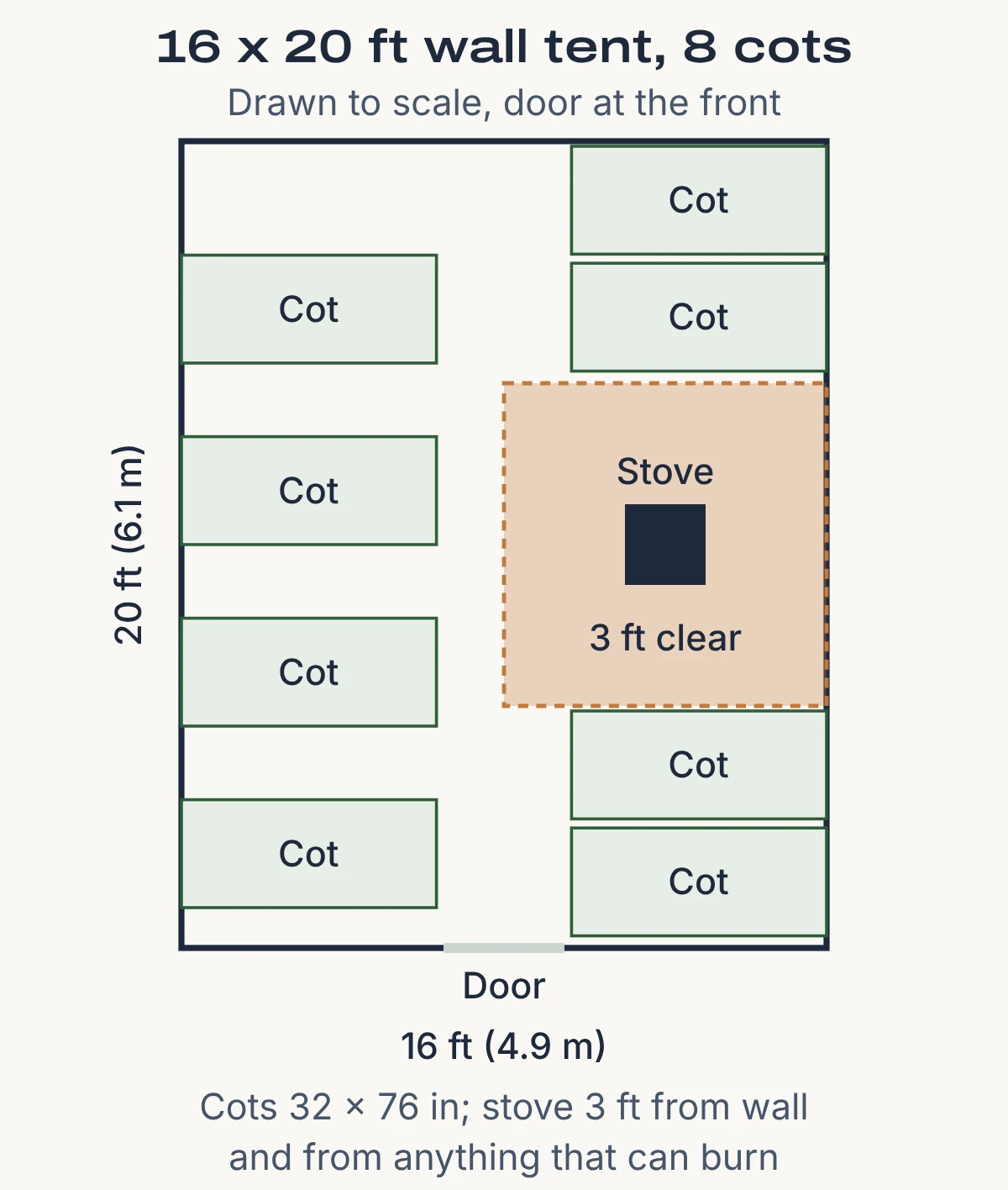
Elk Mountain Tents says a wood stove needs about 35 to 40 sq ft (3.3-3.7 m²), and White Duck plans “36-40 square feet of space for any canvas wall tent with stove.” That room is clearance as well as floor: Elk Mountain Tents advises a clear zone “at least three feet in all directions” around the stove, with nothing that can burn inside it, and “3ft from the wall unless you are using a stove shield.” Only plan a stove in a tent built with a stove jack (see the stove section below).
Chalk it out
Davis Tent suggests “taking a tape measure and chalk outside to your driveway”, drawing the floor, then the cots, the stove and any table. Leave gaps between cots: Davis notes “you must have enough room between cots to store your clothes and gear under the cots.”
Check the campsite, then round up
A bell tent needs more ground than its floor. Life inTents gives the footprint with guy lines as about 19 ft (5.8 m) across for a 4 m bell, 25 ft (7.6 m) for a 5 m and 32 ft (9.8 m) for a 6 m. If your total falls between two sizes, see the section on choosing between sizes.
Example (worked out): six adults on cots with a stove need 6 x 30-40 sq ft plus 35-40 sq ft, or 215 to 280 sq ft (20-26 m²). That range runs from about Airdrie’s 14 x 16 ft (224 sq ft, five cots with a stove) to Elk Mountain’s 13 x 20 ft (260 sq ft, rated 7-8 with a stove); Elk’s 13 x 16 ft (208 sq ft), just under it, rates 5-6 with a stove.
Does the rule match the makers’ charts?
We worked out the space each sleeper gets in every stove-in rating above, after taking out 35 sq ft for the stove (Elk Mountain’s low figure), and how many sleepers the rule would allow in the same tent:
| Tent and maker’s stove-in rating | Sq ft per sleeper (worked out) | Rule at 30 sq ft | Rule at 40 sq ft |
|---|---|---|---|
| Elk 13 x 13 ft: 3-4 | 34-45 | 4 | 3 |
| Elk 13 x 16 ft: 5-6 | 29-35 | 5 | 4 |
| Elk 13 x 20 ft: 7-8 | 28-32 | 7 | 5 |
| Airdrie 10 x 12 ft: 2 | 43 | 2 | 2 |
| Airdrie 12 x 14 ft: 4 | 33 | 4 | 3 |
| Airdrie 14 x 16 ft: 5 | 38 | 6 | 4 |
| Airdrie 16 x 20 ft: 8 | 36 | 9 | 7 |
At 30 sq ft a sleeper, the rule lands inside or within one sleeper of every maker’s rating. At 40 sq ft it matches the 10 x 12 and the 13 x 13 and allows one or two fewer sleepers than the makers in the rest, which is the roomy end. Elk Mountain’s largest ratings are the tightest, at about 28 to 29 sq ft each.
Headroom: why a bell tent sleeps fewer than its floor suggests
A bell tent’s floor is not all usable. Elk Mountain Tents says “The industry standard for bell tent side walls is 1-2 ft” (its own are 3 ft) and rates its 13 ft bell lower than its 133 sq ft suggests “because the curved design makes it a little harder to pack in cots.” Stout Tent notes that in a bell “usable standing room is concentrated towards the center”, while a wall tent offers “consistent headroom throughout the tent”; White Duck lists 5 ft (1.5 m) walls on every Alpha wall tent size.
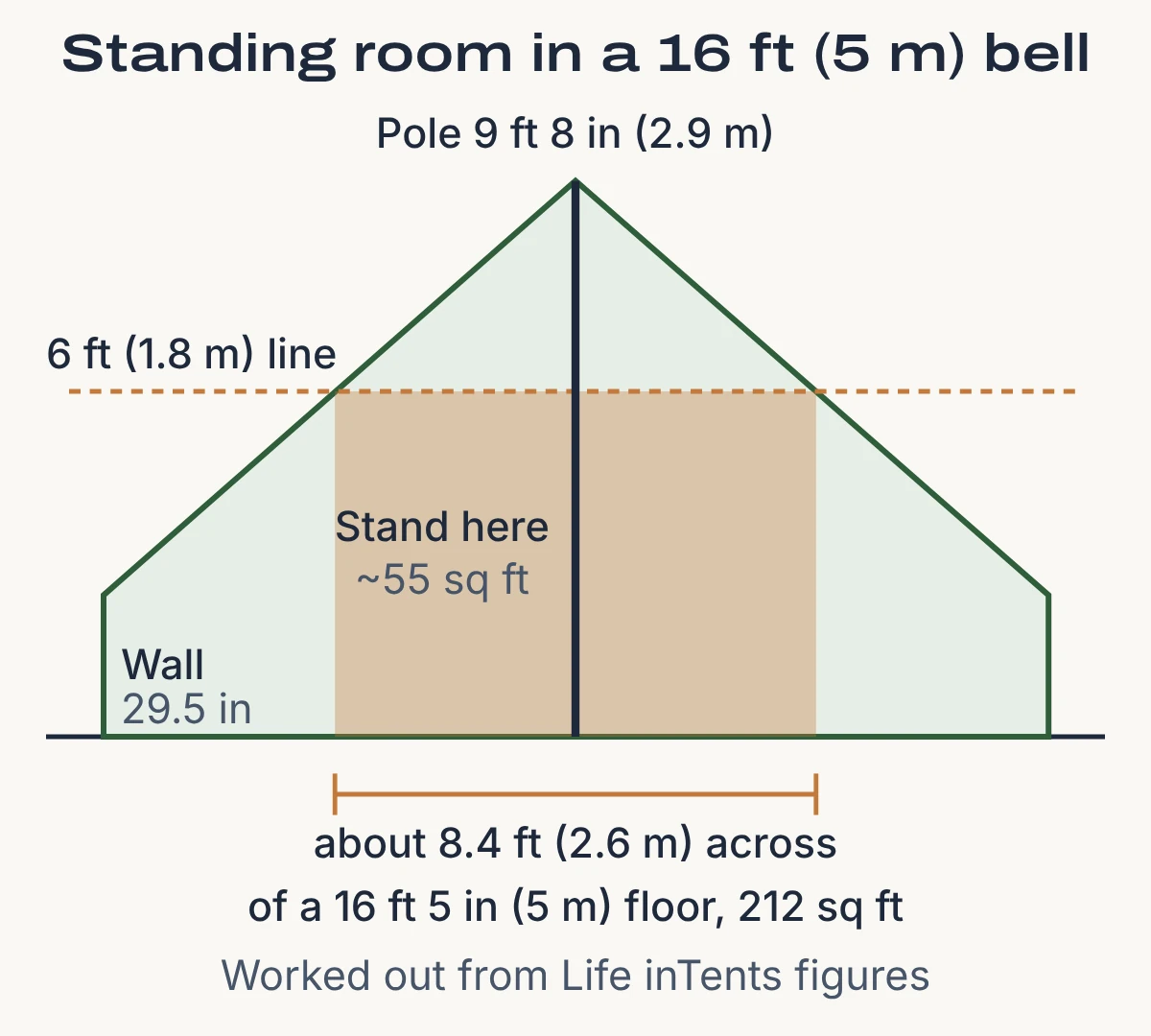
Worked out from Life inTents’ figures for its 16 ft bell (9 ft 8 in center pole, 29.5 in walls), the roof clears 6 ft (1.8 m) over a circle only about 8.4 ft (2.6 m) across: roughly 55 sq ft, a quarter of the 212 sq ft floor. The same sum for its 20 ft bell (11 ft 4 in pole, 31 in walls) gives about 110 sq ft, or 38% of the floor. In practice, cots go against the low walls, and the standing room in the middle is where you dress and cook.
Leaving room for a wood stove
A stove takes more than its own footprint. Life inTents suggests “a sleeping bag-size space” for it, “roughly three feet in front and three feet behind the stove,” and notes that a stove sits closer to the wall than the center so the pipe can pass through the stove jack. The jack’s position is fixed by the maker (Elk Mountain puts it in the front right corner of the roof on its wall tents), so draw your layout around it. Kodiak Canvas advises buying the jack with the tent: “A factory-installed jack is properly reinforced and positioned; an aftermarket cut is a permanent modification that can compromise the canvas around the opening.”
Tent size also sets the stove size. Life inTents’ rule is that a stove’s “firebox should have roughly a cubic inch of space for each cubic foot of your tent”, and it warns that a tent can be “too small to equip with a wood stove, which can lead to producing too much heat or even smoking you out.” White Duck adds that “A larger space does take more heat to stay warm.”
Safety
Elk Mountain Tents warns that “Stoves, yes even wood-burning ones, produce carbon monoxide and other harmful gasses that need to be vented outside the tent,” and that “The remedy is NOT to just open the door and windows.” Run a wood stove only with its pipe out through the tent’s stove jack. Elk Mountain also says to watch it: “Would you make a big fire outside and then leave it for hours unattended while you go hunting? Of course not! The same is true for a fire that’s quite literally inside your tent.” It advises “using dry, seasoned wood for fuel” and to “avoid using accelerants such as gasoline or lighter fluid to start the fire.” None of the sources cited here says a wood stove may be left burning while everyone sleeps; the stove maker’s manual governs overnight use, clearance and fuel. Asked whether a tent stove can go in a regular nylon tent, Elk Mountain answers “No, definitely not, even if you try to install a stove jack.”
Safety
The CDC says “Don’t cook or burn anything on a stove or fireplace that isn’t vented” and that “People who are sleeping, drunk, or under the influence of other substances can die from CO poisoning before they have symptoms.” It adds: “Infants, the elderly, and people with chronic heart disease, anemia, or breathing problems are more likely to get sick from CO.” The CPSC says “Never use fuel-burning portable heaters or lanterns while sleeping in enclosed areas such as tents, campers and vehicles,” and “Know the symptoms of carbon monoxide poisoning: headache, dizziness, weakness, nausea, vomiting, sleepiness, and confusion.” Elk Mountain advises carrying a carbon monoxide detector; the CDC’s advice for homes is a “battery-operated or battery back-up” detector. The CPSC also says: “See a doctor if you or a member of your family develops cold or flu-like symptoms while camping.”
Choosing between two sizes
Most makers lean toward the bigger tent. Colorado Tent says “When in doubt, size up: the extra square footage costs little and it changes the camp when everyone is inside all day in bad weather,” and Kodiak Canvas advises “Size to your longest, most demanding trip rather than your average weekend.”
The smaller size wins when:
- One person pitches it. Life inTents warns against “an oversized tent that is too cumbersome or complicated for one person to set up.”
- Weight matters. Life inTents lists its 4 m bell at 60-80 lb (27-36 kg) with poles and its 5 m at 90-105 lb (41-48 kg).
- The site is tight. Check the guy-line footprint from step 5 against the campsite pad.
- You heat it. A bigger tent needs a bigger firebox and more wood, as above.
If both sizes fit your worked range, take the larger one for stove use and bad-weather days inside, and the smaller one for short summer trips you pitch alone.
Sizing for one or two people
Small canvas tents exist, but makers rarely recommend them with a stove. Airdrie Canvas says its 8 x 10 ft “will be good for 2 cots at the most” if you run the stove, Davis Tent rates a 10 x 10 ft “for 1 or 2 people”, and Life inTents puts a two-person canvas tent at about 51 sq ft (4.7 m²), pointing to cabin-style tents from makers such as Kodiak and Springbar.
If you carry the tent yourself, canvas is the wrong material for the job. Elk Mountain Tents says “if you need to pack your tent in by yourself (i.e. no four-wheeler or horse), then a canvas tent is not the right fit for you.” For a tent you carry, our two-person backpacking tent roundup compares lightweight nylon and polyester tents instead; none of them takes a stove, so for a hot tent you can carry, see the nylon tipis in our hot tent roundup below. Our guide to tent materials sets out what canvas trades for its weight, and our guide to the types of camping tents explains bell, wall and hot tents.
Ready to buy?
Our hot tent roundup compares canvas cabins, a 16 ft canvas bell and lighter tipis that take a wood stove.
Frequently Asked Questions
Q. How many people fit in a 5 m bell tent?
Life inTents rates its 16 ft (5 m) bell at 6-8 and says eight adult sleeping bags is the most it fits; Stout Tent says 3-6. With cots and a stove, the 30-40 sq ft rule gives four or five on its 212 sq ft (worked out).
Q. What size wall tent do four hunters with a stove need?
Worked out by the rule, about 155 to 200 sq ft (14-19 m²). A 13 x 13 ft is the tight end (Elk Mountain rates it 3-4 with a stove); a 14 x 15 ft or 13 x 16 ft gives the roomier end.
Q. How much floor does a camping cot take?
Elk Mountain Tents puts the average cot at 32 x 76 in, about 17 sq ft (1.6 m²); White Duck says a cot takes “approximately 17-24 square feet” (1.6-2.2 m²).
Q. Is a 4 m bell tent big enough for a family of four?
Without a stove, yes on Life inTents’ chart (4-6, or 3-4 cots), though Stout Tent rates it for 1-3. With a stove, Elk Mountain suggests two people in its 13 ft bell, so a family of four with a stove fits the rule better in a 5 m.
Q. Can I add a stove to any canvas tent?
Only to a tent made for one: makers build in a reinforced stove jack, and Kodiak Canvas warns that cutting your own “can compromise the canvas around the opening.” Elk Mountain also advises nothing smaller than 13 x 13 ft for a wall tent with a stove, unless you plan on only two cots.
Sources (16)
- Elk Mountain Tents, Canvas Tent Sleeping Capacity
- Elk Mountain Tents, How to Choose the Right Canvas Wall Tent
- Elk Mountain Tents, Tent Specs & Features
- Elk Mountain Tents, Safety Precautions for Using a Canvas Tent Stove
- Life inTents, The Ultimate Bell Tent Size Guide
- Life inTents, Camping Tent Size Guide
- Life inTents, Top 5 Mistakes to Avoid When Buying a Canvas Tent
- Life inTents, How to Select the Right Tent Stove
- Kodiak Canvas, Canvas Wall Tent Buying Guide
- White Duck Outdoors, What Wall Tent Size Should You Buy?
- Stout Tent, The Ultimate Guide to Comparing Canvas Tents
- Colorado Tent Company, Wall Tent Size Guide
- Davis Tent, Choosing the right size wall tent (sponsored post on RMEF Media)
- Airdrie Canvas, Wall Tents: How to choose your perfect size
- CDC, Carbon Monoxide Poisoning Basics
- CPSC, Portable Heaters & Camping Equipment
