The short answer
Tie the line straight to the lure’s eye with an improved clinch or Palomar for a snug connection, or use a loop knot such as the Rapala or non-slip mono knot when the lure should swim freely. Some lures come with a split ring to tie to, and snaps and swivels are add-ons for particular jobs.
Which connection is right depends on the lure and the line. A snug knot and a loop knot let a lure move differently. The tackle maker Rapala and Coastal Angler magazine both describe a loop knot as letting the lure move freely, and a fishing lodge says a snug knot limits a crankbait’s wobble.
The steps follow named sources pass by pass, and where sources give different turn counts, the text says who says what.
What you need
- The lure, with its eye or split ring.
- Fresh line or leader. Rapala’s Sufix guide describes its loop knot for monofilament, and other sources below cover fluorocarbon and braid.
- Line clippers or scissors for trimming the tag end.
- Water, or saliva, to moisten the knot. Rapala says: “Remember to wet the line before tightening! Tightening a knot on a dry line reduces tensile strength significantly.”
Snug knot or loop knot: choose by the lure
Coastal Angler Magazine puts the trade-off in one sentence: with a loop knot “you give up a bit of strength in comparison to snug Palomar or uni knots, but you’re trading it for lifelike lure action.” Animated Knots says the loop in the non-slip mono knot works because it “doesn’t grip the lure,” which gives “a flexible attachment and allows a more natural action.”
Vermilion Bay Lodge, a fishing lodge on Eagle Lake in Ontario, publishes its own rules of thumb for which lures to tie straight to the line without a snap or swivel: spinnerbaits, buzzbaits, jigs and surface plugs such as the Jitterbug, Zara Spook and poppers, plus crankbaits that have an attached split ring, which are tied to the ring. For a crankbait with no ring that you still want to tie straight to the line, it says to “use a loop knot.” To limit the action for a more subtle presentation with less wobble, especially in cold water, it says to “tie directly onto the front loop with a snug knot.” Coastal Angler says the loop “allows a little more movement when you’re working lures like jigs, topwaters and plugs.”
Related guide: How to Tie a Tent Knot: Taut-Line Hitch, Half Hitches and Bowline
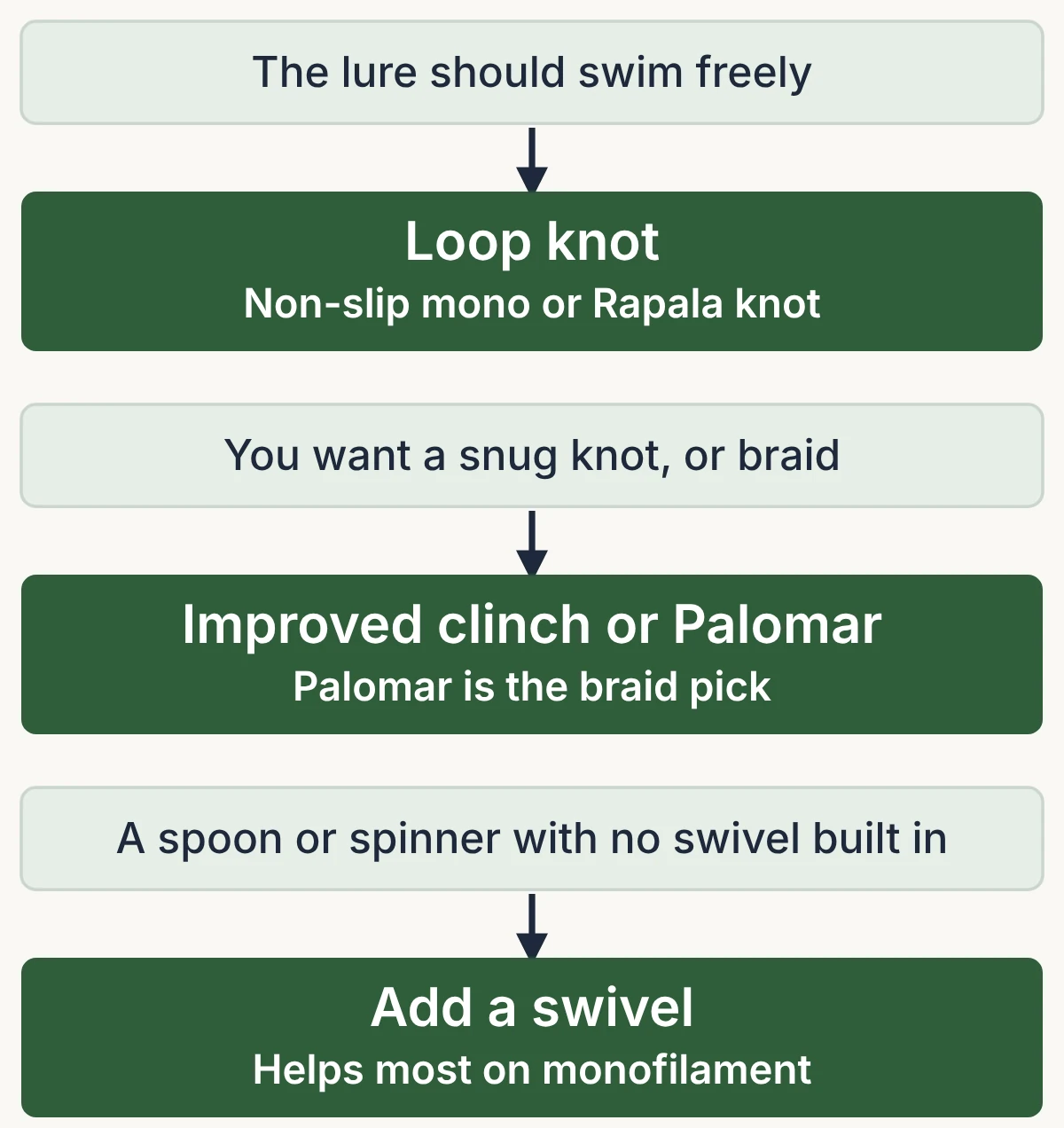
| Connection | Use it when | Line, by source | Trade-off |
|---|---|---|---|
| Improved clinch | You want a snug knot against the eye | Utah DWR says it works for all types of line; Animated Knots and Berkley do not recommend it over 30-pound test | Lowe Boats: “Arguably the easiest fishing knot to tie” |
| Palomar | You tie braid, or a large hook or lure | Braided line (Utah DWR, Rapala) | The lure or hook has to pass through the loop (Animated Knots) |
| Non-slip mono knot | The lure should move freely | Monofilament and fluorocarbon (Coastal Angler) | Gives up a bit of strength against snug knots (Coastal Angler) |
| Rapala knot | Wobblers (plugs) and finesse presentations (Rapala) | Monofilament (Rapala, Sufix) | Tag end faces away from the hook (Animated Knots) |
| Split ring or snap | Split ring: tie to the ring the lure comes with. Snap: a crankbait with no ring, or trolling or drifting where snags are unlikely (Vermilion Bay Lodge) | Uni on mono or Palomar on braid for split rings (Rapala); Trilene knot for snaps (Berkley) | Hardware can dull lure action (Vermilion Bay Lodge) |
Tie a lure with an improved clinch knot
The improved clinch is the knot the Illinois Department of Natural Resources calls “an old standby” in its knot leaflet, and the U.S. Fish & Wildlife Service’s beginner pamphlet teaches it, with the Palomar, for tying on a hook. Sufix lists it as “a good method of securing a fishing line to a hook, lure or swivel.”
Thread the line through the eye of the lure
Pass the end through the eye or split ring and leave at least 6 inches (15 cm) of tag end, as the Illinois DNR leaflet says. Lures carry sharp hooks, so follow the U.S. Fish & Wildlife Service’s pamphlet: “Be careful when handling sharp hooks.”
Wrap the tag end around the standing line
Illinois DNR gives turns by line weight: “making six turns with light (2-6 lb.), five turns with medium (8-12 lb.) or four turns with heavy (14-20 lb.) line” (about 1 to 3, 3.5 to 5.5 and 6 to 9 kg). The U.S. Fish & Wildlife Service pamphlet says 5 turns, and Berkley says to twist five to seven times. Berkley adds that the coils must not overlap.
Pass the tag end through the small loop beside the eye
This is the loop formed right at the eye, between the eye and the first wrap. The U.S. Fish & Wildlife Service words it as inserting the loose end “between eye and first loop formed.”
Pass the tag end back through the big loop
Take it through the larger, second loop that step 3 created. This is the extra tuck that makes the knot “improved.”
Moisten, tighten and trim
Wet the knot, then hold the tag end between thumb and index finger and pull on the standing line slowly so the coils close against the eye, as the U.S. Fish & Wildlife Service describes. Trim the tag end.
Animated Knots and Berkley both say the improved clinch is not recommended over 30-pound test line (about 14 kg), because it gets hard to tie. Utah’s Division of Wildlife Resources says moisture “reduces friction heat that can cause the fishing line to stretch and weaken.”
Tie a loop knot so the lure can move
Animated Knots calls the non-slip mono knot, which Lefty Kreh developed, “a very strong fixed loop in the end of a line.” Animated Knots quotes Kreh on the tag end, which faces the hook “so it doesn’t catch grass and other things on the retrieve.” Coastal Angler calls the Kreh knot “a tad easier to tie” than the Rapala knot, which it says “might be a little stronger.”
Tie a loose overhand knot in the line
Leave a generous tag end. Sufix’s illustrated Rapala-knot guide leaves 5 inches (13 cm) of free end. Do not pull the overhand knot tight.
Pass the tag end through the eye of the lure
Keep your fingers clear of the hooks and handle the lure as the U.S. Fish & Wildlife Service advises: “Be careful when handling sharp hooks.”
Pass the tag end back through the overhand knot
Animated Knots words these two passes as: “pass the tag end through the eye, then back through the overhand knot.”
Wrap the tag end around the standing line, then back through the overhand knot
Animated Knots says to wrap “about five times” and pass the tag end “back through the overhand knot,” and gives turns by line test in the table below.
Set the loop before you tighten
Animated Knots says “The size of the loop must be adjusted while the turns are still loose. Once tightened the size of the loop is fixed.” Animated Knots says for the Rapala knot that “A long enough loop should be left to ensure that the lure is not gripped.”
Moisten, tighten and trim
Wet the knot, tighten it and trim the tag end, as Animated Knots says: “Lubricate, tighten, and trim the end.”
| Line test | Turns (Animated Knots) |
|---|---|
| 6 to 8 lb (2.7 to 3.6 kg) | 7 |
| 8 to 12 lb (3.6 to 5.4 kg) | 5 |
| 15 to 40 lb (6.8 to 18 kg) | 4 |
| 50 to 60 lb (23 to 27 kg) | 3 |
| Over 60 lb (27 kg) | 2 |
Animated Knots lists 8 lb in two rows, 7 turns for 6 to 8 lb and 5 for 8 to 12 lb, so check the weight of your line against both. The table skips 13 to 14 lb and 41 to 49 lb; Animated Knots gives no count for those.
The Rapala knot is the same idea with a different wrap count and one more tuck. Animated Knots gives it as: “Form an overhand knot in the line. Pass the tag end through the eye and back through the overhand knot. Wrap the end three times around the standing end. Pass the end back through the overhand knot and then through the loop just formed. Lubricate and tighten the knot. Trim the end.” Animated Knots adds that Kreh found the extra tuck “made it harder to tie and added no strength,” and that the Rapala knot’s tag end “faces away from the hook and therefore has a greater tendency to catch grass.”
Rapala’s knot guide says the Rapala knot is “a solid, non-tightening tackle knot to be used with monofilament lines,” and the Sufix guide says the loop “allows the lure to move freely and naturally.” Coastal Angler says the Kreh knot “works well with both monofilament and fluorocarbon lines.” None of these pages describes the loop knot for braided line, so if you fish braid, tie the loop knot in a mono or fluorocarbon leader (our reading of those guides; none says this in so many words; see the leader section below for the knot that joins it to braid).
Tie a lure to braid with the Palomar knot
Rapala’s guide says the Palomar is “recommended by many famous fishing gear brands such as Sufix to be used with braided lines,” and Utah’s wildlife agency says it works especially well on large hooks and braid. Sources give different loop lengths: the U.S. Fish & Wildlife Service starts with 4 inches (10 cm) of doubled line, while Berkley and the Illinois leaflet use about 6 inches (15 cm).
Double the line and pass the loop through the eye
Fold 4 to 6 inches (10 to 15 cm) of line back on itself and push the loop through the eye of the lure. Make the loop large enough, because Animated Knots says “the fly or hook has to pass through the loop.”
Tie a loose overhand knot in the doubled line
Let the lure hang free. The U.S. Fish & Wildlife Service says: “Don’t twist or tighten line.”
Pass the loop over the lure
Pull the loop down, passing it completely over the lure and its hooks, as Berkley says for the hook. Handle the lure with care: the U.S. Fish & Wildlife Service says “Be careful when handling sharp hooks.”
Moisten, pull slowly and trim
Wet the line, then pull the loose end and the standing line slowly to tighten. The U.S. Fish & Wildlife Service says: “Hold the hook carefully.” Clip the loose end.
Snaps, split rings and swivels: when to add hardware
- Split rings. Many lures carry one. Vermilion Bay Lodge says to tie crankbaits that have attached split rings to the ring. Rapala says its Uni and Palomar knots attach “leaders, locks and split rings.”
- Snaps. Vermilion Bay Lodge uses a snap or snap-swivel in two cases: crankbaits with no attached split ring, and lures or live-bait rigs trolled or drift-fished where you won’t run into snags (a smooth bottom, or open water when fish are suspended). Berkley says its Trilene knot is “suitable for attaching line to snaps, swivels, hooks, and lures.” Vermilion Bay Lodge says “Snaps, swivels or snap-swivels negatively affect the actions of many lures.” Animated Knots advises that if a swivel or leader is essential, “it is best to choose the lightest tackle possible to allow the lure to move with a natural motion.”
- Swivels. Vermilion Bay Lodge uses them for lures that can twist the line, naming in-line spinners and spoons that don’t already have an attached swivel. SaltStrong, a fishing media site that also runs a tackle store, reported its own experiment: “if you’re using monofilament as your main line, then it’s a very good idea to use a swivel when fishing with a spoon or any other lure that is prone to twist up your line,” but with braid “it doesn’t seem necessary to use a swivel because the braid is just too flexible for the swivel to do much good until significant twisting has already occurred.”
Add a leader between the line and the lure
A leader is a length of line, often mono or fluorocarbon, tied between the main line and the lure. Berkley says the Uni to Uni knot suits “attaching a fluorocarbon or monofilament leader to your superline mainline.” Sufix calls the double uni: “The best knot for joining together two fishing lines of approximately the same diameter.” Rapala’s guide says the FG knot is “the slimmest connection knot,” which suits long leaders that must travel through the rod guides.
Related guide: How to Tie a Fishing Rod Knot: Reel Spool to Hook
Tie the lure to the leader with any knot above, then join the leader to the main line with a double uni knot; Berkley’s Fishing Knots 101 shows the Uni to Uni in five steps. Berkley overlaps the lines about 6 inches (15 cm) and makes 6 to 8 turns on each side, while Sufix’s illustrated guide overlaps about 12 inches (30 cm) with five wraps, so use one maker’s version for both knots.
Mistakes to avoid
- Tightening a dry knot. Rapala’s guide says dry-line tightening “reduces tensile strength significantly.” Moisten every knot.
- Setting the loop too small. Animated Knots says the size of the loop is fixed once the knot is tightened, so set it while the turns are loose (step 5 above). A loop set too small can grip the lure.
- Overlapping coils. Berkley says to be careful that the coils do not overlap in the improved clinch.
- Using the clinch on heavy line. Animated Knots and Berkley both advise against it over 30-pound test.
Note
Depending on where and how old you are, you may need a license to fish. The U.S. Fish & Wildlife Service’s pamphlet says: “Depending on your age and your state, you may need one to fish legally.”
Ready to buy?
Our roundup of the best bass lures for winter lists lures worth tying on, and our best bass topwater lures roundup covers the surface plugs that Vermilion Bay Lodge says to tie on without a snap or swivel.
If you also need new line for the leader or main line, our roundup of trout fishing lines compares monofilament, fluorocarbon and braid.
Frequently Asked Questions
Q. What is the easiest way to tie a lure?
Lowe Boats calls the improved clinch arguably the easiest fishing knot to tie, and the U.S. Fish & Wildlife Service teaches it, with the Palomar, for tying on a hook. For a loop that lets the lure swim freely, Coastal Angler calls the Kreh (non-slip mono) knot a tad easier than the Rapala knot.
Q. What is the best knot for lures?
Sources do not name one winner. Rapala and Coastal Angler point to loop knots for lure action, while Utah’s wildlife agency and Rapala point to the Palomar for braid. Match the knot to the lure and the line using the table above.
Q. Do you use swivels with lures?
Not always. Vermilion Bay Lodge uses them for lures that twist the line and avoids them where it can. SaltStrong’s own test found a swivel helps on monofilament, but on braid does little until many twists have built up.
Q. How do I set up my lure fishing line?
Put the line on the reel, add a leader if you want one, then tie the lure with the knot that fits it. The leader section above names the knot and links Berkley’s step-by-step guide for joining the leader to the main line.
Q. How do I tie a lure to a leader?
Use the same knots you would use on main line: the improved clinch, Palomar or a loop knot, as sourced above. Join the other end of the leader to your main line with a double uni knot, using the Berkley steps linked in the leader section.
Q. Does the knot change for bass, trout or surf fishing?
The sources used here choose knots by lure type and line type, not by species. Vermilion Bay Lodge’s rules sort by lure. For bass, our roundup of the best bass lures for winter covers what to tie on.
Sources (15)
- Illinois Department of Natural Resources, Knot-Tying Guide
- U.S. Fish & Wildlife Service, Fishing is fun for everyone: it’s easy to learn how
- Utah Division of Wildlife Resources, Learn to fish: tying the knot
- Animated Knots, Non-Slip Mono Knot
- Animated Knots, Rapala Knot
- Animated Knots, Uni Knot
- Animated Knots, Improved Clinch Knot
- Animated Knots, Palomar Knot
- Rapala, Knot tying guide
- Sufix (Rapala), Sufix knot tying guides
- Berkley, Fishing Knots 101
- Coastal Angler Magazine, The Kreh Knot: Best Loop Knot For Lures
- Vermilion Bay Lodge, Direct tie ons? How to
- SaltStrong, Should you use a swivel with a spoon?
- Lowe Boats, Types of Fishing Knots and How to Tie Them