The short answer
Tie a taut-line hitch where the line needs adjusting, a round turn and two half hitches to fasten a line to a stake, and a bowline where you need a fixed loop. Animated Knots warns that a clove hitch should not be used alone, because it slips and can bind.
Two or three knots cover almost every tent job: tightening a guy line, fastening it to a stake, and making a loop. This guide gives the steps for each from the maker or knot reference that describes them, and says where the sources differ.
It is about tying the knots. How to position guy lines and stakes is covered in separate guides, and fishing knots are a different set.
What you need
- A guy line or cord with a free end long enough to work with. Zpacks, an ultralight shelter maker, says to leave “a long tail to work with” for its taut-line steps.
- A stake, post or other anchor. A tent that is not freestanding needs stakes or guy lines to take shape, as our guide to types of camping tents explains, and stakes and guylines are on our camping packing checklist.
Which knot for which job
| Knot | Use it for | Watch for |
|---|---|---|
| Taut-line hitch | A guy line you adjust | Slides when you push it |
| Round turn and two half hitches | Line to a stake or post | Tie both half hitches the same way |
| Bowline | A fixed loop | Can work loose with no load |
| Clove hitch | Quick, temporary hitch | Slips and can bind |
Zpacks says the taut-line hitch “is best utilized to secure guy lines on tents or tarps.”
How to tie a taut-line hitch (adjustable)
MSR, which makes tents, calls the taut-line “a rolling hitch knot” that “can be adjusted to increase or slacken tension on an anchored line.” The steps below are MSR’s.
Take the rope around the anchor
MSR says to pass the rope around an anchor point and run the free end parallel to the standing line, and Zpacks says to start with a long tail.
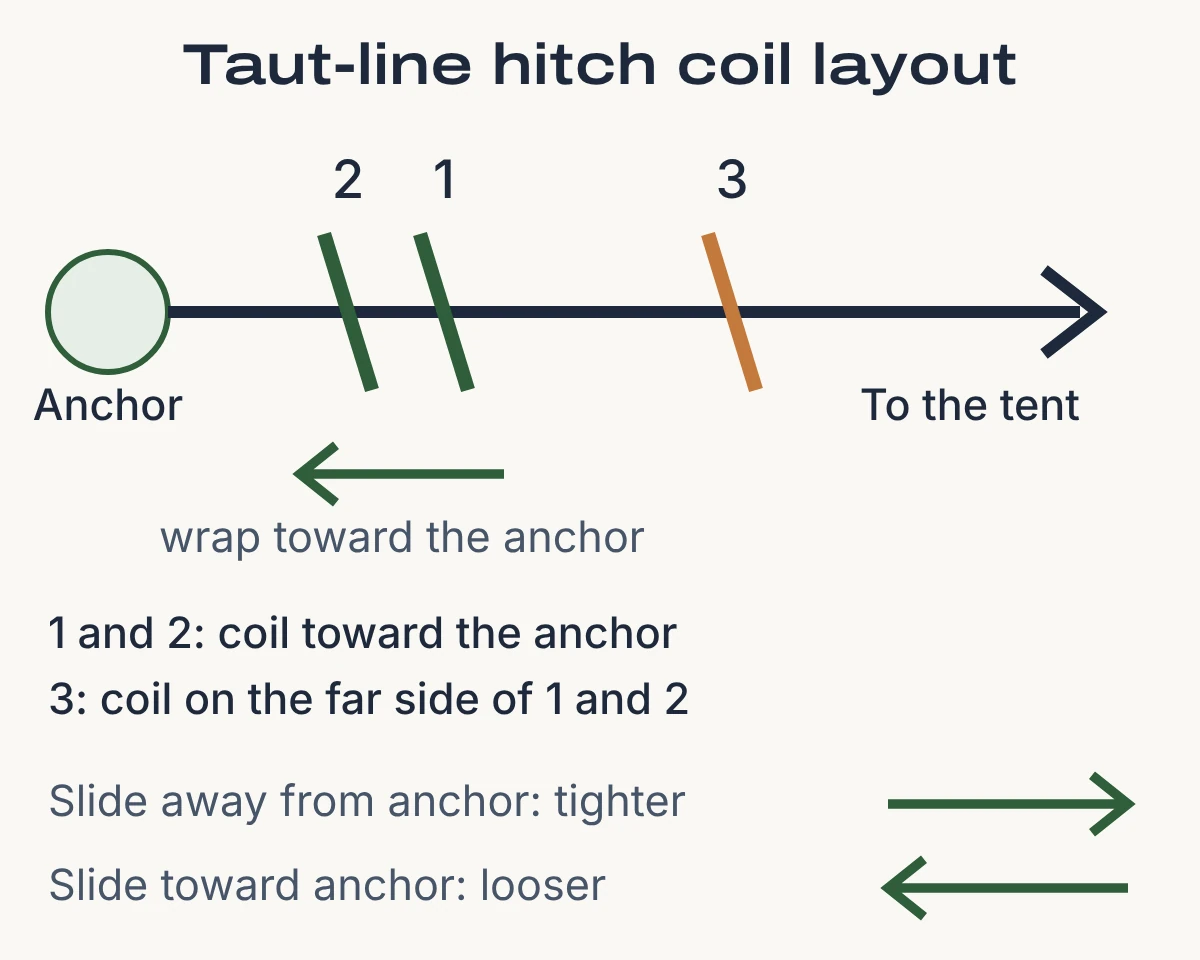
Make two coils toward the anchor
MSR: “Coil the free end around the standing line twice, each time looping back toward the anchor.”
Make the third coil on the far side
MSR: “Make a third coil around the standing line this time on the far side of the two coils just made. Loop it toward the anchor, threading the free end between the first coils and this third one.”
Dress and tighten
MSR: “Dress the knot, removing any kinks or twists of the rope.” Then pull the free end to fully tighten it.
Slide to adjust
MSR: “To tighten the line, slide the hitch away from the anchor point” and “To loosen it, slide the hitch toward anchor point.”
Snow Peak, another tent maker, gives its “Taught line hitch” in a different order: it loops the guyline through or around a stake, wraps once around the long end, then “wrap the short end twice more,” and does not say which side. MSR puts two coils first, toward the anchor, then one on the far side; this guide follows MSR. Animated Knots gives a similar tensioning knot, the Adjustable Grip Hitch, for “a tent ridgeline or a guy-line,” and cautions that it “should be avoided for critical applications such as climbing since it may slip when shock loaded.” Use these hitches to tension tent and tarp lines, not for climbing or anything a person’s safety hangs on.
Related guide: How to Put a Tarp Over a Tent
How to tie a line to a stake: round turn and two half hitches
Animated Knots gives the two half hitches as: “Pass the rope around the pole, around itself, and then between the ropes to make a Half Hitch. Go around the rope again to make the second Half Hitch.” It prefers the version with a round turn first, which it calls an “Excellent way of securing a rope to a post or ring.”
Take two passes around the stake
Animated Knots: “Pass the end around the post twice. This takes the strain while you tie the knot.”
Make the first half hitch
Go around the standing end, then pull it tight.
Make the second half hitch in the same direction
Animated Knots: “Continue around in the same direction to make the second Half Hitch. Pull tight to complete the knot.” Pull tight again before you let go.
Do not stop at a plain clove hitch. Animated Knots says “It does have two giant faults: it slips and, paradoxically, can also bind,” and “The Clove Hitch is not a knot to be used alone.”
Note
The National Park Service’s Alaska Leave No Trace page says: “Use tent stakes to tie down tents and shelters instead of tying off to trees.” Parks differ, so check the rules for where you camp.
How to tie a bowline (fixed loop)
Zpacks says a bowline can be used to “stake out your tent or tarp.” Animated Knots says: “Under load, it does not slip or bind.”
Form a small loop
Animated Knots: “Form a small loop leaving enough rope for the desired loop size.”
Pass the end through it
“Pass the end of the rope through the loop as though making an overhand knot.”
Go around the standing end and back down
“Continue around the standing end and then back through the small loop.” Zpacks says “Pull both ends to tighten.”
Animated Knots warns that a bowline “cannot be tied, or untied, when there is a load on the standing end,” and that “When a Bowline is unloaded, it can very readily work its way untied.” Check any bowline that has been left slack.
A trucker’s hitch for tarps
Animated Knots describes the trucker’s hitch as a “Valuable knot usually used for securing loads or tarpaulins.” It gives the pull a theoretical 3:1 advantage but says “In practice the mechanical advantage is much less, may be more like 1.6:1.” Its steps start with a figure-8 loop that this guide does not teach, so see Animated Knots for them.
Common mistakes
- Tying only a clove hitch to a stake. Use the round turn and two half hitches above instead.
- Half hitches in opposite directions. Animated Knots says to always tie them in the same direction.
- Trusting a slack bowline. Animated Knots says an unloaded one can work its way untied.
If you are shopping rather than tying, we compare tents in our roundups of the best 2 man backpacking tents and the best tents for winter.
Ready to buy?
If your tent needs replacing, start with our 2 man backpacking tent roundup.
Frequently Asked Questions
Q. What is the best knot to tie a tent line?
The taut-line hitch, according to MSR and Zpacks, because you can slide it to adjust tension. For the stake end, use a round turn and two half hitches, which Animated Knots calls an “Excellent way of securing a rope to a post or ring.”
Q. How do you tie a sliding knot for a tent?
That is the taut-line hitch: coils around the standing line that you push along it. The steps are above.
Q. How do you tie a knot to secure a tent to a stake?
Use a round turn and two half hitches, tying both in the same direction.
Q. Is a clove hitch good enough for a tent?
Animated Knots says it is not a knot to be used alone, because it slips and can bind.
Q. Can I tie a tent to a tree?
The National Park Service’s Alaska page says to use tent stakes instead of tying off to trees. Check local rules.
Q. What knot do I use for a tarp or canopy tie-down?
Animated Knots names the trucker’s hitch for securing loads or tarpaulins; it does not mention canopy tents, so check the canopy maker’s tie-down instructions.
Sources (10)
- MSR, Best Camping Knot: How to Tie the Taut-Line Hitch Knot
- Zpacks, Need to Know Knots for the Backcountry
- Snow Peak, Knot Tying Guide
- Animated Knots, Two Half Hitches
- Animated Knots, Round Turn and Two Half Hitches
- Animated Knots, Clove Hitch
- Animated Knots, Bowline
- Animated Knots, Trucker’s Hitch
- Animated Knots, Adjustable Grip Hitch
- National Park Service, Leave No Trace in Alaska