The short answer
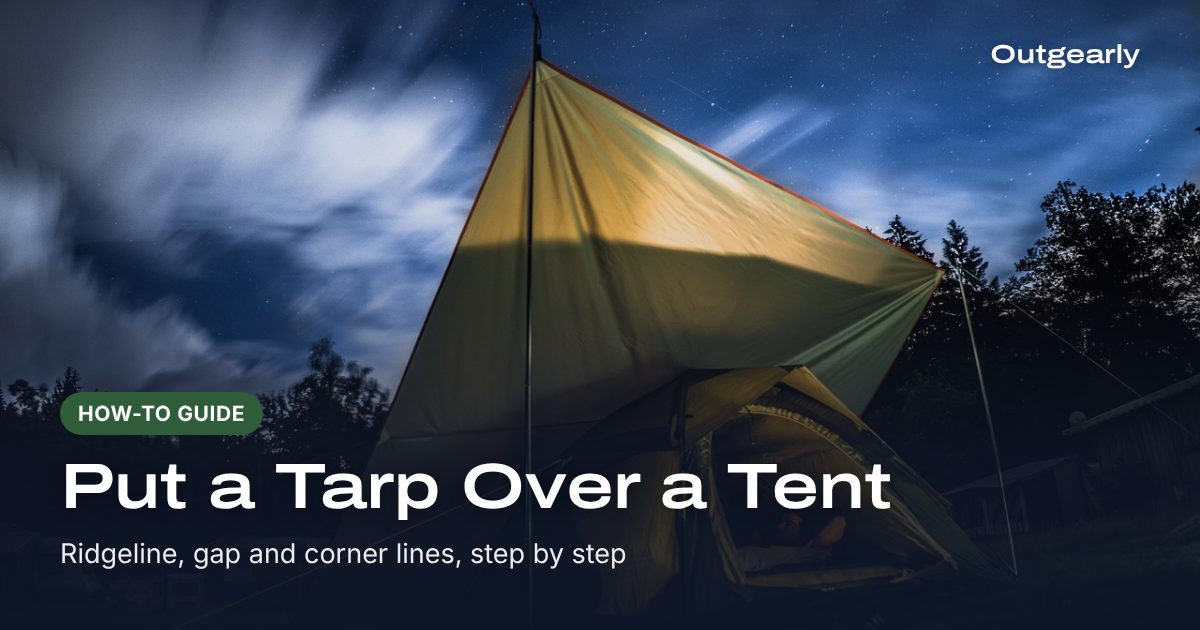
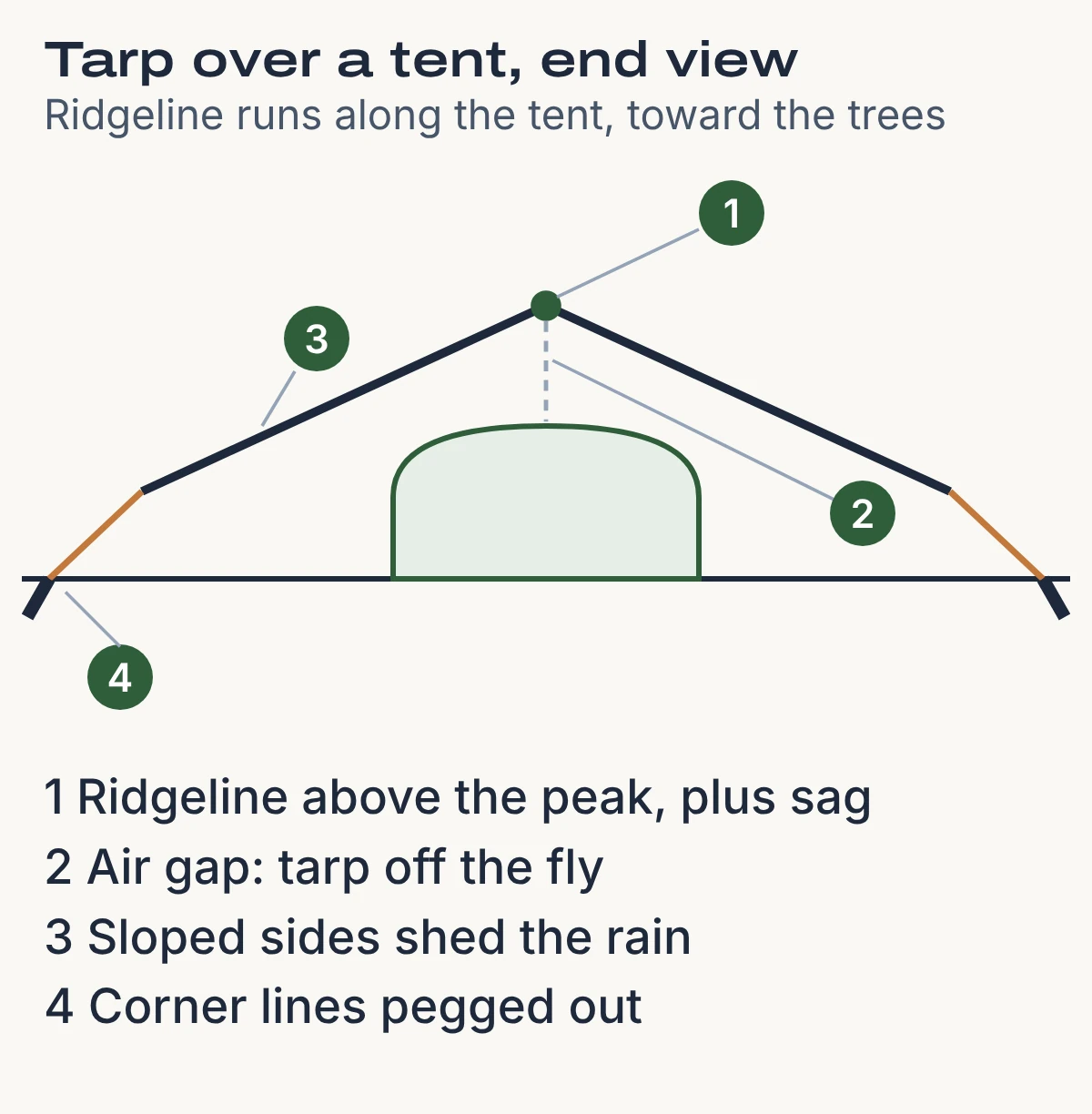
Hang a ridgeline a foot or two above the tent’s peak, between two sturdy trees if the campground allows ropes on trees, or between two poles if not. Drape the tarp over it, peg the corners out taut so rain runs off, and keep the tarp clear of the tent fly.
Why not just lay a tarp on the fly? One r/camping commenter says it does little: “you will still conduct the cold and so will still get condensation”. A tarp earns its place when it hangs above the tent, catches the rain and leaves air between the two layers.
Sources disagree on heights and gaps, so each number is shown with its source. None of the pages we read gives a pitch angle in degrees, so this guide does not either.
What you need
- A tarp with grommets or tie-out loops at the corners. Scandinavian Outdoor, a European outdoor retailer, calls “around 3×3 m” a common size for a shelter tarp (about 10 by 10 feet); Outdoor Family, a family camping blog, uses a 16 by 20 foot (4.9 by 6.1 m) tarp over its living area. Lay yours out beside the tent first to see what it covers.
- Ridgeline cord, longer than the gap between your anchors. Outdoor Family uses two 6 mm, 50 foot (15 m) ropes for its large tarp.
- A guy line for each corner, and a stake for each one.
- Two anchors: two strong trees, or two poles (trekking poles or tent poles, per My Open Country, an outdoor-gear site).
- Two knots: a bowline and a taut-line hitch. Steps 3 and 4 link to NetKnots pages with pictures and animations.
- Your tent, pitched after the tarp is up.
Which setup suits you
| Setup | Good for | Source |
|---|---|---|
| Ridgeline between two trees, tarp draped over it (A-frame) | Most camps with two trees in reach | My Open Country, Wilderness Times |
| Ridgeline between two poles | No suitable trees, or a campground that does not allow ropes on trees (NPS) | My Open Country, Scandinavian Outdoor, NPS |
| Small tarp over the tent door only | Small sites, or no trees suitable for a large tarp | Outdoor Family |
| Lean-to: one side to the ground, one side raised | Shielding one side, such as a windowed side | Wilderness Times |
| Tarp laid directly on the fly | Not recommended: it does not stop contact condensation | r/camping commenter |
Pitching a tarp over a tent between two trees
Choose the spot, look up and check the wind
Outdoor Family lists “Clear drainage points, preferably down slope from important living areas” first, and My Open Country says to “keep wind direction in mind”. Then look into the canopy over the whole tarp and tent area. A 2019 National Park Service release about burned forest at Crater Lake says: “Dead or damaged trees can fall at any time and without warning.” Park staff there “recommend that visitors avoid these burned areas because of the risk posed by standing dead trees”. If you see dead limbs or a dead tree overhead or beside the site, pick another spot. The National Weather Service advises: “Listen to the weather forecast for the outdoor area you plan to visit.”
Check the rules, pick two strong trees and set the height
The National Park Service says: “Many frontcountry campgrounds do not allow you to tie ropes to trees”. If yours does not, skip to the poles method below. Otherwise follow Outdoor Family: “Choose 2 strong trees on either side of the site.” They need to be far enough apart for the ridgeline to run along the tent with the tarp over it. Leave the tent in its bag for now: Wilderness Times says to put the ridgeline up first because “you’re going to pitch it underneath later”. Height: Wilderness Times says to set the ridgeline “A foot or two above your tent will be just enough”, and not much higher. My Open Country adds that the tarp height should be higher than you think you need, “to allow for sag”. Other sources give other heights for other tarps; see the table below.
Tie the first end with a bowline
My Open Country says a bowline works because it is “extra-secure and easy to adjust”. Pass the cord around the trunk at your chosen height and tie the bowline so its loop closes around the trunk; NetKnots, a knot-reference site, shows the bowline step by step with pictures and an animation. Pull on the finished knot to check it holds.
Tie the other end with a taut-line hitch and pull the line tight
Wilderness Times says to use a bowline for the first tree and, for the other tree, “a taut-line hitch”; NetKnots shows the taut-line hitch, which you tie around the trunk and slide along the standing line (the part running back to the first tree) to adjust tension. Pull the line tight: Scandinavian Outdoor says “Get the ridgeline as tight as you can”. Outdoor Family describes an easier tie-off for a large tarp: wrap the rope around the tree 3-4 times and tie off loosely, “No fancy knot required”, because bark friction holds it.
Tie a guy line to every corner grommet before you lift the tarp
Wilderness Times says to tie guy lines around the grommets first so you can pull the whole thing taut. My Open Country uses the bowline here too: pass the free end through the grommet, then tie it as in step 3, so the knot closes around the grommet.
Drape the tarp over the ridgeline, centered
Spread it evenly on both sides. My Open Country warns that “Rain is likely to pool in any wrinkles or creases”, so pull out wrinkles and overlaps now. If the line is too high, Outdoor Family ties a corner to a guy line, tosses the guy line over the ridgeline and pulls the tarp across.
Peg out the corners and tension them
Run each corner line outward and down to a stake clear of the tent’s sides. My Open Country says: “Peg out and adjust guy line tension to suit.” It says to keep guy lines taut “so rain can flow off the tarpaulin”, which also adds protection against wind. Wilderness Times says a taut-line hitch can also tie guy lines to stakes: tie it around the stake and slide it to tension. Outdoor Family says to “slope the tarp to allow for clear drainage” and to lead the drainage points away from tents.
Keep the lines out of the walkways
Lines at ground level are a tripping hazard. Outdoor Family says to avoid putting guy lines near areas where people walk and, if you cannot, to use “reflective ropes”.
Pitch the tent under the tarp and check the gap
Outdoor Family says to “Set up the tent after you are happy with the tarp” and to put at least the front door, “and preferably the whole front half”, under the tarp for a dry entrance. Then check that nothing touches. One r/camping commenter says “Ideally you want a gap of at least a couple of inches”, and another that “A few inches will do.” If the tarp touches the fly, raise the ridgeline until it clears, or move the corner stakes farther out so the tarp’s sides lift off the tent. Stoves and heaters: the Consumer Product Safety Commission says: “People die every year from carbon monoxide poisoning from the use of portable camping heaters, lanterns, or stoves inside tents, campers, and vehicles.” It adds: “Never use fuel-burning portable heaters or lanterns while sleeping in enclosed areas such as tents, campers and vehicles.” The CPSC page speaks to tents, campers and vehicles, not tarps, so keep stoves and heaters out of the tent and follow your stove maker’s instructions for any clearance beneath a tarp.
Add a drip line
My Open Country defines a drip line as “a length of rope or cord that is attached to the ridgeline to divert water away from your shelter when it rains”. Its instruction: “Using a foot or two of cord, tie a hitch over the tail end of your ridgeline and leave the ends of the cord dangling in space”. The source does not name the hitch; a taut-line hitch from step 4 is one you already know. Tie it on the ridgeline between the tarp’s edge and the tree, one at each end. Then watch the first rain: Outdoor Family warns “With a pool of water on the tarp, it can get heavy very quickly.” If water collects, adjust a corner so the low spot drains.
Know what to do when lightning threatens
The National Weather Service says: “The only completely safe action is to get inside a safe building or vehicle.” For campers it says: “Go to your vehicle! The tent and picnic shelter are NOT safe places. Wait 30 minutes until after the last rumble of thunder before going back to the campsite.” The page does not mention tarps; in our reading, a tarp is open-sided like the picnic shelter it calls unsafe. If you absolutely cannot get to safety, the NWS says you can only “slightly lessen the threat” and “you are NOT safe outside”; its tips include “Stay away from tall, isolated trees or other tall objects.” and “Stay away from water, wet items, such as ropes, and metal objects, such as fences and poles.” That includes a wet ridgeline between trees and trekking poles holding up a tarp. None of the sources we read gives a wind speed at which to take a tarp down, so also follow your tarp and tent makers’ instructions.
How high, and how big a gap
The sources do not agree, partly because they pitch different things. Start from your tent’s peak and your tarp’s size, and adjust to the weather.
| Source | Source type | What it says | What it applies to |
|---|---|---|---|
| Wilderness Times | Camping blog | Ridgeline “A foot or two above your tent” | An A-frame over a tent |
| My Open Country | Outdoor-gear site | Poles “a foot taller than your shelter”, because the tarp sags in the center | A pole-supported A-frame |
| Outdoor Family | Family camping blog | Ridgeline “at least 2 feet higher than the tallest person in your group” | A 16 by 20 foot living-area tarp |
| r/camping commenters | Forum | “A few inches” or “at least a couple of inches” between tarp and tent | The gap between the layers |
If there are no trees
Use this method when no suitable trees are near, or when the campground does not allow ropes on trees. It follows My Open Country’s pole-supported A-frame.
Get two poles, each about a foot taller than your shelter
My Open Country says the poles “should be a foot taller than your shelter as the tarpaulin will sag a bit in the center”. Trekking poles work if they are long enough.
Lay out the lines and the tarp on the ground
You need a ridgeline cord as long as the gap between the pole tops, with a bowline loop in each end (as in step 3; make each loop big enough to slip over a pole tip), and one guy line per pole, each with a bowline loop in one end. My Open Country secures its ridgeline “using a bowline”. Tie a line to each corner grommet as in step 5. My Open Country says a pole’s tip should be “sharp and narrow so that it fits through the tarp grommets”: if yours are, push each tip through the grommet at the middle of each end of the tarp. Then drop the ridgeline loop and the guy-line loop over each tip. (Putting the tarp on the tips before the poles go up is the article’s reading of that sentence.)
Raise the poles
Tie the first guy line to its stake with a taut-line hitch, out in line with the ridgeline, and stand the first pole; then stand the second and tension its guy line with a taut-line hitch around its stake. The lines pulling both ways are what hold the poles up: Wilderness Times notes that poles “can’t stand straight on their own”. With a second person this is easy. Alone, with the tarp on the pole tips, do as Wilderness Times does: “stake one side of the tarp first”, so the poles have something to lean against while you guy them. This order is the article’s own reading of the two sources.
Drape the tarp, if it is not already on the pole tips, then peg out the corners
Follow steps 6 to 8 above: smooth the tarp on both sides of the line, peg the corner lines out and away from the tent’s sides, and keep them out of walkways.
Pitch the tent beneath, check the gap, and add the drip line
Steps 9 to 11 apply, with the pole in place of the tree for the drip line, including the stove and lightning cautions.
Ground tarp or tarp over the tent
These are different jobs. A ground tarp, also called a footprint, goes under the tent to protect the floor. Wilderness Times gives one rule for it: “make sure none of the edges are sticking out from underneath”, because otherwise “water could get in and create a pool beneath”. A tarp above the tent keeps rain off the fly. You can use both.
Related guide: How to Use Tent Stakes
Mistakes and fixes
| Problem | Fix | Source |
|---|---|---|
| Tarp lies on the fly | Raise the ridgeline until the tarp clears the fly, or move the corner stakes farther out so the sides lift off the tent | r/camping commenters (leave a gap); Wilderness Times (ridgeline height) |
| Water pools in the tarp | Smooth wrinkles and slope the tarp so water can leave at a corner | My Open Country, Outdoor Family |
| Ridgeline sags once the tarp is on | Set the line higher than you think it needs to be, and re-tighten the taut-line hitch | My Open Country |
| Corner lines catch feet in the dark | Move them away from walkways, or use reflective cord | Outdoor Family |
| Tent door is exposed | Move the tent so at least its front door, or better its front half, is under the tarp | Outdoor Family |
| Rain still gets in | Check the tent’s seams and fly rather than adding more tarps, and follow the sealer label | Our seam-sealing guide (linked below) |
When the tent is the problem
A tarp is a stopgap for a tent that leaks or sheds water poorly. If seams leak, our guide to sealing tent seams shows how. If the tent keeps failing, our guide to tent materials explains what the fabrics do, and our comparison of a backpacking tent versus a camping tent shows how each style pitches. Waterproofing canvas is a separate job, not covered here; follow the canvas maker’s care instructions.
Ready to buy?
If a tarp is patching over a tent that is too small, too old or too leaky, our roundup of the best two-person backpacking tents compares tents you can pitch with or without a tarp.
Frequently Asked Questions
Q. Can I just throw a tarp over my tent?
You can, but it helps little. One r/camping commenter says a tarp lying on the fly “will still conduct the cold” and give condensation; others advise a gap. Another commenter warns against a tarp so heavy it “collapses your tent”.
Q. How high should a tarp be above a tent?
Wilderness Times says to set the ridgeline “A foot or two above your tent”, and My Open Country adds extra for sag. My Open Country uses poles a foot taller than the shelter. For a larger living-area tarp, Outdoor Family puts the ridgeline at least 2 feet above the tallest person.
Q. How do you put a tarp over a tent without trees?
Stand two poles, such as trekking poles, joined at the top by a short ridgeline and guyed out to a stake at each end, tension the guy lines so they hold the poles up, then drape the tarp over the line and peg the corners. Scandinavian Outdoor says two trekking poles or sticks can stand in for trees.
Q. Can I tie a tarp to trees at a campground?
Not always. The National Park Service says: “Many frontcountry campgrounds do not allow you to tie ropes to trees”. Ask the campground, or use poles instead.
Q. Which knots do you need?
A bowline for the first end of the ridgeline and a taut-line hitch for the other end and for tensioning, per Wilderness Times and My Open Country. Outdoor Family wraps its rope 3-4 times around a tree and ties off loosely instead.
Q. Is a tent under a tarp safe in a thunderstorm?
No. The National Weather Service says: “The only completely safe action is to get inside a safe building or vehicle.” Its camping example says: “The tent and picnic shelter are NOT safe places.” The page does not mention tarps.
Sources (11)
- Outdoor Family, Setting up rain tarps for camping
- My Open Country, How to Put a Tarp Over a Tent
- Wilderness Times, How To Put A Tarp Over A Tent
- Reddit r/camping, Can I put a tarp directly on top of my tent?
- Scandinavian Outdoor, 10+ Ways to Pitch a Tarp
- NetKnots, Bowline
- NetKnots, Tautline Hitch
- National Park Service, Crater Lake: Emergency Closure of Two Backcountry Campsites
- National Park Service, What to Bring – Camping
- National Weather Service, When a Safe Building or Vehicle is Nearby
- CPSC, Portable Heaters and Camping Equipment