The short answer
Match the stake to the ground, set it at the angle your tent’s manual gives (or upright to leaning away from the tent), drive it fully in, then hook the corner loop low on it. Sources disagree on angle, so this guide shows each. In sand or snow, bury a stake sideways instead; that is called a deadman anchor.
MSR, the tent maker, says a significant amount of a tent’s stability “comes from the stakes that anchor it to the ground”. Three choices matter: which stake, which angle and how deep.
Where sources disagree, each is named. Your tent’s manual is the last word.
What you need
- Stakes for every corner and vestibule loop. BetterTrail, a gear-guide publication, says most tents come with “eight to 11 stakes” and that you need “(typically six stakes)” at a minimum for corners and vestibules. The Appalachian Mountain Club (AMC), a nonprofit outdoor club, warns that “most tents do not come with enough stakes to secure both the tent and guylines”.
- Optional: a mallet (step 4).
- A spare stake or two of a different type. Slower Hiking, an Australian hiking blog, says “most experienced hikers carry a range of stakes on every hike”.
- For pulling stakes out: a cord loop on each stake, or a claw hammer. Klika, an Australian tent and marquee retailer, lists a claw hammer or a stake puller as tools for stuck stakes.
Pick a stake for the ground
Stake shape and length matter less than matching them to what is under the tent. The table collects what makers and publications say. Makers’ pages describe their own stakes.
| Ground | What the sources suggest | Source |
|---|---|---|
| Firm or hard soil | MSR says its Core stake is “engineered for use in hard ground”. Hilleberg says its Y-Peg “can be hammered into hard ground”. | MSR, Hilleberg (tent makers) |
| Medium loam | Slower Hiking says almost any stake except sand stakes (will not drive in) and nails (too short). | Slower Hiking (blog) |
| Rocky, stony or root-filled | BetterTrail says needle and nail stakes are “particularly useful in rocky, root-filled, or even frozen terrain”. SilverAnt, a titanium gear maker, says Y-shaped stakes are “difficult to get around rocks that are submerged under the ground”. | BetterTrail, SilverAnt |
| Soft or wet soil | SilverAnt says you “may need more tent stakes and perhaps sturdier, longer stakes”. InfinityTents, an installer guide for commercial tents, says “wetter the soil, lesser the holding power”. | SilverAnt, InfinityTents |
| Sand | MSR says its Cyclone is “best for anchoring in firm sand and soft soil” and its Blizzard is “perfect for snow and soft sand”. SectionHiker, a hiking site, suggests rocks or a buried deadman. | MSR, SectionHiker |
| Snow | Hilleberg sells Snow and Sand Pegs. Roger Caffin, an Australian hiker quoted by Slower Hiking, says nail and wire stakes will not do much in snow and that you need “a lot more surface area”. | Hilleberg, Slower Hiking |
| Solid rock | Slower Hiking says no stake “is going to penetrate granite” and that a modified deadman (see below) is the option left. | Slower Hiking |
How to put in a tent stake, step by step
Check the ground, then clear the loose top
Slower Hiking says it is worth “brushing aside very loose material from the surface immediately around where you are going to place your stake”. If the stake stops dead on a rock, do not force it. Slower Hiking says in rocky soil you may only find the rock when a V-stake folds under your boot, and that “you can try different spots and luck upon a rock-free one”. If you pitch in a yard, a Pennsylvania township fire marshal’s handout on staking yard tents says “Dial 811 as early in advance as you can” so utilities can mark buried lines, and warns: “Driving a tent stake into a utility line can cause costly damage and a whole lot worse … serious injury.”
Stake one corner, then the diagonal corner
Advnture, an outdoor publication, gives this order. It says: “Starting with one corner, pull the buckle out and stake it so it stays in line with the seam.” Then “go around and do the diagonally opposite corner”, the remaining corners, the rainfly loops and last the guy lines.
Set the angle
Use the angle your tent’s manual gives. None of the maker pages cited here (MSR, Hilleberg) states one. If the manual gives none, drive a camping stake upright or with its top leaning away from the tent, never toward it (our reading of the camping sources). The next section gives the basis and how the sources differ on how far to lean.
Drive the stake
Push by hand or foot where the soil allows. BetterTrail says delicate stakes need “steady, controlled pressure, either by pushing them in with your foot or carefully pressing them into the soil”. Slower Hiking says a foot “applies sideways as well as downwards forces that are more likely to bend them than when using your hand”. Slower Hiking says a trowel “works to protect your hands when inserting stakes” and that “a small dent in the trowel helps prevent stakes from slipping while pushing them in”; reading that as pushing the stake in with the trowel is our inference. In firm ground, Advnture says “Use a camping mallet or a rock”. SilverAnt’s guide says both: a Y-stake’s flat end is good for “a mallet, the sole of your foot, or a flat rock”, yet later “Never use rocks or other heavy objects to drive tent stakes into the ground”, giving damage to the stakes and tent as the reason. Slower Hiking says to “hit the stake square on, using multiple light taps rather than a few hefty bashes”. Roger Caffin says the rock he used as a hammer “disintegrated after a few blows”, which suggests picking a solid one. Check your stake maker’s page before hammering. Follow the tool’s own instructions for a mallet or hammer.
Drive it to depth and hook the line on
InfinityTents, an installer guide for commercial pole tents, says “Stake pullout strength is directly related to stake depth” and that the guy rope should be kept “not higher than two or three inches” up the stake. For camping stakes: BetterTrail says “fully driven into the ground for maximum security”, and Advnture says “Drive each stake as far down into the ground as it will go” and to turn the hook “so it faces away from the tent”. The township handout’s “six inches of your stake exposed above ground” is for long yard and event-tent stakes, not 6 to 7.5 inch camping stakes. Put the corner loop or line over the stake’s notch or hook. For nail-type stakes with a small lip, Slower Hiking says to angle them or “loop the guyline twice”. Tripping hazard: the AMC calls guy lines “a significant and all-but-invisible hazard underfoot”.
Stake the rest and check the count
Advnture warns not to “pull so hard that you pull the other stakes out of alignment with their seams”. Slower Hiking suggests: “Count your stakes before putting them back into your bag”.
Reinforce any stake that is moving or sits in loose ground
Advnture says to place “a large, heavy rock on top”. Slower Hiking prefers a rock on a line extension in front of the stake, because a line touching a rock can abrade. Slower Hiking, citing the Advanced Textiles Association, says a second stake inline adds only 1.22 times the pull-out resistance, and that side by side “is more effective than staking inline”. Leave No Trace says “Moving rocks can promote erosion and alter habitats for aquatic species and insects.”
Re-check after wind or rain
Slower Hiking says “These repeated tugs loosen soil around the stake”, and InfinityTents says wetter soil holds less. Slower Hiking says pushing a moving stake “all the way in, so the guyline is right at ground level, can be enough to stabilise the stake”.
Pull the stakes out
Unhook the line first. A string loop helps: Hilleberg’s Y-Peg has an “attached string loop” that “provides for easy removal”; Slower Hiking suggests keeping cords on “one or two” stakes “to assist in removing other stakes”. For a stuck stake, Klika suggests digging gently around it with a trowel, pouring water if the ground is very firm, then hooking a claw hammer or stake puller under the head. Klika’s safety points: “Wear gloves”, “Avoid sudden jerks” and “Make sure others stand clear to avoid accidental injury if the stake comes loose suddenly.” Leave No Trace says “Leave areas as you find them.”
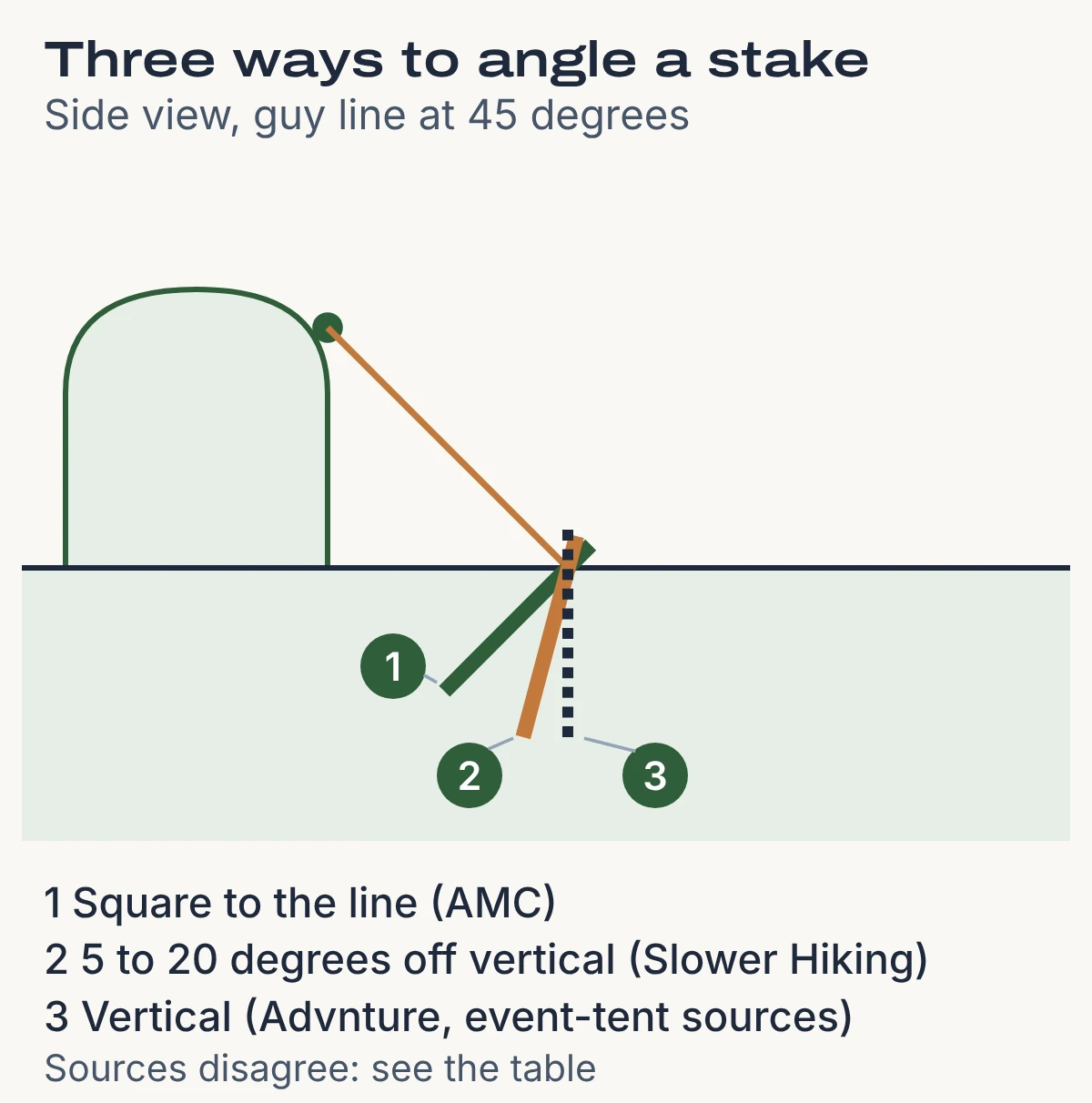
Which way to angle the stake
The sources below disagree, and each is shown with its reasoning where it gave one.
| Source | Source type | What it says |
|---|---|---|
| AMC | Outdoor club | “drive stakes into the ground at a right angle to the guylines to prevent them from pulling out in heavy wind” |
| SilverAnt | Titanium gear maker | Drive stakes “at a roughly 45-degree angle away from the tent”, and watch for bending at that angle with a foot or on firm ground |
| Slower Hiking | Hiking blog | “Stakes should be placed at a slight (between 5 and 20 degrees) angle off vertical”, and it rejects “the oft-touted 45-degrees” |
| Advnture | Outdoor publication | “Hammer the stake down vertically into the ground” |
| Township fire marshal handout | Yard and event tents | “So always drive your tent stakes straight down.” |
| InfinityTents | Installer guide, commercial tents | “installing stakes vertically is superior to installation at an angle”, which it says also makes removal easier |
Slower Hiking backs its angle with its own simple luggage-scale pull tests: with the guy line at 30 degrees, the 45-degree stake failed “at around the 8 kilogram mark” and the 15-degree stake “finally fails at 16 kilograms”. It is one small test. BetterTrail calls vertical versus angled “an ongoing debate”, and explains the aim: “minimize the force pulling the stake straight out of the ground while maximizing the force pushing it sideways into the surrounding soil”.
A right angle to a line that slopes down and away from the tent puts the top of the stake leaning away from the tent. That direction is worked out from the AMC’s rule, not stated by it; it matches SilverAnt’s “away from the tent” on a 45-degree line.
If your manual gives no angle, drive a camping stake upright or with its top leaning away from the tent, never toward it. That is our reading of the camping sources: none says to lean it toward the tent. How far to lean is the open question: 5 to 20 degrees per Slower Hiking, about 45 degrees per SilverAnt and the AMC on a 45-degree line. The straight-down advice comes mostly from the yard and event-tent sources.
When the ground is too loose or too hard: deadman anchors
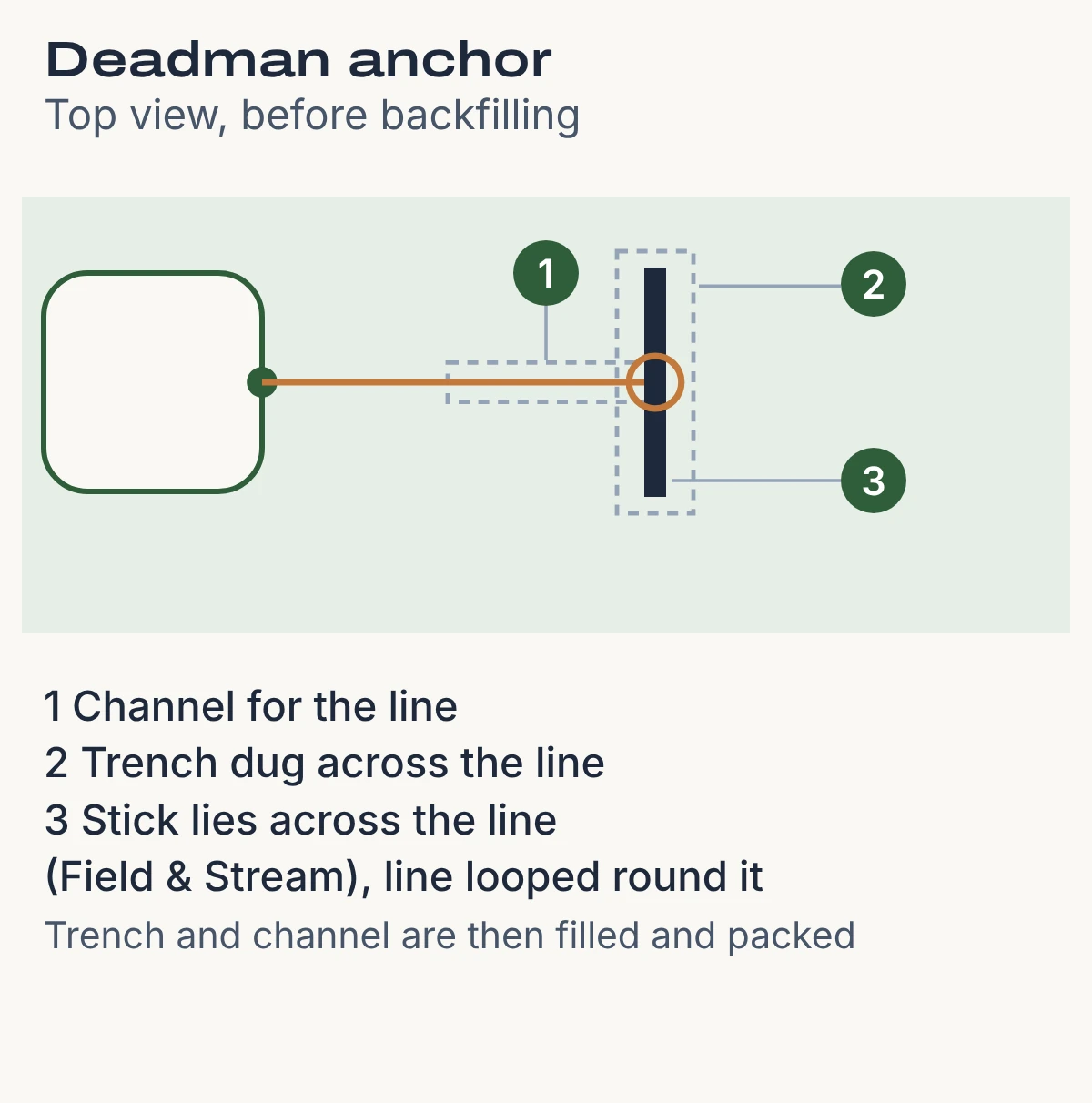
Slower Hiking says “deadman anchoring using sticks, bags or conventional stakes is the most weight-efficient and effective staking method in any substrate that is loose and easy to dig”. A deadman is an object buried sideways so the soil above it holds it down. MSR and Hilleberg make stakes meant to be used that way: Hilleberg’s snow and sand pegs can be buried “sideways in snow or sand, Deadman style”, and MSR’s Blizzard can be “girth-hitched and used as a deadman (buried sideways) in snow or sand”.
Safety
For snow, Slower Hiking warns: “Hypothermia is a real risk from incorrect anchoring in snow, so you must understand techniques thoroughly before venturing anywhere remote.” It suggests you “join a hiking club or contact a company that runs snow camping and safety courses”. SectionHiker says site selection comes first: “make sure that you are not in an avalanche zone”.
Choose the object
A stick, a spare stake, a rock, or a stuff sack or bag filled with sand or earth. Field & Stream, an outdoor magazine, suggests a log or large stick buried perpendicular to the line in snow, which makes a stronger anchor than a bag. Lay it across the line of pull.
Dig a T-shaped trench
Slower Hiking describes “a horizontal slot or trench for the stick, plus a perpendicular channel for the guyline”. SectionHiker, for sand, says to dig a hole 12 inches (30 cm) deep. Slower Hiking says depth matters: “Failures are usually because of insufficient depth or, for very loose substrates, an anchor that has too little surface area.” Leave No Trace says “Do not dig trenches for tents”, and a deadman means digging, so check the area’s rules first and leave the ground as found: “Leave areas as you find them.”
Set the line around the middle
Sources differ on knots. Field & Stream says “Never tie the guyline to the anchor before burying it, as this will compromise tension.” Slower Hiking says to loop, not tie: “If you loop around a stick rather than tying, you can simply slip the guyline free rather than having to disinter the stick” MSR says its Blizzard can be girth-hitched. Leave a long running end above ground.
Backfill and pack it down
Field & Stream says to “pack the anchor with snow or earth”. In snow, SectionHiker says to compact the filled hole with your boots, and Roger Caffin says that after stomping snow, “Give them 10 minutes and they all lock together into a solid mass”. In sand, SectionHiker says combining a deadman with stacked rocks “often results in very secure anchors”.
Tension the line, and plan the morning
To get a buried object out of snow, SectionHiker says “just use an ice axe to chop a hole”. Caffin warns that buried stuff sacks can be “extremely difficult to get them out in the morning” if the snow freezes overnight and that aluminium stakes bond to ice.
On solid rock, where nothing can be buried, Slower Hiking describes a “Big Rock-Little Rock” modified deadman: a small rock on the line extension, with a large rock set in front of it.
Mistakes and fixes
| Problem | Fix | Source |
|---|---|---|
| Stake bends going in | Stop and try a different spot, or make a pilot hole with a nail or needle stake first | Slower Hiking |
| Stake pulls out in wind or wet soil | Longer or wider stake, a rock, a second stake side by side, or a deadman | SilverAnt, Slower Hiking |
| Line slips off a nail stake | Loop the line twice | Slower Hiking |
| Not enough stakes | Use rocks, branches or other natural features | AMC |
| Aluminium stake frozen in | Slower Hiking, quoting Caffin, says aluminium’s oxide “bonds well to ice and snow”; titanium bonds lightly | Slower Hiking |
Ready to buy?
Our roundup of the best tents for winter and two-person backpacking tent roundup say which tents need stakes to reach full shape, and whether a maker’s listed weight includes them. See also our comparison of a backpacking tent versus a camping tent and our skills and how-to guides.
Frequently Asked Questions
Q. How do you get tent stakes into the ground?
Push by hand or foot in soft soil, or use a mallet or a rock in firm ground, and clear loose material first. Advnture allows a rock; SilverAnt’s guide allows a flat rock on a Y-stake’s flat end but also says never to use rocks, citing damage to stakes and tent.
Q. Do screw-in tent stakes work?
SilverAnt says they are “designed with a threaded end that can be screwed into the ground with a tool” and suit soft or loose soil. MSR says its spiral Cyclone is “best for anchoring in firm sand and soft soil”. A reader comment on SectionHiker reports screw-in stakes held only with rocks stacked on top, so treat that as one owner’s experience.
Q. How do you stake a tent on hard or rocky ground?
BetterTrail says needle and nail stakes are “particularly useful in rocky, root-filled, or even frozen terrain”. Slower Hiking suggests trying another spot, or a nail stake for a pilot hole.
Q. How do you stake a tent in sand?
SectionHiker says to dig a hole 12 inches (30 cm) deep, wrap the guyline around a stick, stake or rock, and bury it.
Q. How many tent stakes do you need?
BetterTrail says “typically six stakes” for corners and vestibules at a minimum, and SilverAnt says “The average 2-4 person tent needs roughly 8-12 tent stakes”.
Q. Can you stake a tent on concrete?
None of the sources cited here gives a method for concrete. Slower Hiking says no stake will penetrate solid granite and describes weighting lines with rocks.
Sources (15)
- MSR / Cascade Designs, Which MSR Tent Stake is Right for You?
- Hilleberg, Pegs
- Appalachian Mountain Club, How to Set Up a Tent Guyline
- Slower Hiking, Tent Stakes for Backpacking: What You Need to Know
- Slower Hiking, How to Stake and Guy Your Tent: Snow, Rock, Sand, Platforms and More
- BetterTrail, Backpacking Tent Stakes 101
- SilverAnt, The Ultimate Guide to Tent Stakes
- Advnture, How to stake a tent the right way
- Township of Spring Fire Marshal, How to Stake a Tent Correctly (PDF)
- InfinityTents, Staking
- SectionHiker, How to Set Up a Tent on Sand
- SectionHiker, Pitching a Winter Tent on Snow
- Field & Stream, Camping Hack: The Deadman Anchor
- Klika, Tough Stakes? Simple Tricks for Removing Tent and Marquee Anchors
- Leave No Trace, Principle 4: Leave What You Find