The short answer
For a nylon or polyester tent: pitch it, hose off loose dirt, then sponge it by hand with lukewarm water and a tent wash or non-detergent soap. Rinse twice and dry it completely before storing it loosely. Skip the washing machine, dryer, bleach and household detergent, which MSR says can remove the coating. Canvas tents differ: follow the maker.
A tent needs washing less often than you might expect. MSR’s support center says you’ll only need to clean a tent “if it has an offensive odor or becomes heavily soiled”. MSR’s guidance puts as much weight on drying and storage as on washing, so those steps below matter as much as the wash itself.
Related guide: How to Fix a Tent
Nylon and polyester tents follow one method; cotton canvas tents follow another, and some canvas makers disagree with nylon tent makers on soap and sunlight. Check which one you own first.
Check the fabric before you pick a cleaner
Look at the care label or the manual. Most backpacking, dome and cabin tents are nylon or polyester with a polyurethane or silicone coating. Canvas wall, bell and hot tents are usually treated cotton duck (our guide to the main types of camping tents covers these shapes and how canvas compares with nylon). Polycotton (poly-cotton) tents blend the two fibers; care advice for them varies, so follow your tent’s label.
| Nylon or polyester tent | Cotton canvas tent | |
|---|---|---|
| Cleaner | Tent wash or mild non-detergent soap (MSR, NEMO) | The cleaner your maker names; canvas makers differ |
| Scrubbing | Sponge or wet cloth | Soft-bristle brush, lightly |
| Mildew | White vinegar spray (Sea to Summit) | Mildew remover, then vinegar solution (Montana Canvas) |
| Drying | Pitched or hung, indirect light (NEMO) | Stretched out in the sun (Wall Tent Shop) |
| Afterward | Waterproofing spray and seam sealer if needed | Only the maker’s own reproofer |
What you need
- A garden hose with a gentle spray setting, or a few buckets of clean water
- A soft sponge, a wet cloth and a soft-bristle brush
- A tent or outdoor-gear wash (such as Nikwax Tech Wash or Storm Tent & Gear Wash), or a mild soap free of detergents and added fragrance
- A bathtub or large tub if the tent is very dirty
- For mildew: white vinegar, a spray bottle, an N95 respirator, non-latex, vinyl, nitrile or rubber gloves, and goggles without open vent holes (the CDC says safety glasses will not do)
- Rubbing alcohol for tree sap
- A spot to pitch the tent, or a clothesline, and time for it to dry fully
How to wash a nylon or polyester tent
Pitch the tent and open it up
MSR and NEMO both clean a tent while it is set up. Taut fabric is easier to sponge, and you can reach every panel. Unzip the doors and windows and empty the pockets.
Shake out and sweep the inside
Lift the tent by its floor corners and tip out sand, grit and crumbs, then brush the floor.
Hose off loose dirt
MSR says a regular garden hose removes most loose dirt. Keep the nozzle on a gentle setting: Sea to Summit warns that a hose on a high-power setting can rip a tent.
Scrub the dirty patches
Work on mud, bird droppings and stains with a wet cloth or sponge and a little of your cleaner. For sap, see the fixes further down.
Wash the whole tent by hand
Mix the cleaner as its label says. A 2013 Nikwax blog post, for example, calls for two or three capfuls of Tech Wash in about 1.6 gallons (6 L) of warm water, depending on how hard your water is. Sponge it over the fly, the body and the floor. For a very dirty tent, NEMO suggests a bathtub soak; Sea to Summit turns the tent inside out and soaks it in cold to tepid water. Use no household detergent, dish soap or bleach, and no washing machine or dry cleaning: MSR says “any of these methods can remove the tent’s waterproof coatings”.
Rinse it twice
Hose or sponge off all the cleaner, then do it again. NEMO calls for a second rinse to remove leftover dirt and wash. If you soaked the tent in a tub, NEMO says to squeeze the excess water out of it.
Re-proof it now if water soaks in
Watch the fly while you rinse: if water soaks into the fabric instead of beading, re-proof it while it is still wet. NEMO says it is best to apply a waterproofing (DWR) spray while the tent is still damp from cleaning; Nikwax applies its proofer “evenly to the outside of the tent fabric”. Then follow the proofer’s label for drying: NEMO lets the STORM Tent & Gear Proofer it uses “dry in direct sunlight”, while Nikwax’s 2013 directions say to wipe off any surplus after 2 minutes and let the tent air dry. Depending on use, NEMO expects you to reapply waterproofing every 1-3 years.
Dry it completely
If you did not re-proof, or once the proofer has dried as its label says, leave the tent pitched, or lay it flat or hang it, in indirect light: NEMO says direct sunlight “can damage tent fabrics if left for long periods of time”. On a clothesline, Sea to Summit suggests moving the fly and inner “every hour or so” so they keep their shape. Use no tumble dryer or other heat: NEMO says “heat can melt the technical fabrics”. Check seams, corners and the floor before you pack it.
Seal leaking seams once it is dry
For seams that leak or flake, NEMO recommends a seam sealer made for your fabric, noting “there is a difference between silicon and polyester fabrics”. It applies “a thin, even coat” to the underside of the rainfly seams, and to the seams inside the tent body if needed, then allows 24 hours for the sealer to cure.
How to clean a canvas tent
Canvas needs a lighter touch than its weight suggests. Montana Canvas says its treated canvas takes on the colors of where it is used, and advises: “don’t try to get your tent back to a natural clean color”. Aim to remove surface dirt, not to restore the tent to new.
Canvas makers disagree on soap. Montana Canvas suggests “a mild laundry detergent mixed with water” for an all-over clean. Wall Tent Shop, an Idaho seller of canvas wall tents, lists a tent cleaner, Woolite or a mild dish soap at one capful to 2 gallons of lukewarm water. White Duck Outdoors prefers vinegar or lemon solutions, saying “soap and other detergents can harm the fabric and leave deposits”. Whichever your maker names, the steps run in this order; follow your maker on timing:
Set it up or lay it flat
Wall Tent Shop sets the tent up or lays it down on the ground or a driveway to wash it.
Brush off dry dirt and leaves
Do it before any water touches the canvas.
Mix the cleaner your maker names
Follow its dilution on the label.
Wet the canvas, then scrub the cleaner in lightly with a soft brush
Montana Canvas uses a hose and a soft-bristle brush together. Wall Tent Shop says “hard scrubbing or pressure sprayers can remove the water repellency from the canvas”.
Rinse it well
Makers differ on timing: Wall Tent Shop rinses very thoroughly and right away, while Montana Canvas lets its detergent mix stand about ten minutes first. Either way, leave no cleaner in the fibers.
Dry it fully in the sun
Wall Tent Shop dries canvas stretched out in the sun, and it should be completely dry before you fold it.
Recondition only with your maker’s product
Montana Canvas warns that other coatings can react with its original treatment.
Tip
Hose canvas off after dusty trips. Wall Tent Shop calls a layer of dust “an open invitation for mildew”.
Match the fix to what you see
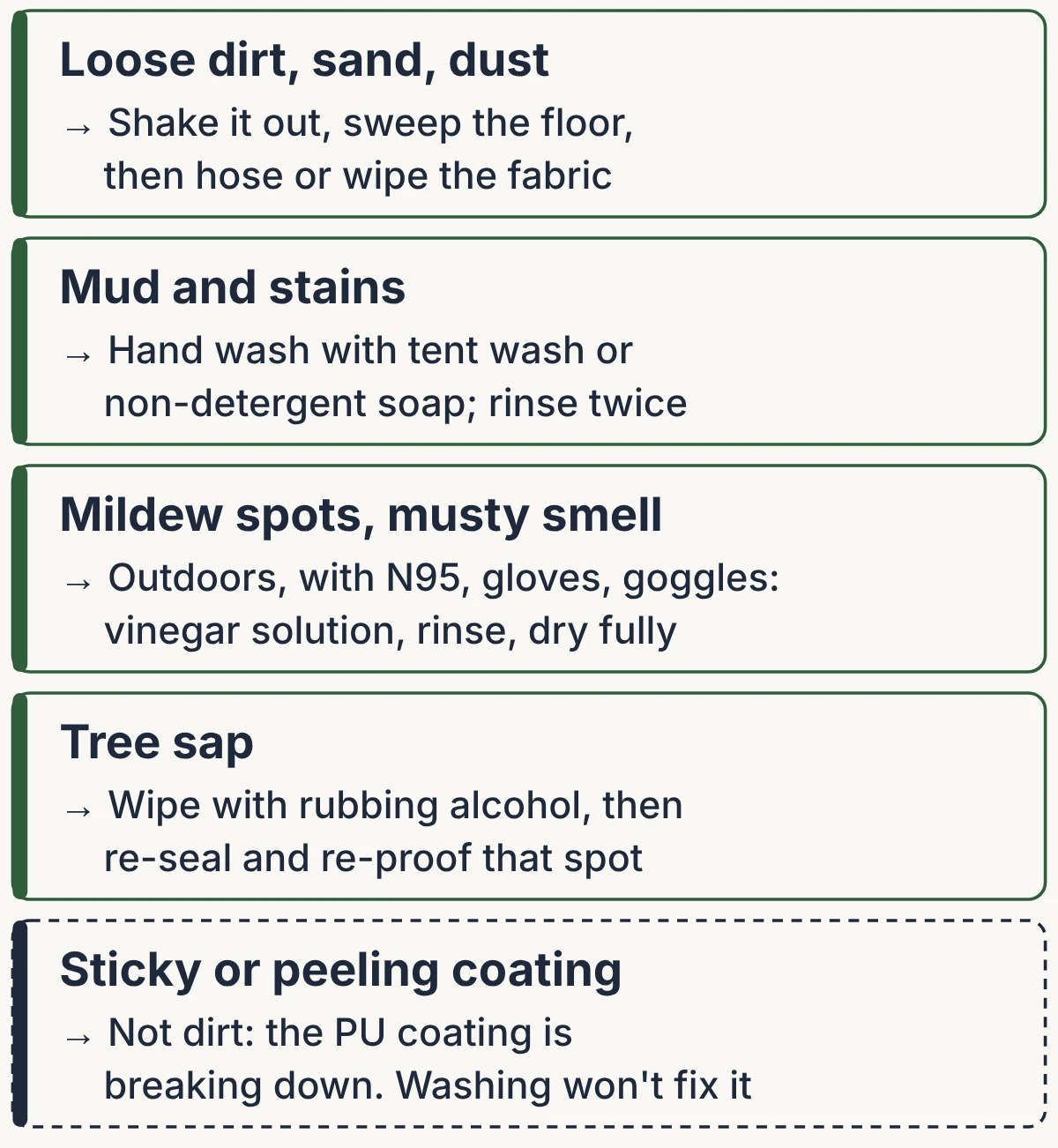
- Tree sap. Sea to Summit removes sap with straight rubbing alcohol, wiping until it breaks down. Once the residue has evaporated, it says to “re-seal and re-waterproof the affected area”.
- Gritty zippers. NEMO wipes zippers with a wet cloth after dusty or salty trips, and for bad cases washes them and adds a zipper lubricant.
- A sticky or peeling coating. This is not dirt. MSR calls it hydrolysis: moisture breaks down the waterproof coating until it turns “soft, sticky and no longer waterproof”, and Sea to Summit describes it as the polyurethane (PU) coating breaking down. Sea to Summit says early cases can sometimes be rescued, but “beyond a certain point there is no way to fix it”. Washing will not bring it back. Ask the maker about repair or a replacement fly; if the tent is past saving, our waterproof family tent roundup compares replacements.
How to remove mold and mildew
Safety
The CDC says three groups “should not take part in cleaning up” mold: “people with allergies, who may be more sensitive to molds”; “people with immune suppression or underlying lung disease, who are at higher risk of fungal infections”; and “individuals with chronic respiratory diseases like asthma or chronic obstructive pulmonary disease (COPD), who may have trouble breathing when exposed to mold”. Everyone else should “wear at least a NIOSH Approved N95 respirator”, “protective gloves (non-latex, vinyl, nitrile, or rubber)” and “goggles that provide complete eye protection”, according to the CDC, which warns that “safety glasses or goggles that have open vent holes will not protect you against dust and small particles”. Do the job outdoors. MSR and Sea to Summit advise against bleach on tents; if you use bleach on anything else, the CDC says never to mix it with ammonia or other cleaners, because the mix gives off a poisonous gas.
On a nylon or polyester tent, Sea to Summit suggests treating the spots with “a mixture of warm water and a few tablespoons of white vinegar” in a spray bottle. Wipe the spots with a damp sponge, rinse, wash the tent as above if it also smells, and dry it fully. Sea to Summit adds that the vinegar smell fades quite quickly.
On a canvas tent, Montana Canvas recommends a mold and mildew stain remover such as Iosso first, mixed as directed and scrubbed lightly with a soft brush. If the mildew is still there, it suggests ½ cup of cleaning vinegar per gallon of water, scrubbed in on a warm, sunny day, left about ten minutes, then rinsed well. Let the canvas dry and repeat until it is gone. On its treated canvas, pinkish patches mean the mildew inhibitor is fighting active spores, so treat them too.
Related guide: How to Remove Mold From a Tent (Nylon and Canvas)
Good to know
Wall Tent Shop says mildew in its early stages can be washed off, but calls it canvas’s worst enemy because it can eventually stain or damage the fabric. Catch it early, and dry the tent before it starts.
What not to do
- Machine wash, tumble dry or dry clean it. NEMO says the fabric and mesh will likely tear in a washer and that heat can melt technical fabrics, and MSR says never to dry clean a tent. Sea to Summit adds that a wet tent is heavy enough to damage the washing machine.
- Use household detergent, dish soap or bleach on a nylon or polyester tent. MSR says these can remove the waterproof coating.
- Use a pressure washer or scrub hard. Sea to Summit says a pressure washer can split seams, and Montana Canvas and Wall Tent Shop warn against pressure sprayers and hard scrubbing on canvas.
- Leave a nylon tent baking in the sun for days to dry. NEMO warns that long periods of direct sun damage tent fabrics.
- Pack it damp or store it compressed. MSR links damp storage to mildew and a breaking-down coating, and NEMO says long compression in the stuff sack can damage the fabric and seam tape.
- Spray bug repellent or hair spray near canvas. Wall Tent Shop says some of these dissolve the water repellency.
Dry and store it so it stays clean
MSR says “it can take as few as 24 hours for mildew to start forming on a wet, crumpled tent”. If you packed up in the rain, or after a muddy festival weekend (our roundup of tents for festivals is there if yours did not survive it), unpack and dry the tent the day you get home.
Damp storage also speeds up hydrolysis. MSR says the lighter coated fabrics of modern backpacking tents are more prone to it, and that it is “greatly accelerated by humid environments and improper or damp storage”.
For storage between trips:
- Store it only when it is bone dry, seams and floor included.
- Keep it loose. NEMO says long compression in the stuff sack can damage the fabric and seam tape; MSR suggests an oversized cotton bag, a mesh duffel or a pillowcase.
- Pick a cool, dry, dark place, away from direct sun.
When your tent’s maker says otherwise
Treat the care label and the manual as the final word, because makers do not agree on everything. Sea to Summit’s UK guide allows a drop of mild dish soap (washing-up liquid) on stubborn stains, while MSR says to avoid dishwashing liquid. Canvas makers split on soap, as above. A coating, a fabric or a seam tape can need something the general advice does not cover.
It also protects your warranty: MSR states that “mildew and moisture damage are not covered under our limited warranty”. If your tent has no label, ask the maker’s support team before using anything stronger than water.
Ready to buy?
If cleaning turns up a sticky coating or a fly that no longer sheds rain, our waterproof family tent roundup compares 10 tents, including a treated canvas pick.
Frequently Asked Questions
Q. Can you wash a tent in a washing machine?
No. MSR, NEMO and Sea to Summit all say to hand wash the tent body and fly, because a washer can tear the fabric and mesh and strip the coating.
Q. Can you machine wash a tent footprint?
NEMO says its footprints may go in a washing machine with no agitator and should then be line-dried. Check your own footprint’s label first.
Q. How often should you wash a tent?
Makers differ: MSR says only when it smells or is heavily soiled, while Sea to Summit washes after any long, wet or muddy trip and at least once a season. Either way, shake it out and dry it after every trip.
Q. Can you use dish soap on a tent?
Not on a nylon or polyester tent: MSR lists dishwashing liquid among the cleaners that can remove its coating. Wall Tent Shop does list mild dish soap for its canvas tents.
Q. Is bleach safe for getting mold off a tent?
MSR says to avoid bleach on its tents. For canvas, Montana Canvas uses a vinegar solution and says it is less abrasive than bleach to the canvas fibers.
Q. How do you get a musty smell out of a tent?
Wash it with a tent cleaner, treat any mildew spots with a vinegar spray, then dry it fully. MSR notes that mildew on a tent packed wet causes both stains and smell, so dry storage is the lasting fix.
Sources (11)
- MSR (Cascade Designs) support, How do I keep my MSR tent clean and dry?
- MSR (Cascade Designs) support, Xtreme Shield tent coating
- NEMO Equipment, Cleaning, repairing, and storing your tent
- NEMO Equipment, How to re-waterproof your gear
- Sea to Summit, How to clean a tent
- Nikwax blog (2013), Clean, waterproof and protect your tent
- Montana Canvas via the Rocky Mountain Elk Foundation, How to clean and remove mold on a tent
- Wall Tent Shop, Caring for tents
- White Duck Outdoors, How to clean mold from your cotton canvas tent
- CDC, Mold clean up guidelines and recommendations
- CDC, About mold