The short answer
Fly fishing casts a nearly weightless fly by the weight of the line, not the lure. A beginner needs a rod, a reel with matching line, a leader, tippet, a few flies and a fishing license. Start on a pond with panfish or bass, use one simple cast, and keep the first day short.
Most people are put off by the gear lists and the film-style casting. The real starting point is smaller: one outfit, one fly type, one easy piece of water.
This guide covers the minimum kit, how fly fishing differs from the spin and bait fishing you may know, a first outing step by step, the mistakes that cost beginners the most, and where to go next.
How fly fishing differs from spin and bait fishing
In spin and bait fishing the lure or sinker carries the line out. In fly fishing the line does the work. L.L.Bean’s beginner guide says “the bulk and weight of the fly line provides the momentum to cast the fly”, which is why the fly line is thick and the fly can be almost weightless. A tapered leader and a thin tippet then sit between the line and the fly so the fish do not see the heavy line. (L.L.Bean is both an outdoor retailer and a maker.)
| Spin or bait fishing | Fly fishing | |
|---|---|---|
| What carries the cast | The weight of the lure or sinker | The weight of the fly line |
| What you throw | A lure, or bait on a hook | A fly that weighs almost nothing |
| What matters most | Covering water | A quiet approach and a natural drift |
The approach is different too. Georgia Wild Trout, a North Georgia fishing-guide service, says the number one lesson for anglers who fish with conventional tackle is that “stealth will yield you far more opportunities to catch trout than with any other fish species”. Its writer contrasts a “shotgun” style of many casts with a careful style of fewer, better ones. Fly fishing also asks for more patience at the end of the fight: FishTalk magazine says that “unlike a spinning rod, reeling in requires more patience and grace”.
A streamer is the closest fly to what you already know. Orvis’s Fly Fishing Learning Center says “Streamers are the fly-fishing equivalent of conventional lures.” (Orvis is a fly-fishing maker and retailer; its Learning Center is its free teaching site.)
What you can catch
You are not limited to trout. Orvis’s Learning Center says “You can catch sunfish on a farm pond with fly tackle. You can catch bass and pike.” It also lists saltwater fish such as striped bass and bonefish and says “It just takes a little adjustment to your tackle.” For a first day, panfish and bass in a pond are the easy targets; Orvis says “it’s best to start out on a pond with bass or panfish instead of on moving water”.
The minimum kit
You do not need everything. The kit below follows L.L.Bean’s beginner guide and the advice of an Idaho fly-fishing guide writing for the river outfitter OARS; sizes differ by fish and water.
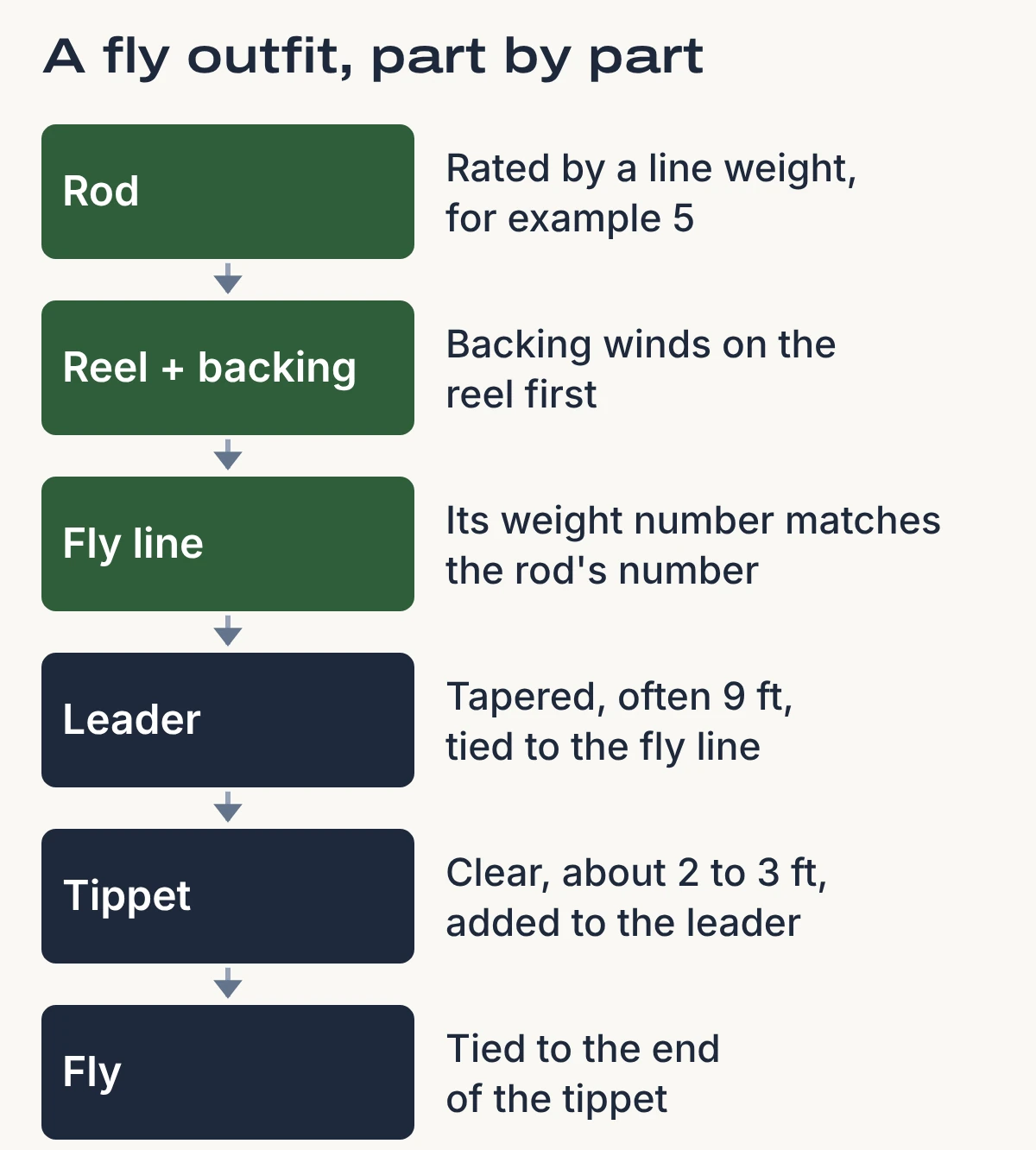
- Rod, reel and fly line, matched. L.L.Bean suggests “a 9-foot, 5-weight fly rod paired with a matching reel and weight-forward floating fly line”. The OARS guide, writing about trout, likes “a 9-foot-long, 4-weight rod” and says to “buy a 4-weight line for a 4-weight rod”. Both point to a 9-foot outfit in the 4- to 5-weight range as a starting size for trout; the right size changes with the fish and the water.
- Backing. OARS: “Backing is a string-like-line that goes on the reel first.” L.L.Bean says its packages come with the correct line already on the reel.
- Leader and tippet. L.L.Bean suggests tapered 9-foot leaders, with tippet “usually about two to three feet in length”. Leaders and tippet are sold by an X number, and “the larger the X number, the finer (thinner) the leader or tippet.”
- A few flies. A handful of dry flies, nymphs and streamers, picked with a local fly shop’s help.
- Small tools. L.L.Bean lists “line nippers, forceps, or hemostats (for hook removal), and a landing net”.
- Polarized sunglasses. They cut glare and, as the step below explains, protect your eyes.
- A fishing license. Check your state’s rules before you go.
Skip at first: waders, on easy water in warm months. Georgia Wild Trout says “a pair of old hiking boots, and either a swimsuit or quick dry pants will be perfectly adequate”. L.L.Bean adds that “Stream beds are slippery so wading shoes with good traction are a not only advised, but a lifesaver.”
Is it expensive? Orvis’s Learning Center says “You might have also heard that fly fishing is expensive and complicated” and sets out to show how simple it can be. Georgia Wild Trout agrees the upfront cost “may look intimidating at first, but maintaining simplicity is key”. Prices change often, so this guide gives none. Two ways to keep the bill down are to buy one matched outfit and to skip waders in warm weather. L.L.Bean sells such packages, and OARS says “Fly shop employees are there to help you decipher all this.”
Tip
If a full fly outfit is more than you want to buy just to try fishing, a spinning or spincast combo is the conventional route. Our roundup of beginner rod-and-reel combos compares eight.
Your first outing, step by step
Get your license and read the rules
Most states require a fishing license for anglers over a set age, and the age varies by state; check your state’s wildlife agency before you go. Maine’s Department of Inland Fisheries and Wildlife says “A valid Maine fishing license is required for anyone 16 years of age or older, to fish in inland waters”, and Washington’s Department of Fish and Wildlife says “All fishers age 16 and older need a fishing license.” Waters can have their own rules on hooks, seasons and what you may keep.
Pick easy water and the right time
Choose a pond with panfish or bass (Orvis). Georgia Wild Trout says “Late spring through early fall is the ideal time to give fly fishing a shot.” FishTalk adds that “choosing a fly fishing spot without any trees around it is a good move” while you learn.
Have the outfit built for you
If the line is not on the reel, ask a fly shop. OARS says “Fly shop employees are there to help you decipher all this.” Check that the line’s weight number matches the rod’s.
Put on your sunglasses before you pick up the rod
Orvis says “there’s always a risk of hooking yourself or a buddy in the eye” and that “sunglasses should be mandatory for anglers and anyone nearby”. Before every back cast, look behind you; Georgia Wild Trout says to “make extra sure to check for any obstructions within your back cast radius”.
Make the basic cast and nothing fancier
The OARS guide says “A basic cast is more than enough to get you started for a great day of angling.” Mossy Oak’s beginner article describes it as smoothly accelerating until the rod tip is behind you, pausing to let the line unfurl, then accelerating forward. Casting has more to it than fits here, so expect to practice.
Tie on one fly and stay with it
FishTalk’s writer, himself a beginner, says “Focus on one type of fly at a time. I’d recommend starting on a dry fly.” Orvis calls a streamer “perhaps the easiest way to begin fishing in moving water”, so on a stream a streamer is a fair first choice. OARS names the improved clinch knot for tying on a fly and the surgeon’s knot for adding tippet as two great beginner knots; learn them at home first.
Move slowly and keep a low profile
On a stream, Georgia Wild Trout says “Trout will be facing upstream 99.9% of the time”, so it advises approaching from downstream. FishTalk’s writer adds that fish fear the shade of an approaching predator, so watch your shadow and tread lightly. If you step into the water, the National Park Service’s fishing safety tips say: “Be aware of unseen water hazards – use caution when walking or wading in the water”, “Assess swift water before entering or crossing” and “Check the water temperature; get out of the water if you get cold”. The same list says: “Always wear your U.S. Coast Guard approved life jacket when you are on, in, or near the water”.
Set the hook, then play the fish patiently
For trout on small flies, Georgia Wild Trout describes the set as “a fast sweep of the rod that stops when tension is secured”, and says pulling softer will likely not secure the hook while pulling harder could break the line. FishTalk says to tire a fish before bringing it in.
Release fish quickly and carefully
The OARS guide says that “fishing a barbless hook, and fighting and releasing fish quickly help keep trout populations healthy”. Check local rules on what you may keep.
Mistakes that cost beginners the most
- Starting on a fast trout stream. Orvis recommends starting on a pond with bass or panfish rather than moving water.
- Thinking the cast is the whole game. Georgia Wild Trout and FishTalk both put stealth and approach ahead of casting. Georgia Wild Trout’s writer says the number one reason he sees new fly anglers spook fish before casting is the wake they push while wading.
- Casting under trees. FishTalk’s advice is to find open water while you learn to cast; branches, docks and lily pads take flies.
- Learning every fly at once. Stay with one type (FishTalk).
- Expecting a catch every trip. Georgia Wild Trout says “A beginner must accept that they will stink for a decent while”, and OARS says “This is a normal part of fishing. Even the experts get skunked!”
Where to go next
- Get a person involved. FishTalk says to “take a friend who can give you the basics before you develop bad habits”. Georgia Wild Trout says a guide can cut the learning curve, and OARS suggests a fly shop or a guide’s group workshop.
- Watch the Orvis Learning Center. Its video chapters cover the basic overhead cast, a roll cast, two basic knots and the bare essentials of kit.
- Fish a pond near you with a simple outfit. Our bass fishing tips for beginners cover gear, rigs and a simple first day for bass on conventional tackle, and our roundup of baits for stocked trout shows the bait approach for comparison.
- Browse the rest of our fishing gear. The fishing gear section collects our fishing roundups and links our fishing how-to guides.
Frequently Asked Questions
Q. Is fly fishing hard?
The cast takes practice, but a basic cast is enough to start. Orvis says fly fishing “seems like an intimidating pastime at first. It doesn’t have to be.” Georgia Wild Trout warns that early progress can be slow.
Q. Is fly fishing expensive?
It can be, but a beginner does not need a full kit. A single matched outfit, a few flies and a license are the core; waders can wait in warm weather, though stream beds are slippery and need shoes with good traction. Prices vary, so check current ones.
Q. Can you use a fly rod for bass?
Yes. Orvis says bass and pike can be caught on fly tackle and that fly fishing in a pond for bass or panfish is a good start. For other fish, Orvis says “It just takes a little adjustment to your tackle.”
Q. What is tippet?
It is the thin, clear line between the leader and the fly. L.L.Bean says it is usually about two to three feet long and that a higher X number means a thinner line.
Q. Do I need waders to start?
Not in warm weather. Georgia Wild Trout says old hiking boots and quick-dry pants will do, and that waders are needed outside the warmer months. L.L.Bean warns that stream beds are slippery, so wear shoes with good traction.
Q. What is the best time of year to start?
Late spring through early fall, according to Georgia Wild Trout, when trout feed heavily and waders are not needed in many places. Wade with the care the National Park Service advises in step 7.
Sources (10)
- Orvis Fly Fishing Learning Center, The Basics of Fly Fishing
- L.L.Bean Outdoor Discovery Programs, A Beginner’s Guide to Fly-Fishing Clothing and Gear
- OARS, 10 Things I Wish I Knew as a Beginner Trout Angler
- Georgia Wild Trout, Fly Fishing For Beginners: Guide Tips
- FishTalk Magazine, 10 Fly Fishing Lessons for Beginners
- Orvis, Choosing the Best Sunglasses for Sight Fishing
- National Park Service, Reel It In: Be Prepared for a Successful Fishing Day
- Mossy Oak, Fly Fishing 101: 5 Tips for Beginners
- Maine Department of Inland Fisheries and Wildlife, License Requirements
- Washington Department of Fish and Wildlife, Fishing and shellfishing licenses