The short answer
Insulate from the ground up. Pitch out of the wind and above cold hollows, stack a closed-cell foam pad under an insulated air pad, seal the mesh but keep vents open, and keep snow out. The CPSC says: “never use fuel-burning portable heaters or lanterns while sleeping in enclosed areas such as tents.”
Tent fabric is thin, so it holds little heat by itself. Insulating a tent for winter really means building a warm shell around you: a sheltered pitch, a thick floor, a dry sleeping bag, and enough airflow to stop your breath turning to frost on the ceiling.
Related guide: How to Put a Tarp Over a Tent
Related guide: How to Use Tent Guy Lines
The steps below come from MSR’s winter guides, the Appalachian Mountain Club, and three federal safety agencies: CPSC, CDC and NIOSH.
What you need
- Two sleeping pads: a closed-cell foam pad and an insulated air pad on top. MSR’s snow-camping tips say “Two mattresses are better than one” and to “Use a closed-cell foam mattress for insulation from the cold ground”.
- A groundsheet or footprint under the tent.
- A sleeping bag rated for the trip. For winter in the Northeast, the AMC says “a sleeping bag rated between zero and minus-20 degrees provides ample warmth for all but the most Arctic conditions.”
- A snow shovel if you camp on snow. The AMC calls it essential for winter camping.
- Dry sleep clothes: base layer, thick socks, a hat or balaclava.
- Snow stakes or deadman anchors (stuff sacks you fill with snow work).
- Optional: an insulated water bottle, a pee bottle that looks nothing like your water bottle.
Fuel-burning heaters are not on this list.
How to insulate your tent, step by step
Pick a sheltered spot above the cold air
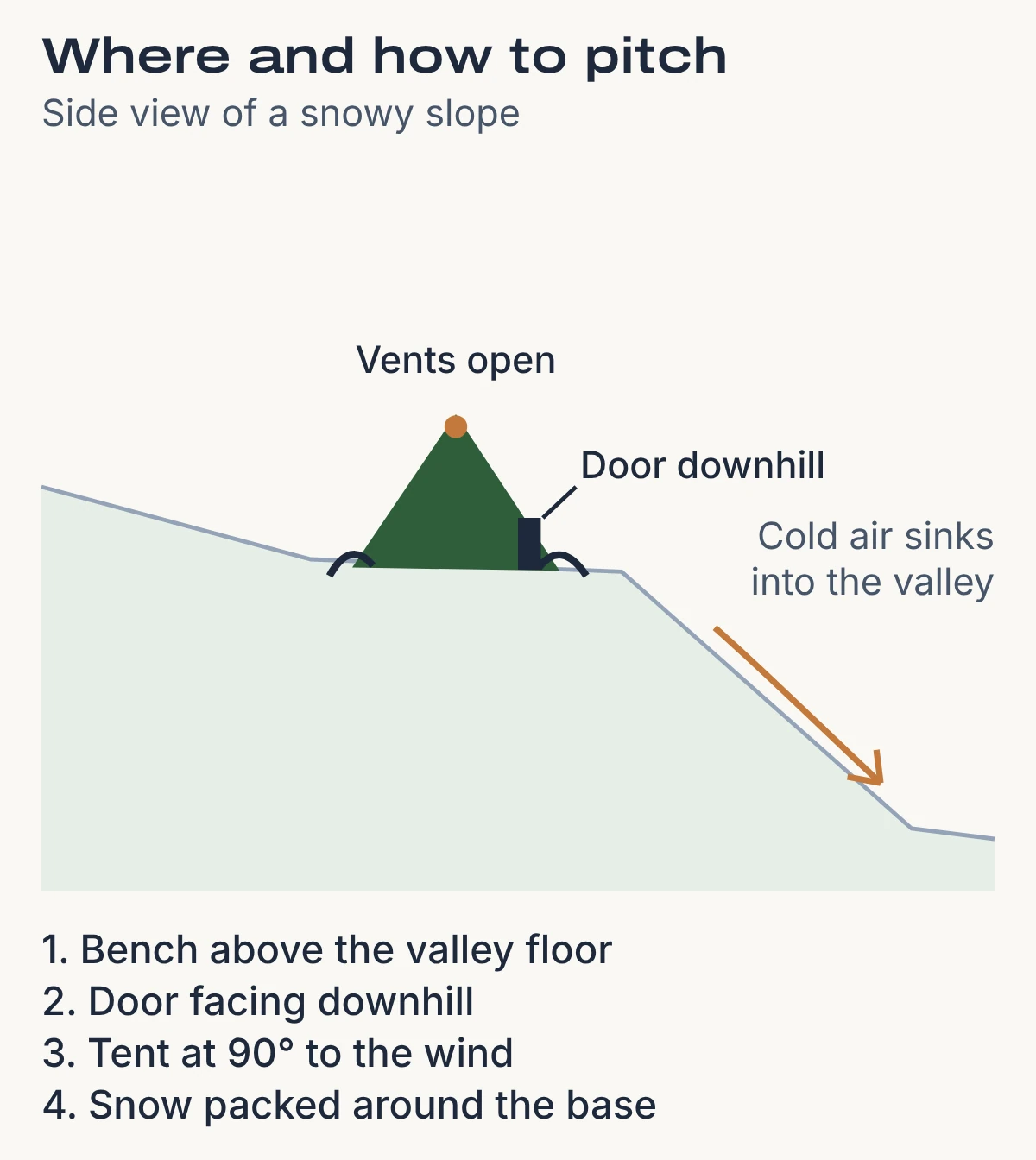
MSR’s snow-camping guide says “Cold air flows downward, settling in low regions; so benches and outcroppings above valley floors will be warmer.” Use trees, boulders or a tarp between trees as a windbreak. Look up before you pitch: MSR warns “Dead branches and those heavily burdened with snow can release, causing injury or harm.” Stay out of avalanche terrain; MSR puts that first on its list.
Stomp a platform and let it set
On snow, pack down a level area about twice the size of your tent (AMC). MSR says to “let the snow set for 30 minutes to refreeze and harden to make walking around easier.” A firm, smooth base avoids the kind of lump the AMC warns is hard to fix once the tent is up.
Pitch at 90 degrees to the wind with the door downhill
MSR says “Place the tent ninety degrees to the wind” so snow does not blow in the door, and warns: “If your tent faces uphill, cold air, which flows downward, can enter it.” At higher elevations, MSR suggests you “dig down a foot or two for your tent” (30-60 cm) for extra wind protection.
Anchor it and seal the base
In loose snow, bury deadman anchors 10-12 inches (25-30 cm) deep, as MSR describes, and wrap the line rather than knotting it (“don’t tie a knot, as it can freeze”). Then pack snow around the bottom of the fly. MSR notes “Snow is a great insulator, and it can add stability in windy conditions.” In open terrain, a snow wall at least three feet (0.9 m) high, per MSR, cuts the wind further.
Build the floor in layers
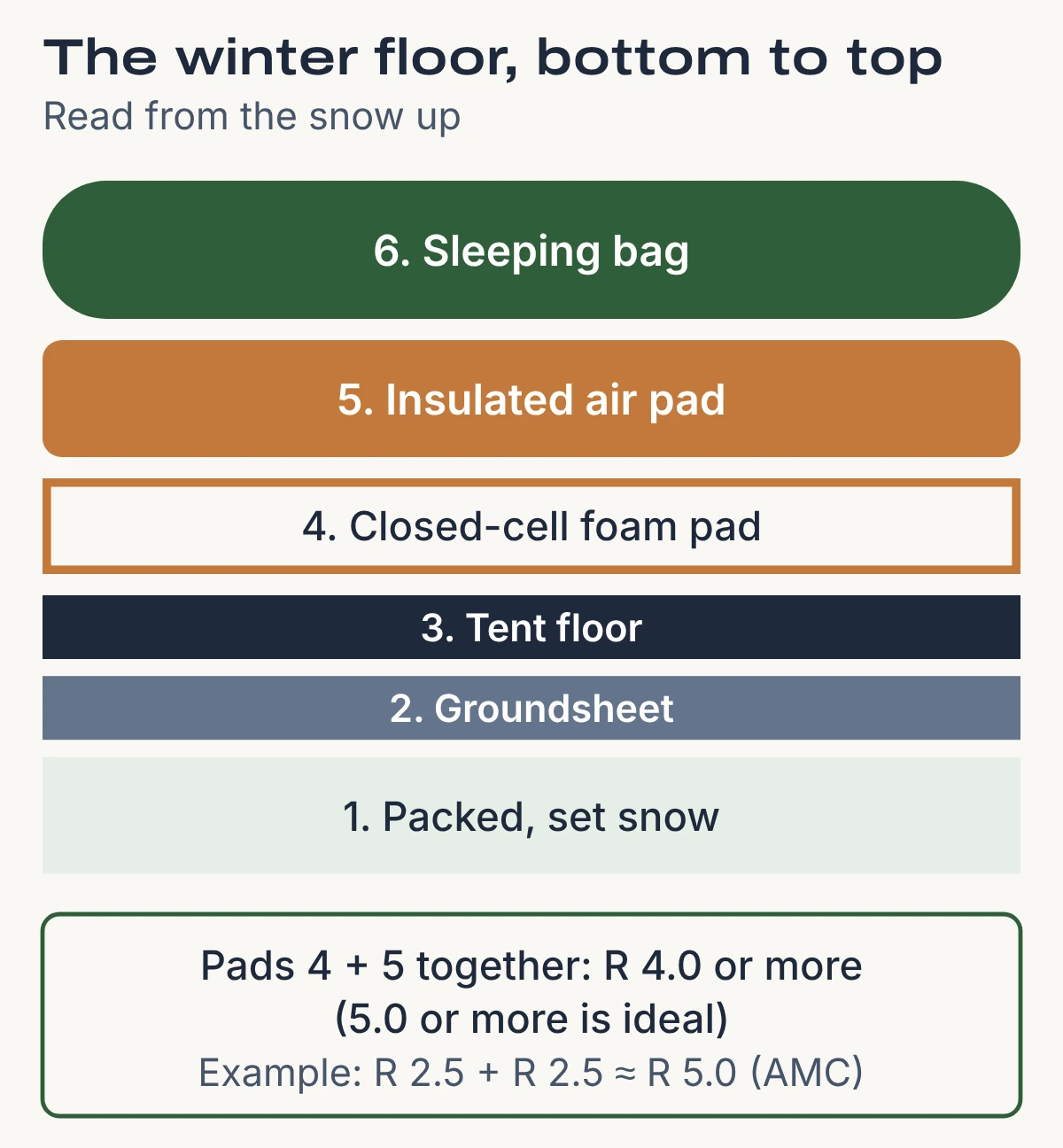
Lay a groundsheet; on snow, MSR explains that moving in the tent can heat the snow underneath, and “When that snow refreezes, it can feature sharp, ripping points.” Inside, put the closed-cell foam pad down first and the air pad on top. The AMC’s rule: “Look for a pad, or combination of pads, with a minimum R-value of 4.0 (ideal is 5.0 or more). R-values are roughly additive: two pads with R-values of 2.5 will together provide an R-value of approximately 5.0.”
Close the mesh, open the vents
On a four-season tent, the AMC notes, “all the mesh can be sealed up, both for warmth and to keep out blowing snow.” Leave the vents open anyway. On condensation, MSR says “the key to reducing it is ventilation” and to “leave at least two vents open if possible”, since we each give off “about 1 – 2 pints of moisture per night”. Do not cover the vents with a liner, blanket or tarp.
Keep snow and moisture out
Brush off clothes and boots before you get in, and keep cooking outside. MSR: “Stoves give off potentially deadly carbon monoxide, which is odorless.” The AMC also says “Avoid cooking inside the tent or vestibule”. By day, air out your sleeping bag so frozen moisture does not build up.
Load the sleep system before bed
Unpack your bag early so it regains loft. Change into dry clothes: per the AMC, “a completely dry layer will be considerably warmer than one moist with sweat.” Wear a hat; NIOSH notes “Hats reduce body heat escaping from your head.” Put boot liners in a plastic bag inside your sleeping bag. Eat a fatty or protein-rich snack, go to the bathroom (MSR: “Your body burns calories keeping a full bladder warm”), and keep your breath outside the bag.
Where the cold gets in, and the fix
| Where heat goes | What you notice | Fix | Source |
|---|---|---|---|
| Down into snow or frozen ground | Cold hips and shoulders in a warm bag | Foam pad under an air pad, combined R 4.0 or more | AMC, MSR |
| Wind through the fly | Fly flaps, drafts at the base | Pitch at 90° to the wind, pack snow at the base, wind wall | MSR |
| Cold air pooling | A colder low campsite, cold air at the door | Camp on a bench, door downhill | MSR |
| Moisture in insulation | Frost on the ceiling, damp bag | Two vents open, brush off snow, air the bag | MSR |
| Wet clothing | Chilled after setting up camp | Dry base layer and socks for sleep | AMC |
Liners, space blankets and covers: what to expect
Many online guides suggest taping space blankets, bubble wrap or foam board to the walls, and some print R-values for them. None of the makers or agencies we read publishes a figure for these add-ons, so we do not give one. If you try a liner, keep it off the vents: a liner that slows airflow works against MSR’s ventilation advice above.
A tarp over the tent mainly helps as a windbreak: MSR lists “a tarp hung between trees” among good wind buffers.
If your tent is a summer model with a lot of mesh, MSR says a three-season tent “may be as simple” an answer “depending on the conditions. However, if you anticipate heavy snow or high winds, choose a four-season or mountaineering tent.” Our guide to types of camping tents and how to choose explains the four-season and hot-tent styles.
Related guide: How to Choose a Canvas Tent Size
Heaters and stoves: what the safety agencies say
Safety
The CPSC says: “People die every year from carbon monoxide poisoning from the use of portable camping heaters, lanterns, or stoves inside tents, campers, and vehicles.” Its rule: “Never use fuel-burning portable heaters or lanterns while sleeping in enclosed areas such as tents, campers and vehicles.” The CDC adds: “Never use a portable gas camp stove indoors. Do not use portable flameless chemical heaters indoors.” and “Never burn charcoal indoors.”
- Why sleep is the danger: the CDC warns “People who are sleeping, drunk, or under the influence of other substances can die from CO poisoning before they have symptoms.” The CPSC adds that the risk is higher at altitude: “This is especially important at high altitudes, where the risk of carbon monoxide poisoning is increased.”
- Symptoms to know: the CPSC lists “headache, dizziness, weakness, nausea, vomiting, sleepiness, and confusion.” The CPSC says “See a doctor if you or a member of your family develops cold or flu-like symptoms while camping.”
Our camping heater roundup quotes each heater’s manual.
Common mistakes and quick fixes
| Problem | Likely cause | Fix |
|---|---|---|
| Cold from below in a warm bag | Pad R-value too low | Add a closed-cell foam pad under your air pad |
| Frost raining off the ceiling | Breath moisture with vents shut | Open at least two vents (MSR) |
| Bag feels damp on night two | Breathing into the bag, no airing | Breathe out of the bag, air it by day |
| Cold draft at the door | Door facing uphill | Re-pitch with the door downhill |
| Canister stove sputters | Cold canister | Cook outside; the AMC says canister stoves “work poorly in subfreezing temperatures” |
| Headache or nausea in the tent | Possible carbon monoxide | Get everyone outside and see a doctor (CPSC) |
Tip
Sleeping on an air mattress? Check its R-value as you would a pad’s. Our sleeping pad vs air mattress guide explains R-values and how stacking works.
When to stop and get warm
Cold that will not go away is a sign to pack up or head to a warm building, not to add a heater. NIOSH lists early hypothermia signs as shivering, fatigue, loss of coordination, and confusion and disorientation, and warns: “Hypothermia is dangerous because a person may not know it is happening or be able to do anything about it.”
Warning
For first aid, follow NIOSH’s steps, which include “Move the victim into a warm room or shelter.”, “Remove their wet clothing.” and “Do not give the victim alcoholic beverages.” For frostbite, NIOSH says “Do not rub or massage the frostbitten area.” and “Do not use a heating pad, heat lamp, stove, fireplace, or radiator.” Call for medical help; this article is not a substitute for first-aid training.
Ready to buy?
If your tent is not up to winter, our winter tent roundup compares eight picks. Pair it with the pad advice above.
Frequently Asked Questions
Q. Does a tarp over a tent keep it warmer?
It mainly blocks wind. MSR lists a tarp hung between trees as a wind buffer; keep it clear of the tent’s vents.
Q. What temperature is too cold for tent camping?
There is no single cutoff; it depends on your sleep system. The AMC suggests a bag rated between zero and minus-20 degrees and a combined pad R-value of 4.0 or more for Northeast winter camping.
Q. Is there a heater you can use inside a tent?
The CPSC says: “Do not use portable heaters or lanterns while sleeping in enclosed areas such as tents, campers, and other vehicles.”
Q. Can I use a three-season tent in winter?
Sometimes. MSR says it depends on conditions, and recommends a four-season or mountaineering tent if you expect heavy snow or high winds.
Q. How do I keep a tent warm without electricity?
Put the effort into what you sleep on and in: stacked pads, a rated bag, dry clothes and a snack. Heat comes from you, not the tent.
Q. How do I stay warm car camping in winter?
The same rules apply: insulation under you and a bag rated for the night. The CPSC says: “Never use fuel-burning portable heaters or lanterns while sleeping in enclosed areas such as tents, campers and vehicles.”
Sources (8)
- MSR (Cascade Designs), Snow Camping Pro Tips
- MSR (Cascade Designs) support, How do I prevent or reduce tent condensation?
- Appalachian Mountain Club (nonprofit outdoor club), Warm Winter’s Night: A Guide to Winter Camping
- U.S. Consumer Product Safety Commission, Portable Heaters & Camping Equipment
- U.S. Consumer Product Safety Commission, Winter Weather Safety Tips to Prevent Fires and Carbon Monoxide Poisoning
- CDC, Carbon Monoxide Poisoning Basics
- CDC NIOSH, Cold Stress: Cold and Work
- CDC NIOSH, Cold-related Illnesses