The short answer
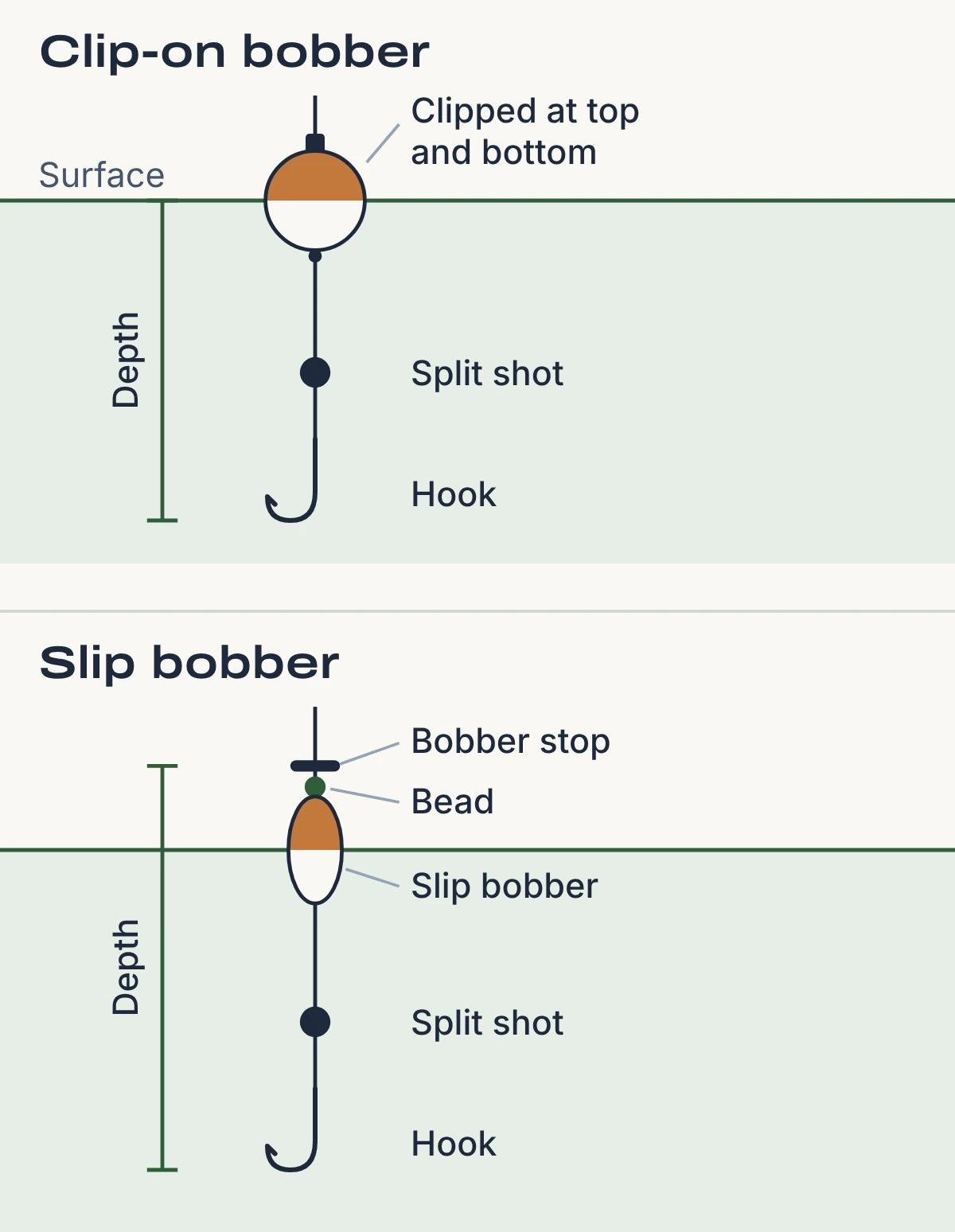
Tie your hook on first. On a clip-on bobber, press the top button to expose the bottom wire hook, catch the line and let go; then push the button’s edge while holding the bottom in, and catch the top hook. Set the bobber as far above the hook as you want the bait to hang, with split shot between.
Bobbers go on a line in one of three ways. Texas Parks and Wildlife’s beginner guide says most “are spring-loaded and attach to your fishing line with a clip,” some are tied to the line, and others let the line slip through. Below are steps for the two you will meet most, the push-button clip-on for a few feet of water and the slip bobber for deeper fish, then short notes on pencil, spring and bubble bobbers.
What you need
- A rod and reel with line on it. If the spool is empty, start with our guide to putting line on a reel. If you still need a first outfit, our beginner fishing reel roundup compares spincast and spinning reels for new anglers.
- Hooks. Nebraska Game and Parks suggests sizes 6 to 10 for bluegill and crappie (the bigger the number, the smaller the hook).
- A bobber. Nebraska Game and Parks calls a 1-inch (2.5 cm) clip-on bobber “a good choice for a new angler.” For deeper water, add a slip bobber; Mercury Marine notes that most “are packaged with a handful of threaded bobber stoppers and some small plastic beads.”
- Split shot. Small sinkers with a slot down the middle. Non-lead shot is the safer pick and is required in some states (see the note after the clip-on steps).
- Bait. The beginner slip rigs of Mike Frisch, host of the Fishing the Midwest TV series, are “usually baited with a leech, minnow, or portion of a nightcrawler”; Mercury Marine adds small jigs as a common choice.
- Needle-nose pliers to pinch split shot on and off, and clippers to trim line.
- A fishing license, if your state requires one at your age. Most states require one for adults; Texas Parks and Wildlife, for example, tells anglers: “If you are 17 years old or older, purchase appropriate fishing licenses and tags.” Check your state wildlife agency, and follow the regulations for the water you fish.
Clip-on or slip bobber?
Mercury Marine’s bobber guide sums up the trade-off: “If you’re fishing more than a few feet deep, a fixed bobber makes it difficult to cast and net fish because of the long line dangling down below the float.”
| Clip-on bobber | Slip bobber | |
|---|---|---|
| How it holds the line | Spring-loaded wire hooks at the top and bottom | Line slides through it until a bead and stop halt it |
| Water depth | Shallow, up to a few feet | Just under the surface to near the bottom |
| Casting | All the line below the bobber hangs from the rod tip | The bobber slides down to the weight, so you cast a short line |
| Changing depth | Unclip one end and slide the bobber | Slide the stop along the line |
| Landing a fish | The bobber can keep a fish out of reach | The stop reels onto the reel, so the fish comes close |
Choose a clip-on when the bait hangs a few feet down, such as for panfish along a shallow weed edge; choose a slip bobber for deeper fish or quick depth changes.
How to put on a clip-on bobber
Tie on the hook
Thread the line through every rod guide and tie the hook to the end; New York DEC’s fishing basics guide teaches the clinch knot for this. With children, Nebraska Game and Parks suggests barbless hooks “for the ease of removal from people.”
Pinch on a split shot
Lay the line in the shot’s slot a few inches to a foot above the hook (the table below has the distances) and squeeze it shut with pliers, not your teeth. If the shot is lead, wash your hands afterward, and check your state’s lead rules (see the note below these steps).
Pick your depth
Measure up the line from the hook by the depth you want the bait to hang (“How to set the depth,” below, shows how to find it). New York DEC suggests setting it so the hook “hangs just above structure (i.e. weeds, logs, etc.) or the bottom”; Minnesota DNR’s pier notes start with the bobber “a foot or two up from the hook.”
Clip the bottom hook
Press the button on top of the bobber so a small wire hook slides out of the bottom. Lay the line under it at your mark and let go.
Clip the top hook
Push down on the edge of the button while holding the bottom hook in, run the line under the top hook, and release. The line now runs straight past both ends of the bobber.
Bait the hook
New York DEC’s steps put the bait on just before casting. Bait adds weight, so do this before you check the balance.
Test it at your feet
Lower the baited rig into the water and watch the bobber. Minnesota DNR’s rule is short: “If the bobber is slightly submerged it is perfect” (riding a little low, not pulled under). If it sinks or lies flat, adjust the split shot (see the fixes below).
Cast
Reel up until the bobber hangs about 6 to 12 inches (15 to 30 cm) from the rod tip, the length New York DEC teaches for casting. Then follow its rule: “Before you cast, look behind you to be sure no one else is there,” and check for trees and bushes in the way.
Note
Lead tackle rules vary. A 2020 Connecticut legislative research report, which looked only at New York and the New England states, found that Maine, Massachusetts, New Hampshire, New York and Vermont “restrict the use or sale of certain lead fishing equipment for fresh water fishing,” mostly for sinkers of one ounce (28 g) or half an ounce (14 g) or less. Rules change and other places may have their own, so check your state wildlife agency’s current regulations and the rules for the water you fish. TPWD’s instructor guide names “stainless steel or tin sinkers” as better alternatives.
How to rig a slip bobber
On a slip rig, the order on the line is stop, bead, bobber, then weight and hook.
Put the stop on the main line
With the line through every rod guide, start here. Most stops come wound on a small plastic tube. Mercury Marine’s instructions: “put your line through the tube, slip the thread off the tube onto the line, then tighten the thread around the line.”
Slide on a bead
The bead sits between the stop and the bobber. Mike Frisch calls it “a cushion between the stop and bobber to prevent the bobber from sliding over the stop.”
Slide on the bobber
Thread the line through the bobber’s tube or end eyes so it slides freely. If the package shows which end goes up, follow it.
Tie on the hook or jig
Mercury Marine names live bait on a plain Aberdeen or bait hook, and small jigs, as the usual slip-bobber presentations.
Add the weight
Pinch one or two split shot about a foot (30 cm) above the hook with pliers, not your teeth, the spacing Frisch teaches beginners. Wash your hands afterward if the shot is lead. Some states ban small lead sinkers; see the lead note after the clip-on steps. With a live minnow, Mercury Marine suggests going farther: “Keep the weight at least 18 inches or so above the minnow.”
Slide the stop to your depth
The distance from the stop to the hook is roughly how deep the bait will hang (“How to set the depth,” below, shows how to find it). Frisch’s rule: moving the stop away from the hook “makes the rig fish deeper,” and moving it closer makes it fish shallower.
Bait the hook
Put the bait on now, so the weight you balance against includes it.
Cast and let it settle
Look behind you before you cast. The weight pulls line through the bobber until the bead meets the stop, and then the bobber stands up. Mercury Marine’s balance test is that the waterline sits “roughly even with that painted line on the bobber”; add or remove split shot until it does.
Tip
Mercury Marine says to trim the stop’s tag ends. Wisconsin guide Greg Bohn, profiled by Outdoor Life as “Mr. Slip Bobber,” does the opposite: “Never trim the tag lines after you tighten the bobber stop,” because “they make the knot easier to see, and they make it easier to retighten the knot after it loosens.” Either way, the stop must still pass through your rod guides.
Pencil, spring and bubble bobbers
Texas Parks and Wildlife lists bobber shapes “from round, to pencil or quill, to popping, and oblong.” Most go on in one of the ways below; designs vary by maker, so follow the package when it differs.
| Bobber | How it goes on |
|---|---|
| Spring bobber (a spring over a notch at one end) | Pull the spring back from the tip to expose a notch, hook a small loop of line into it, and let the spring close over it (tackle retailer Mystery Tackle Box’s spring-bobber guide) |
| Pencil slip float | Rigs like the slip bobber above (if your pencil bobber has a spring at one end, see the spring row) |
| Clear casting bubble | Line runs through a hollow center peg, wide end toward the hook. It slides, so it needs a stop below it: a crimp and bead, a swivel, or a split shot |
| Bobbers tied to the line | No standard method; tie them as the package shows |
Bohn switches to a pencil float when waves make a pear-shaped bobber rise and fall too much, since it “isn’t as responsive to wave action.”
To fill a casting bubble, push the peg partway out, add water for casting weight, then push it back to seal. For the stop, the Fishing Destin Guide (a personal saltwater fishing site) notes that “if you don’t have any crimps, you can tie on swivels instead or use the small freshwater lead clamp-on sinkers.”
Where to put the weight
The split shot goes on the line below the bobber, between it and the hook, and usually much closer to the hook. How close depends on the guide and the bait:
| Guide | Rig | Split shot above the hook |
|---|---|---|
| Texas Parks and Wildlife, Fish Texas | Basic live-bait rig | 4 to 8 in (10 to 20 cm) |
| TPWD Angler Education instructor guide | Simple rig, #3 split shot | 6 to 12 in (15 to 30 cm) |
| Minnesota DNR, cane pole | Bobber and split shot | About 1 ft (30 cm) |
| Mike Frisch, Fishing the Midwest | Slip bobber | A foot or so |
| Mercury Marine | Live minnow, slip bobber | At least 18 in (46 cm) |
TPWD’s reason for keeping the shot close is to “allow live bait to look natural to the fish,” while Mercury Marine’s wider gap keeps a minnow lively. The TPWD instructor guide’s 6 to 12 inches is a reasonable place to start; adjust from there.
To move or remove split shot, pinch the wings on its back with pliers; Nebraska Game and Parks notes that “the pliers can pinch these to remove the split shot.”
Safety
Close split shot with pliers, not your teeth. Michigan’s MiLeadSafe program advises: “Do not put leaded items in your mouth (fishing sinkers, etc.).” It also says to wash your hands before eating or drinking.
How to set the depth
Greg Bohn usually fishes his bait “one foot above the bottom.” His method, from Outdoor Life:
Clip a heavy weight to the hook
Bohn uses an ice-fishing depth weight, a heavy clip-on weight sold in tackle shops for this job. Any sinker heavy enough to sink the bobber will do.
Lower the rig straight to the bottom
This needs a boat, dock or pier you can drop straight down from. From shore, use the cast-and-adjust method below.
Reel up the slack with the rod tip at the water’s surface
Lift the rod tip one foot above the water
Then set the stop one foot below the tip.
Take the weight off
The bait now hangs about a foot (30 cm) above the bottom.
Cast and adjust (from shore, or for a spot you can’t reach straight down). Bohn casts the weighted rig to the spot and moves the stop after each cast. He stops when the bobber floats about a foot under the surface with the weight on the bottom: the heavy weight pulls it under by the foot of line you are leaving above the bottom. Take the weight off and the bait hangs a foot off the bottom. On a clip-on bobber, both methods work the same way: clip the bobber where the stop would go.
Related guide: Easy Fishing Line Knots: Which Ones to Learn and When to Use Each
Reading the bobber: mistakes and fixes
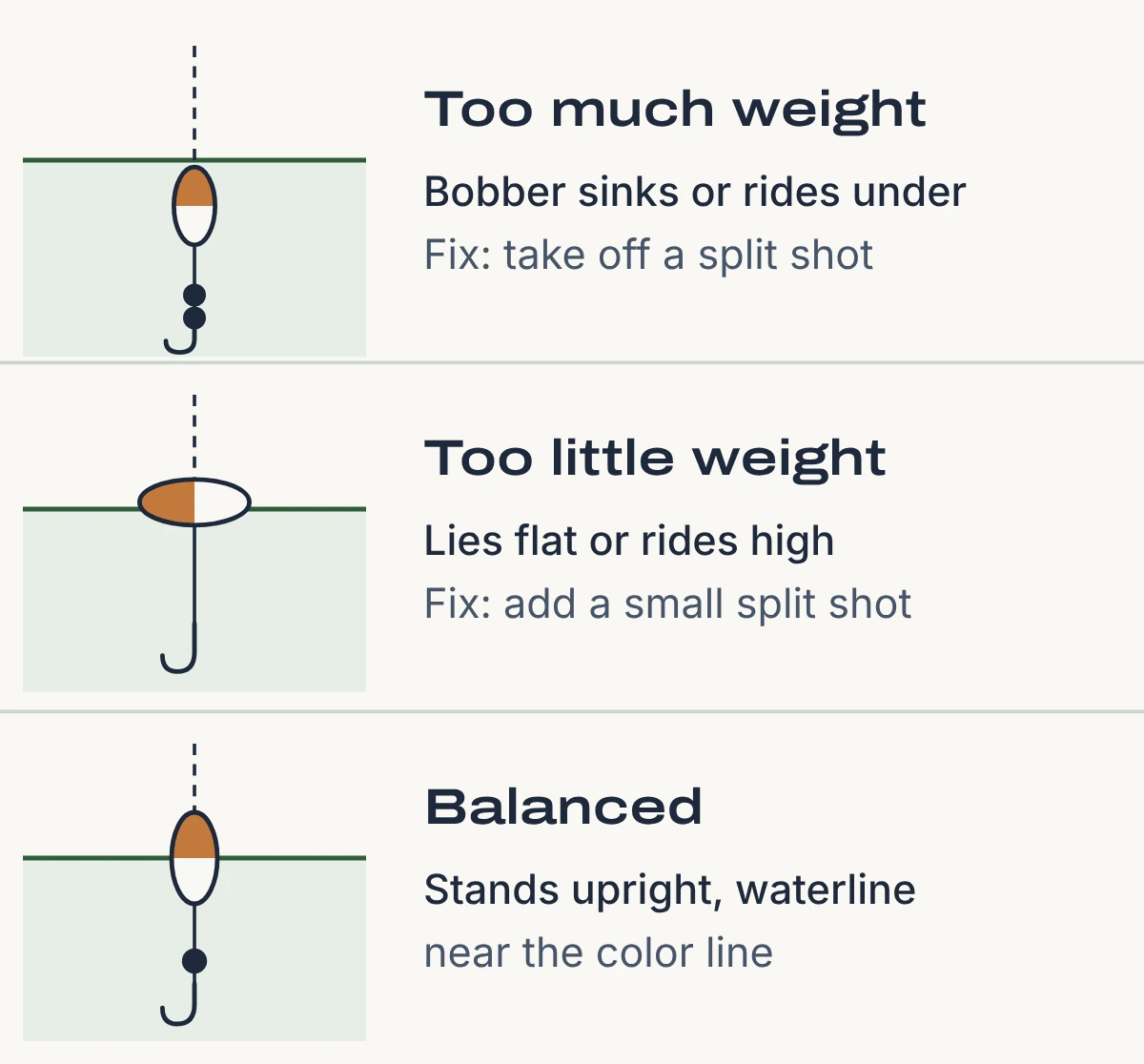
If your bobber doesn’t stand like the balanced one above, find the symptom here.
| What you see | Likely cause | Fix |
|---|---|---|
| Bobber sinks with no bite | Too much weight (Minnesota DNR) | Take off a split shot, or use a bigger bobber |
| Bobber floats high or on its side | Too little weight (Minnesota DNR) | Add a small split shot |
| Slip bobber lies flat after every cast | Stop set deeper than the water, so the weight rests on the bottom | Slide the stop toward the hook |
| Depth keeps changing on a slip rig | The stop has loosened and slides on the line | Pull both tag ends to retighten it; Bohn leaves the tags long for this |
| Stop pulls into the top of the slip bobber | Bead too small or missing | Use a bead too big to pass through the bobber’s stem, as Bohn does |
| Bait snags weeds or the bottom | Set too deep | Move the bobber or stop toward the hook |
| Casts tangle with a long drop below a clip-on | Too much line hanging under a fixed bobber | Switch to a slip bobber |
A few other common mistakes:
- A bobber that’s too big. Nebraska Game and Parks: “Use the smallest bobber you can get away with.”
- Missing the “up” bite. Mercury Marine points out that “if a fish gently engulfs the bait, the bobber can actually pop up.” Treat a bobber that suddenly rises as a bite.
- Line heavier than you need. TPWD’s beginner guide says heavier line than needed “may reduce the number of hits or strikes you get because heavier line is more visible to fish.”
Ready to buy?
Light line gets more bites under a small bobber (TPWD, above). If you’re bobber fishing for trout, our trout fishing line roundup compares light monofilament, fluorocarbon and braided lines.
Tip
Not sure what depth, hook or bobber size suits the fish in your local water? TPWD’s advice is simple: “Ask a seasoned angler or a bait and tackle dealer for suggestions.”
Frequently Asked Questions
Q. Are bobbers only for beginners?
No. Mercury Marine calls bobber fishing “a highly effective, highly adaptable method for catching freshwater and inshore saltwater fish,” and Greg Bohn has fished slip bobbers for walleyes in “numerous big-money tournaments.”
Q. How do you put a bobber on without clips?
Use a slip bobber with a stop and bead, or a casting bubble, whose line runs through a center peg, with a stop such as a swivel, or a crimp and bead, below it. Bobbers that tie onto the line come with their own instructions.
Q. Does the weight go above or below the bobber?
Below it. The split shot sits between the bobber and the hook, so it pulls the bait down and holds the bobber upright.
Q. What size bobber should I use?
Go as small as will float your bait and weight. Nebraska Game and Parks notes that “the smaller the bobber, the easier it will be to detect nibbles,” while Mercury Marine says heavier rigs and bigger fish call for a bigger bobber.
Q. Does bobber color matter?
Pick the color you can see best. TPWD’s instructor guide says to “Place the bobber color that’s easiest to see on top of the water,” and Bohn finds that orange tops “show up well under most conditions, especially on sunny days when the water is choppy.”
Q. Can you fish a lure under a bobber?
Yes. Mercury Marine lists small jigs with soft plastics as a common slip-bobber setup. TPWD suggests a clear “bubble” bobber four to five feet (1.2 to 1.5 m) above a fly if you don’t have a fly rod. For more simple rigs, see our beginner’s guide to bass fishing.
Sources (13)
- New York State DEC, Fishing Basics: Getting Started Fishing (PDF)
- Minnesota DNR MinnAqua, Pier Notes: Rods and Reels, Rigging and Knot-Tying (PDF)
- Minnesota DNR, Using a cane pole
- Texas Parks and Wildlife, Fish Texas: A Basic Guide for the Beginning Angler (PDF)
- Texas Parks and Wildlife, Angler Education Instructor Guide (PDF)
- Nebraska Game and Parks, Fishing with basics of hooks, bobbers and sinkers
- Mercury Marine, Bobber-Fishing Basics (English article on Mercury’s Swiss site)
- Outdoor Life, Floating Temptations (Greg Bohn’s slip-bobber rig)
- The Fishing Wire, Slip Bobbers Are Simply Effective (Mike Frisch)
- Michigan MiLeadSafe, Jobs and Hobbies
- Connecticut Office of Legislative Research, Lead Sinker Laws in Select States (PDF)
- Mystery Tackle Box, How To Rig A Spring Bobber In 4 Easy Steps (tackle retailer blog)
- Fishing Destin Guide, Bubble Rigs (personal Destin, Florida fishing site; saltwater straw rig)
