The short answer
Tie the line to the lillian, the soft cord at the rod tip, with a girth hitch or a slip knot, keeping the hard tip inside the handle. Extend the sections tip first, trim the line to about the rod’s length, then add a few feet of tippet and a fly. Collapse from the handle end.
A tenkara rod has no reel. Tenkara Rod Co., a tenkara rod seller, says “tenkara rods do not use a reel” and that “a fixed-length line is attached directly to the rod tip.” That makes the tip the delicate part of the setup, and most of the steps below exist to protect it.
Related guide: How to Set Up a Baitcaster Reel, From the Box to a Test Cast
The steps follow named makers part by part: Tenkara USA, a tenkara rod company founded in 2009, the rod brand WETFLY, and Tenkara Rod Co. Where they differ, the text says so. For the rest of your kit, see our fishing gear hub.
What you need
- A telescoping tenkara rod with its end cap. The lillian is the cord at the tip; Tenkara Rod Co. calls it “the soft tip of the rod.”
- A tenkara line. Either a level line you cut and knot yourself, or a line with a loop on the back end. Tenkara USA’s John Geer says of its tapered nylon lines that “the loop on the back of the line makes them easy to attach to the Lillian of the rod.”
- Tippet and a fly. Tenkara Rod Co. describes flies as “Imitation insects that attract fish.”
- Nippers or scissors. Pat Jaeger, a veteran Eastern Sierra fly-fishing guide who teaches Tenkara USA’s Masterclass video series, cuts line with nippers, not his teeth.
- Eye protection. See the safety note below.
- A fishing license, before you go to the water. Most states require a fishing license for anglers over a set age, and the age varies by state; check your state’s wildlife agency before you go. Washington’s Department of Fish and Wildlife says “All fishers age 16 and older need a fishing license,” and Maine’s says “A valid Maine fishing license is required for anyone 16 years of age or older, to fish in inland waters.”
Safety
A tenkara fly is a hook on the end of a long rod, so check overhead and behind you before every cast. Pat Jaeger tells viewers extending a rod to watch for ceiling fans and for a buddy’s eyes, and to point it diagonally up. Tenkara Bum, a tenkara retailer, says: “Wear eye protection.” and “Pay attention to your back cast so no one gets hooked.” The National Park Service says: “If you are hooked, learn first aid for removing hooks from the skin and treating the wound. If the hook has deeply penetrated the skin, muscles, tendons, or bone, if it is on the face or near/in the eyes, or if you are bleeding excessively, seek medical treatment immediately.” For an object in the eye, MedlinePlus (National Library of Medicine) says: “Leave the object in place. Do not try to remove the object. Do not touch it or apply any pressure to it.” and “Get medical help right away. Do not delay.” The Park Service also says: “Only cast where fishing is permitted” and “Find shelter if thunderstorms form and seek higher ground if water levels rise.”
The tenkara rig from tip to fly
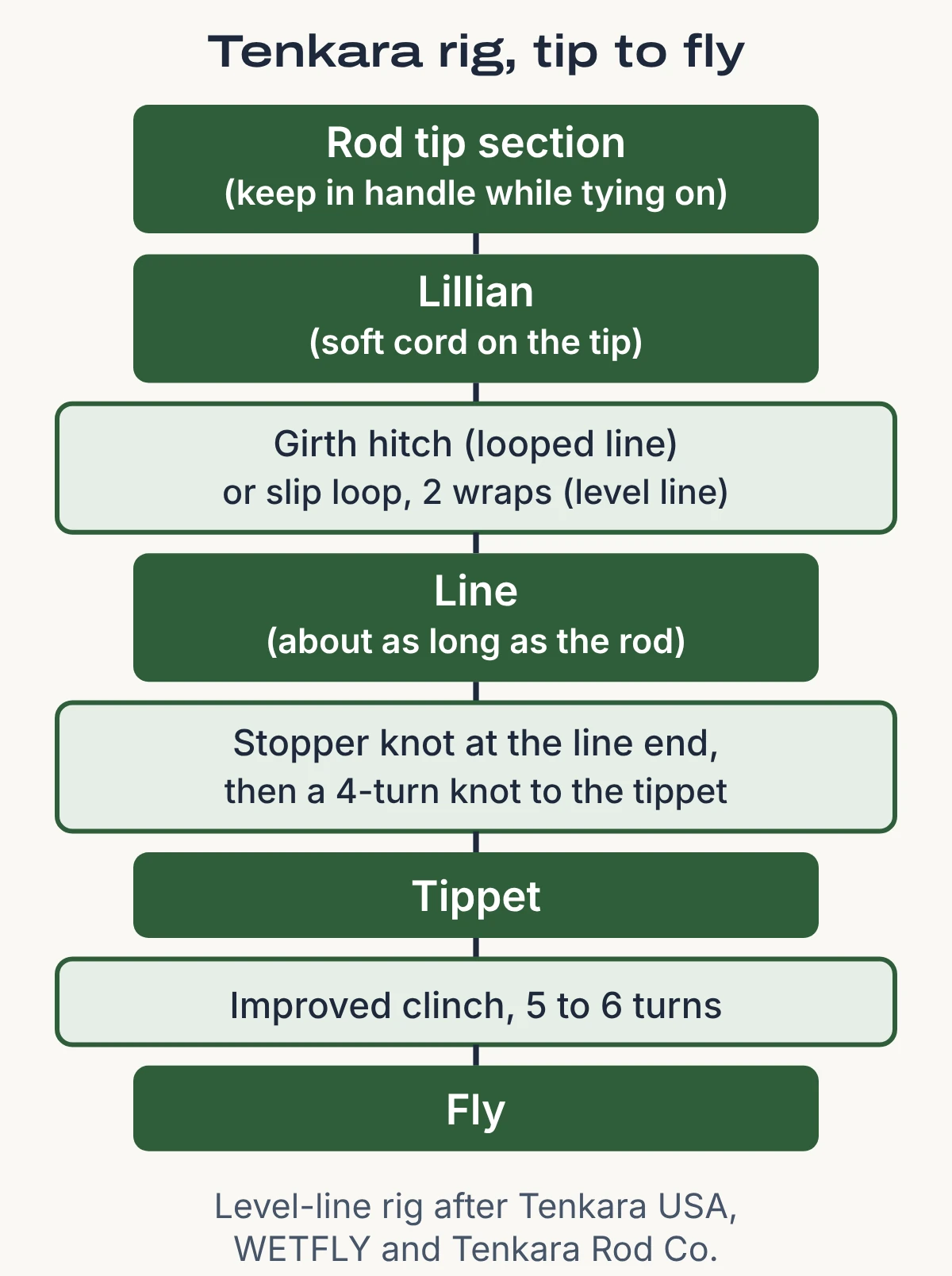
Each piece ties to the one before it, starting at the lillian. The diagram shows the level-line version Pat Jaeger teaches for Tenkara USA, with the joints WETFLY and Tenkara Rod Co. name for a looped line. Tenkara Rod Co. describes the tippet as the piece that “connects your line to your fly.”
How long should the line be?
Makers give a range, not a fixed rule. Start near the rod’s length.
| Source | What it says about line length |
|---|---|
| Tenkara USA (John Geer, customer service) | To keep the line off the water, “a line not much more than a foot or two longer than the rod.” |
| Pat Jaeger on Tenkara USA’s Masterclass | “I want the line to be roughly as long as the fly rod.” |
| Tenkara Rod Co. | A line that “matches the length of the rod (give or take a few feet).” |
| WETFLY (rod brand) | For a level line, “equal to 1 to 2 times the length of the rod.” |
| 1Source Outdoors (Bass Pro Shops’ tips site) | “a good place to start is with a line of the same length of the pole.” |
Geer adds that a level line is “usually about the length of the rod but up to twice that length if you have a good reason for it.” A tapered nylon line is a different case: you can cut it back “up to about 18 inches from the tip” before you reach the taper, and it is best to go no further.
Open the rod and free the lillian
Put on eye protection and clear the space above you
WETFLY’s quick-start guide says to “have at least 15ft of clear space” for its rods, and Pat Jaeger points his rod diagonally upward so he does not hit a ceiling fan or a buddy’s eyeball.
Hold the rod handle-down and take off the end cap
1Source Outdoors says: “Remove the end plug from the rod.” Pull straight out, with the handle down and the tip up so the sections do not slide out.
Shake out only the lillian
1Source says to drop the tip toward the ground and gently shake until the lillian shows, then pull it out a few inches: “Do not pull out the entire rod yet!”
Keep the hard tip hidden whenever you touch the lillian
Discover Tenkara, a tenkara shop and guide site run by angler and biologist Dr. Paul Gaskell, calls this its golden rule: “the delicate rod-tip must be hidden inside the handle-section.” It adds: “trap the lillian against the rim of that section with the thumb or index finger.”
Attach the line to the lillian
Which knot you use depends on the line. Tenkara Rod Co. names two: “a loop-to-loop connection or girth hitch.” WETFLY also describes a girth hitch, and Tenkara USA’s Pat Jaeger uses a slip knot for level line. Many rods have a small overhand knot near the end of the lillian, “about a quarter inch from the end of the lilian” per WETFLY, to keep the line from sliding off. Tenkara Bum disagrees for level lines: “If you fish with level lines you absolutely, positively do not need a knot in the end of your lillian.” For a girth hitch it says “I suspect you would be safer with the knot than without.”
A line with a loop: girth hitch
These steps follow Net Knots, a knot-reference site, and WETFLY’s guide, which agree on every part.
Open the loop and fold it back over the line
Net Knots: “fold it back over the line.”
Pull the line a little way up through the loop
WETFLY: “Double the loop over and pass the base of the Tenkara line through the end of the loop.”
Pass the lillian through the loop you just made
This is the girth hitch. Net Knots says to “Pass the girth hitch beyond the stopper knot” if your lillian has one. Expose only the lillian: “leave the hard rod tip inside.”
Tighten it with the tip still hidden
Net Knots says to tighten “by carefully pulling on the fly line while holding the lilian firmly.” WETFLY warns: “Be very careful to keep the tip of the Tenkara rod fully retracted into the base section of the Tenkara rod handle when applying pressure to this hitch.”
A level line: slip knot
These steps follow Pat Jaeger’s rigging lesson for Tenkara USA, with the loop detail from Net Knots and 1Source Outdoors.
Tie a slip loop in the end of the level line
Net Knots says some people also tie a stopper knot at the very end of the line for extra security. Net Knots: tie “an overhand knot with the tag end around the standing part.” 1Source Outdoors says to leave “about a half-inch tag,” which “will allow you to easily remove it at the end of the day.”
Pass the lillian through the loop two times
Pat Jaeger: “go around two times.” Net Knots: “If the lilian has a stopper knot be sure to go past the stopper,” and “Some people make three wraps for extra security, but two will suffice.” Pat calls it an arbor knot and says it is tied this way “So we can take it apart.”
Pull the line to tighten the loop onto the lillian
Net Knots says to hold “the two wraps of the lilian together” while you pull the level line. To take the line off later, hold the lillian firmly with the tip inside the rod and tug the tag end of the slip knot.
Extend the rod, set the line length, add tippet and fly
Extend the tip section first, one section at a time
Discover Tenkara: “Always EXTEND the rod with the tip section first, followed in sequence by each section (going one thicker each time) and never rest the handle on the floor.” Pat Jaeger pulls the lillian through a pinched finger in short pulls, “only using two inches” at a time, with a little tug at each junction. WETFLY says to hold the cork handle firmly and extend the sections away from you.
Hold the rod up and check the line against it
Pat Jaeger’s target is a line “roughly as long as the fly rod.” 1Source Outdoors says to trim it to the pole’s length once the rod is extended. See the table above for the range.
Tie a stopper knot in the end of a level line
Pat Jaeger’s third knot is “another overhand knot, the exact same knot,” pulled tight and trimmed with nippers. He calls it “the knob knot,” a stopper knot. A line that already has a clear loop end, such as the WETFLY line described in the next step, may not need it.
Join the tippet to the line
Tenkara Rod Co. says to “Attach 3-4 feet of tippet”; 1Source Outdoors says “three to six feet.” Pat Jaeger overlaps the line and tippet, wets them, folds the clear section into a loop and goes “through four times,” then trims. WETFLY’s Duraleader line has a clear loop end for the tippet, tied with an improved clinch.
Choose a tippet size that will not strain the rod
WETFLY says to “avoid heavy tippets that are 3X or larger” and that “a 5X or 6X tippet is perfect for most situations.” In the X system, “the higher the X-coefficient, the lighter the tippet.”
Tie the fly on, hook away from your face
Pat Jaeger ties the fly on with what he calls “a fisherman’s knot”: he goes “five turns and back through the hole” and wets the knot. WETFLY’s improved clinch passes 2 to 3 inches of tippet through the eye, then twists “that tag around the main stem of the tippet five to six times,” passes it through the hole at the base of the twist and then through the loop, and pulls it snug. Eye protection stays on.
Straighten the line and check behind you
Discover Tenkara says to “stretch out any coils that are in your line BEFORE you fish.” Look behind you for people before the first cast.
Note
Makers disagree about knots. WETFLY teaches the improved clinch for the fly. Discover Tenkara lists the clinch, the improved clinch, the Ishigaki one knot and the two- or three-turn water knot, and says that in its tester’s trials these knots “only retained less than half the breaking strain of the un-knotted line.” That is one seller’s test, not a standard, so tie the knots your maker shows and check each one.
Collapse and store the rod
Secure the fly first
The National Park Service’s list says “Don’t get hooked, prevent and treat fishing hook related injuries.” Cut the fly off or hook it into a keeper before your hands are busy with the rod.
Wipe off grit
Tenkara USA’s rod-care page says that if the water carries a lot of sediment, or you fished salt water, wipe the segments “with a moist cloth and possibly rinse them with clean water, before you collapse your rod.” Discover Tenkara suggests a microfiber cloth to dry it first.
Collapse from the handle end, a couple of inches at a time
Discover Tenkara: “Always COLLAPSE the rod from the butt-section first.” WETFLY: collapse “in order from thickest to thinnest as you move toward the tip.” Pat Jaeger says retracting is “when people break their rods”: work it back “just a couple of inches at a time,” and if a piece jams, push it down and “Grab as close as you can to that very piece.”
Push straight down, with your hands close together
Discover Tenkara: “Never hold the rod with your hands far apart when you collapse each section.” Its own replacement-section data show the second section from the tip is the most vulnerable, and it blames pushing sections together with the hands held too far from the joint.
Cap the handle and stow the line
WETFLY says to put the stopper back “to keep sections from sliding out unintentionally.” Pat Jaeger shows his own way of wrapping the line around the collapsed rod and says there are no rules to it.
Store it clean and dry
Tenkara USA’s rod-care page: “always store your tenkara rod clean and dry.” It advises against “extreme heat or extreme cold (such as a car in the summer or winter)” and says “do not apply any products to your rod.” WETFLY says to keep the rod in its protective sock and tube.
Common mistakes and fixes
- Touching the lillian with the tip out. Discover Tenkara calls it “The biggest culprit of broken tenkara rod tips.”
- Pulling sections out of order, or reaching far up the rod to collapse it. Discover Tenkara says sections can shuffle inside larger ones and then will not collapse. Extend tip first, collapse handle first, and push close to the joint.
- A stuck joint. Discover Tenkara suggests gripping the blank with a patch of non-slip matting “as CLOSE to the stuck joint as you possibly can,” and warm water for a joint that is “really stuck fast.”
- A heavy fly or heavy tippet. Tenkara USA’s rod-care page names “heavier flies such as those with beadheads, hitting the rod while casting” as a main cause of cracks, and advises avoiding “putting the rod down onto rocks whenever possible.” WETFLY says to avoid 3X or heavier tippet.
If a section breaks, contact the maker. Tenkara USA’s rod-care page says “we can replace individual segments if anything ever breaks,” and Pat Jaeger counts the sections so he can tell the maker which piece broke (“I broke piece five”).
Tenkara or western fly fishing?
| Tenkara | Western fly fishing | |
|---|---|---|
| Reel | None | Reel holds line (see below) |
| Line | A fixed length on the rod tip | Line you strip out and reel in |
| Missing a spot by six inches | “we pick up, throw it down again, and take a six-inch step” | “the guy usually pulls out about two feet of line” |
The last row is Pat Jaeger’s own comparison. He describes tenkara as “a telescoping rod with a fixed amount of line on the end.”
If you would rather fish with a reel and lures or bait, a spinning outfit is the usual route; our roundup of spinning rods under $100 and our trout spinning rods roundup cover that side. A tenkara rod skips the spooling step that our guide to putting fishing line on a reel walks through.
Related guide: How to Set Up a Spinning Reel: Mount It, Spool It and Set the Drag
Frequently Asked Questions
Q. Where does the line attach on a tenkara rod?
To the lillian, the soft cord at the tip. Tenkara Rod Co. names “a loop-to-loop connection or girth hitch”; level line uses a slip knot with two wraps.
Q. Do I need a knot in the end of the lillian?
WETFLY says the small knot keeps the line from sliding off. Tenkara Bum, a retailer, says a level line does not need it but a girth hitch is safer with it. Follow what your rod’s maker shows.
Q. Which section do I extend first?
The tip section, then each thicker one. Collapse from the handle end first.
Q. How long should the tippet be?
Tenkara Rod Co. says 3 to 4 feet and 1Source Outdoors says 3 to 6 feet.
Q. Is there a video?
Tenkara USA publishes a rigging lesson with a transcript. DRAGONtail Tenkara, a tenkara rod and line seller, lists “Connecting Level Line to your rod tip” on its help page. If your rod came with its own sheet, that sheet has the last word.
Sources (18)
- Tenkara USA, Getting Ready to Fish: Rod Rigging & Choosing Your Line (Masterclass episode 2)
- Tenkara USA, The Right Way to Rig for Your Conditions (Masterclass episode 3)
- Tenkara USA, Tenkara Basics: Introducing the Fundamentals of Tenkara (Masterclass episode 1)
- Tenkara USA, All About Lines For Your Tenkara Rod
- Tenkara USA, Our Story
- Tenkara USA, Tenkara Rod Care and Maintenance
- Tenkara Rod Co., Tenkara Fly Fishing How to Guide
- WETFLY, Tenkara Quick Start Guide
- Discover Tenkara, Tenkara Rod Setup: Your Guide to Rigging Up
- Net Knots, Tenkara Traditional Line to Rod Knot
- Net Knots, Tenkara Level Line to Rod Knot
- 1Source Outdoors (Bass Pro Shops), How to Set Up Your Tenkara Rod in Seven Steps
- TenkaraBum, Lillian Knot
- DRAGONtail Tenkara, Getting Started With Tenkara
- National Park Service, Reel It In: Be Prepared for a Successful Fishing Day
- MedlinePlus, Eye – foreign object in
- Washington Department of Fish and Wildlife, Fishing licenses
- Maine Department of Inland Fisheries and Wildlife, License requirements