The short answer
A tippet is the thin, even length of line tied to the end of a tapered leader, with the fly on its far end. It is the part you replace most often. Tippet is sold by X size, a diameter code: the higher the number, the thinner and weaker the line, so 6X is finer than 3X.
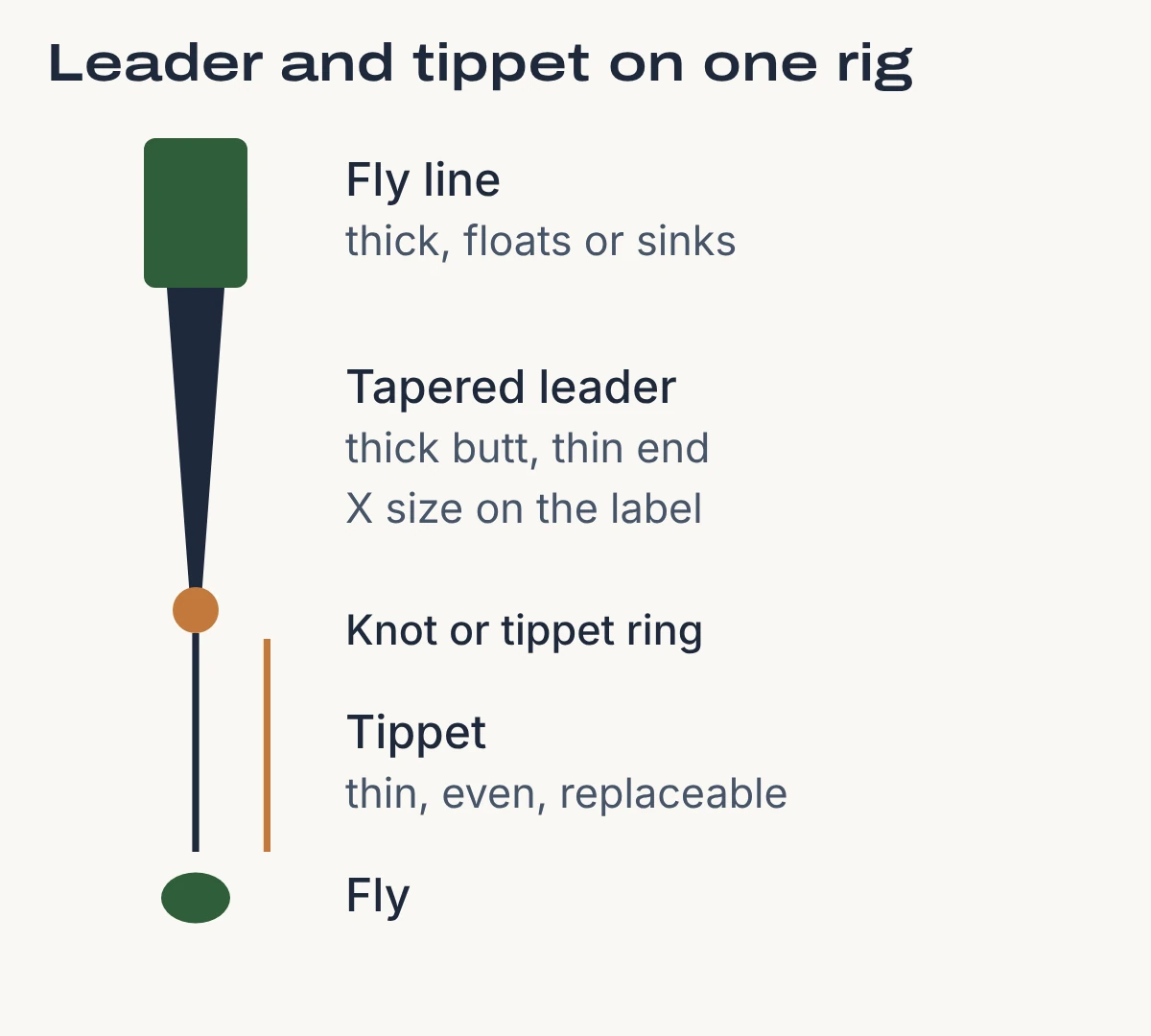
Fly line is too thick to tie to a fly, so a fly rig steps down in stages: backing on the reel, fly line, tapered leader, tippet, fly. The leader does the turning over of the cast, and the tippet is what the fish and the fly actually meet. Our fishing gear hub lists the rods, reels and lines we cover.
Leader vs tippet: where one ends and the other starts
Orvis, the fly-fishing maker and retailer, describes the leader as “a piece of monofilament (or sometimes fluorocarbon), usually tapered, that connects your fly line to the thinner section of line”. It describes the tippet as “a finer, more delicate length of line tied to the end of the leader, to which you tie your fly.”
Two details cause most of the confusion:
- “Tippet” means two things. Hatch Magazine’s Todd Tanner notes that “the tippet” is also commonly used for the very end of the leader, the part that attaches to the fly, while “tippet material” is the spooled line you buy to build or repair a leader.
- The X on a store-bought leader describes its end. For tapered leaders, Tanner writes, “the X tells you the diameter of the narrowest part of the leader.” A 9-foot 4X leader, for example, finishes at 4X thickness.
Do you need tippet at all?
You can fish a tapered leader with no tippet, but each fly change shortens it. Orvis’s Tom Rosenbauer explains that “your leader will be shortened and the diameter will start to increase once you have used up the tippet section and start cutting into the taper.” Adding tippet restores the length without buying a new leader. Fly Fishing Bozeman adds that thick, stiff line impedes a fly’s drift, while light, supple tippet lets it drift with less interference.
A spool of tippet also lets you change size on the water. Heavier tippet suits big or bulky flies and strong fish; finer tippet suits clear, slow water and small flies. That choice is the next section.
What the X numbers mean
Spin and bait lines are sold by breaking strength in pounds. Tippet is sold by diameter. Tanner puts it plainly: “Please keep in mind that Xs correspond to diameter, not breaking strength.” Rosenbauer agrees for trout leaders: “the diameter of the leader (rated in X sizes) is more important than the pound test rating.”
The table shows how one maker’s spools line up. The diameters are the same for both materials; the breaking strengths are not, because they depend on the product.
| X size | Diameter (in) | RIO Powerflex (nylon) | RIO Fluoroflex Strong (fluorocarbon) | Orvis fly sizes |
|---|---|---|---|---|
| 0X | .011 | 15 lb | 15.5 lb | 2, 1/0 |
| 1X | .010 | 13 lb | 13.3 lb | 4, 6, 8 |
| 2X | .009 | 10 lb | 11.2 lb | 6, 8, 10 |
| 3X | .008 | 8.2 lb | 8.8 lb | 10, 12, 14 |
| 4X | .007 | 6.4 lb | 7.3 lb | 12, 14, 16 |
| 5X | .006 | 5.0 lb | 5.2 lb | 14, 16, 18 |
| 6X | .005 | 3.4 lb | 3.8 lb | 16, 18, 20, 22 |
| 7X | .004 | 2.4 lb | 2.6 lb | 18, 20, 22, 24 |
| 8X | .003 | 1.5 lb | not listed | 22, 24, 26, 28 |
Sources: RIO’s Powerflex and Fluoroflex Strong spec tables on the Far Bank site (breaking strengths as RIO lists them); Orvis’s “Recommended leader diameters for different fly sizes” chart (fly sizes). Diameters match across the Orvis chart and both RIO tables.
Read the table two ways. Going down, the line gets thinner, weaker and harder to see. Going across, a different brand or material at the same X can break at a different weight, as Tanner warns: “4X material from Company A may well have a different breaking strength than 4X material from Company B.” The printed label on the spool is the figure to trust.
Which size to tie on: the rule of three
Orvis gives a starting rule: “divide the hook size by three to get the tippet size.” A size 16 fly works out to about 5X. Size numbers run backwards (a bigger number is a smaller hook), so a size 22 gives about 7X and a size 6 gives 2X.
The check below is worked out here, not taken from Orvis: each fly size divided by three and rounded to the nearest whole X, set against the fly sizes Orvis pairs with each X.
| Fly size | Rule of three (rounded) | Orvis chart pairs it with |
|---|---|---|
| 24 | 8X | 7X, 8X |
| 22 | 7X | 6X, 7X, 8X |
| 20 | 7X | 6X, 7X |
| 18 | 6X | 5X, 6X, 7X |
| 16 | 5X | 4X, 5X, 6X |
| 14 | 5X | 3X, 4X, 5X |
| 12 | 4X | 3X, 4X |
| 10 | 3X | 2X, 3X |
| 8 | 3X | 1X, 2X |
| 6 | 2X | 1X, 2X |
Every row lands inside the Orvis range except size 8, where the rule gives 3X and the chart suggests a step heavier. For bigger flies, treat the rule as a starting point.
Move from the starting size using what you see:
- Finer for clear, slow water, picky fish and small flies. Orvis says finer tippet “reduces visibility and improves drift” but “sacrifices strength and abrasion resistance.”
- Heavier for murky or fast water, larger fish and bulky flies. Orvis notes that foam dries and big streamers on thin tippet “can spin, twist or land poorly.”
- Use the largest tippet you can get away with. Fly Fishing Bozeman, a Montana guide service, gives this as its general rule.
Orvis’s UK guide calls “a 9-foot tapered nylon leader tied to a 2X–5X tippet” the most versatile freshwater setup for trout, panfish or small bass, and for a first spare spool it suggests “a mid-range size (4X or 5X).” Tanner’s spools run from 0X to 7X.
Nylon or fluorocarbon tippet
Both are sold in the same X sizes. RIO describes its Powerflex as a “high knot strength copolymer nylon tippet” and Fluoroflex Strong as “100% fluorocarbon”. Here is how makers and guides compare them:
| Nylon (mono) | Fluorocarbon | |
|---|---|---|
| Sinks? | Floats better, per Fly Fishing Bozeman | Denser, so it sinks |
| Visibility | More visible | Closer to water’s refractive index, so less visible (Orvis) |
| Strength | Absorbs water, which lowers its breaking strength (Rosenbauer, Orvis) | Orvis’s Rosenbauer says breaking strength is “usually less” than comparable nylon |
| Shelf life | Fly Fishing Bozeman says UV weakens it, nylon especially | Lasts longer; former Orvis product developer Tim Daughton says fluorocarbon “is impervious to UV” but can turn milky with long exposure, he adds |
| Cost | Cheaper | Fly Fishing Bozeman says nearly double |
Tanner uses fluorocarbon for streamers, wets and nymphs, and nylon for dry flies because it does not sink. Rosenbauer ties a piece of fluorocarbon to a nylon leader, and says it lets him “go up one X size in tippet diameter” because it is harder for fish to see. That is one angler’s experience, not a rule for every river.
One more point: RIO’s own tables show Fluoroflex Strong rated above Powerflex at each X, which looks like the reverse of Rosenbauer’s “usually less”. Products differ, so compare labels instead of trusting the material name.
Tanner also points out that fluorocarbon, unlike nylon, does not break down in nature, so he says to collect clippings and “dispose of them in the trash.”
How long should tippet be, and when to add it
Sources give examples, not one fixed number:
- Rosenbauer buys a 9-foot 4X nylon leader and adds three feet of 5X fluorocarbon tippet.
- Fly Fishing Bozeman suggests “a long (three to four foot) section of very light, delicate tippet (5X or 6X)” in slow, clear water, and a longer tippet to get nymphs down.
- Orvis’s UK guide says large streamers and sinking lines call for “tippets just a couple of feet long” on a leader of 4-6 feet.
Add tippet when:
The tippet gets short
Orvis’s UK guide: “Once your tippet gets too short, knot strength and casting performance can suffer.”
You change fly size
Match the X to the new fly, using the tables above.
The line is nicked or frayed
Fly Fishing Bozeman says to run it through your fingers and replace it if you find damage.
The usual joins are a surgeon’s knot or a blood knot, or a tippet ring, which this guide only names; knot steps need their own page.
Tip
Store spare tippet at home. Former Orvis product developer Tim Daughton says “your vest/pack is actually the worst place to store leader and tippet”, and as a rule of thumb he would replace material “every two years unless it shows signs of degradation.”
Note
Most states require a fishing license for anglers over a set age, and the age varies by state; check your state’s wildlife agency before you go. California’s wildlife department, for example, sells its resident sport fishing license as “Available for any resident 16 years of age or older.”
If you also fish a spinning outfit, tippet sizing is the opposite of how those lines are sold, by pounds of strength. Our spinning reel size guide shows how spinning gear matches line to reel, and our trout fishing line roundup covers lines for that gear.
Frequently Asked Questions
Q. Do you really need a tippet for fly fishing?
No rule forces it, but a leader loses length every time you change a fly. Tippet lets you keep it, and lets you change size to suit the fly and the water.
Q. Can you use normal fishing line as tippet?
Yes, if you know its diameter. Fly Fishing Bozeman notes that conventional lines are labelled by breaking strength while tippet is sized by diameter, so a pound-test label will not tell you the X size. Look for the diameter and check it against the X table.
Q. What is the difference between a leader and a tippet?
The leader is the tapered section that connects the fly line to the thinner end of the rig; the tippet is the finer line tied to its end, to which the fly is attached.
Q. How long should tippet be?
Examples run from a couple of feet for streamers on a short leader to three or four feet of 5X or 6X in slow, clear water.
Q. What does tippet size mean on a spool?
It is a diameter code. 0X is thickest, about .011 inch, and 8X is among the thinnest, about .003 inch.
Q. What tippet do you use in saltwater?
Orvis’s UK guide says saltwater and toothy species can call for heavier, more robust material, “sometimes fluorocarbon or even wire.” Heavier tippet is also sold by pound test rather than X; RIO, for example, lists Fluoroflex Strong from 16 lb to 100 lb. Check the maker’s chart for the species you target.
Q. What size tippet for a size 16 fly?
The rule of three gives about 5X, and Orvis’s chart pairs size 16 with 4X, 5X and 6X.
Sources (8)
- Orvis, How to choose the right leader and tippet for any situation
- Orvis Learning Center, Stillwater Trouting (Tom Rosenbauer)
- Orvis News, Ask a Pro: How Long Does Tippet Material Last?
- Hatch Magazine, Understanding Leaders and Tippets (Todd Tanner)
- RIO / Far Bank, Powerflex Tippet
- RIO / Far Bank, Fluoroflex Strong Tippet
- Fly Fishing Bozeman, What is a Tippet for Fly Fishing?
- California Department of Fish and Wildlife, Fishing licenses
