The short answer
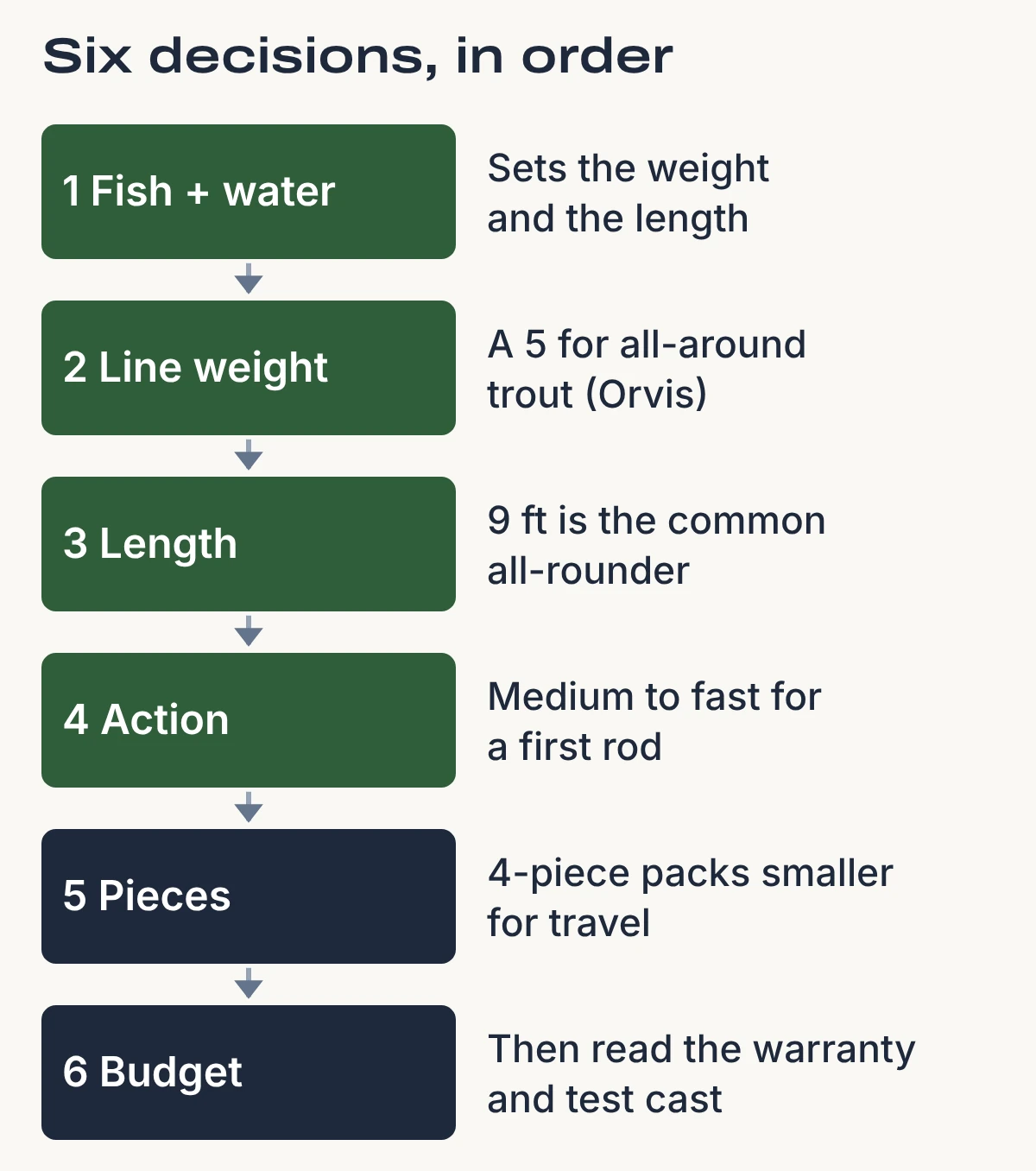
Start with the fish and water you will fish most, then choose line weight, length, action, number of pieces and budget, in that order. For general trout fishing, Orvis and Trout Unlimited both point to a 5-weight, and Orvis calls a 9-foot rod the most versatile length. Cast a few rods at a fly shop before you buy.
This guide sticks to the points where makers, a conservation group and fly shops line up, and says where a source is giving a personal preference rather than a rule.
The sequence matters. Weight and length depend on where you fish, action depends on how you cast, and price comes last, once you know what you are shopping for.
What you need
- A short list of where and what you will fish. One body of water and one kind of fish is enough to start.
- A fly shop or friend with rods to cast. Orvis, a fly-fishing maker and retailer, says to “head down to the local fly shop and begin casting the various brands.”
- A rough budget. The last step covers how to set it.
- Sunglasses or clear safety glasses. They matter when you cast any rod with a fly on the line (see step 7).
How to choose a fly rod, step by step
Name the fish and the water
Orvis’s rod guide by Jim Lepage (a former Orvis rod and tackle vice president) and Marshall Cutchin (editor of MidCurrent, a fly-fishing news site) says to “decide on size by deciding what species you are most likely to fish for.” Kirk Deeter, who writes the True Cast column for Trout Unlimited’s TROUT magazine, adds that fly rods are “designed more around the types of flies you’ll want to cast, rather than the type of fish you’re going to be pulling on,” so note the flies as well as the fish. If you have no idea yet, write down the one place you will fish first, and choose for that.
Pick the line weight
A rod’s weight number is the fly line it is built to cast. Orvis says “A 5-weight rod is designed to cast a 5-weight line.” Lamson, a fly-fishing maker, says the weight is usually printed near the handle, with the rod length. Use the table below as a starting point and remember that these are maker and shop guidelines, not rules.
Pick the length
Orvis says “The most versatile all-round rod length is a 9-foot rod,” and Trout Unlimited says “Most fly rods are 9-feet long with good reason—easier to form casts, roll cast, mend the line, and so on.” Go shorter for tight, brushy water and longer when you want reach for mending or nymphing (both Trout Unlimited and Lamson say this). If you wade deep, remember that Tom Dorsey of Thomas & Thomas, a rod maker, says in an opinion column that the rod becomes effectively shorter: “It takes a nine foot rod to make up the difference” when you are in to your waist.
Pick the action
Action describes how a rod flexes and recovers. For an all-around first rod, Telluride Angler, a fly shop and guide service, recommends a “medium, medium-fast, or fast action” and advises against both extremes. Lamson sums it up as “slow = feel and finesse, medium = versatility, fast = power and control.” Telluride Angler says to choose a fast-action rod if you will fish larger, windy rivers, and a medium action for smaller rivers about 20 to 50 feet across. Makers name actions differently, so cast the rod rather than trusting the label.
Decide on the number of pieces
Orvis asks whether you need “a 3- or 4-piece rod” to “stuff inside a suitcase, strap onto a backpack, or carry on a plane,” or a 2-piece rod you may leave strung up all season. Telluride Angler goes further and says “Buy a 4-piece rod, rather than a 2-piece model,” adding that the makers have put “a ton of R&D” into four-piece designs; treat that as one shop’s preference.
Set a budget and read the warranty
Telluride Angler suggests spending “approximately twice as much on your rod as your reel.” Orvis says a beginner “may not be able to cast” a high-end rod any better than a mid-priced one, and that “many expert fly casters prefer rods that are in the middle of a manufacturer’s price range.” Orvis also lists “the manufacturer’s repair and warranty policy” among things that can influence the final choice. Warranty terms differ, so read the maker’s page before you pay.
Test cast before you buy
Deeter says “You need to test cast a rod and not get sold by what people tell you nor what you read.” Orvis says novices “should simply look for a rod that feels good in their hand and makes them want to continue casting.” Put on glasses before you cast any rod with a fly on the line: Orvis says “there’s always a risk of hooking yourself or a buddy in the eye” and that “sunglasses should be mandatory for anglers and anyone nearby.” Georgia Wild Trout, a fishing-guide service, says to “make extra sure to check for any obstructions within your back cast radius,” so look behind you before each back cast.
Which line weight for which fish
The numbers below come from Orvis and Lamson as general guidelines. Lamson says “many rods overlap categories depending on action and length,” and Dorsey argues that the real link is between line weight and the weight of the fly, not the size of the fish.
| What you will fish | Typical line weight | Source |
|---|---|---|
| Small native trout in high mountain streams | 3 or 4 | Orvis |
| All-around trout, from small brook trout to 20-inchers | 5 | Orvis, Lamson |
| Larger trout, streamers, bass, carp, light steelhead | 6 or 7 | Lamson, Trout Unlimited |
| Alaska salmon and large rainbows | 7 or more | Orvis |
| Bonefish, redfish | 8 | Orvis, Lamson |
| Permit, small tarpon, barracuda | 10 | Orvis |
Orvis lists a 12-weight for tarpon, and Lamson places tarpon, giant trevally and musky in a 9-to-12-weight group. For bass, Lamson’s 6-to-7-weight group is the place to start; a first rod for a mix of trout and bass is a judgment call that a fly shop can help with.
Good to know
Douglas Outdoors, a rod maker, publishes a trout guide that pairs water and technique. Its writer, a fly-fishing guide and MidCurrent news editor, says “Anything bigger than a 6wt is overkill on streams most of the time.” His full list is his own preference from fishing many rods, so treat it as one angler’s view.
Outfit or separate pieces?
Fly rods are sold on their own and in outfits. Lamson’s site, for example, lists outfits “W/ Fly Line, Leader and Backing” and outfits “Unlined.” An outfit saves you the matching step, because rod, reel and line arrive as a set, but you still need to check the weight numbers agree. Lamson says “Matching rod weight and line weight is key to getting the best feel, loading, and presentation,” and that “lining down” (for example a 4-weight line on a 5-weight rod) “usually prevents the rod from loading properly.” Trout Unlimited’s Deeter adds that “Bad lines on great rods don’t work as well as great lines on so-so rods,” and that “a new line costs a fraction of what rods cost,” so replace a tired line before you blame the rod.
Tip
A fly rod casts the weight of the line; a spinning outfit is the conventional tool for lures. Dorsey notes that the fly “has not enough weight to be delivered with a spinning rod,” which is why fly casting uses the line. If lures are what you want to throw, see our roundup of spinning rods under $100, and for trout on a spinning outfit, our trout spinning rods roundup.
Mistakes that lead to the wrong rod
- Choosing weight by fish size alone. Dorsey calls “small fish, light line” thinking “misguided” in his opinion column and says a fly too heavy for a 3-weight line felt like trying to “false cast a rock on a piece of string.”
- Buying a rod before checking the line. Trout Unlimited calls the line “the other important factor in the casting equation,” and Lamson says matching rod and line weight is key.
- Going too extreme on a first rod. Telluride Angler says not to choose a slow action or an “ultra-fast” rod for an all-arounder.
- Skipping the test cast. Trout Unlimited and Orvis both say to cast before you commit.
- Paying for what you cannot yet use. Orvis says a beginner may not cast an expensive rod any better.
Before you go fishing
Most states require a fishing license, and the age it starts at varies by state. Check your state’s wildlife agency before you go. For example, Maine’s Department of Inland Fisheries and Wildlife says “A valid Maine fishing license is required for anyone 16 years of age or older, to fish in inland waters or transport fish taken from inland waters,” and Washington’s Department of Fish and Wildlife says “All fishers age 16 and older need a fishing license.” Browse the rest of our fishing gear section for what to pair with your rod, and if you are still working out the basics of conventional tackle, our bass fishing tips for beginners cover gear and a simple first day.
Frequently Asked Questions
Q. What weight fly rod should a beginner get?
For trout, Orvis says a 5-weight is “a good choice to start with.” Trout Unlimited calls a 5-weight a “gold standard in the trout world.” Choose a different weight only if your water or fish call for it.
Q. Should I get a 5 or 6 weight fly rod?
A 5-weight is the usual all-around trout choice. Lamson puts 6- and 7-weights with larger trout, bass and streamers, so pick a 6-weight if you will often throw big flies or fish in wind.
Q. Is a 9-foot or 10-foot fly rod better?
Neither wins everywhere. Orvis calls 9 feet the most versatile length. Lamson says 10-foot rods suit mending, roll casting and lake fishing, and calls a 10-foot 4-weight “sometimes considered the new all-purpose 5wt.”
Q. Can I use a trout fly rod for bass?
Possibly, but Lamson groups bass with 6- and 7-weight rods, which it says handle streamers, wind and heavy indicator rigs. Check which flies you plan to cast.
Q. Do I need an expensive fly rod to start?
No. Orvis says a beginner may not cast a high-end rod better than a mid-priced one. Telluride Angler argues for buying the best rod you can afford, so decide what you can spend, then test cast.
Q. How do I tell a rod’s weight and length?
Lamson says the weight (such as 2wt, 5wt or 8wt) is usually printed near the handle along with the rod length.
Sources (10)
- Orvis (maker and retailer), Choosing A Fly Fishing Rod by Jim Lepage and Marshall Cutchin
- Trout Unlimited, True Cast: How to choose a fly rod for trout
- Lamson (maker), How to Choose the Right Fly Rod
- Telluride Angler (fly shop and guide service), How to Choose a Fly Rod
- Thomas & Thomas (maker), My Take: Choosing a rod
- Douglas Outdoors (maker), How to Choose a Fly Rod
- Orvis, Choosing the Best Sunglasses for Sight Fishing
- Georgia Wild Trout, Fly Fishing For Beginners
- Maine Department of Inland Fisheries and Wildlife, License Requirements
- Washington Department of Fish and Wildlife, Fishing and shellfishing licenses