The short answer
A fly reel’s weight rating is not how heavy the reel is. It names the fly line weights the reel is built to hold, such as 5/6 for 5- and 6-weight lines. Choose a rating that includes your rod’s line weight, then check how much backing the reel holds and how the outfit balances in your hand.
The number on a reel is borrowed from the rod and the line, which is why it confuses people who come from spinning gear. Rod, line and reel all use one scale, but the reel’s number is a range, and “weight” can also mean ounces on a scale. This page separates the two meanings and shows where the rating stops being enough. Our fishing gear section is the place to browse our other rod and reel coverage.
What the weight on a fly reel actually measures
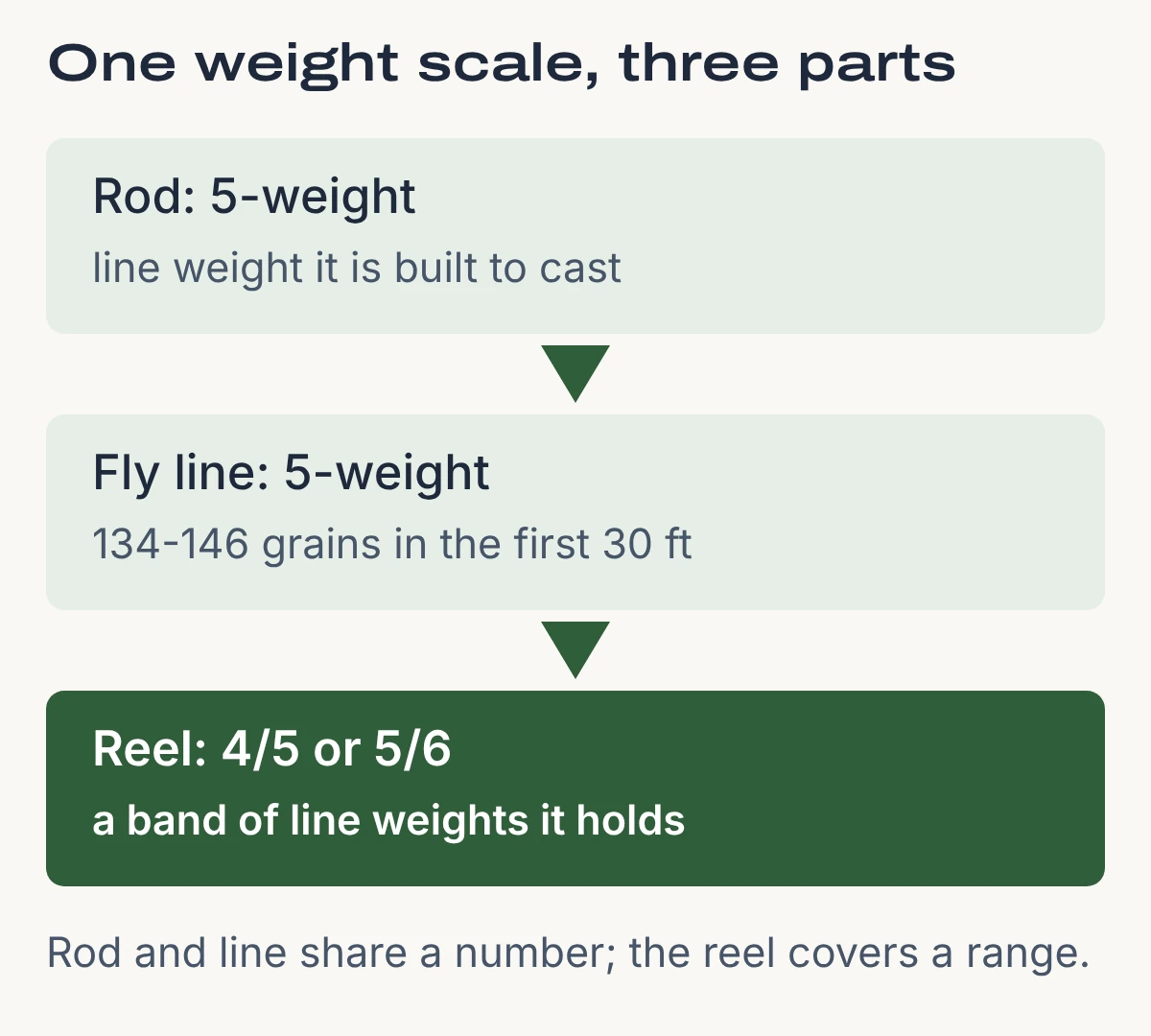
Fly line is sold by weight, not by diameter or breaking strength. MidCurrent explains that the AFTMA standard “assigns a number to each fly line based on its weight in grains for the first 30 feet”, and that a 5-weight line “should weigh between 134 and 146 grains for the first 30 feet”. Fly Fisherman’s Ed Jaworowski says why that matters: “Line weight, not diameter, loads rods.” The rod is built around a line weight, and the reel is built to hold lines of that weight.
Reel makers therefore rate a reel by the lines it takes. Ed’s Fly Shop, a retailer and guide service, puts it this way: “A reel marked 4/5 is built for 4- and 5-weight lines; a 5/6 covers 5 and 6.” Orvis, a fly-fishing maker and retailer, says “Matching a 5WT rod with a 4/5 WT reel or a 5/6WT reel is a good strategy.” Neither number tells you the reel’s ounces.
Makers do not all write the rating the same way. The table shows how it appears on four reels, using each maker’s own figures.
| Reel | Rated for | Backing capacity | Reel weight |
|---|---|---|---|
| Lamson Liquid S -5+ | Rods 4, 5 and 6; max line WF6 | 100 yd of 20-lb | 4.60 oz |
| Lamson Liquid S -7+ | Rods 6, 7 and 8; max line 8-weight | 200 yd of 20-lb | 5.20 oz |
| Orvis Clearwater Large Arbor II | 4-6 weight lines | 125, 100 or 75 yd (WF4, WF5, WF6), 20-lb Dacron | 5.4 oz |
| Orvis Clearwater Large Arbor IV | 7-9 weight lines | Not clear in the booklet (its IV rows are misprinted); check the maker | 6.1 oz |
Sources: Lamson’s Liquid outfit specs page and Orvis’s Clearwater Large Arbor booklet. Lamson labels its sizes with a number and a plus; Orvis uses Roman numerals. Even a numeral does not carry over: Orvis says its Hydros reel “in size II is designed to hold 3- to 5 WT lines”, while its Clearwater II is listed for 4-6. Read the line range the maker prints, not the size name.
Why one reel covers several line weights
A reel has to hold the fly line and the backing, which is thin braided line behind the fly line. Wild Water Fly Fishing, a fly shop, describes backing as the line “that gives you extra length when a fish runs far”. A thicker line takes up more of the spool, so the backing that fits shrinks as the line weight goes up.
Orvis’s booklet shows this on one reel. The Clearwater II holds 125 yards (114 m) of 20-lb Dacron backing with a WF4 line, 100 yards with a WF5 and 75 yards with a WF6. That pattern is our reading of the table; the booklet itself only lists the figures, and says “All capacities are quoted using 20-lb. Dacron® backing.”
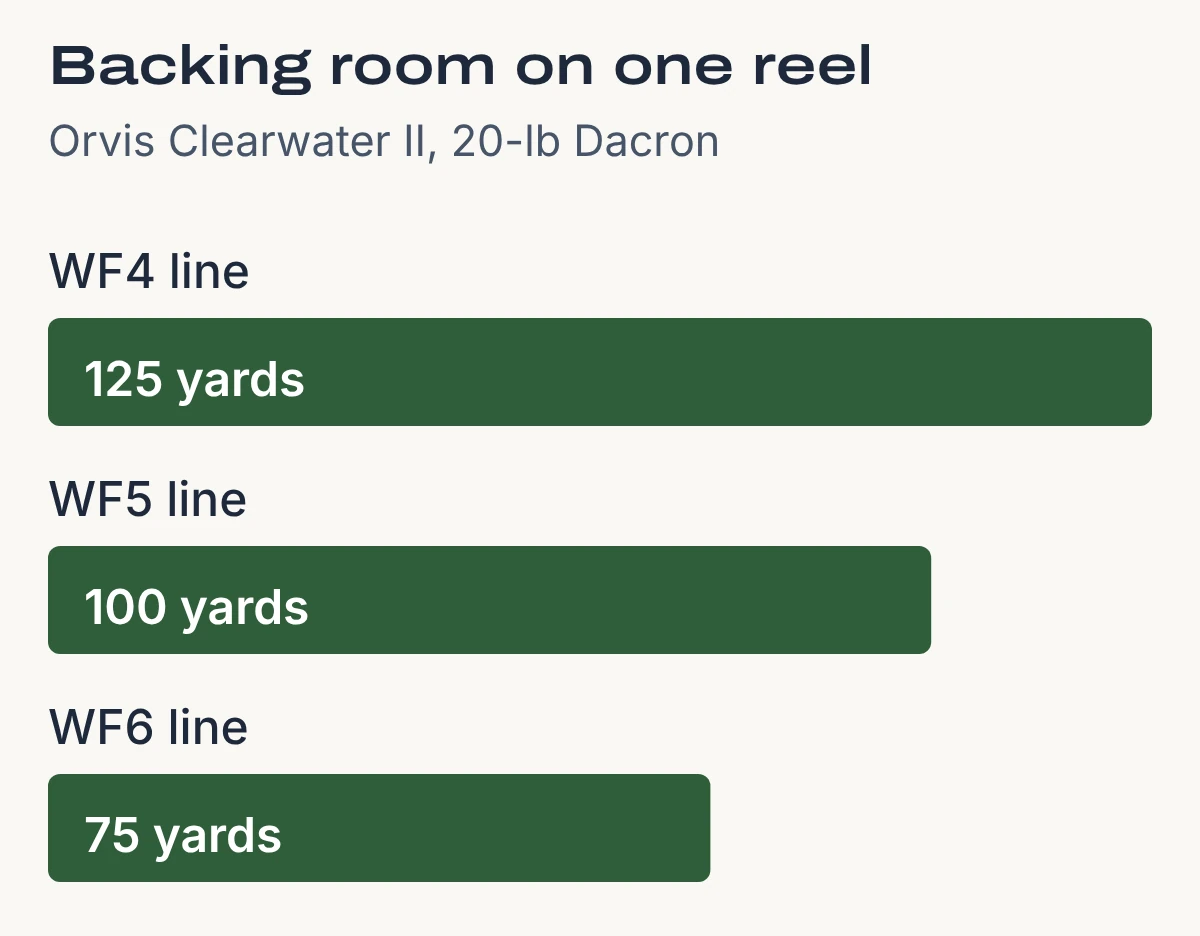
So the rating tells you which lines fit, and the capacity chart tells you how much backing you get at the line you are buying. Check both, especially at the top of the range.
How much backing you need, and how reel sizes line up
Backing matters less for trout than for fish that run. Ed’s says “A standard trout reel holds 75–100 yards of 20 lb backing plus your fly line”. Wild Water adds that for a 5/6 reel on freshwater trout, 75 to 100 yards of 20-lb Dacron is plenty because “Most trout will never pull enough line to reach your backing.” For saltwater, Orvis says to think about “over sizing it a bit”, which “allows for more backing” when a powerful fish takes a long run.
Gel-spun backing is a second lever. Wild Water notes that it is thinner than Dacron, so the same reel “holds significantly more gel-spun than Dacron”. The table is one shop’s pairing chart; Wild Water says backing capacity “is approximate and varies by manufacturer and arbor size.”
| Reel marking | Rod weights it pairs with | Typical backing (20-lb Dacron) |
|---|---|---|
| 3/4 | 3 and 4 | 50-100 yd |
| 5/6 | 5 and 6 | 75-125 yd |
| 7/8 | 7 and 8 | 100-150 yd |
| 9/10 | 9 and 10 | 150-250 yd |
| 11/12 | 11 and 12 | 250+ yd |
Source: Wild Water Fly Fishing’s reel size chart (a retailer’s chart; makers’ ratings differ, as the first table shows). Wild Water’s second chart (“Fly Reel Backing Capacity by Size”) gives narrower figures, 50–75 yd for a 3/4 and 75–100 yd for a 5/6, so even one shop’s numbers differ. Orvis and Ed’s Fly Shop both name 4/5 as well as 5/6 for a 5-weight rod, so the table is a starting point, not a rule.
Reel weight in ounces, arbor size and balance
The ounces on the spec sheet do matter, but for balance, not for the rating. Orvis News’s Eric Rickstad writes that reels “are designed to hold a certain amount of backing with a certain size fly line and balance well with that same size fly rod.” Orvis’s buying guide gives an example: its Hydros size V “is designed for 9- to 11 WT lines and rods” and is much bigger than the size II, so it will not balance a 3- to 5-weight rod well.
Arbor size, the diameter of the spool’s center, changes weight too. Rickstad explains that large arbors pick up line faster but were too bulky for light trout rods, so “the compromise mid arbor is now popular with trout anglers, as well.” His photo caption notes that a large-arbor reel is “usually heavier than a medium-arbor reel”. Ed’s calls large arbor the default today, unless you are building a classic glass or bamboo setup.
You can test balance yourself once the reel is on the rod:
Seat the reel and string the line
Mount the reel on the rod and run the fly line through the guides.
Find the balance point
Rest the rod on one finger just ahead of the grip, as Ed’s Fly Shop does with customers.
Read the tip
Ed’s says “A well-matched outfit balances close to that point.” Its warning is that a reel that is too heavy makes the rod feel dead and one that is too light lets the tip dive.
Steps 1-3 come from one shop’s advice, not a standard. Rickstad’s rule on Orvis News is simpler: “Never buy a reel without the rod in hand”.
When to size up or down
Most outfits take the reel that matches the rod. A few cases pull it the other way.
| Situation | What to do | Who says so |
|---|---|---|
| 5-weight rod, everyday trout | A 4/5 or 5/6 reel | Orvis; Ed’s Fly Shop |
| Streamer-specific line or long sink tips | Go one size larger so line gathers faster | Orvis |
| Saltwater or fish that make long runs | Size up a bit for more backing | Orvis |
| Light classic rod | A smaller traditional or mid arbor reel | Orvis News |
| A reel more than one weight class above the rod | Avoid it unless you need extra backing | Wild Water |
Line weight labels can also drift. Jaworowski reports that “Many fly fishers are shocked to learn that some 5-weight lines are heavier than standard 7-weights”, and MidCurrent notes that many manufacturers make lines heavier than the standard. Since a thicker line takes more spool, our suggestion is to check the capacity chart for the exact line you buy, not just the label on the reel. If you are a beginner, Fly Fisherman still calls a 5-weight line on a first 5-weight rod “a reasonable starting point”.
Fly reel numbers versus spinning reel numbers
Searchers often ask whether a 2500 reel suits trout. That is a spinning-reel size, a different system. Our spinning reel size guide explains that the number “tells you roughly how much line a reel holds and how heavy that line can be”, and it lists a 1000 for panfish and trout and a 2500 for bass and walleye. A spinning size cannot be compared with a fly reel’s 5/6 rating.
If you are weighing fly gear against a simpler start, our roundup of beginner spinning and spincast reels covers those conventional reels, not fly reels. Spooling also differs. A fly reel carries backing as well as the fly line, while our guide to putting fishing line on a reel covers spinning, baitcasting and spincast reels.
Mistakes that come from the number
- Reading it as ounces. The weight rating is a line range. The ounces are a separate spec, and they matter for balance.
- Matching the reel to the fish and ignoring the rod. Orvis says the most important step for trout and bass reels is “to match the size of the spool to the size of the rod”.
- Assuming 5/6 means the same capacity everywhere. Wild Water says capacity “varies by manufacturer and arbor size”, and the Clearwater booklet changes by line weight.
- Treating the label as exact. A 5-weight line from one maker can weigh more than another’s. Check the maker’s grain figures when you can.
Frequently Asked Questions
Q. What weight fly reel do I need?
Pick a reel whose rating includes your rod’s line weight. For a 5-weight rod, Orvis and Ed’s Fly Shop both name 4/5 and 5/6 reels.
Q. What weight fly reel is best for a beginner?
A 5-weight rod and a 4/5 or 5/6 reel is the common starting pairing, and Fly Fisherman calls a 5-weight line “a reasonable starting point” for a first 5-weight rod. Wild Water, a shop, says most experienced anglers would tell a beginner to buy a 5/6.
Q. What weight fly reel for bass?
It follows the rod. Wild Water pairs a 5/6 reel with smallmouth bass and a 7/8 with largemouth bass, steelhead and light saltwater. Orvis says the key for trout and bass reels is to match the spool to the rod.
Q. Is a 2500 reel too big for trout?
A 2500 is a spinning-reel size, so it does not apply to fly reels. Our spinning reel size guide lists the 1000 for panfish and trout and the 2500 for bass and walleye.
Q. Is a 7-weight too big for trout?
Not for streamers or big rivers; for general trout fishing a 5- or 6-weight is the norm. MidCurrent lists 5-6 weights for general trout fishing, and Ed’s Fly Shop describes building “a streamer or big-river rig around a 6- or 7-weight”. Wild Water’s chart pairs a 7-weight rod with a 7/8 reel.
Q. Do all brands use the same reel sizes?
No. Lamson calls a reel -5+ for 4-, 5- and 6-weight rods, Orvis’s Clearwater II is listed for 4-6 weight lines, and its Hydros II is listed for 3-5. Compare the line range on each reel.
Sources (8)
- Orvis, How Do I Choose A Fly Reel?
- Orvis News, How to Buy a Fly reel (Eric Rickstad)
- Orvis, Clearwater Large Arbor reel booklet (PDF)
- Lamson, Liquid Outfit with Fly Line, Leader and Backing Specs
- MidCurrent, Understanding the Fly Rod and Line Weight System
- Fly Fisherman, Why are Fly Lines Getting Heavier?
- Wild Water Fly Fishing, Fly Reel Size Chart
- Ed’s Fly Shop, What Size Fly Reel Should You Buy?
