The short answer
A click-and-pawl fly reel has no brake discs. A spring-backed pawl presses on a toothed gear in the spool, giving a light resistance, adjustable on many reels, as line leaves; you add more by palming the rim. Orvis calls it adequate for smaller fish and a disc drag more suitable for bigger, faster ones.
Searches for this reel mix three questions: what the click is, why a reel feels loose, and whether to buy one over a disc drag. This guide answers them in that order, with the parts drawn from two makers’ own documents.
How a click-and-pawl reel works
The parts are few. Orvis’s parts list for its Battenkill Click reel names a “Pawl Spring”, a pawl and a drag gear among the reel’s 24 numbered parts. East Coast Ghillies, a Newfoundland salmon and trout guiding service that fishes old click reels, describes how they fit together: the spool has “a cogwheel around its hub with several teeth (cogs)”. A post on the inside of the frame holds the pawl, which lets the cogs pass over it “with very little resistance in the incoming direction, but provides a slight bite and resistance by engaging with the cogs if the spool reverses and line is going out”. A spring on the frame keeps the pawl pressed into place.
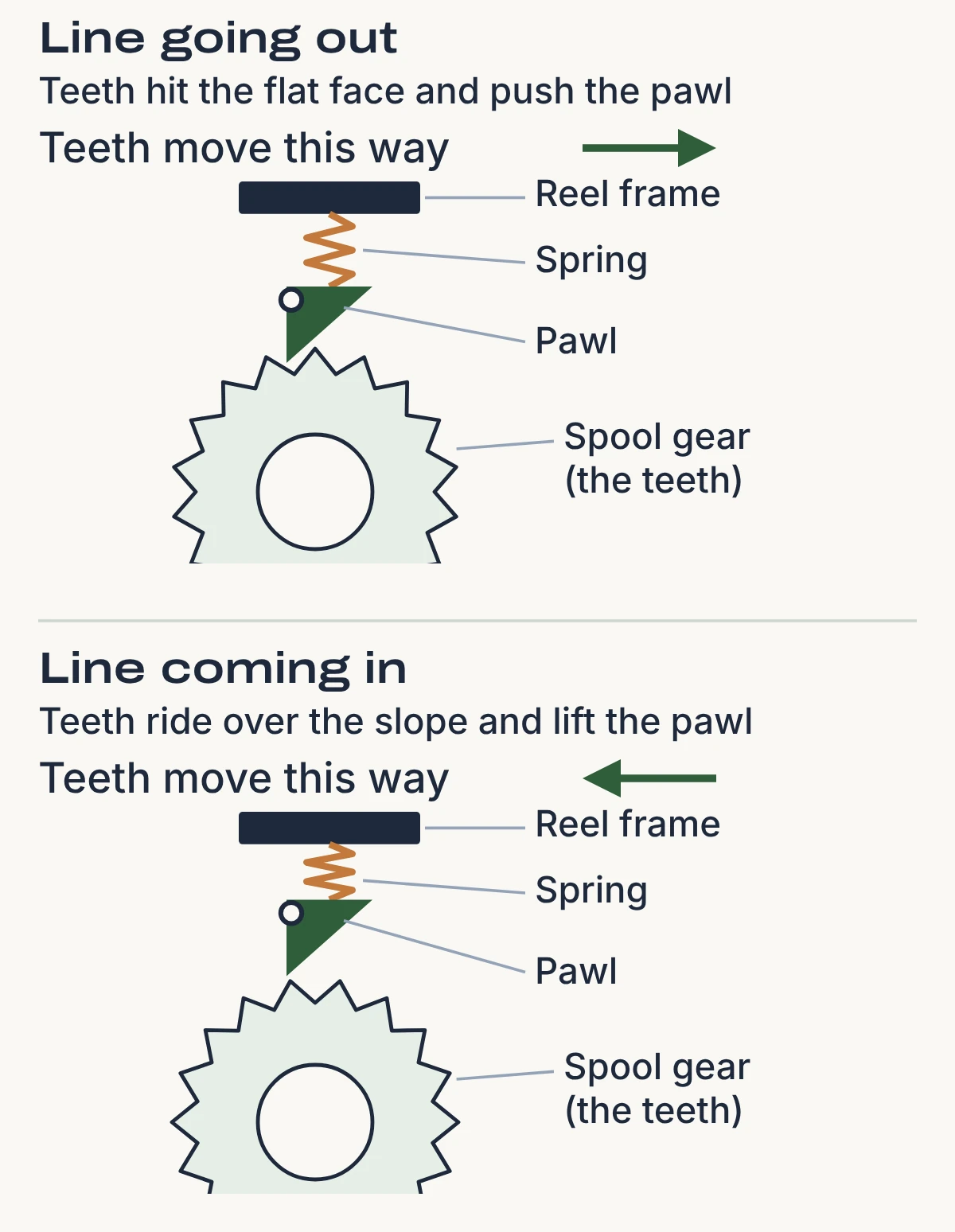
Two things follow from that design:
- The click is the mechanism, not a gadget. East Coast Ghillies says the sound “comes solely from the cogs grabbing on the pawl”, and compares it to a ratchet, “except the pawl is designed to only introduce resistance and doesn’t fully lock”.
- The pawl faces one way. The same guide service warns that if it is set wrong, “the cogs will pass smoothly over the rounded end of the pawl on the way out and uselessly grab the pawl when you’re retrieving line”. The reel still works, which is why a wrong setting can go unnoticed.
East Coast Ghillies also notes that Abel’s TR reel “places the cogwheel on the frame and the pawl on the spool”, the reverse of the classic layout, so check your own reel’s manual before assuming the picture above matches it.
What you control: the check setting and your palm
Many click reels let you change the resistance. Orvis’s Battenkill Click booklet describes a “four position click-and-pawl drag system that is adjusted internally”: you remove the spool and turn an adjusting block to raise or lower the resistance. Hardy’s instruction sheet for its freshwater Marquis reels describes the same idea with a different control: the click-check “can be adjusted by simply turning the regulator button on the face of the frame, clockwise to increase the check, anti-clockwise to decrease the check”.
The settings are light, and both makers say so in how they tell you to fight a fish. Orvis states that the drag is “designed to be used in tandem with the palm of your hand”, and adds: “Additional drag may be applied by palming the spool rim with your fingers or palm.” It also warns: “Sufficient drag must always be applied when fighting a fish to prevent the line from overrunning.” Palming means resting your fingers or palm lightly on the exposed rim of the spool so that you, not a disc stack, control how fast it turns. Read your own maker’s description of how its reel is meant to be fought.
Related guide: How to Use a Fly Rod: How It Works, and How to Fish It
Click-and-pawl vs disc drag
Orvis puts the difference this way in its guide to choosing a fly reel: the click-and-pawl system “offers a light level of resistance” and is “adequate for smaller fish”, while the disc drag “offers smoother, more consistent resistance and can apply more stopping power”, which “makes it more suitable for larger, stronger fish that often make long, fast runs”. Orvis is a maker and a retailer, so read that as a seller’s summary, not a test.
| Click-and-pawl | Disc drag | |
|---|---|---|
| How it resists | A spring-backed pawl on a toothed gear (Orvis: “a light level of resistance”) | Friction between discs (Orvis: “smoother, more consistent resistance”) |
| Stopping power | Added by palming the rim (Orvis Battenkill Click booklet) | Orvis: “can apply more stopping power” |
| Fish Orvis says it suits | “Smaller fish” | “Larger, stronger fish” with “long, fast runs” |
Not every angler thinks the gap matters for trout. A short opinion item in Trout Unlimited’s TROUT magazine says some anglers see a trout reel as “nothing more than a spool to collect line”, and its author writes that he has not lost a trout “during a fight because the drag on my reel failed”. The same item adds: “In saltwater, sure, drag is key.” That is one author’s opinion, but it matches Orvis’s split by fish size.
When a click-and-pawl reel suits you
Based on what the makers and guides above say, a click reel makes sense when:
- you fish for smaller fish that, in Orvis’s words, do not tend to make “long, powerful runs”;
- you want a simple mechanism you can open and clean yourself (Orvis and Hardy both publish short care steps, below);
- you like feeling and hearing the line leave, and are happy to palm the rim.
A disc drag is the safer starting point when you expect large fish, fast runs or saltwater, where the Trout Unlimited item says drag is key.
Click-and-pawl vs a spinning reel or a fly rod
The two reels are rated differently. Most spinning reel makers publish a maximum drag: our roundup of beginner spinning and spincast reels lists it where the maker publishes one, such as “Max drag: 3.6 kg (about 8 lb), per Pflueger” for the Pflueger President. Orvis’s Battenkill Click booklet lists capacity, weight and diameter for its reel, not a drag rating. If you are sizing a spinning reel instead, see our spinning reel size guide, and browse the rest of our fishing gear guides for rods, line and lures.
Related guide: Which Fly Rod Weight Should a Beginner Start With?
A click-and-pawl reel also is not an alternative to a fly rod. It goes on one: Orvis says a fly reel “balances your rod”, so reel and rod are chosen as a pair.
Check which way your pawl is set
Many fly reels can be set for left- or right-hand retrieve, and the pawl decides which way the click works. Orvis ships its Battenkill with “the drag factory installed for left-hand wind” and Hardy’s Marquis sheet says that when you receive the reel, “it will be set for left hand wind”. To check yours:
Take the spool off
On the Orvis Battenkill, press the spool release latch while lifting the spool out of the reel body; on a Hardy Marquis, operate the latch release lever. Other models differ, so use your reel’s own instructions.
Look at the pawl, not the sound
East Coast Ghillies says that on reels with weak or worn springs “both the feel and sound can become indistinguishable between outgoing line and incoming retrieve”, so the click is not a reliable test. Its method is to hold the frame with the reel foot at the top, split it into left and right halves with a line through the pawl (on many reels the spring tensioner screw marks the middle), and “focus on the (notchless) flat, straight sides of the pawls”. The guide service says a flat side in the right half means left-handed retrieve, and in the left half right-handed retrieve.
Switch it if you wind with the other hand
Orvis’s Battenkill booklet: remove the pawl, “flip the pawl over, slide it back into place, then reattach the spool”. Hardy’s Marquis sheet: using your thumb and forefinger, “switch the left hand tongue into the off position”, then switch the right hand tongue to engaged. If a part will not move as the sheet describes, contact the maker; Orvis says its “Technical Advisors are always available”.
Test it by resistance
Pull line off by hand: it should click and resist lightly. Wind it back in: it should turn with very little resistance. If it is the other way round, go back to step 2. Both directions may click, so go by resistance, not silence.
Why a click-and-pawl reel feels loose
“Loose” usually comes down to one of two things. The fixes come from the makers’ sheets above, not from our own testing.
| What you notice | Likely cause | What to do |
|---|---|---|
| Resistance on the wrong stroke, or none going out | The pawl is facing the wrong way | Flip it as in the steps above |
| Very little click or resistance on a reel that used to have it | The check is set low, or the spring is weak: East Coast Ghillies mentions “weakened tension springs” on well-used reels | Raise the setting (Orvis adjusting block; Hardy regulator button clockwise); if the spring is the problem, Orvis says it offers “a reel cleaning and reconditioning service” (for Orvis reels; otherwise contact your reel’s maker) |
Care: follow your maker’s own sheet
Both makers publish short care steps, and they differ, so your reel’s manual has the last word.
Orvis (Battenkill Click booklet). The reel “should be cleaned and lubricated after extensive use or after contact with dirt or sand”, with “routine cleaning and maintenance at least twice each year”. Orvis says to “lightly lubricate all moving components” (the handle, center spindle and gear shaft) with Penn reel lube, and gives two storage rules: “Do not put the reel away wet, or into a wet reel case or tackle box. For extended storage, remove both line and backing.”
Hardy (Marquis instruction sheet, freshwater range). Hardy’s steps are to remove line and backing, remove the spool, “flush away dirt by placing the spool and frame under a stream of warm water”, dry carefully with a lint-free cloth, lubricate “with a good quality oil at the points illustrated on the diagrams”, and “always ensure the spindle head is adequately greased”. Hardy also says: “When the reel is not in use, the check should be turned to the minimum setting”, and, on its care list, “Always turn the click-check to the minimum setting to avoid compression of the springs”; it also says to make sure “the reel and line are dry before storing in the case or pouch”.
The two sheets disagree on products (Orvis names Penn reel lube; Hardy asks for oil at its diagram points plus grease on the spindle head) and on the warm-water rinse, which only Hardy gives. Use the one that matches your reel.
Frequently Asked Questions
Q. What is a click-and-pawl fly reel used for?
It is used for fly fishing where light resistance is enough, which Orvis describes as smaller fish that do not tend to make long, powerful runs. You control the extra pressure with your palm.
Q. Does a click-and-pawl reel click both ways?
Often it does; the difference is resistance. East Coast Ghillies says the pawl gives “a slight bite and resistance” as line goes out and “very little resistance in the incoming direction”. If the stiffer side is on the retrieve, check the pawl with the flat-side test above.
Q. Is a click-and-pawl reel good for a beginner?
It can be, for small fish, because there is little to adjust. Orvis ties the choice to fish size, so decide by what you expect to catch; a disc drag gives a beginner more margin with bigger fish.
Q. Can I change which hand I wind with?
On the Orvis Battenkill and Hardy Marquis, yes, by flipping or switching the pawl as each maker describes. Other reels vary, and some designs are fixed, so check your manual.
Q. Do I need to oil a click-and-pawl reel?
Both makers say to lubricate it, at the points in their own instructions; Orvis says lightly. Orvis recommends cleaning at least twice a year.
Q. What is the difference between click-and-pawl and a spinning reel?
They are different tools for different rods. A spinning reel has an adjustable drag, usually with a published maximum; the Orvis click reel booklet gives no drag rating and relies on the check setting and your palm.
Sources (6)
- Orvis, Battenkill Click reel booklet (PDF)
- Hardy, Marquis Reel Series instruction sheet (PDF)
- Orvis UK, What Features Should You Look for in a Fly Reel?
- East Coast Ghillies, Flip Your Pawl: How to Engage Your Click and Pawl Reel
- Trout Unlimited, Click And Pawl Vs. Disc Drag
- Outgearly, Best Beginner Fishing Reels roundup
