The short answer
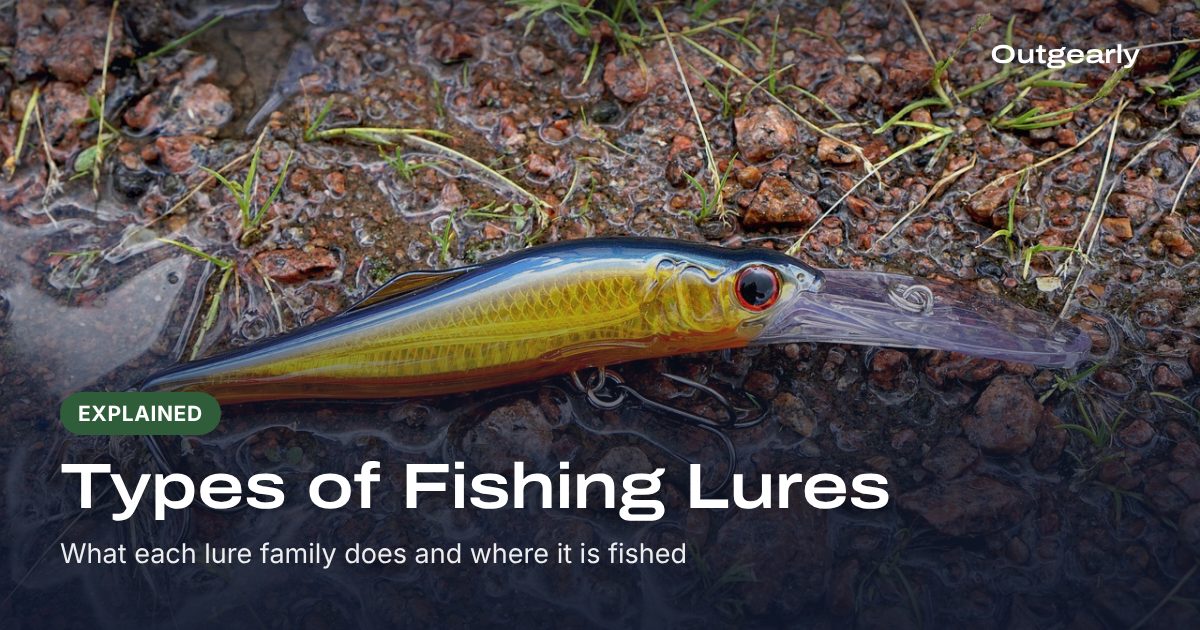
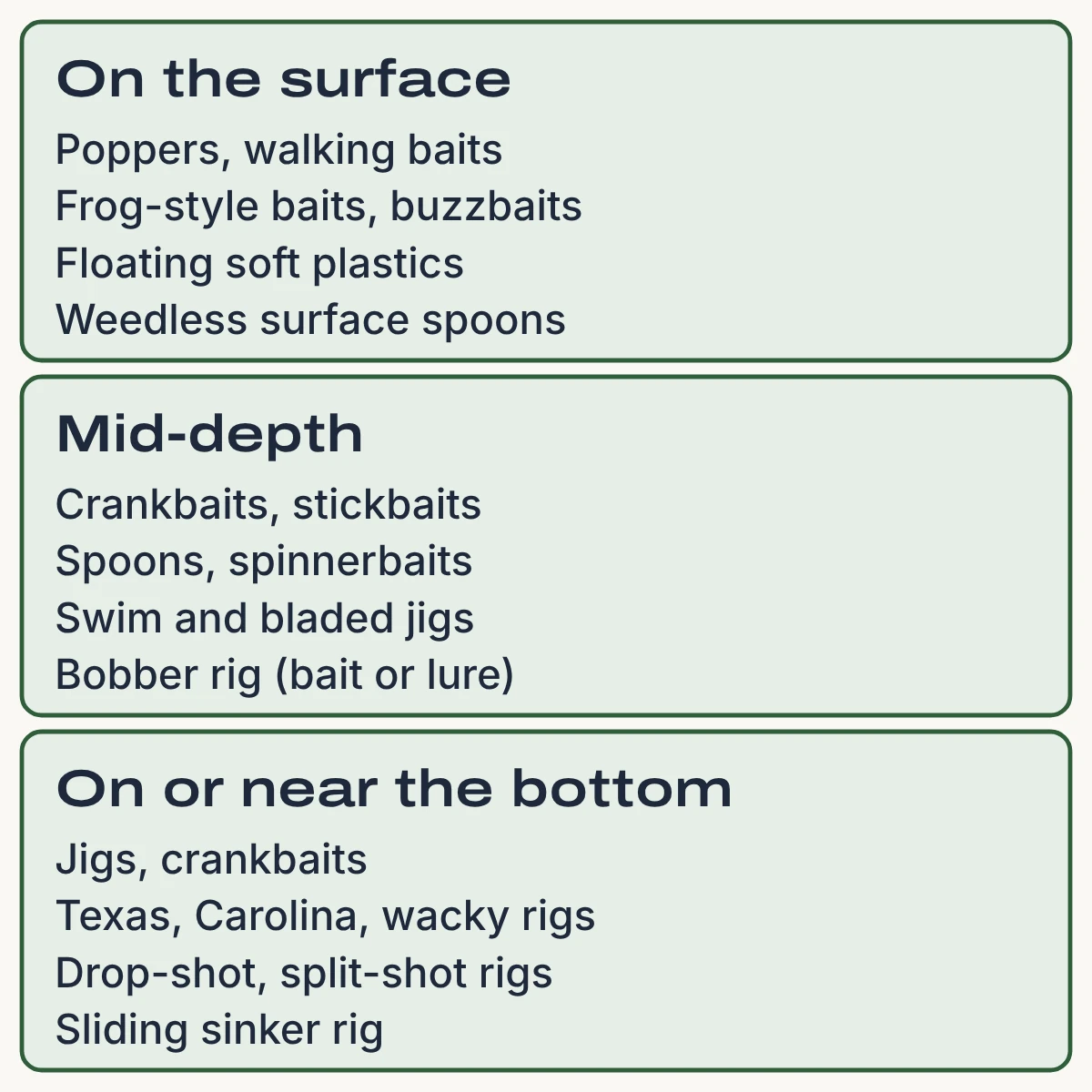
A fishing lure is a man-made imitation of food, designed to draw a strike from a fish. Vermont Fish & Wildlife sorts common lures by where they are fished: on the bottom, at mid-depth or on top. The main families are jigs, soft plastics, crankbaits, jerkbaits, spinnerbaits, spoons, topwaters and swimbaits.
Vermont Fish & Wildlife describes “a seemingly endless assortment of fishing lures and rigs”. Vermont and Oklahoma’s wildlife agencies and Wired2Fish each sort them into families, and the sections below follow those groupings.
Fish respond to water, season and pressure, so every pairing below is a starting point from the cited source, not a promise.
Lure or bait: what the words mean
Maine’s wildlife agency defines an artificial lure as “Any fishing lure constructed by humans as an imitation or substitute for natural bait or fish forage”. Its list of examples includes artificial flies, spinners, spoons, poppers, plugs and jigs. Bait is the other side: the same agency says an artificial-lures-only rule prohibits “any live, dead or chemically preserved natural or organic bait or food”. So natural bait comes in three forms: live, dead and preserved.
Vermont’s page on the basic bobber rig shows how the two mix. That rig “can be baited with night crawlers, minnows, crayfish and other live bait, as well as with artificial lures”. A lure is one thing you can put on the line, and bait is another.
Definitions differ a little by state. Texas defines an artificial lure as “Any lure (including flies) with hook or hooks attached that is man-made and is used as a bait while fishing.”
What fishing lures are made of
Wikipedia’s fishing lure article says modern lures are made of “wood, plastic, rubber, metal, cork, and materials like feathers, animal hair, string, tinsel and others”. In practice each family leans on a few of these:
- Metal: spoons, and the weighted heads of jigs. Sportsman’s Warehouse, a retailer, describes a jig as “a single hook with a round, or sometimes fish-head-shaped lead head poured around the eye of the hook.”
- Hard plastic or wood: plugs, crankbaits and jerkbaits. Wired2Fish, a bass-fishing publication, treats crankbaits and jerkbaits as hard plastic baits, and Wikipedia lists wood among lure materials.
- Soft plastic or rubber: worms, craws, grubs and swimbaits. Maine’s definition of an artificial lure includes “plastic, rubber or other artificial imitations of natural bait”.
- Feathers, hair and rubber or silicone strands: the skirts on jigs and spinnerbaits (Wired2Fish mentions rubber or silicone skirts) and the dressing on flies.
The main lure families at a glance
The table pairs each family with where it is generally fished, what it imitates and the fish the source names. Species lists are the sources’ own, not a ranking.
| Family | Where it is generally fished | What it imitates | Fish the source names |
|---|---|---|---|
| Jigs | On or near the bottom; can also be fished mid-depth and higher | Crayfish, insects, minnows (Vermont) | “All species” (Vermont) |
| Soft plastics | Floating soft plastics on top; Texas, Carolina and wacky rigs on the bottom (Vermont) | Worms, lizards, craws and creatures (Wired2Fish) | Bass (Wired2Fish) |
| Crankbaits | Just under the surface to over 15 feet (4.6 m) deep, by lip or weight | Baitfish | All species (Vermont) |
| Jerkbaits (stickbaits) | Shallow, mid-depth or deep, by model | Minnows and other baitfish | All species (Vermont) |
| Spinnerbaits and bladed jigs | Mid-depth (Vermont) | Flash and vibration | Bass (Wired2Fish) |
| Spoons | Mid-depth; weedless surface spoons on top (Vermont) | A wounded or fleeing baitfish | All species; most often trout, salmon, bass and pike (Vermont) |
| Topwaters | On the surface | Frogs, mice, insects or a wounded baitfish | Primarily bass, pike, pickerel and panfish (Vermont) |
| Swimbaits | Not grouped by Vermont; cast and retrieved or trolled (Sportsman’s Warehouse) | A swimming baitfish | Trout, bass, walleye, perch, crappie (Sportsman’s Warehouse) |
The families, one at a time
Jigs
Wired2Fish says almost all jigs share “a hook with some sort of molded weight on it”. Vermont calls them “one of the most versatile types of fishing lures” and says they are known for tempting fish “on or near the bottom”. Sportsman’s Warehouse lists a football jig as “Designed to drag along rocky bottoms without catching”, which shows how head shape follows the job.
Related guide: How to Set Fishing Drag and When to Change It in a Fight
Soft plastics
Worms, lizards, toads, craws and creature baits belong here. Wired2Fish notes they pair with rigs such as the Texas rig, Carolina rig and drop shot, can ride on jig heads, and can trail behind jigs and spinnerbaits. Oklahoma’s wildlife department groups its soft plastics into worms, grubs, creatures, tubes and panfish styles.
Crankbaits
A crankbait is a hard lure that dives when you reel it. Sportsman’s Warehouse says “The length of the bill determines the depth this lure works at”, and describes lipless versions as the “Most versatile” and says they dive “based on rate of retrieval”. Wired2Fish names Rat-L-Traps and Strike King Red Eye Shads as lipless examples. Vermont adds a practical use: crankbaits “can be cast and retrieved quicker than other baits, therefore allowing an angler to cover more water until a productive section of water is found.”
Jerkbaits
Vermont says “stickbait” refers to “a series of versatile hard-body lures”, often called jerkbaits, slashbaits or minnow baits. It says stickbaits “may shine best in situations with cooler and clearer water” and can be worked “erratically or steadily, fast or slow”.
Spinnerbaits and bladed jigs
Wired2Fish describes a spinnerbait as a wire arm running down to a weighted head and hook, with metal blades on the arm and usually a skirt over the hook. A bladed (vibrating) jig puts a blade on the line tie of a skirted jig instead. Both use a blade for flash and vibration. Wired2Fish names Z-Man ChatterBaits, the Berkley SlobberKnocker and the Strike King Thunder Cricket as bladed jigs.
Spoons
Vermont says spoons “imitate a wounded or fleeing baitfish” and come in casting, trolling, jigging and weedless types. Weedless spoons “typically feature a single, medium to heavy wire hook, and a wire hook guard to keep the bait from hanging up on cover”. Sportsman’s Warehouse says a spoon “is best in bright conditions where the dappling on the surface of a gold or silver spoon can reflect light.”
Topwaters
These float and work on the surface: poppers, walking baits, buzzbaits and frogs. Wired2Fish names Spooks, poppers and Whopper Ploppers as hard topwaters. Vermont notes that for poppers and walking-style baits, “Monofilament and braided fishing line are much more optimal for these types of baits as these lines have greater buoyancy”, while less buoyant lines such as fluorocarbon “tend to sink more” and, Vermont says, “adversely affect the action” of these baits. That tip is Vermont’s advice for those two bait styles, not a rule for every topwater.
Related guide: Braided vs Mono Fishing Line: Which to Use and When
Swimbaits, blade baits and flies
Wired2Fish groups glide baits, multi-jointed swimbaits and large soft swimbaits, “anything 6 inches and up” (15 cm), in the swimbait category, and names the Storm Arashi Glide as a glide bait and the Megabass Magdraft and Berkley Powerbait Cull Shad as big soft swimbaits. Sportsman’s Warehouse also lists blade baits and inline spinners. Flies are the lure of fly fishing and need different tackle; our guide to types of fly fishing flies covers them.
Types of fishing lures for bass
Oklahoma’s wildlife department lists lipped and lipless crankbaits, jerkbaits, bass jigs, bladed jigs, offset spinners, topwaters, swimbaits and several soft plastic styles as popular categories. Wired2Fish ties several of these to water temperature:
- Warm water: topwaters “are the most effective when the waters are warmer (above 55 degrees) and the fish are more active.” (55°F is about 13°C.)
- Cold water: Wired2Fish says “bass often become lethargic and unwilling to chase down baits in water below 50 degrees” (10°C) and that a jerkbait is “one of the more effective lures when fishing in cold water because of its ability to stall and suspend in the water column.”
- Spring: it calls bladed jigs well suited to big bass, “especially in the spring”.
Those are one publication’s guidelines, in Fahrenheit, and they will not fit every lake. For specific lures in these situations, see our roundups of early-spring bass lures, bass topwater lures, bass fishing worms and river smallmouth lures. If you are new to bass fishing, our bass fishing tips for beginners covers the basics around the lure.
Ready to buy?
For cold-water bass fishing, see our roundup of the best bass lures for winter.
Matching a lure family to the water
Use this as a starting list, with each pairing coming from the source named.
| If the situation is… | Look at | Source says |
|---|---|---|
| Fish near the bottom or rocky structure | Jigs, football jigs | Vermont: jigs are known for tempting fish “on or near the bottom” |
| You need to find fish across a lot of water | Crankbaits | Vermont: a crankbait is a “fish-finding tool” |
| Cold water, sluggish bass | Jerkbaits | Wired2Fish: effective in cold water because they stall and suspend |
| Warm water, active bass | Topwaters | Wired2Fish: most effective above 55°F (13°C) |
| Thick weeds and cover | Weedless spoons | Vermont: weedless spoons are for “the thickest aquatic habitat” |
| Bright sun | Gold or silver spoons | Sportsman’s Warehouse: best in bright conditions |
Tip
Vermont’s tip for beginners: “Consider trying the Basic Bobber Rig, the Sliding Sinker Rig, and Jigs.”
Check your state’s rules first
Rules about lures and bait are set by each state, so read your state wildlife agency’s regulations before you buy. Maine, for example, says “An artificial lures only rule prohibits the use of any live, dead or chemically preserved natural or organic bait or food”, which would rule out real bait on waters with that rule. Maine’s page also states: “It is unlawful to use, sell, or offer for sale lead sinkers and unpainted lead jigs measuring 2.5 inches or less in length or weighing one ounce or less.” On painted lead jigs it says: “It is unlawful to sell or offer for sale painted lead jigs measuring 2.5 inches or less in length or weighing 1 ounce or less. Effective September 1, 2026, the use of painted lead jigs measuring 2.5 inches or less in length or weighing 1 ounce or less will be prohibited”. It adds: “Sale restrictions are statewide; use restrictions only apply in inland waters.”
Note
Those are Maine’s rules, quoted from its agency. Other states differ, including on what counts as an artificial lure, hook limits and lead tackle. Check the current regulations for the water you will fish.
Frequently Asked Questions
Q. What are the different kinds of fishing lures?
The table above lists the main families. Oklahoma’s wildlife department also names blade baits, offset spinners and spoons, slabs and Super Dupers as popular categories.
Q. What type of lure catches the most fish?
None of the agency pages used here ranks lure types. Vermont calls jigs “one of the most versatile types of fishing lures”, and results still depend on the species, water and season.
Q. What lure should I use for each fish?
Start with the table, where each source names the fish it ties to each family, then check your state agency’s pages for local species. Trout, bass, pike and panfish each have families listed against them.
Q. What is the difference between a lure and bait?
A lure is man-made. Maine’s definition covers it as “constructed by humans as an imitation or substitute for natural bait or fish forage”. Bait is natural: live, dead or preserved.
Q. Are slugs good fishing bait?
The agency pages used for this guide do not cover slugs. Bait rules are state-specific, and Tennessee’s wildlife agency, for example, has a page that “explains which species can be used for bait, and how they can be harvested, sold, and transported.” Check your state’s rules before using anything unusual.
Sources (14)
- Vermont Fish & Wildlife Department, Common Lures and Rigs
- Vermont Fish & Wildlife Department, Bottom Lures – Jigs
- Vermont Fish & Wildlife Department, Mid-Depth Lures and Rigs – Crankbaits
- Vermont Fish & Wildlife Department, Mid-Depth Lures and Rigs – Fishing Spoons
- Vermont Fish & Wildlife Department, Mid-Depth Lures and Rigs – Stickbaits or Jerkbaits
- Vermont Fish & Wildlife Department, Mid-Depth Lures and Rigs – Basic Bobber Rig
- Vermont Fish & Wildlife Department, Top Water Lures and Rigs – Popper Baits
- Oklahoma Department of Wildlife Conservation, Popular Lures
- Maine Department of Inland Fisheries and Wildlife, General Fishing Laws and Definitions
- Texas Parks and Wildlife Department, Definitions – Fishing
- Tennessee Wildlife Resources Agency, Tennessee Live Bait Regulations
- Wired2Fish, Types of Fishing Lures
- Sportsman’s Warehouse, Fishing Lures Types Chart
- Wikipedia, Fishing lure
