The short answer
Set the drag before your first cast so it holds firm for the hook set but slips before the line breaks. Makers and magazines start at roughly a quarter to a third of the line’s rated strength, checked with a scale, then go lighter or heavier for line type, cover and fish size. Change it mid-fight deliberately, if at all.
Drag lives in the reel, not the rod. It is a stack of washers that slips under load. New York’s Department of Environmental Conservation says: “The tighter the drag, the harder it is to pull line off the reel.” It wants the drag “tight enough to set the hook and control the fish, but not so tight that the line breaks.”
Sources disagree on the percentage and on touching the knob mid-fight, so this guide names who says what.
What you need
- A rod and reel with line spooled and run through every guide.
- A hand-held scale, such as a spring or luggage scale. Poveromo advises one unless you have “developed that special touch over decades of fishing experience”. If you test alone, use one with memory, which holds the reading.
- A helper, or a fence post or tree to hold the scale, per Fish Talk magazine, and about 10 to 12 feet (3 to 3.7 m) of open outdoor space.
- Your line’s pound-test, and your leader’s if it is lighter than the main line.
- A permanent marker to mark the knob once it is set.
Pick your starting number
No agency or maker gives one universal figure. The table works each rule out for 10-pound (4.5 kg) line so you can compare them. Figures marked “worked” are arithmetic from the rule shown, not a number the source printed.
| Source | Rule | 10-pound line works out to | Line type |
|---|---|---|---|
| Shimano (maker’s FAQ) | “approximately 1/3 of the line’s breaking strength” | About 3.3 lb (1.5 kg), worked | Not specified |
| Quantum and Zebco (maker manuals) | About 1/3 for spinning (Quantum); “1/4 – 1/3 the line weight” for baitcast (Zebco) | “2.5-3.3 lbs” (1.1 to 1.5 kg), the Zebco manual’s own example | Not specified |
| Kentucky Fish and Wildlife (state agency) | A weight “equal to 1/3 the tensile strength of your line” | About 3.3 lb (1.5 kg), worked | Not specified |
| Poveromo (angler and TV host) | 20% for mono up to 20-pound test; 25% for 30 to 50-pound; 30% for 80 to 130-pound. Braid: 15% up to 20-pound; 20% for 30 to 65-pound; 25% above 65 | Mono 2 lb (0.9 kg); braid 1.5 lb (0.7 kg), worked | Separate rows for mono and braid |
| Capt. Bouncer Smith (Salt Water Sportsman) | 20% of breaking strength; the Salt Water Sportsman article adds “Other experts suggest drag of up to 33 percent of the line strength” | 2 lb (0.9 kg), worked; 3.3 lb (1.5 kg) at the 33% others suggest | Not specified |
| New York DEC (state agency) | “about 25% less than the pound test line you are using” | Read literally, 7.5 lb (3.4 kg), worked; far above every other source, not a starting point | Not specified |
Three things stand out.
- Makers and agencies mostly cluster at one-quarter to one-third. The outlier is New York DEC, whose wording, read literally, means three-quarters of the rating. It adds that the setting is done “by feel”. Do not start there. Fish Talk explains the small fractions: “Why such a small fraction of the pound-test? To account for changing spool diameter, all that friction we talked about, and weak links like knots and terminal tackle.”
- Braid gets a lower figure from Poveromo. He says “the cushion against sudden spikes in tension is nonexistent, so lighter drag settings are in order.” Shimano rep Capt. Bryan Williams says the old standard “still holds true,” but “braid has changed things.”
- Lean lower when unsure. Fish Talk magazine says to “tilt towards one quarter” if you are not confident in your connections.
Two traps change your number:
- The label may not be the breaking strength. Fish Talk says manufacturers will often stamp 20-pound test on line that really breaks at 25 pounds. Poveromo says most lines are not classed by actual breaking strength unless the label says IGFA or tournament, and tells anglers to check the maker’s website.
- The weakest link sets the number. Capt. Kevin Beach, quoted in Sport Fishing, says it is “critical to set to your leader strength, not your line strength” when you use a lighter leader.
Set the drag with a scale
Rig the rod as you will fish it
Mount the reel and feed the line through every guide to the tip, as Shimano’s FAQ says: “mount your reel to the rod then feed the line through each guide.” Use bare line, with no hook or lure on it, since Poveromo and Salt Strong, a fishing-tips site, both attach the line itself to the scale.
Work out your target
Multiply the weakest line’s pound-test by the fraction you chose in the table. For 10-pound line and one-third, 10 ÷ 3 gives about 3.3 pounds (worked).
Hang the line on the scale, outdoors
Fish Talk’s method is to have a buddy hold the scale (helper route), or, if you are alone, secure it “to a fence post or a tree, loop your line around the scale’s hook, back off 10 or 12 feet, and faux-fight a fish” (solo route). Its warning: “do not try this indoors, as a snapped line will result in a broken rod tip and a hole in the ceiling drywall.”
Engage the reel and hold the rod in a fighting position
New York DEC says to test with the reel “engaged to retrieve line, as it would be if you hooked a fish.” Most sources test with the rod bent as in a fight. Shimano says “it is necessary to simulate a fishing condition”, Fish Talk says to “hold the rod in a fish-fighting position”, and Smith, in Salt Water Sportsman, keeps the line at 45 degrees to the rod, with a bend in it. Poveromo’s variant is to point the rod tip “directly at the line (with no bend)”, and his percentages are the lower ones in the table. Fish Talk says a bent rod adds friction in the guides, so a number read on a straight line is a heavier drag in a real fight. Whichever method you choose, use the same one each time.
Warm up the drag
Smith says: “Pull line off the reel four or five times to warm up the drag.”
Pull steadily and read the scale
With a helper, Poveromo has the helper “pull the scale back slowly and steadily, and call out the reading when line comes off the reel.” Alone, with the scale fixed, pull with the rod until line slips, then read the held weight; Smith pulls “a foot or so of line” and recommends a scale with memory to mark the weight.
Adjust and repeat
Poveromo’s instruction is to “Tighten or loosen the drag and repeat the procedure until the scale shows the desired percentage of the fishing line’s breaking strength.”
Mark the knob and note the setting
Smith marks the setting on his lever-drag and spinning reels with permanent marker.
No scale? Setting the drag by feel
Kentucky Fish and Wildlife describes two ways. One is to tighten the drag “until the line can be pulled directly from the reel with some resistance”, with a friend pulling line from the pole “while you hold the pole as if fighting a fish.” The other attaches a weight “equal to 1/3 the tensile strength of your line” to the line “as if fishing”, then adjusts “until the weight can just be lifted from the floor with the pole.”
Related guide: Braided vs Mono Fishing Line: Which to Use and When
Zebco’s baitcast manual says that without a scale it is fine to start low and increase if needed. Hand-testing is less accurate:
- Friction hides in the rod. Fish Talk says a pull just above the reel is “not even close” to what a fish feels, because the guides add friction.
- Experience is the catch. Capt. Will Burbach, in Sport Fishing, sets drags by feel but says you “gotta get the feel” through experience. Salt Strong says to set the drag with a scale first, then note how the line feels in your hand.
- Braid can cut. Salt Strong describes a drag too heavy to test by hand on 10-pound braid as one where “it felt like it was about to cut my hand”, and surf angler John Skinner describes the right tension as one where there is “a good risk of braided line cutting into my hand or fingers.” Use the scale with braid.
Where the drag control is: front, rear and star drag
The control differs by reel, so check your reel’s labels or manual. New York DEC says tightening is usually toward a “+” sign and loosening toward a “-” sign.
- Spinning reel, front drag. The Quantum manual’s drag is “controlled by the knob on the front of the spool”; “Gradually rotate the drag control clockwise to increase the tension, counterclockwise to decrease the tension.”
- Spinning reel, rear drag. Bass Pro Shops’ buying guide says rear-drag controls are “easier to access (especially when fighting fish) yet they don’t stand up as well to large, hard fighting fish species.”
- Baitcaster star drag. Zebco’s baitcast manual puts the drag on a “star-shaped dial on the handle” and, like the Quantum manual, has you turn it clockwise to add tension and counterclockwise to reduce it.
- Not the spool tension knob. On a baitcaster, Zebco’s manual says the “spool tension knob must be adjusted properly to allow peak casting performance.” That knob sets the spool for casting, not the drag.
When to use the drag during a fight
Steps 1 to 3 are common ground. Steps 4 to 6 follow the “adjust as you go” camp and New York DEC. The anglers who leave the knob alone disagree with them, and the table after the diagram says who.
Set the hook with the drag you set
Surf angler Dave Anderson says “if your drag slips when you set the hook, not only is it too loose, but you’re costing yourself fish because of an inferior hook set.” Tournament angler Dave Wolak, in a 2008 Bassmaster article, says “If you’re setting the hook and you can hear your drag slip, you’re not applying as much pressure on the hook-set as you possibly can.”
Keep the line tight and let the rod work
Kentucky Fish and Wildlife says to hold the rod “between a 10 o’clock and a 12 o’clock position” and to “Allow the rod to fight the fish.”
Do not wind while the fish takes line
Poveromo’s rule is “Never try to wind on line as it leaves the reel”, because winding against the drag creates twist that weakens the line.
Ease off on a big run
New York DEC says: “If you think you have a large fish, consider loosening the drag.” Smith says one of the most valuable skills is lowering the pressure when a fish makes a powerful run: “Drop the rod tip and point it at the fish.”
Back off as the spool empties
Fish Talk says “As its diameter shrinks the effective drag setting constantly increases.” Poveromo says to begin backing off when a fish will not slow down, then tighten “little by little, without exceeding the original setting.”
Ease off again near the end
Poveromo says to “immediately back off the drag to about half” once someone grabs the leader at the boat. Surf angler Tom Kosinski sometimes backs off about a quarter of a turn when a fish is close. When you unhook the fish, the U.S. Fish & Wildlife Service’s beginner pamphlet reminds anglers: “Be careful when handling sharp hooks.”
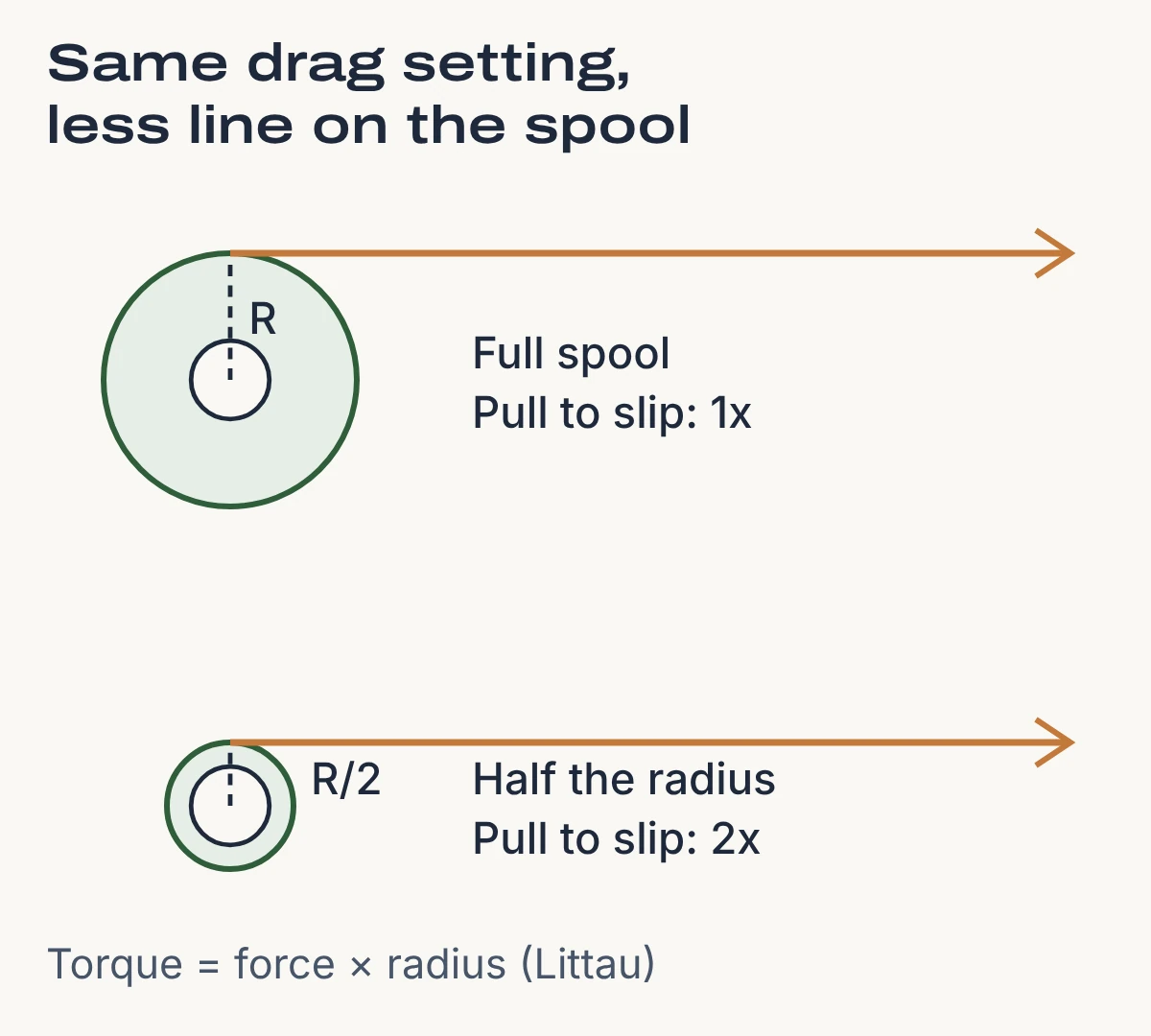
Chris Littau of Rather Outdoors, quoted in Sport Fishing, explains it with the torque equation (“torque equals force times radius”). He says “if the diameter of the line on the spool reduced to half, then the line tension would double.” In a separate 2018 Sport Fishing article, Williams says the same goes for spinning reels, though the change is less noticeable.
Anglers split on how much to touch the knob once a fish is on:
| Angler | Camp | In their words |
|---|---|---|
| Capt. Bryan Williams (Shimano rep, Sport Fishing) | Leave it alone | “In the old days, we’d move up the drag on big fish, but now I tell people to leave it alone.” |
| Capt. Will Burbach (Sport Fishing) | Leave it alone | Fiddling with a spinning reel’s drag midfight is the worst thing, because “you’ll never know where the drag is and where it really belongs.” |
| Steve Gallant (The Fisherman) | Leave it alone | “I never, ever mess with it.” |
| Dennis Zambrotta (The Fisherman) | Adjust as you go | “As far as adjusting my drag during the fight, I pretty much do it all the time.” |
| Jay Hanecak (The Fisherman) | Adjust as you go | “Now, I constantly adjust my drag throughout the fight.” |
| Dave Wolak (Bassmaster) | Adjust as you go | He often loosens the drag after the hook set so as not to “rip a hole in the bass’ mouth”. |
Poveromo sits between them. He says “major drag-setting adjustments in the heat of a fight often prove costly” and recommends cupping the spool for a temporary boost. Williams disagrees: thumbing the spool is worse, because “touching the spool creates uneven pressure and increases the chance of pulling the hook.”
Cover and water change the starting point too:
- Heavy cover calls for a tighter drag. Burbach, who fishes snook in mangroves, says “you can’t set your drag for small or average fish” there, and Williams sets his tight for grouper because “You have to force those fish away from the ledges very quickly.”
- Open water allows a lighter drag. Burbach says you “can go lighter on the drag without as much break-off risk” there.
Tip
Shimano’s FAQ on rod-tip breaks: “If while boat flipping a fish the drag is not released quickly enough or the angle of the flip brings the rod tip up too high it can cause a failure in the blank.”
Note
Most states require a fishing licence for anglers above a set age. The U.S. Fish & Wildlife Service’s beginner pamphlet says: “Depending on your age and your state, you may need one to fish legally.” Check your state wildlife agency’s regulations before you go.
Mistakes and fixes
- Forgetting that the setting creeps up. The drag you set gets heavier as line leaves the spool (see the diagram above), so a number that is right on a full spool can be too tight once much of the line is off.
- Leaving the drag cranked in storage. Poveromo says: “Back off the drags when storing reels.” Leaving them tight over time is “creating memory and fatigue in the drag system that ultimately results in sputtering and uneven pressure during a fight.”
- Jerky or rough drag. Shimano’s FAQ lists “Lack of grease on the drag washer or drag washer soaked with oil” as a cause and says to “Replace drag washers or re-grease.”
Ready to buy?
The drag is in the reel, so start with our beginner fishing reel roundup, and match reel to line with our spinning reel size guide and the trout fishing line roundup. If you are replacing the whole outfit, our roundup of spinning rods compares budget spinning rods.
Frequently Asked Questions
Q. What should your drag be set at?
Most sources here land at a quarter to a third of the line’s rated breaking strength, with Poveromo going as low as 15 percent for light braid. Check it with a scale.
Q. What is the purpose of the drag on a fishing reel?
It keeps steady pressure on the fish and lets line slip before it breaks. New York DEC says it gives you “the ability to land a bigger fish than your line may be rated for.”
Q. Should you reel when a fish is pulling drag?
Poveromo says not to wind on line as it leaves the reel, because winding against the drag twists the line.
Q. How much drag do you need in saltwater?
Accurate Reels’ Ben Secrest says “One-quarter or one-third of the line’s breaking strength should be your drag setting at strike.”
Q. Should the drag be tight or loose for bass?
Start in the same quarter-to-a-third range, lighter on braid per Poveromo, and check it with a scale. Bassmaster’s Dave Wolak, in a 2008 article, says he cranks the drag “as tight as possible when using braid” and often loosens it after the hook set, which is one pro’s practice, not a rule.
Sources (15)
- Shimano, Shimano FAQ
- Quantum, Spinning Reel Owner’s Manual
- Zebco, Baitcast Manual
- Kentucky Department of Fish and Wildlife Resources, Basic Fishing
- New York State DEC, Basic Fishing Tackle and Techniques
- U.S. Fish & Wildlife Service, Fishing is fun for everyone; It’s easy to learn how
- George Poveromo, How To Manage Your Drag
- Sport Fishing, How to Set and Use Reel Drag
- Sport Fishing, How Much Reel Drag Do You Really Need?
- Salt Water Sportsman, How Much Drag Pressure Should I Use on My Reel?
- The Fisherman, A Reel Drag: How Tight And Why?
- Fish Talk, Setting a Fishing Reel Drag
- Salt Strong, 2 Ways To Set The Drag On Your Spinning Reel
- Bassmaster, Dave Wolak: Setting the drag
- Bass Pro Shops, Buying Guide: Picking the Best Spinning Reel