The short answer
Braid is much thinner for its rated strength, barely stretches and is the most visible line, so it suits lures, deep water and heavy cover, usually with a clear leader. Mono stretches, ties easier knots and costs less, so it suits beginners, bait and treble-hook lures. Fish Talk’s scrape test found mono more abrasion-resistant.
Most of the debate is about stretch and thickness. The makers’ own spec tables and two Fish Talk magazine tests settle the points where they agree, and the sections below say who says what where they don’t.
Braid vs mono side by side
| Trait | Braid | Mono | Who says |
|---|---|---|---|
| Made of | Woven fibers: UHMWPE, sold as Dyneema or Spectra | One extruded strand of nylon | Berkley; PowerPro’s Tom Woldruff in Salt Water Sportsman |
| Thickness for its rating | Thinnest: 8 lb is 0.007 in (0.18 mm) | 8 lb is 0.011 in (0.28 mm) | Sufix tables for 832 braid and Elite mono |
| Stretch | Very little | Two to three times braid in light line, seven to 10 times in heavy line | Fish Talk test |
| Abrasion | Lost more strength in Fish Talk’s scrape test; Berkley’s guide calls it tough | Won Fish Talk’s scrape test; Berkley calls it “abrasion prone” | Fish Talk test; The Fisherman; Berkley |
| Visibility | “typically the most visible underwater” | Clear to colored | Berkley |
| Floats or sinks | Floats, per Berkley | Berkley says it is “designed to float”; Salt Water Sportsman says denser fluoro “sinks faster” | Berkley; Salt Water Sportsman |
| Knots | Can slip unless well secured | “normally the best for knot tying” | Berkley |
| Cost | About three times a mono spool in one comparison (a 300 yd braid spool vs a 400 yd mono spool) | Cheapest of the three (worked: Fish Talk and The Fisherman put braid above mono; Berkley calls fluoro the most expensive) | Fish Talk; The Fisherman; Berkley |
Two things follow from the table. Berkley’s line guide puts the strength point plainly: “Monofilament is strong, but far less strong than braid for its diameter. It has significantly more stretch than either braid or fluoro.” And no single line wins every row, which is why Berkley says the choice comes down to “your lure or hook choice, the water clarity, and any cover or obstructions in the water you’re fishing.”
How thick is braid compared with mono?
A pound-test number tells you strength, not thickness. Berkley defines line strength as how much weight it “can handle before breaking”. Salt Water Sportsman adds that “the pound-test rating on most lines is a minimum breaking strength”, and that unless a line is tournament- or IGFA-rated, it may break well above its label. So 20 lb braid and 20 lb mono carry the same minimum rating, but the braid is far thinner.
Diameters differ by brand. Berkley chemist Tim Wiedow told Salt Water Sportsman: “I can make line with 0.010-inch and 0.015-inch diameters that both break at 10 pounds.” The fairest comparison uses one maker’s mono and braid tables side by side:
| Maker and line | Type | Rating | Diameter (maker’s figure) |
|---|---|---|---|
| Sufix Elite | Copolymer mono | 4 lb (1.8 kg) | 0.008 in (0.20 mm) |
| Sufix Elite | Copolymer mono | 8 lb (3.6 kg) | 0.011 in (0.28 mm) |
| Sufix Elite | Copolymer mono | 10 lb (4.5 kg) | 0.012 in (0.30 mm) |
| Sufix Elite | Copolymer mono | 12 lb (5.4 kg) | 0.014 in (0.36 mm) |
| Sufix 832 | Braid | 8 lb (3.6 kg) | 0.007 in (0.18 mm) |
| Sufix 832 | Braid | 10 lb (4.5 kg) | 0.008 in (0.20 mm) |
| Sufix 832 | Braid | 40 lb (18 kg) | 0.013 in (0.33 mm) |
| Seaguar Smackdown | Braid | 20 lb (9.1 kg) | .010 in (.260 mm) |
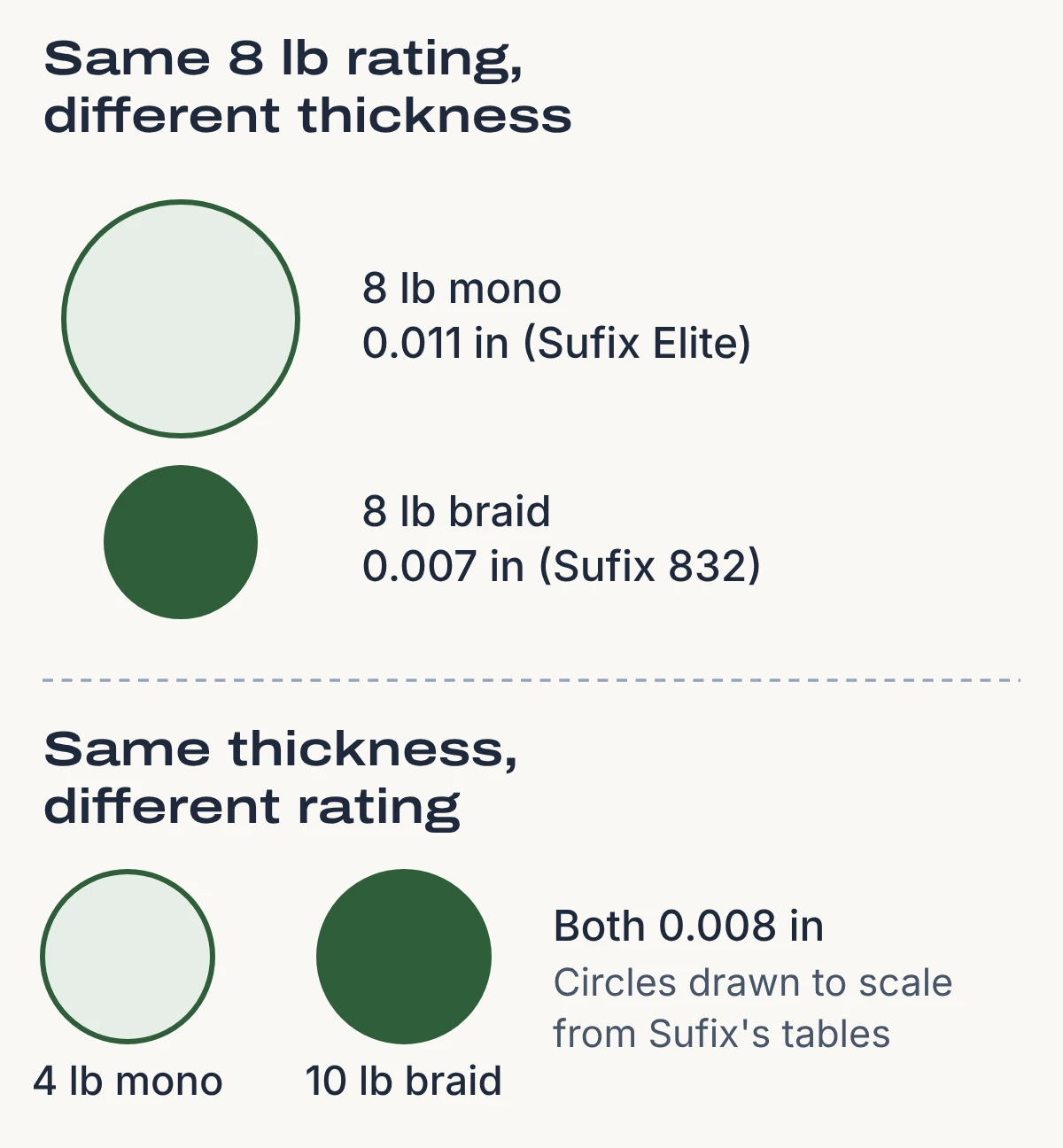
Read from those tables:
- At the same 8 lb rating, Sufix’s mono is about 1.6 times as thick as its braid (0.011 ÷ 0.007, worked from Sufix’s figures).
- At the same 0.008 in, Sufix lists 4 lb mono and 10 lb braid.
- Seaguar makes the same point: its Smackdown braid is “so thin that 20 lb test has the diameter of 6 lb monofilament.”
- For 40 lb braid, Sufix lists its 832 at 0.013 in, between its 10 lb (0.012 in) and 12 lb (0.014 in) Elite mono, so roughly 10 to 12 lb mono by diameter (worked from Sufix’s two tables; other brands differ). The 10, 12 and 40 lb rows appear when you open the full tables on Sufix’s pages.
Thinner line holds more. Fish Talk’s example reel takes “120 yards of 12 pound test” mono, “But the same reel holds 250 yards of 15 pound braid”. If you are sizing a reel around braid, our spinning reel size guide explains how line capacity changes the choice.
Stretch, feel and hook sets
Fish Talk magazine’s Lenny Rudow measured stretch with 15 lb PowerPro braid against 14 lb Berkley Trilene XT mono, then 30 lb of each, with drags set at a third of the line rating. His result: “using light mono you’ll experience two to three times more stretch than you would with braid. And using your heavier rigs you’ll experience more like seven to 10 times as much stretch.” Pulled to breaking, the light mono stretched about 16 percent, below the 25 percent that he says line makers usually quote as an “up to” figure. At 100 feet (30 m), he measured “a 25-percent-ish loss in the punch due to stretch” on the hook set with the light mono.
That stretch cuts both ways:
- Braid feels more. PowerPro sells its braid as “a low-stretch braided fishing line”, and Berkley says braid’s lack of stretch makes it sensitive to small bites.
- Mono forgives more. Berkley says the stretch in mono “makes it a viable choice for any baits with treble hooks”, and Fish Talk says it can reduce how often hooks rip free from soft-mouthed fish such as sea trout. Berkley also warns that braid “can also break more easily than a monofilament when targeting fish that strike aggressively”.
- Braid can pull topwater plugs away. Fish Talk says “the no-stretch braid can cause the plug to come cart-wheeling out of the water all too often.”
Abrasion and lifespan: where sources disagree
Abrasion. Fish Talk scraped three brands of braid and three of mono, in three sizes, five times across a rusty rebar anchor, then broke them on a scale. “Across the board monofilament won for abrasion-resistance, but interestingly, the thinner the diameter of the braid, the less significant the difference was.” At 20 lb, braid dropped to 17.4 pounds (7.9 kg) on average and mono held 19 pounds (8.6 kg); at 50 lb, the braid “was actually cut through on the fifth stroke”. The Fisherman agrees that mono “resists abrasion better than braid does, in some situations.” Berkley, a line maker, says the opposite in its line guides: “Monofilament can often be abrasion prone”, while braid, “while it can fray”, is relied on for powering through obstacles. The only side-by-side test here favors mono.
Lifespan. The sources agree that mono ages faster. Berkley says nylon mono absorbs water and weakens over time, “especially with additional exposure to UV rays”, while braid has “high resistance to UV damage with very little water absorption.” Fish Talk says mono “is really only good for two or three seasons” and that braid “maintains its strength indefinitely”. PowerPro is more cautious about its own braid: “UV exposure is one of the biggest long‑term threats to braided line,” and it says to check the first 20 to 30 feet (6 to 9 m) before each trip. Berkley’s general advice is to replace line “once or twice per year” for the average angler.
Visibility and line color
Sources agree that braid is the easiest line for fish to see. Berkley calls it “the most opaque and visible of the line types” and says many anglers choose mono or fluorocarbon in clear water. In murky water, Berkley says that with “less than a foot or two of visibility”, there’s little reason to choose a less visible line.
Does color matter? Sport Fishing magazine says “no single color of braided line has ever proved to cause fish to bite more readily.” Its points on braid color:
Related guide: What Does Medium Heavy Mean on a Fishing Rod?
- Braid has to be colored on the surface. Its fiber is “naturally a white, opaque color”, and coatings fade.
- Some guides like dark green. Capt. Jim Ross says fish “swim under or over dark‑green line like it’s a grass.”
- Red is not invisible. The magazine notes that red “just becomes darker as depth increases.”
- Bright braid is for the angler’s eyes. In Bassmaster, pro Matt Lee says: “With the bright-colored lines, you will see bites that you may not feel, especially if the wind is blowing or a fish picks up the bait and moves toward you.” Bassmaster says those pros tie on 7- to 10-foot (2.1 to 3 m) fluorocarbon leaders to put distance between the bright line and the lure.
Bassmaster’s summary: “Color choice is strictly a matter of preference and what your eyes pick up best.”
Choose braid if… choose mono if…
Where the sources agree, the choice is clear:
Choose braid if:
- You fish lures more than bait. Fish Talk’s rule of thumb: “braid is the better pick for fishing artificials”.
- You fish floating frogs or heavy cover. Berkley calls 50 lb braid “the #1 line used to fish floating frogs” and says anglers flipping and punching heavy cover often use braid of 50 pounds and more.
- You fish deep or need to feel light bites. Berkley credits braid’s zero stretch for feeling bites in deep water.
- You need more line on a small reel. See Fish Talk’s capacity example above.
Choose mono if:
- You fish natural bait. Fish Talk calls mono “the better bet for fishing natural baits”; in one season of side-by-side chumming, the author found mono caught twice as many fish.
- You are starting out. Berkley calls mono the easiest line for knots, and The Fisherman says it is usually easier to cast because it creates fewer wind snarls.
- You fish treble-hook lures or topwater plugs. Berkley and Fish Talk both point to mono’s stretch here (see above).
- You fish in the cold or on the ice. Berkley says mono “retains its elasticity in winter climates better than other line types.”
- You want a cheaper spool. Mono costs less than braid, per Fish Talk and The Fisherman, and Berkley calls fluorocarbon the most expensive line.
A common answer is both: braid main line, mono or fluorocarbon leader. For trout, our trout fishing line roundup compares nine mono, fluorocarbon and braid lines and sizes each for trout. For bass setups by technique, see our bass fishing tips for beginners.
Fishing braid with a leader
Berkley suggests “pairing your braided line with a fluorocarbon or monofilament leader” to reduce visibility. Seaguar, which makes fluorocarbon, says braid with a fluorocarbon leader “has become the standard in fresh and saltwater environments”. Leader length varies by fishery:
- Bass on spinning gear: 7 to 10 feet (2.1 to 3 m) of fluorocarbon, per Bassmaster’s pros.
- Offshore: Fish Talk says “most savvy offshore anglers add at least 25 feet of monofilament leader (usually fluorocarbon for minimal visibility)” to braid rigs, about 7.6 m.
- Hard-jumping fish: The Fisherman says some Florida tarpon pros “ran a topshot of mono between the braid and the leader to absorb some of the impact.”
- Flipping grass: Not every pro uses one. Bassmaster’s Greg Hackney rarely does, because “the bass don’t see the line because it’s more of a reactionary strike”.
For knots, Berkley says braid knots can slip “if they are not properly secured” and suggests “a Palomar, Loop, or Uni to Uni knot set up”. For spooling, Shimano’s FAQ says braid “may slip on a spool due to a lack of pressure applied during the spooling process”; its fixes are more tension while spooling and, for line slippage, “wrap 2 layers of line or masking tape around the arbor of the spool.” Check your reel’s manual first: the same FAQ warns that taping the backing on a baitcasting reel “can cause spool imbalance, leading to noise and vibration during high-speed rotation.” Our guide to putting fishing line on a reel covers the mono-backing method step by step.
Safety
If you wrap line around your hand to pull free a snag or land a fish, The Fisherman warns: “Never take wraps around your hand with braid, which could lead to severe and deep slices before the line parts or you can swing a big fish aboard. Use a glove or wrap a rag or towel around your hand first.”
Fluorocarbon, and copolymer mono
Fluorocarbon is a single strand like mono, but Berkley says it is made from polyvinylidene fluoride (PVDF), and it sinks. Berkley calls it “one of the only lines that sinks naturally due to its density”, and Seaguar lists its InvizX line as “fast sinking”. Salt Water Sportsman says it “refracts less light than nylon, so it is virtually invisible underwater.” Berkley says fluorocarbon stretches differently from mono: it “only begins to stretch after a given load has been applied to it.” It is “typically the most expensive” line, per Berkley, which suggests it as leader material even if you spool something else.
Copolymer is mono made from more than one polymer. Salt Water Sportsman describes engineers “combining high-quality nylons with different characteristics to create copolymer fishing lines.” Examples from the makers:
- Sufix: product development manager Ben Miller says copolymers give “a monofilament with ultrahigh abrasion resistance, increased sensitivity, high transparency and low memory”, and calls Sufix’s Elite, the mono in the table above, a copolymer.
- Berkley: lists Trilene Sensation as a “nylon copolymer”. FluoroShield is a “fluorocarbon-infused co-polymer (more than one polymer)”, which Berkley says is not to be confused with true fluorocarbon.
- Sufix Advance: blends HMPE, the braid fiber, with copolymer nylon, and Sufix claims “50% Lower stretch and UV absorption than standard monofilament.”
Frequently Asked Questions
Q. What are the downsides of braided fishing line?
Per Berkley, braid is the most visible line, its knots can slip, and wind knots form more easily in rough conditions. Berkley and Fish Talk add that braid has no stretch to cushion hard strikes, and Fish Talk’s test found it wore through faster than mono on rough structure.
Q. Does braided line float?
Yes, per Berkley, which recommends it for floating frogs and topwater baits. Berkley says mono floats too; Salt Water Sportsman notes that fluorocarbon is denser and sinks faster.
Q. Does braided line have memory?
Very little. Fish Talk says braid users love that it has none, and that line twist is less of a problem than with mono.
Q. Is braided line good for baitcasters?
Yes, for heavy work. Berkley says anglers flipping, pitching and punching cover often use braid of 50 pounds and more, and Bassmaster says darker braids stay popular with pros for flipping and pitching.
Q. Can fish see braided line?
Berkley says braid is typically the most visible line underwater, which is why many anglers add a fluorocarbon or mono leader in clear water. In murky water or for reaction strikes in grass, Berkley and Bassmaster’s Hackney say it matters less.
Q. What is fishing line made of?
Per Berkley, mono is nylon, fluorocarbon is PVDF and braid is woven ultra-high molecular weight polyethylene fiber, sold as Dyneema or Spectra.
Sources (20)
- Berkley, Choose the Right Line for Your Fishing Needs
- Berkley, Monofilament: A Complete Fishing Line Guide
- Berkley, Braid line guide
- Berkley, Fluorocarbon: A Complete Fishing Line Guide
- Berkley, How to Choose the Perfect Line for Freshwater Fishing
- Sufix, Elite monofilament specifications
- Sufix, 832 Advanced Superline specifications
- Sufix, Advance Monofilament
- Seaguar, Smackdown braid
- Seaguar, InvizX fluorocarbon
- Seaguar, What Makes a Leader a Leader?
- PowerPro (Shimano), PowerPro braided line
- PowerPro (Shimano), Post-Trip Care and Maintenance for Braided Line
- Shimano, Shimano FAQ
- Fish Talk, Fishing Line Stretch Test
- Fish Talk, Best Fishing Line: Monofilament Versus Braid
- The Fisherman, Inshore: Mono vs. Braid
- Salt Water Sportsman, Monofilament Versus Braid
- Sport Fishing, Does Fishing Line Color Matter?
- Bassmaster, High-visibility braid
