The short answer
For a Texas-rigged plastic worm, push the point into the nose and out the underside, slide the worm up over the eye, turn the hook, and bury the point in the body so the worm lies straight. For a wacky rig, hook the middle. Loop a live worm on 2 to 4 times.
How a worm goes on the hook depends on what kind of worm it is. This guide covers the hooking motion for each: the Texas rig that makes a plastic worm weedless, the wacky rig, and a live worm on a bait hook.
Related guide: How to Rig a Bass Lure: Texas, Carolina, Wacky, Ned and Drop Shot Rigs
Each method is built from named sources, and where two sources differ the text says so. Rigs that add a weight to the line are a separate topic and are not covered here.
Which method fits your worm
| Method | Worm | Hook | Where the hook goes |
|---|---|---|---|
| Texas rig | Plastic worm | Offset worm hook | In the nose, out the underside, point buried |
| Tex-posed | Plastic worm | Offset worm hook | Same, point rests on the back |
| Wacky rig | Stick worm | Wacky or octopus hook | Through the middle |
| Live worm | Nightcrawler, earthworm | Bait hook | Looped on 2 to 4 times |
Field & Stream, a fishing publication, says “Extra Wide Gap (EWG) hooks work better with creature baits and other thicker lures”, so a bulky bait takes a wider hook than a worm does. Plastic worms are one of the soft-plastic families in our guide to the types of fishing lures, and a first-time bass angler can find the wider picture in our bass fishing tips for beginners.
Ready to buy?
Our roundup of the best bass fishing worms compares eight plastic worms, with the rig each one is described for.
What you need
- A worm: plastic for the Texas and wacky rigs, live for the last method.
- A hook that suits the worm. Field & Stream says “Offset-shank worm hooks are the gold standard for this technique when fishing with thinner baits, like finesse worms and lizards.” Wired2Fish, another publication, says “An offset worm hook simply has a 90-degree elbow made for this style of rig.”
- For a wacky rig: a wacky or octopus hook, and an O-ring if you want one.
- A fishing license, if your state requires one. The US Fish and Wildlife Service says: “First, you’ll need a fishing license.” It adds: “Every state has slightly different rules, so look up your state for state-specific requirements.”
- Pliers, if you want a barbless hook. Indiana DNR, a state agency, says “For a safer hook, smash down the barb with pliers or use barbless hooks.”
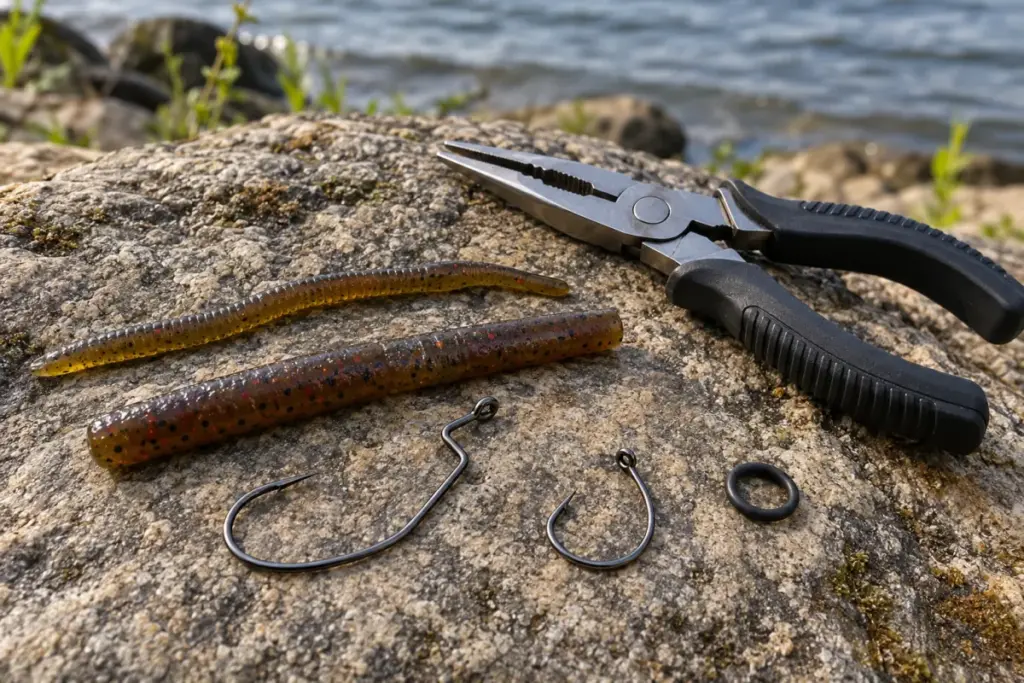
How to Texas-rig a plastic worm
The Texas rig buries the hook point in the worm so it slides through weeds and wood. Bassmaster, the B.A.S.S. publication, says “A worm hook is designed to allow the bait to be rigged weedless, preventing snags when fishing in thick cover.” Field & Stream adds that the rig’s “versatility has long made it a great choice for beginners”.
The steps below follow Field & Stream’s step-by-step guide, with Wired2Fish’s guide for the turn and where the guides differ. Bassmaster’s lesson gives the same order in one sentence: “insert the hook point into the head of the bait. Slide it up the hook shaft, rotate, and then bury the hook point back into the body of the bait to make it weedless.”
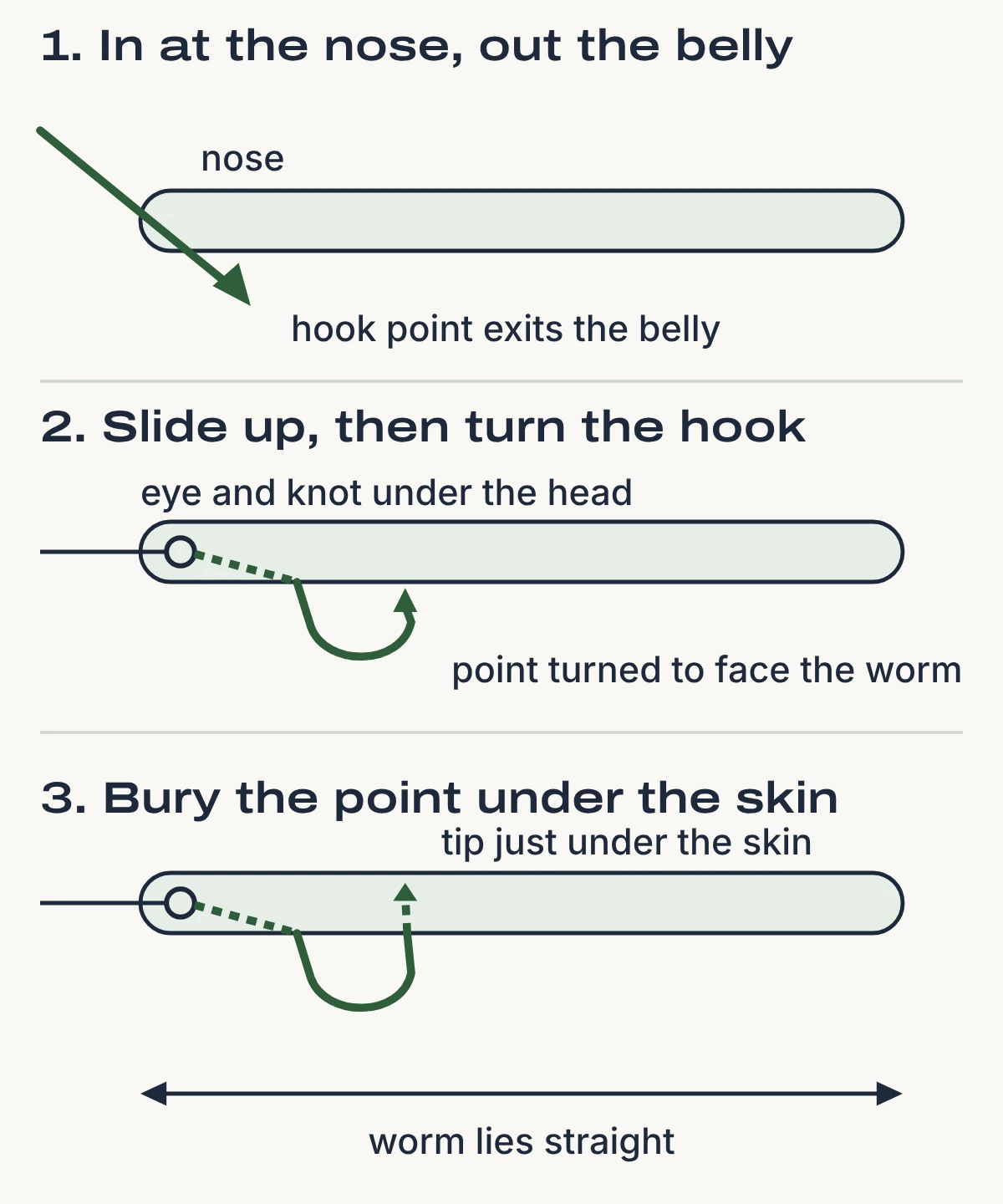
Start with the hook tied on and the worm in your hand
Tie the hook on first, using the knot you know. If you plan to add a sliding weight, the sources thread it on the line before the hook; weighted rigs are a separate topic. The National Park Service says to “Handle the hook carefully during baiting and removing your catch”.
Push the point into the nose and out the underside
Field & Stream says: “Run the hook point through the nose of the soft-plastic bait and out of the bottom of it.” Go in far enough that this section of worm will cover the eye and knot. Field & Stream exits the bottom; Wired2Fish exits the side, about 1/8 to 1/4 inch down from the nose. Either way the exit is close to the nose.
Pull the hook through and slide the worm up over the eye
Field & Stream says: “Slide the head of your bait up the hook until it is in place and covering the eye and knot.” Wired2Fish describes the same move: “bring the worm over the elbow of the offset hook (or over the keeper on the straight shank hook)”.
Turn the hook so the point faces the worm
Wired2Fish says to “twist the hook so the point faces back towards the worm and the eye is at the nose of the worm”. Bassmaster’s word for this step is “rotate”.
Pinch the middle and push the point through
Field & Stream says: “Pinch the midsection of the soft-plastic bait and put a slight bend in its back as you run the hook point through its midsection.” Wired2Fish finds the spot by laying the hook next to the worm to “see where the bend meets the worm”, then to “kink the worm and put your hook at that precise point”.
Check that the worm lies straight
Field & Stream says: “Done correctly, the bait should lie straight.” If it does not, it says to “remove the hook point and repeat this process until the bait is straight, with the hook point all the way through the back of the bait”. Wired2Fish stops one move earlier: “Push it into the worm until the worm is perfectly straight on the hook and the point is covered.”
Bury the point just under the skin of the back
Field & Stream says to “slip the point just under the skin of the back of your bait to make the rig weedless”. Hook it to a rod eyelet before you walk. South Dakota Game, Fish & Parks says: “Always have the hook attached to an eyelet when carrying the pole to a new place.”
Quick check
Look at the rig from the side. Field & Stream says the bait “should lie straight”, and Wired2Fish wants it “perfectly straight on the hook” with the point covered. A bent worm means backing the point out and repeating step 5.
Tex-posed and straight-shank variants
Wired2Fish describes “Tex-posing”: instead of burying the point fully, “you lay the flat part of the hook point on the back of the bait and push just a small bit of the point in”. Wired2Fish says this gives “a much easier hookset”, but it means you “snag more since the hook is more exposed”. It suggests the variation where cover is sparser, “like around boat docks or bank grass”. It is one publication’s description, so use it only where snags are not the problem.
A straight-shank hook goes on the same way. Wired2Fish’s step 3 brings the worm “over the keeper on the straight shank hook” in place of the elbow. Field & Stream says “straight shank hooks work really well when flipping and pitching Texas rigs”.
Related guide: How to Put a Tarp Over a Tent
How to hook a wacky rig
A wacky rig puts the hook in the middle of the worm so both ends move. Mustad, a hook maker that sells wacky O-rings and a ring tool on the same page, says a wacky rig “comprises a worm” with “a hook positioned at the middle”. It is usually a stick worm such as a Senko. Two sources describe the hooking, and they differ on the O-ring.
Pick a hook for the worm
Jay Yelas, a Bassmaster Elite pro writing in Outdoor Life, a fishing publication, says: “Use a 3/0 octopus hook, and hook the Senko in the middle of the bait.” That is one pro’s choice for a Senko.
Find the middle of the worm
Davy Hite, a Bassmaster Classic winner writing in Carolina Sportsman, a magazine, leaves “roughly even lengths of tail and head on either side of the hook”.
Put the hook through the middle, or under an O-ring at the middle
Hite says: “You push the point of your hook through the middle of the body of the worm and leave it exposed, leaving roughly even lengths of tail and head on either side of the hook.” Mustad says hooking through the side of the worm means replacing it after every fish, “due to the nearly inevitable tearing”, and says: “The key to bait preservation is to slip your hook under an O-Ring placed over the worm.” Mustad adds: “This also leaves the hook gap virtually wide open, so your hook ups are cleaner.” Handle the hook carefully while you do this; the National Park Service says to “Handle the hook carefully during baiting and removing your catch”.
Check both ends hang about the same
Hite’s rule is the even lengths in step 2. The point stays exposed on this rig, and Yelas says: “Because you have an exposed hook, it will snag in heavy cover areas.”
For heavy cover Yelas switches to a Texas rig: a weightless, Texas-rigged Senko is “perfect for fishing around shallow, heavy cover”, on “a 5/0 offset shank EWG hook on the 5-inch Senko, and a 6/0 on the 6-inch Senko”. Those sizes are his pairing, not a rule.
How to hook a live worm
State agencies give short rules for a live worm. South Carolina’s Department of Natural Resources says to “loop the worm through the hook 2-4 times and to leave some of the worm dangling from the bottom of the hook”.
Match the worm to the hook
Indiana DNR says: “Keep the bait approximately the size of your hook, so the fish is less likely to steal your bait.” It adds: “You can also cut the bait to fit your hook.” Its tip for beginners is: “Use hook sizes 6 to 10 (size 6 is larger than size 10).”
Loop the worm onto the hook 2 to 4 times
Follow South Carolina’s rule above. Handle the hook carefully as you pass it through; the National Park Service says to “Handle the hook carefully during baiting and removing your catch”.
Leave a short tail
South Carolina warns against “more than an inch of worm dangling below the hook”, because “fish will nibble away at the worm without biting the hook”.
Safety
The National Park Service tells anglers to “Handle the hook carefully during baiting and removing your catch” and to “Look around before you cast – make sure no one is near you”. It says: “If you are hooked, learn first aid for removing hooks from the skin and treating the wound.” It adds: “If the hook has deeply penetrated the skin, muscles, tendons, or bone, if it is on the face or near/in the eyes, or if you are bleeding excessively, seek medical treatment immediately.”
Mistakes that cost you the worm
- A bent or bunched worm. Field & Stream and Wired2Fish both want the worm straight on the hook before the point is buried.
- A point left out in cover. Wired2Fish says an exposed point means you “snag more”; Field & Stream and Bassmaster bury it to make the rig weedless.
- A wacky worm that tears after each fish. Mustad says a worm hooked through the side must be replaced “after every fish” because of “the nearly inevitable tearing”, and slips the hook under an O-ring. Hite hooks straight through the middle without one.
- Too much live worm hanging. South Carolina’s limit is an inch below the hook.
- A worm too big for the hook. Indiana DNR says to keep bait about the size of the hook.
Frequently Asked Questions
Q. How should a worm look on a hook?
A Texas-rigged plastic worm should lie straight, with the point out of sight; Field & Stream says “Done correctly, the bait should lie straight.” A wacky worm hangs with even ends (Hite), and a live worm leaves no more than an inch dangling (South Carolina DNR).
Q. How do I get a worm to stay on the hook?
For a live worm, South Carolina DNR says to loop it through the hook 2 to 4 times. For a plastic worm, Field & Stream says to slide the head up until it covers the eye and knot, and Mustad says an O-ring protects a wacky worm from tearing.
Q. What hooks do plastic worms need?
Field & Stream names offset-shank worm hooks for thinner baits such as finesse worms and lizards, and EWG hooks for thicker baits. Yelas uses a 5/0 offset EWG hook for a weightless Texas-rigged 5-inch Senko and a 3/0 octopus hook for a wacky-rigged Senko.
Q. What is the easiest way to hook a plastic worm for beginners?
Field & Stream calls the Texas rig a great choice for beginners. Follow the seven steps above and check that the worm lies straight.
Q. Do I hook a worm differently for trout, perch, catfish, crappie or bluegill?
The sources used here do not give species-specific hooking. For a live worm, South Carolina’s 2-to-4-loop rule and Indiana DNR’s advice to match bait size to hook size apply, and Indiana suggests hook sizes 6 to 10 for beginners. Check your state agency for the rules on live bait where you fish.
Q. Is a fake worm hooked differently from a live one?
Yes. The sources above hook a plastic worm the Texas or wacky way and loop a live worm onto the hook 2 to 4 times.
Sources (11)
- Field & Stream, Texas Rig Fishing for Bass
- Wired2Fish, The Texas Rig: How to Rig and Fish
- Bassmaster, Lesson 5: Essential soft plastics, terminal tackle, and rigs
- Mustad, Winning with Wacky
- Outdoor Life, 6 of the Best Ways to Rig a Senko
- Carolina Sportsman, Add the Senko to your arsenal
- South Carolina DNR, A Beginner’s Guide to Fishing
- Indiana DNR, Fishing tips and videos
- National Park Service, Reel It In: Be Prepared for a Successful Fishing Day
- South Dakota Game, Fish & Parks, Fishing Fun
- US Fish and Wildlife Service, Purchase a fishing license