
The short answer
It depends on the build and how many nights you use it. Huddle, a UK airbed maker, estimates 1-6 months for a budget airbed in regular use. Better Homes & Gardens says about two to eight years for occasional guest or camping use. Therm-a-Rest says a pad used daily and seldom cleaned may last only months.
None of the makers or publications below gives a measured lifespan, so every figure is an estimate, a warranty term or one owner’s account, and the chart says which. Therm-a-Rest and Better Homes & Gardens both tie the spread to how often the bed is used and how it is cared for.
This guide covers blow-up air beds and camping air or self-inflating mattresses. Adjustable home air beds with motors and remotes are a different product: Saatva, which makes one, says “A typical adjustable air mattress should last for 8 or more years with normal use.”
Related guide: Queen Air Mattress Dimensions, and Whether It Fits Your Tent or Truck
Air mattress lifespan chart, with the basis of each figure
| Bed and use | Lifespan figure | Who says it | Basis |
|---|---|---|---|
| Budget airbed, “regular use” (not defined) | 1-6 months | Huddle Living | Maker’s estimate |
| Mid-range airbed | 1-3 years | Huddle Living | Maker’s estimate |
| Premium airbed, with care | 3-5+ years | Huddle Living | Maker’s estimate |
| Air mattress, occasional guest or camping use | About 2-8 years | Better Homes & Gardens | Publication’s estimate |
| Air mattress used every weekend | “only a few years” | Better Homes & Gardens | Publication’s estimate |
| Therm-a-Rest pad, daily use, seldom cleaned | “a few months” | Therm-a-Rest | Maker’s statement |
| Therm-a-Rest pad, occasional use, well cared for | “many years” | Therm-a-Rest | Maker’s statement |
| Backpacking sleeping pad, heavy use | About 180-250 nights before he replaces it, often before it fails | One Backpacking Light member | Owner report |
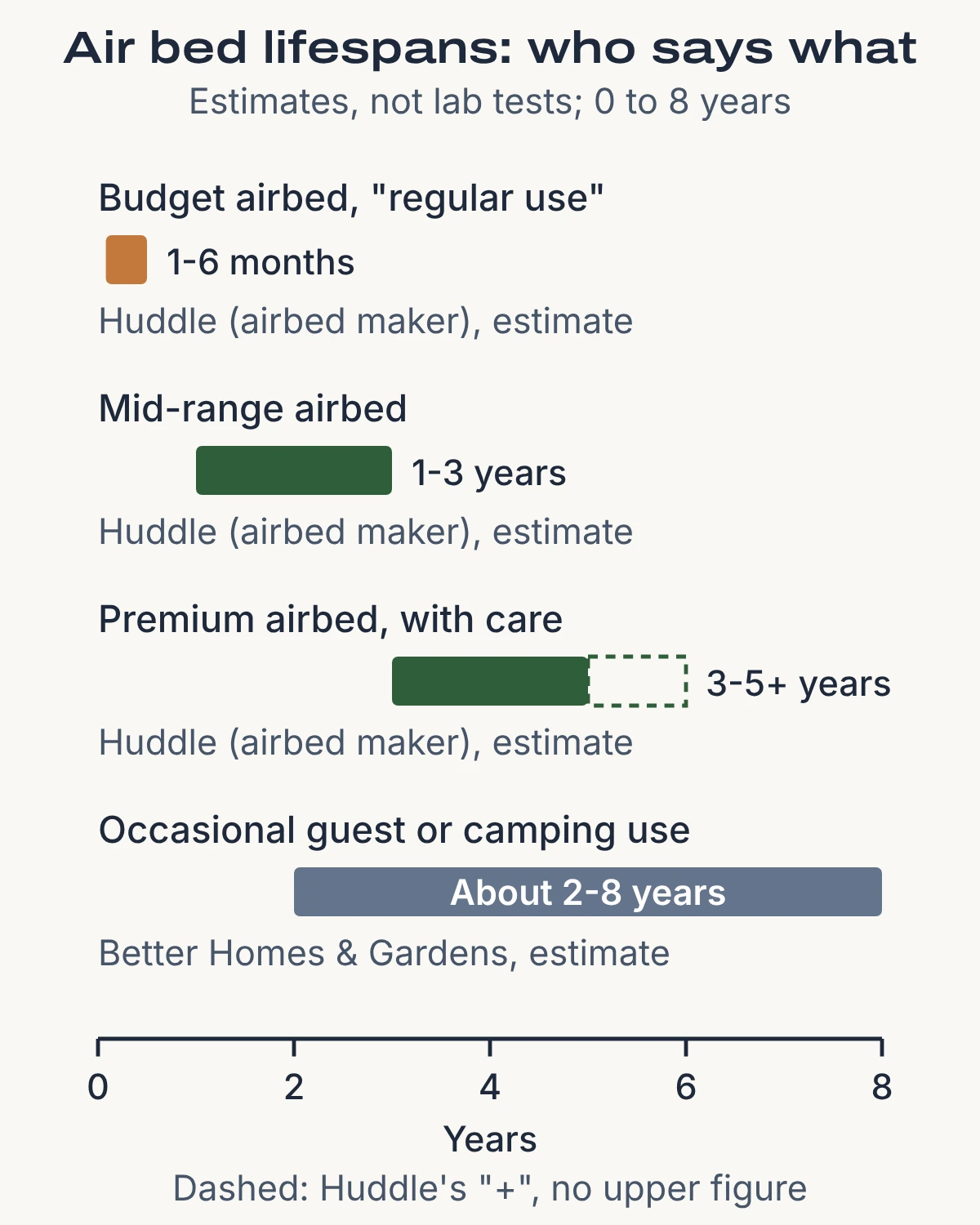
Huddle’s figures are a seller’s estimate for its own category; it gives no basis and does not say what “regular use” means. Better Homes & Gardens’ writer drew on testing of 26 air mattresses, but the range itself is an estimate, not a measured life. Therm-a-Rest puts it in terms of use and care: “A mattress that is used daily and seldom cleaned may only last a few months, while a well taken care of mattress, used occasionally under normal conditions, can last for many years.”
Related guide: What Does Medium Heavy Mean on a Fishing Rod?
The owner reports sit at the short end for nightly use. A Reviewed writer slept on a budget Intex queen every night through a four-month semester; it sprang a leak “no larger than the tip of a pin” with one month to go, so after about three months. That one account falls inside Huddle’s 1-6 month range for budget beds.
What the warranty tells you, and what it doesn’t
A warranty is the maker’s promise against defects for a set time. It is not a lifespan estimate, and the terms below all leave out punctures or ordinary wear, so a bed can outlive its warranty or fail inside it with no claim.
| Maker | Warranty | Not covered (maker’s words) |
|---|---|---|
| Intex air beds | 90 days to 1 year by model: 90 days on the 10-inch Dura-Beam Standard twin, 180 days on a Dura-Beam Plus bed, 1 year on a Dura-Beam Deluxe bed | “punctures, tears, abrasions, or ordinary wear and tear” |
| Bestway, incl. Coleman-brand beds | 90 days to 2 years by series | “normal wear and tear” and improper storage |
| SoundAsleep | 1 year | “Punctures and holes from use are not covered.” |
| Exped mats | 5 years, materials and workmanship | “normal wear and tear, negligence, or force majeure” |
| Therm-a-Rest | Limited lifetime (2 years for electronics) | “Normal wear, puncture, abrasion, misuse” |
| NEMO | Lifetime, original owner | “normal wear and tear” |
Intex lists the term on the Warranty tab of each bed’s product page, so check the page for your exact model; CNET’s comparison table agrees, listing 180 days and 90 days for two Dura-Beam beds. Bestway’s US table gives its SleepSupport beds without a built-in pump 90 days and SleepSupport Preferred beds with one 180 days. For Coleman-brand air mattresses it lists “Tough Guard and ToughLite 2 years/ All others 1 year.” CNET sums up the blow-up bed market the same way: “most manufacturers offer a one-year warranty or guarantee. A few extend that to two years. Others will give you 90 days”.
Work out where your own bed sits
There is no tape measure for this, but you can read the chart for your own use in four steps.
Name the type
A plain blow-up air bed (vinyl or TPU, usually with a pump) reads from the airbed rows. A camping pad or self-inflating foam mattress, such as a Therm-a-Rest or Exped, reads from the pad rows.
Count your nights a year
A guest bed used a few weekends a year is occasional use. Every weekend is Better Homes & Gardens’ “frequent use” case. Every night is the heaviest use of all; Huddle’s 1-6 month budget figure is for “regular use”, which it does not define.
Read the row, then the low end
Huddle’s top figure assumes “proper care” and Therm-a-Rest’s “many years” a “well taken care of” pad, so without that care, read the short end.
Set the warranty against it
Write down the purchase date. A 90-day bed you sleep on nightly has used its whole warranty in about 90 nights; a lifetime warranty still won’t cover a puncture.
Worked from that one Backpacking Light member’s figure of 180 to 250 nights, a pad used 30 nights a year would reach that count in about 6 to 8 years. He replaces pads at that point, “often not for failure but as a precaution for failure,” so this is a retirement point, not a failure point. It is also one heavy user’s experience with backpacking pads, so treat it as a rough guide, not a rating.
Between the rows: nightly and long-term use
If you are sleeping on one for months, read the shortest rows. Intex’s own manual says “Airbeds are designed for temporary use and are NOT designed to be a replacement for a traditional mattress.”
Owners in an r/povertyfinance thread on long-term use report a wide spread. One budget bed “lasted 45 days” of nightly use; another owner “had it for like 9 months” with the bed left inflated; a third “used it for six months and it was still good when I left it.” Treat those as single accounts, not averages. The Reviewed writer’s advice after months of nightly use was simple: “just make sure you have an extra patch kit.”
Safety
The CPSC says: “Never place infants to sleep on air mattresses or other soft surfaces”. It warns that “air mattresses are too soft for use with sleeping infants” and that “Even properly inflated air mattresses are usually too soft for infants to maintain a clear airway. Air leaks and under-inflation also contribute to incidents.” Of the 16 deaths it reported, mostly of infants, “5 died due to suffocation after falling into gaps between the mattress and bed frame and mattress and adjacent furniture or wall.” Intex’s safety page says: “Never place an infant younger than 15 months on an inflatable mattress.” For older children it adds: “Avoid entrapment between the mattress and vertical spaces created by walls, dressers and other furniture. When used by children over 15 months old, make sure there’s ample space between the mattress and other objects. (We recommend at least a shoulder’s width of space.)”
What wears an air mattress out
- Punctures from below. Intex tells owners to set the bed on an area “free of sharp objects that could puncture the bed” and warns that “Pets may puncture the surface of the bed.”
- Heat and overpressure. In heat, Intex says the bed “may burst” unless you release air, and Coleman warns that bursting items “can cause serious injury.”
- Dirt, body oils, bug spray and sunscreen. Therm-a-Rest calls them a mattress’s “biggest enemies”: they can contribute to the breakdown of the laminates that bond the outer fabric to the inside. It singles out DEET as “extremely damaging to pad fabrics.”
- Rough handling. Intex says to never drag the bed and to lift it when moving; it also says not to stand, walk or jump on it.
- Sharp folds in storage. Intex says to fold it loosely and avoid “sharp bends, corners and creases”.
- Damp storage. Therm-a-Rest warns that a self-inflating pad stored a long time in a damp space can get mildew damage, which its warranty does not cover.
How to make an air mattress last longer
These steps come from the makers’ own manuals and care pages. Your bed’s manual has the final word, because makers differ (a self-inflating pad is stored differently from a vinyl air bed).
Test it before the trip
Therm-a-Rest suggests you “Inflate your pad and let it hold air overnight” at home. With a new vinyl bed, Intex calls early softening normal: “Stretching is a natural characteristic of new vinyl.”
Inflate to firm, not drum-tight
Coleman’s manual says to inflate “until most of the wrinkles in the material are gone and the bed feels firm to the touch.” Intex says to use only a low-pressure inflator and not to over-inflate. Coleman also warns never to use a hair dryer, which “could cause melting.”
Let air out in heat, top it up in cold
Coleman says hot weather expands the air, so “You must let some air out to prevent the airbed from failing due to overpressure.” For cold nights, Intex’s manual says “At low ambient temperature the air will contract within the airbed and the airbed will feel softer: add air as necessary.” It also says not to expose the bed to extreme temperatures, hot or cold.
Put something under it
For its NeoAir pads, Therm-a-Rest says to avoid “placing it directly on rock or sharp sticks” and to “At very least, use a ground tarp or footprint”. For a vinyl air bed, Intex says to set it on an area that is flat, smooth and free of sharp objects.
Keep skin and sunscreen off it
Therm-a-Rest says to “always use a barrier between your skin and the pad”, such as base layers or a sheet, and to keep DEET off the fabric.
Clean it gently
Intex says to use only a cloth with a mild soapy solution and no chemicals. Therm-a-Rest’s FAQ says to wash pads with a hose or in a bathtub, never in a washing machine, with the valve closed, and names a general household cleaner for scrubbing. Its page on bubbles and delamination says to use a mild detergent and to avoid harsh cleaning agents, especially bleach.
Dry and store it the maker’s way
Intex says the airbed should be “clean and dry” and folded loosely. Therm-a-Rest recommends storing a self-inflating pad unrolled and inflated in a dry place with the valve open, and its NeoAir air pads rolled tight in a stuff sack with the valve open.
Patch holes the way the kit says
Follow the label on your patch kit or glue. SoundAsleep’s instructions are to deflate the bed, press the patch on for 2 minutes and “Wait about 4 hours for the patch to set” before inflating; for seams or the flocked top it suggests PVC glue, which it says takes “approximately two hours to set or cure”. Intex says to rub the flocking away with an eraser before patching a flocked surface. Therm-a-Rest says duct tape and off-brand patches “often don’t seal properly” on its pads.
Signs it’s time to replace it
- A leak you can’t find or can’t keep sealed. If a soapy-water search turns up nothing, or patches keep failing, our guide to why an air mattress keeps deflating walks through the causes in order, including a bed that only goes soft because the air cools overnight.
- A bubble or bulge. On self-inflating and air pads, Therm-a-Rest says a bubble is delamination, when the internal adhesive “begins to degrade and fail”. It says that “In most cases, we replace the pad for the original owner”, though typically not when the pad hasn’t been properly cared for, so make a warranty claim before you bin it.
- A dead built-in pump. That alone may not end the bed: Intex’s manual explains how to replace the internal pump or the airbed separately, and a manual or battery pump can inflate the bed through its manual port.
Can an air mattress pop or explode?
Yes, it can burst, and makers name the causes. Intex says that at high temperatures the air “will expand significantly and the airbed will become hard and may burst”. Coleman’s manual says: “Do Not Over Inflate. Bursting items can cause serious injury.”
Fire and chemicals are the other risk. Intex warns: “Never introduce any flammable substance into the inflatable airbed, SUCH AS AEROSOL TIRE REPAIR PRODUCTS, as it may ignite or explode.” Coleman says its airbed “can melt or burn” and must be kept away from open flames, heaters and other hot objects.
Ready to buy?
Our roundup of the best air mattresses for camping compares queen air beds with self-inflating foam mattresses, using the makers’ specs, and notes warranty differences where they matter. If you are still choosing between the two kinds, our sleeping pad vs air mattress guide weighs warmth, weight and durability.
Frequently Asked Questions
Q. How often should you replace an air mattress?
When it no longer holds air through a night after you have searched for and patched leaks, or when it bulges or bubbles. There is no set schedule; the chart above gives the range of estimates by type and use.
Q. Can you leave an air mattress inflated all night?
Yes, sleeping on it inflated is what it is for, and Intex says to keep it fully inflated in use. The pump is different: Intex’s manual says “Do not operate air pump for more than 5 minutes at a time” and to unplug the cord when not in use.
Q. How long is a twin air mattress?
Intex gives the inflated size of its 10-inch twin Dura-Beam bed as “39in x 75in x 10in”, about 99 x 191 cm. Other brands’ twins are close but not identical, so check the listing against your tent floor.
Q. How long does an air mattress take to inflate?
It depends on the pump. In our camping roundup, Outside inflated the Kelty Kush queen “in about four minutes” with its included pump, and SoundAsleep says its Camping Series pump fills the bed “in under three minutes”.
Q. Do air mattresses lose air overnight?
Some softening is normal: new vinyl stretches and cooling air takes up less room, as our deflating air mattress guide explains. A bed that goes flat within hours has a real leak.
Q. What are the downsides of an air mattress for camping?
Plain air beds have no insulation of their own: the queen air beds in our roundup publish no R-value, so on cold nights a pad or blanket underneath helps. They also puncture, and Intex’s manual for its built-in electric pump beds says “For indoor household use only.” Our camping packing list covers the rest of a sleep setup.
Sources (24)
- Huddle Living, How Long Should a Good Airbed Last?
- Better Homes & Gardens, The Best Air Mattresses
- Therm-a-Rest, What is the life expectancy of my sleeping pad?
- Therm-a-Rest, What does the Therm-a-Rest warranty cover?
- Therm-a-Rest, My sleeping pad has a bubble
- Therm-a-Rest, Sleeping pad FAQ
- Therm-a-Rest, Tips for NeoAir care
- Intex, a 1-year airbed limited warranty (PDF, one model family’s terms)
- Intex, Dura-Beam Plus Deluxe Pillow Rest 16.5in queen (Warranty tab)
- Intex, Dura-Beam Deluxe Ultra Plush Headboard 18in queen (Warranty tab)
- Intex, Owner’s manual for airbeds with the Quickfill Plus internal pump (PDF, copy hosted by Amazon)
- Intex, Air mattress safety
- Intex, 10in Twin Dura-Beam Single-High Airbed (incl. Warranty tab)
- Coleman, QuickBed instructions (PDF)
- Bestway USA, Our warranties
- SoundAsleep, Returns & Repairs page (soundasleepproducts.com/warranty-returns)
- Exped, Warranty and repair
- NEMO, Adventure Forever Guarantee
- CNET, Best air mattress
- Reviewed, I slept on a budget blow-up mattress for 4 months
- CPSC, Deadly danger: CPSC urges parents to not place infants on air mattresses
- Saatva, How long do adjustable air mattresses last?
- r/povertyfinance, Long term use of air mattress (forum)
- Backpacking Light forum, Pad insulation longevity
