The short answer
A pop-up tent opens on a built-in frame, so it stands within minutes, but packs bulky and its poles are hard to replace. A dome’s crossing poles come out for packing: it pitches in five to ten minutes, packs smaller and is easier to repair. Pop-ups suit festivals and car camping; domes suit carrying and rougher weather.
The two designs trade the same things against each other: setup time against packed size, and convenience against how easily a broken part can be swapped. Below, makers’ own specs sit next to an owner’s measurements and a forum of campers, with each figure credited to whoever published it.
Pop-up vs dome tent at a glance
| Trait | Pop-up tent | Dome tent | Who says |
|---|---|---|---|
| Setup | 1.5 to 3.5 minutes fully staked for its seven pop-ups | Sundome 2-person 5.5 minutes; 4-person 9 minutes | Camping Guidance, timed by its writer |
| Packed size | 1.8 to 3.7 times bigger | Smaller; poles break down | Camping Guidance; CORE |
| Frame | Fiberglass hoops that stay in the tent | Poles that cross overhead and come out for packing | Camping Guidance; CORE |
| Wind | Decathlon rates its pop-ups to 31 mph (50 km/h), properly pitched with all guy ropes | Coleman rates the Sundome to 35 mph (56 km/h) | Each maker’s own test |
| Repairs | A broken pole is hard to swap (maker parts exist for some) | A new pole “drops straight in” | Camping Guidance |
Camping Guidance, a camping blog whose writer says they own seven pop-up tents and measured each one, sums up the trade in one line (its fastest, a Coleman 2-person pop-up, took “15 seconds to pop, and 1.5 minutes fully staked”): “Pop up tents set up 2 to 4 times faster. They also pack 1.8 to 3.7 times bigger.” The wind row needs care, because each maker runs its own test; the section on wind and rain below sets those claims against an independent estimate.
Related guide: 3-Season vs 4-Season Tent: What Changes and Which One You Need
“Pop-up” covers two different designs
Shops use “pop-up” for two kinds of tent, and they behave differently:
- Throw-open pop-ups. Sprung fiberglass hoops are sewn into the tent and fold flat under tension. Decathlon’s Quechua 2 Second range is a widely sold example; Decathlon calls the 2-person Fresh & Black model a “Self-supporting structure”, and its Easy model a “Free-standing structure”. Camping Guidance’s routine is to unzip the bag, pull off the strap and “toss the tent away from you”.
- Instant tents. The poles are attached to the tent body and lock into place. CORE, which makes them, says “Instant tents feature pre-attached poles for fast, stress-free setup in minutes.” and that “CORE instant tents set up in two minutes or less.” CORE sells these under a collection that mixes “pre-attached poles and pop-up frames”. Hub tents such as the Gazelle T4 in our festival tent roundup belong to this family.
A dome is the traditional design. CORE’s definition: “A dome tent uses two or more flexible poles that cross overhead, creating a curved shape.” The poles come apart into short sections, which is why CORE says a traditional pole tent “packs down a bit smaller, and is a lighter-weight option”. Our guide to types of camping tents covers the other shapes, from tunnels to cabins.
Three real tents, makers’ specs side by side
Category averages hide a lot, so here are three tents with each figure from its maker. The two pop-ups are Decathlon’s; the dome is Coleman’s Sundome, with Coleman’s figures taken from Coleman’s own listing on Amazon (its product copy and spec table).
| Spec | Quechua 2 Second Fresh & Black 2P (pop-up) | Quechua 2 Second Easy 2P (pop-up) | Coleman Sundome 4P (dome) |
|---|---|---|---|
| Setup, maker’s words | Self-supporting; no time given | “pitches in minutes” | “Snag-free continuous pole sleeves and pre-attached poles let you pitch the tent in about 10 minutes” |
| Packed | Round, 29 x 4 in (74 x 10 cm), 43 L | 23 x 8 x 8 in (59 x 20 x 20 cm), 23.6 L | Listing’s “Product Dimensions”: 23 x 6.5 x 6.5 in (59 x 17 x 17 cm) |
| Weight | 8.8 lb (4 kg) | 10.4 lb (4.7 kg) | 9.2 lb (4.2 kg) |
| Wind, maker’s claim | 31 mph (50 km/h), wind tunnel | 31 mph (50 km/h), wind tunnel | 35 mph (56 km/h) |
| Sleeping area | 47 x 83 in (120 x 210 cm), 39 in (99 cm) high | 57 x 81 in (145 x 205 cm), 43 in (110 cm) high | 63 sq ft (5.9 m²) floor |
Decathlon’s pages give the weights as “Weight: 4 kg” and “Weight: 4.7 kg”, and the bags as “Cover size: Ø74×10 cm” and “Dimensions of the bag: 59x20x20 cm”. Coleman’s listing gives “9.2 pounds” for the 4-person size; the 63 sq ft floor is from our festival roundup’s table. Note the sizes: the Sundome is a 4-person tent at about the weight of the two 2-person pop-ups, so the weight row does not mean the pop-ups are lighter per sleeper. Like for like, Camping Guidance lists Coleman’s own 2-person pop-up at “6.6 lbs” against “6.4 lbs” for the 2-person Sundome.
Related guide: Queen Air Mattress Dimensions, and Whether It Fits Your Tent or Truck
One wording point: Coleman’s copy calls the Sundome’s poles “pre-attached”, yet they still run through sleeves, and Camping Guidance, which owns several Sundomes, counts it among its regular tents, the kind whose poles come out and break down for packing. That is the line this article draws between a dome and a pop-up.
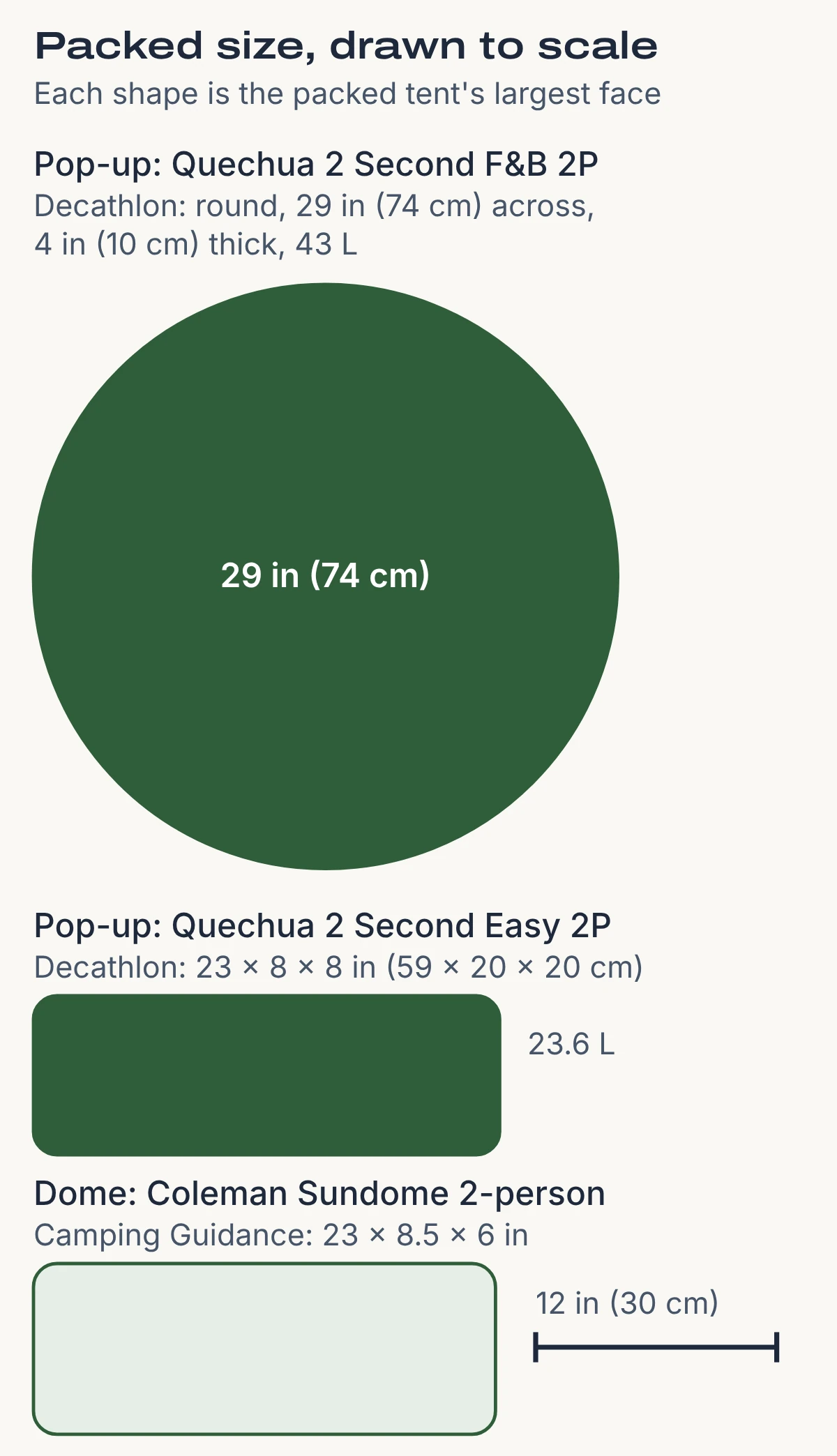
The diagram shows why the packed shape matters more than the volume. The classic throw-open pop-up packs as a disc 29 in (74 cm) across, because its hoops cannot come apart; Camping Guidance measured its own 2-person Fresh & Black at “27 x 27 x 6 in” against “23 x 8.5 x 6 in” for a 2-person Sundome. Decathlon’s Easy model folds into a long bag instead, so not every pop-up packs as a disc.
Wind and rain: where the sources disagree
Makers rate their own tents, and their tests differ, so a higher number from one maker does not prove a sturdier tent than a lower number from another.
- Decathlon says both pop-ups resist 31 mph (50 km/h), a figure “validated in a wind tunnel on a turntable” for the Fresh & Black and “validated in wind tunnels on rotating plate” for the Easy. It gives its Arpenaz 4.1 pole tent the same rating: it “Withstands force 6 winds”. Decathlon puts conditions on the 50 km/h figure: its product pages say it holds for a “properly pitched” tent “with all guy ropes fitted”, with the wind “measured near the ground”. By Decathlon’s own test, then, its pop-ups and its pole tent sit at the same level, guyed out.
- Coleman says the Sundome’s frame is “tested to withstand winds up to 35 mph”. The listing does not say how it was tested.
- Camping Guidance puts the gap wider: “Regular tents handle wind blowing at 30 to 50 mph. Pop up tents take a lot less, more like 20 to 30 mph.” That is the writer’s own estimate, not a lab test, and it sits below Decathlon’s figure for its pop-ups.
- CORE credits the dome shape itself: “The curved shape sheds wind naturally, making domes a strong choice for exposed campsites.”
In short, the only lab figures here are the makers’ own, and an independent writer rates pop-ups lower than Decathlon does. Read any wind rating as the maker’s claim for that one model.
Rain and condensation draw owner complaints more than test data. One r/CampingGear commenter wrote: “Pop up tents usually leak. Perhaps nice ones do not.” Another said “Popups have huge pack sizes” and blamed single-wall designs for condensation. Camping Guidance found its Quechua 2 Seconds stuffy with the door shut, noting “It has exactly 1 rear vent”, and a few drops of condensation on the roof by morning. Decathlon now lists “Double roof, mechanical ventilation” for the Fresh & Black 2P, so check the vents on the exact model you buy.
Packing down, durability and repairs
Folding is the part of a throw-open pop-up that owners find hardest. Decathlon builds a “Guided folding system” into the Fresh & Black 2P, and describes the Easy 2P’s system as “folding exclusive patented technology”. The sequence differs from model to model, so follow the folding instructions or video for your exact tent rather than a general method. Camping Guidance warns that the folded frame stays under tension (“The strap is the only thing holding all that tension in.”), and that with a 4-person Coleman pop-up, “standing it on one end to fold it down puts it well over my head”, so a large pop-up is a lot to handle alone.
Poles are the main durability difference:
- Pop-ups. Camping Guidance writes that “Pop up tents are always fiberglass, never metal” and that the hoops run through long sleeves, so “when a pop up pole does go, you’re mostly stuck.” Makers can soften that. Decathlon’s product pages say each part of the Fresh & Black 2P, poles included, can be bought from its stores and “replaced in our workshops” or by the owner, and that for the Easy 2P “pole repairs are available” from its workshops. It also sells a kit “to replace the half-structure on your Quechua 2-Second Easy 2-person tent”.
- Domes. “On a regular tent the poles are separate and a replacement drops straight in,” in Camping Guidance’s words. For a break on the trip, Advnture magazine says duct tape “can be used to do temporary tent repairs” on a broken pole or a punctured air beam.
Choose a pop-up if… choose a dome if…
Choose a pop-up tent if:
- You camp beside the car or at festivals, and want the shortest setup. A long-time backpacker on r/CampingGear who switched said “I have not found a pop-up light and small enough to carry”, but called it hard to beat for car camping and walk-in sites.
- Speed is what puts you off camping. Camping Guidance’s verdict: “If you want speed and user-friendliness, and you aren’t planning to camp in bad weather, a pop up tent will suit you perfectly.”
- Your trunk has room for a wide, flat disc, or you pick a long-bag model like Decathlon’s Easy range.
Choose a dome tent if:
- You carry the tent any distance. CORE says “Dome tents, on the other hand, feature a smaller, rounded shape, which is lighter weight,” and recommends them for backpacking and moving camp. Our roundup of 2-person backpacking tents compares eight backpacking tents built for that job, from freestanding pole tents to a trekking-pole shelter.
- You expect wind or rain on open ground. CORE calls domes “a strong choice for exposed campsites”, and Camping Guidance rates regular tents ahead of pop-ups in wind.
- You want a tent you can keep repairing, since a dome’s poles come out and are replaced one at a time (Camping Guidance).
Ready to buy?
Our festival tent roundup compares instant cabins, a Gazelle hub pop-up and Coleman’s Sundome domes side by side, with each maker’s setup and weight figures.
Related choices in brief
Pole tent vs frame tent. “Frame” is used loosely. CORE uses it for instant tents, whose collection it describes as “pre-attached poles and pop-up frames”; a pole tent is the traditional kind whose separate poles you assemble. CORE’s trade-off is the same as pop-up vs dome: setup “in minutes” against a pole tent that “packs down a bit smaller”.
Air-beam vs pole tents. Inflatable beams replace the poles. In one head-to-head test, Advnture magazine pitched Vango’s Osiris Air 500 against Vango’s Aether 450 XL pole tent and found “the beams can be fully inflated in about a minute” with the supplied pump. It scored the two a draw on stability, noting that its air tent relied on internal bracing straps in strong wind, that “not all air tents are equipped with bracing straps, which means they are more prone to bending in the wind”, and that “inflated tubes won’t snap”, though a beam can puncture. It also found the air versions “about 20% more expensive than the pole version of the same tent”, and found the air tent marginally harder to fit back in its bag.
3-season vs 4-season. MSR defines a 4-season tent by what it handles, not the calendar: it “is designed to withstand extreme weather, holding up to fierce winds and heavy snow loads”. Of 3-season tents, MSR says “Most can handle pounding rain and light dustings of snow, but the lightest weight models are not great for extended periods of harsh weather.” Hilleberg sorts its tents into labels instead, from Black (“Our strongest, most adaptable, most comfortable all season tents.”) to Yellow, which it suggests “if light weight is your highest priority and if you travel in the snow-free months and in protected terrain, or in warmer climates.” Coleman lists the Sundome as “3 Season”, and Decathlon calls its Easy 3-person pop-up a “3 season tent: from spring to fall”. For snow, see our winter tent roundup.
4 m vs 5 m bell tent. A bell tent is a round canvas tent on one center pole, sold by size in meters; choosing between a 4 m and a 5 m is a sizing question for a separate canvas tent sizing guide.
Choosing between a backpacking tent and a car-camping tent is a related question; our comparison of backpacking tents and camping tents covers weight, space and durability.
Frequently Asked Questions
Q. What are the downsides of a dome tent?
It takes longer to pitch than a pop-up: Camping Guidance timed a 2-person Sundome at 5.5 minutes, and Coleman quotes about 10 minutes for the 4-person. Its sloped walls also give less standing room than a cabin tent, which CORE recommends when headroom matters.
Q. What are the disadvantages of pop-up tents?
They pack large and awkward, their fiberglass hoops are hard to replace, and folding takes practice. Camping Guidance also rates them lower in wind than regular tents.
Q. What is the most comfortable camping tent?
For room to stand and move around, CORE points to cabin tents with straight walls and tall ceilings rather than domes or pop-ups. Size matters too: Hilleberg says “going up a size offers significantly more comfort with very little extra weight”.
Q. Can you take a pop-up tent backpacking?
Rarely. Decathlon’s 2-person pop-ups weigh 8.8 to 10.4 lb (4 to 4.7 kg), while the tents in our backpacking roundup weigh from 2 lb 1 oz packed (NEMO Hornet Elite OSMO 2P) to 6 lb 3 oz packaged (MSR Elixir 2).
Q. Are pop-up tents waterproof?
Good ones are rated like other tents: Decathlon lists the flysheet of its 2 Second Fresh & Black 2P at over “2000 mm” of water column. One r/CampingGear commenter wrote that pop-ups “usually leak. Perhaps nice ones do not,” so check the rating and seam taping on the exact model.
Q. Is a pup tent the same as a pop-up tent?
No. A pup tent is a small two-person tent, named after older designs made of two shelter halves buttoned together, and it is not defined by how it pitches. Our types of tents guide explains it alongside the other shapes.
Sources (14)
- Decathlon, Quechua 2 Second Fresh & Black Pop Up Camping Tent 2 Person
- Decathlon, Quechua 2 Second Easy Fresh & Black Pop Up Camping Tent 2 Person
- Decathlon, Quechua 2 Second Easy Fresh & Black Pop Up Camping Tent 3 Person
- Decathlon, Arpenaz 4.1 Fresh & Black Camping Tent 4-person
- Decathlon, Quechua 2-Second Easy 2 Person replacement half-structure kit
- Coleman, Sundome camping tent product description (Coleman’s listing on Amazon, 4-person size)
- CORE Equipment, Best Tent Styles for Camping: A Side-by-Side Comparison
- CORE Equipment, Cabin Tent vs Dome Tent
- CORE Equipment, Instant Tents
- MSR (Cascade Designs), What are some of the differences between three and four season tents?
- Hilleberg, The Hilleberg Label System
- Advnture, Air tents vs pole tents
- Camping Guidance (camping blog), Pop Up Tents vs. Regular Tents
- r/CampingGear (forum thread), Traditional vs Pop-up tents
