The short answer
Medium heavy (MH) is a power rating. It tells you how stiff the rod is and, through the maker’s printed line and lure range, how much weight it is built for. It sits between medium and heavy. The numbers differ by maker: St. Croix’s Premier spinning MH rods list 8 to 14 lb line and 3/8 to 3/4 oz lures.
“Medium heavy” is easy to misread. It is often confused with action, the separate rating for how the rod bends. And because each maker sets its own line and lure range, one brand’s MH is not guaranteed to match another’s. Below: where MH falls between medium and heavy on real makers’ charts, and how to check an MH rod against the lures you throw.
Power is stiffness, and the maker prints the range
Power describes how much force it takes to bend the rod. FishUSA, a tackle retailer, defines rod power as “how much force it takes to bend the rod into a load.” The Kentucky Department of Fish and Wildlife Resources puts it in terms you can read off the blank: “The power rating is simply the manufacturer’s recommended line and lure weight.” That is why a rod’s label lists a power word next to a line range and a lure range.
On a label like MH/F, the first letters are power and the last is action. FishUSA’s label guide reads it this way: “Power (MH): The overall stiffness.” and “Action (F): Where and how quickly the rod bends.” So MH/F is medium heavy power, fast action.
Power and action are different ratings
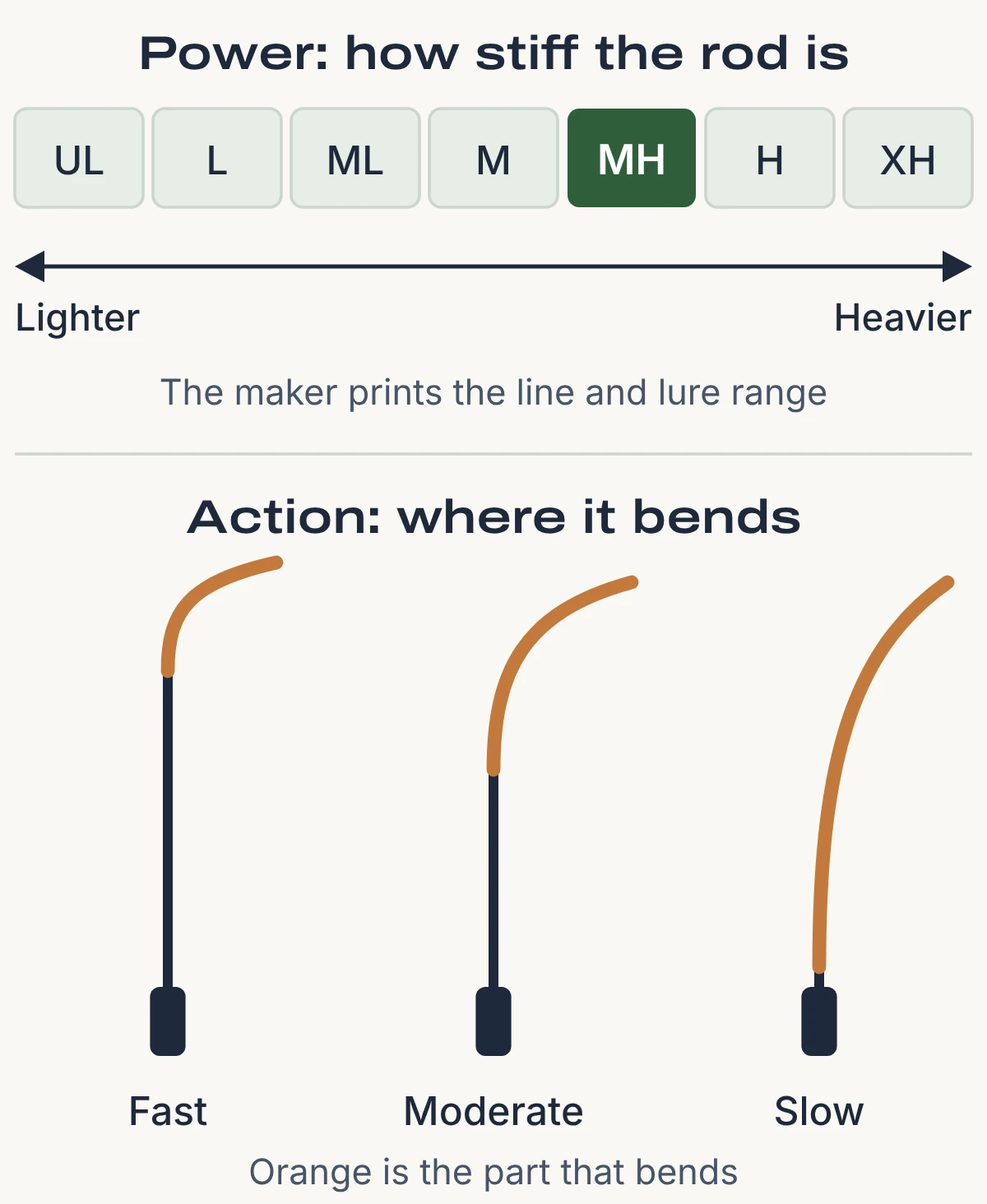
Action is where the rod bends. The Kentucky agency’s column says “What defines a rod’s action is where it bends the most,” and Bass Pro Shops’ help page sorts action into fast (only the tip section bends), medium (about half the rod’s length) and slow (nearly the whole length). Makers print that middle category as “moderate”: St. Croix’s model lists say MODERATE, and so does the Kentucky column’s list. Power says nothing about where the rod bends.
The two ratings are independent, which is why two MH rods can feel different. FishUSA says “Two rods can share the same Medium-Heavy power rating and feel completely different based on action alone.” The Kentucky column warns about everyday speech. The column says you may hear an angler say “I like a medium action rod,” “but there really is no such thing.” In its words, “What they’re likely describing is a medium power rod with a fast action.”
Wired2Fish, a fishing publication, notes that a fast action “often pairs nicely with a Medium Heavy power.” It also says an 8-foot medium or medium-heavy rod with a moderate action “will be a great deep diving crankbait rod.” Same power, different job, depending on action and length.
What medium heavy is built to handle
The table below shows how St. Croix, a rod maker, rates four powers on its Premier spinning rods. Line and lure columns are St. Croix’s printed ratings for the 24 Premier spinning models of these four powers (37 spinning models in all); every model of a given power below carries the same pair of ranges. The lure column is Wired2Fish’s chart of what each power fishes, written for bass and multispecies rods.
| Power | Line (lb) | Lure (oz) | Lures Wired2Fish lists |
|---|---|---|---|
| Medium light | 4-10 | 1/8-1/2 | Shaky heads, drop shots, small crankbaits, small topwaters, jerkbaits |
| Medium | 6-12 | 1/4-5/8 | Jerkbaits, crankbaits, spinnerbaits, chatter baits |
| Medium heavy | 8-14 | 3/8-3/4 | Spinnerbaits, jigs, worms, small swimbaits, spoons, buzz baits, deep diving crankbaits |
| Heavy | 10-20 | 1/2-1 1/2 | Flipping and pitching, frogging, swimbaits, umbrella rigs |
Each step up raises both the line range and the lure range. That is the plain meaning of medium heavy: more backbone than a medium, short of a heavy.
For fish, Wired2Fish’s chart lists bass and catfish for medium heavy, and the Kentucky column says “A medium-heavy power baitcaster is what you need to fish larger and heavier lures for largemouth bass.” The same column says a heavy rod “is the choice for striped bass, blue or flathead catfish or muskellunge.” These are starting points from two sources, not limits.
Spinning versus baitcasting matters at this weight. The Kentucky agency’s rule of thumb is that “any situation that requires 10-pound test line or lighter and 3/8-ounce or lighter lures should be cast on spinning gear.” The same column adds “Lures weighing ½-ounce or more should be thrown on baitcasting gear.” Premier’s MH range of 3/8 to 3/4 oz straddles those two points. If you mostly throw heavier lures, our roundup of baitcasting rods for bass covers that side. For lure families, see our guide to types of fishing lures.
Related guide: How Does a Fishing Reel Work? Spinning, Baitcasting and Spincast Explained
Note
Rod length does not change the power word. On St. Croix’s Mojo Inshore spinning list, the 6’6″, 7′ and 7’6″ fast-action medium heavy rods all carry 10-20 lb line and 1/2-1 1/4 oz lure ratings. Length changes how the rod casts and where it fits: FishUSA says “Longer rods cast farther, control line at distance, and give more sweeping leverage.”
Medium heavy versus medium and heavy
Ranges overlap, and makers draw the lines in different places. The table compares three spinning rod lines from two makers, using each maker’s own page.
| Maker and line | Medium | Medium heavy | Heavy |
|---|---|---|---|
| St. Croix Premier spinning | 6-12 lb, 1/4-5/8 oz | 8-14 lb, 3/8-3/4 oz | 10-20 lb, 1/2-1 1/2 oz |
| St. Croix Mojo Inshore spinning (fast action) | 8-17 lb, 3/8-3/4 oz | 10-20 lb, 1/2-1 1/4 oz | 12-25 lb, 3/4-2 oz |
| Ugly Stik GX2 spinning | 6-15 lb, 1/8-5/8 oz | 8-20 lb, 1/4-3/4 oz | 8-20 lb; 3/8-1 oz on the 6 ft model, 1/4-3/4 oz on the 4 ft 9 in model |
Exceptions to the table, all from the same maker pages: Mojo Inshore’s 7 ft moderate-action medium rod is rated 1/4-5/8 oz, its 7 ft moderate-action medium heavy is 1/2-1 oz, its 7’11” medium heavy is 14-30 lb and 1/2-2 oz, and its 7’11” heavy is 17-40 lb and 3/4-3 oz. Ugly Stik’s 9 ft GX2 medium is 4-20 lb and 1/8-3/4 oz.
Within one maker’s line, the pattern holds: medium heavy is the step above medium. Across makers it does not. Mojo Inshore’s medium lists the same 3/8-3/4 oz lure range as Premier’s medium heavy, and Ugly Stik’s medium heavy carries the same 8-20 lb line range as its 6 ft heavy. A forum owner on Reddit’s r/Fishing_Gear put it the same way: “depending on the brand a MH could be a M for a different brand.” FishUSA’s advice is to “Use the lure weight rating as your consistent reference.”
Choosing between medium and medium heavy
Within one maker’s line the two overlap. Worked out from the Premier numbers above, a 1/2 oz lure fits both a medium (1/4-5/8 oz) and a medium heavy (3/8-3/4 oz); the shared range is 3/8 to 5/8 oz. In that zone, use these sourced guides:
- Pick by where your usual lure falls. FishUSA: “When you straddle two ranges, pick the one where your main bait lands near the middle.”
- Large hooks push toward more power. Wired2Fish says “the heavier the rod, the easier it will be to set a good hook even with large hooks.”
- Light lures push toward less. Wired2Fish also says “Generally speaking the heavier the power of the rod, the harder it will be to cast,” with the exception of very heavy lures, and that “The lighter the rod, the better it will cast lighter lures.”
At the top end, the Kentucky column says a heavy rod “is designed for large fish and may throw lures up to 2 ounces.”
Quick check
Find the printed line and lure ranges on the blank. Your usual lure should land near the middle of the lure range, and your line should fall inside the line range. FishUSA warns that overloading a rod “collapses the tip and can snap the rod.”
Which medium heavy rod to look at
If your lures are mid-weight jigs, spinnerbaits or soft plastics and you want a spinning outfit, read the printed ratings on each rod before the price. The power word is only a label.
Ready to buy?
Our roundup of spinning rods under $100 compares eight rods. Check each one’s printed power, line range and lure range against the tables above.
Pair the rod with a reel that suits its line range; our spinning reel size guide shows how to match them.
Frequently Asked Questions
Q. What fish is a medium-heavy rod good for?
Wired2Fish’s chart lists bass and catfish for medium heavy, and the Kentucky agency’s column points to largemouth bass with larger, heavier lures. Makers also build MH rods for inshore saltwater, such as St. Croix’s Mojo Inshore line. Check the lure and line ratings for the fish and lure you have in mind.
Q. What does medium heavy fast action mean?
Medium heavy is the power: stiffness and the line and lure range. Fast is the action: where the rod bends, mostly toward the tip. They are two ratings on the same label.
Q. Should I get a medium, medium heavy or heavy rod?
Match the rod’s printed lure range to the lure you throw most. Medium heavy suits mid-weight lures; medium suits lighter ones; heavy is for large fish and heavier lures, per the Kentucky agency and Wired2Fish.
Q. What is a 7 ft medium heavy rod good for?
In the lines compared above, the 6’6″ and 7′ fast-action MH rods carry the same ranges; some longer or moderate-action models differ (see the exceptions under the table), so read the label. By use, Wired2Fish lists spinnerbaits, jigs, worms and spoons for medium heavy, and the Kentucky column points to larger, heavier lures for largemouth bass. The extra length helps with casting distance and line control, per FishUSA.
Q. Is medium heavy the same on every brand?
No. St. Croix’s Premier spinning MH is rated 8-14 lb and its Mojo Inshore MH 10-20 lb; Ugly Stik’s GX2 MH is 8-20 lb. Even one maker’s lines differ, so compare the printed ranges, not the power word.
Q. Is a medium-heavy spinning rod too heavy for light lures?
It can be. FishUSA says underloaded blanks “won’t catapult light lures.” If your lures are mostly under the rod’s lower lure rating, look one power lower.
Sources (8)
- St. Croix, Premier spinning rod model list (maker)
- St. Croix, Mojo Inshore model list (maker)
- Ugly Stik, GX2 spinning rod models (maker)
- Kentucky Department of Fish and Wildlife Resources, Kentucky Afield Outdoors: Power vs Action (agency)
- Wired2Fish, Fishing Rods Explained: Action, Power and More (publication)
- Bass Pro Shops, What Does the Action of a Fishing Rod Mean? (retailer help page)
- FishUSA, Fishing Rod Power vs Action (retailer guide)
- r/Fishing_Gear, difference between a medium heavy and a medium rod (forum)