The short answer
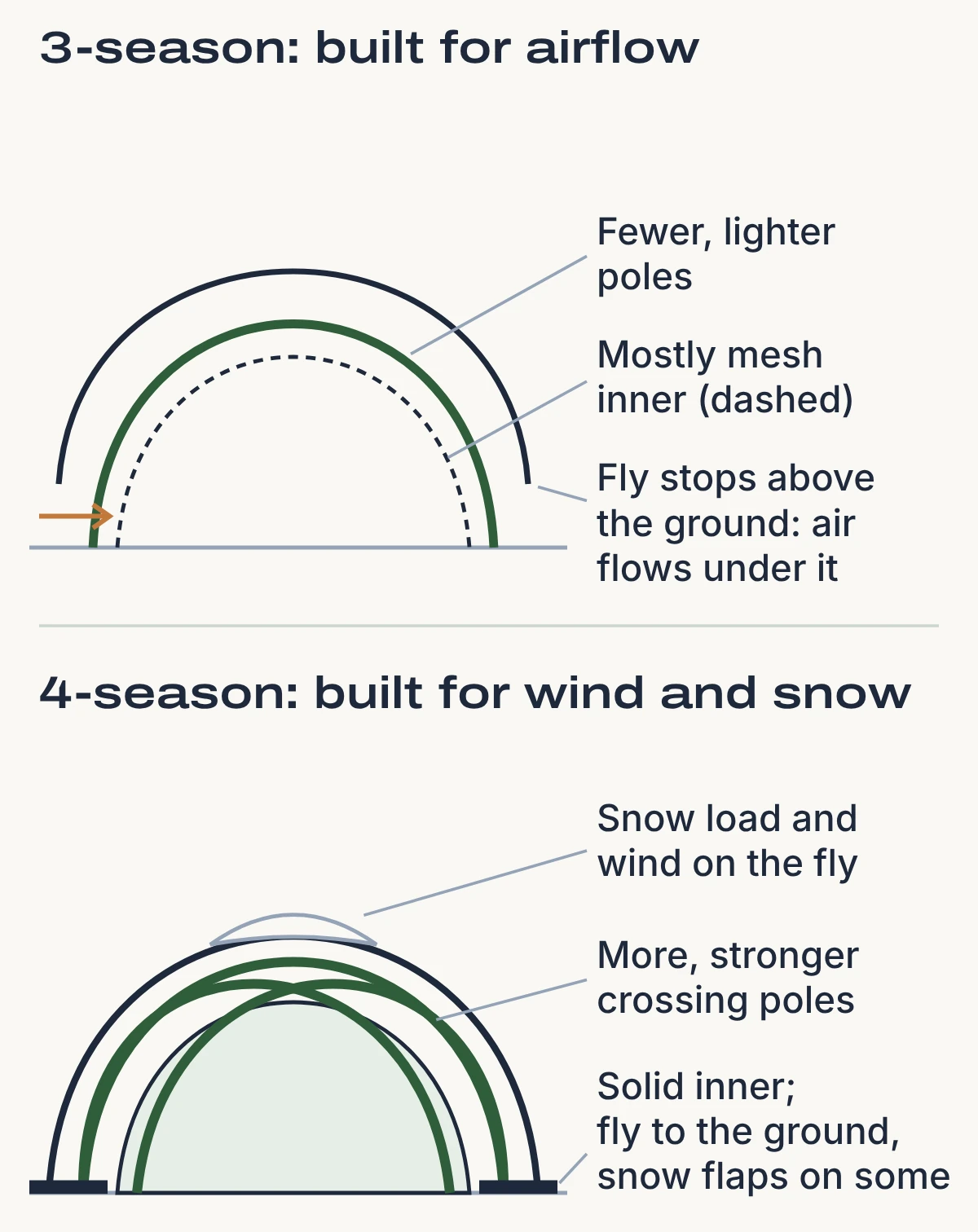
A 3-season tent is built light and airy for spring, summer and fall: lots of mesh, fewer and lighter poles, and a fly that often stops short of the ground. A 4-season tent is built for strong wind and heavy snow, with stronger poles, solid walls and a fly closer to the ground. Choose by conditions, not the calendar.
The names suggest a calendar, but MSR, which makes both kinds, says “it’s not the season but rather the environment that dictates your choice of tent.” Its own examples are a winter of backpacking in the Southwest and a summer camped on a remote Alaskan glacier: the label and the month do not have to match.
So the useful question is what the tent has to survive: rain and bugs, or wind and snow piling on the roof.
The differences side by side
| Attribute | Typical 3-season | Typical 4-season |
|---|---|---|
| Main job | Light weight and airflow | Wind and snow loads |
| Poles | Fewer, lighter | More or stronger, often crossing |
| Inner walls | Mostly mesh | Mostly solid fabric |
| Fly | Often stops above the ground | Closer to the ground; snow flaps on some |
| Snow | Light dustings | Substantial snow loads |
| Ventilation | High; mesh does the work | Lower; depends on vents you open |
| Weight | Lighter | Heavier for the same size |
MSR’s comparison describes 3-season tents as “often built of lighter fabrics” with “more mesh for breathability and airflow”, and 4-season tents with “rigid shapes and pole geometries that allow them to bear substantial snow loads and powerful winds.” MSR also says 4-season tents “greatly reduce or eliminate mesh on the tent body” and that “The addition of snow flaps around the tent’s perimeter on some models prevents snow and cold air from blowing inside.”
Switchback Travel, an outdoor gear publication, gives the reason for the weight gap: “Four-season tents weigh more than their 3-season counterparts due to heavier and more durable fabrics, stronger poles, and beefier zippers.” For two-person 4-season tents it says that “Even if you look at the trail weight instead of the packaged weight (which doesn’t factor in stuff sacks, stakes, or guylines), you’ll still be close to 9 pounds for a number of tents on this list for the two-person version”. Trail weight leaves out stakes and stuff sacks, so the like-for-like gap is, if anything, a little larger. The lightest tent on its list is a minimalist single-wall tent at a packaged weight of 2 lb 11.2 oz, and a few lighter treeline and bivy-style tents come in around 4 lb, such as the two-person MSR Access 2 at a trail weight of 4 lb 1 oz and the SlingFin HotBox at a packaged weight of 4 lb 2 oz. For comparison, the two-person 3-season tents in our two-person backpacking tent roundup run from 2 lb 1 oz to 6 lb 3 oz by each maker’s packaged weight. If you are also weighing a backpacking tent against a larger car-camping tent, that trade is covered in our backpacking tent vs camping tent comparison.
What “3-season” means, and the 2-season and 3-4 season labels
A 3-season tent is the ordinary backpacking tent. MSR calls it “A 3-season (or backpacking) tent” and says it “is designed for lightweight performance and breathability.” It keeps out rain, bugs and wind on spring, summer and fall trips, and MSR notes that “most typical outdoor adventures call for a 3-season tent.” Hilleberg, a Swedish tentmaker, uses colored labels instead of season numbers; the closest it has to a 3-season tent is its Yellow Label, its lightest tents, “engineered for warmer climates and for the snow free months of the year.”
Its limit is snow and sustained storms. In MSR’s words, “Most can handle pounding rain and light dustings of snow, but the lightest-weight models are not great for extended periods of harsh weather.”
2-season tents. The label is less common in the US. One answer on the Outdoors Stack Exchange forum says a 2-season tent “will likely only be designed for camping in relatively good weather in the sunnier parts of the year”: it copes with mild rain and wind, but heavy weather can push it past its design.
3-4 season (or “3.5-season”) tents. Some tents sit in between. NEMO sells its Kunai as a “3–4 Season Backpacking Tent”, and Switchback Travel calls this group “treeline” tents: “Compared to a 3-season version, a treeline tent will have a more substantial bathtub floor, less mesh, and heavier canopy and rainfly fabrics.” They suit shoulder seasons and sheltered winter camps, not exposed mountain storms.
What makes a tent 4-season, and is it the same as a winter tent?
MSR’s definition is short: “a 4-season (or winter) tent is designed to withstand extreme weather, holding up to fierce winds and heavy snow loads.” Its page then lists rigid pole geometry, more durable fabrics and reduced mesh, and adds that “4-season tents are generally a bit roomier than a typical backpacking tent”, to fit bulky winter gear.
Daniel Weadley, a UK hillwalker and scrambler who writes as the Bald Scrambler, lists what to look for: “Most 4-season tents are dome-shaped or at the least, have poles that cross over each other”, and “Most winter tents will have more numerous poles as well.” He also wants the fly down: “The outer flysheet should touch the ground to stop snow from blowing into the vestibule areas.”
Winter tent vs 4-season tent. MSR uses the two names for the same thing. Hilleberg puts it differently: its Black Label tents are “all season” tents, “Ideal for any trip, anywhere, in any weather condition and in any season”, so a 4-season tent in that sense is also a summer tent. MSR and Switchback Travel both use 4-season for tents built for winter conditions, and that is the sense used here.
Not every 4-season tent is equal. Switchback Travel splits the category into mountaineering, basecamp and treeline tents. MSR’s lighter Access tents for ski touring, for example, save weight by “forgoing the hoop vestibule and snow flaps”. You may also see “5-season” on expedition tents; one answer on the same forum thread, which calls itself not authoritative, reads it as tents “specifically designed for the harshness of Arctic-like climates”.
No standard temperature rating for tents
No maker cited here (MSR, Hilleberg, NEMO) gives either category a temperature; they describe wind, snow and terrain instead. The temperature ranges some retailers publish for 3-season tents are rules of thumb, not ratings.
The reason is that a tent barely insulates. SectionHiker, a backpacking publication, puts it plainly: “thin tent walls don’t impart any insulation value beyond your clothing or sleep system.” Appalachian Outfitters, a gear retailer, makes the same point: “A 4 season tent cannot compensate for an inadequate sleeping bag or sleeping pad.”
A 4-season tent does feel warmer. Switchback Travel says “By nature, 4-season tents are warmer than 3-season tents: They have less mesh, are designed to protect you from the elements, and therefore hold in more heat.” That warmth comes from blocking wind, not from insulation, so how cold you can camp depends on your sleeping bag, pad and clothing. For what to add to the floor and walls, see our guide on how to insulate a tent for winter.
Can you use a 3-season tent in winter?
Often, with limits. SectionHiker says “Many three-season tents can be used for winter camping or backpacking if you set them up below treeline”, with strong poles and enough sleeping insulation. Its conditions:
- Pole material. Aluminum poles or carbon fiber poles, not fiberglass: “fiberglass tent poles tend to shatter in cold temperatures when stressed.”
- Snow load. SectionHiker’s conservative figure for a moderate snow load is about 3 inches (8 cm) of overnight snow, less if the snow is wet.
- The fly gap. “the rain fly or walls of most three-season tents, especially those of ultralight tents, seldom go all the way to the ground”, which lets cold wind in. SectionHiker’s fix is a low wall of snow around the base.
- Anchors. “When the ground is frozen solid or covered with a deep layer of snow, you can’t rely on regular tent stakes, conventional guyline tensioners, and guylines to stake your tent down”. SectionHiker uses snow stakes or a deadman: a stick or a snow-filled bag tied to the guyline and buried in the snow.
- Sleeping pad. SectionHiker says “We recommend a sleeping pad with an R-value of 5 or more.”
- Condensation. SectionHiker advises keeping the door partly unzipped, especially toward the ceiling, to stop frost forming on the walls.
MSR draws the line where a 3-season tent stops being the right tool: “If you’re looking to camp on snow or in sub-freezing areas with the potential for strong winds, choose a 4-season tent.” If your winter plans include exposed snow camps, our winter tent roundup compares tents built for that.
Are 4-season tents good in summer?
Mostly not. Weadley writes that “4-season tents can be overly cumbersome and some lack suitable ventilation, which is crucial in the summer.” You also carry the extra weight on every trip.
Condensation is the daily cost of less mesh. Switchback Travel notes that “even the best 4-season tents are prone to condensation”, and MSR says 4-season protection “must be balanced with strategic ventilation options to manage moisture and prevent condensation build-up.” NEMO’s advice for any of its tents is to “Create a passive “high-low” airflow system where cool air enters from ground-level vents and hot air is expelled through roof-level openings.” Big Agnes is blunter: “Ventilation is KEY.”
The exceptions are tents built to swing both ways, like Hilleberg’s all-season models or NEMO’s Kunai with zip-open mesh panels.
Hot tent vs 4-season tent
These solve different problems. Seek Outside, which makes hot tents and stoves, says “In its simplest form, a hot tent is a tent with a heat source.” It lists the common kinds as canvas wall tents with a wood stove, lightweight floorless tents with a wood stove, and canvas tents with a propane heater. A wood-stove tent has a stove jack: a heat-resistant port the stovepipe passes through. Seek Outside says of its own: “Our hot tents are floorless for several reasons.” A 4-season backpacking tent is a floored shelter built to keep out wind and snow, and unless its maker built it with a stove jack, it takes no stove.
A stove only goes in a tent built for one. hot-tent.com, which sells hot tents and its own wood stoves, says “The tent must have a designated heat-resistant stove jack and enough room for the stove, required clearance, sleeping equipment, and an unobstructed exit.” It adds: “Not every camping tent is stove-compatible. Never cut an improvised opening in ordinary tent fabric.” A 3-season or 4-season tent without a maker-fitted stove jack is not a stove tent. Eureka’s tent instructions carry the standard warning: “keep all flame and heat sources away from this tent fabric.”
Safety
Carbon monoxide is the risk with any fuel-burning heater or stove in a tent. The CPSC says “People die every year from carbon monoxide poisoning from the use of portable camping heaters, lanterns, or stoves inside tents, campers, and vehicles.” Its rule: “Never use fuel-burning portable heaters or lanterns while sleeping in enclosed areas such as tents, campers and vehicles.” On the same page it adds: “This is especially important at high altitudes, where the risk of carbon monoxide poisoning is increased.” The CDC says “Never use a portable gas camp stove indoors” and warns “People who are sleeping, drunk, or under the influence of other substances can die from CO poisoning before they have symptoms.” The CPSC lists the symptoms as “headache, dizziness, weakness, nausea, vomiting, sleepiness, and confusion.” Its CO Information Center says “If you suspect CO poisoning, get outside to fresh air immediately, and then call 911.” Its camping page adds: “See a doctor if you or a member of your family develops cold or flu-like symptoms while camping. Carbon monoxide poisoning, which can easily be mistaken for a cold or flu, is often detected too late.”
Even in a stove-ready hot tent, the stove is not the overnight heat. hot-tent.com’s checklist says “Never leave the stove unattended and do not sleep while a portable fuel-burning heater is operating”, and to “Use a sleeping bag and insulated pad appropriate for the overnight low so safety does not depend on keeping the stove running while people sleep.” For use while you are awake, the same checklist says to “Test the smoke and carbon monoxide alarms” and to “Maintain continuous airflow; never seal the tent to retain heat.” Follow your stove and tent makers’ instructions, and see the section on running a wood stove in a tent in our hot tent roundup. A hot tent is for warm evenings in a camp built around a stove; a 4-season tent is a shelter that stands up to wind and snow. For the canvas and hot tent styles, see our guide to tent types.
Choose a 3-season tent if… or a 4-season tent if…
Most people need a 3-season tent. MSR, which sells both, says most typical trips call for one. Buy a 4-season tent when your trips actually include the conditions it is built for.
Choose a 3-season tent if:
- you camp from spring to fall, below treeline;
- you might meet rain, wind and an occasional light dusting of snow, but not heavy snowfall;
- you carry the tent on your back and want the lightest load;
- you camp in heat or humidity, where mesh and airflow matter most.
Choose a 4-season tent if:
- you will camp on snow or in sub-freezing places where strong wind is possible (MSR’s own line);
- you camp above treeline or in exposed terrain in winter;
- you expect heavy or overnight snowfall that would load the roof;
- you will wait out storms in the tent for long stretches.
Consider a 3-4 season tent if you want one tent for shoulder seasons and sheltered winter camps and accept a bit more weight than a 3-season model.
Ready to buy?
For most two-person trips, start with our two-person backpacking tent roundup, which compares 3-season tents by weight, space and weather protection.
Frequently Asked Questions
Q. Do I really need a 4 season tent?
Only if you will camp on snow, above treeline in winter, or where strong wind and heavy snow are likely. For spring-to-fall trips, MSR says a 3-season tent is the usual choice.
Q. Is a 4 season tent warmer than a 3 season tent?
A little, because less mesh lets less wind through, but the walls add almost no insulation. Your sleeping bag, pad and clothing decide how cold you can go.
Q. How much heavier is a 4 season tent?
Often by a few pounds for the same capacity. Switchback Travel says a number of the two-person 4-season tents on its list are still close to 9 lb even by trail weight, while the two-person 3-season tents in our backpacking tent roundup run 2 lb 1 oz to 6 lb 3 oz packaged. Lighter treeline, bivy-style and single-wall 4-season tents are the exceptions, from under 3 lb to about 4 lb.
Q. What is a 5 season tent?
An informal label some brands use for expedition tents meant for polar (Arctic-like) storms. It is not a standard rating.
Q. Can a 3 season tent handle snow?
Light dustings, yes. SectionHiker treats about 3 inches (8 cm) of overnight snow as a conservative moderate load for a tent with aluminum or carbon poles, and less if the snow is wet.
Sources (17)
- MSR, 3-Season vs. 4-Season Tent: Which is Right for You?
- MSR, How to Choose a Winter Tent
- Hilleberg, The Hilleberg Label System
- NEMO, Kunai 3-4 Season Backpacking Tent
- NEMO, Minimizing and Preventing Condensation in Your NEMO Tent
- Big Agnes, Tips: Tents
- Switchback Travel, Best 4-Season Tents
- SectionHiker, Can You Use a 3 Season Tent in Winter?
- The Bald Scrambler (Daniel Weadley), The Difference Between 3-Season & 4-Season Tents
- Appalachian Outfitters (retailer blog), 3 Season vs 4 Season Tent
- CPSC, Portable Heaters & Camping Equipment
- CPSC, Carbon Monoxide Information Center
- CDC, Carbon Monoxide Poisoning Basics
- hot-tent.com, Wood-Burning Tent Stove Safety Checklist
- Seek Outside, What Is A Hot Tent?
- Eureka, Timberline SQ 4XT tent instructions (PDF)
- Outdoors Stack Exchange (forum), What’s the difference between a 2, 3, 4 and 5 season tent?
