The short answer
Size a fly rod by the fish and the flies you will cast most. Named makers and guides put trout on 2- to 6-weights (a 9-foot 5-weight is the all-round pick), bass on 6 to 8, steelhead and salmon on 7 to 10, bonefish on 8 or 9, and tarpon and musky on 8 to 12.
A fly rod’s size is two numbers: its length and its weight. The weight matters most, and it is the one people get wrong, because it has nothing to do with how heavy the rod is.
Related guide: Stout Waders Size Chart: What Stout Means, Brand by Brand
Related guide: What Size Trolling Motor Do I Need? Thrust, Shaft Length and Battery by Boat
The chart below gives a range for each fish, not a single number, because makers, guides and magazines do not agree. Each row names who recommends what, so you can see where they line up and where they split.
How to read a fly rod size
A rod labelled “9′ 5wt” is 9 feet long and built for a 5-weight fly line. Orvis, a fly-fishing maker and retailer, says “The first number is the length, the second number is the line size,” and that “A 5-weight rod is designed to cast a 5-weight line.” Lamson, a fly reel and rod maker, says the weight number “tells you the fly line weight it’s designed to cast. You’ll usually find it printed near the handle along with the rod length.”
Related guide: How to Use a Fly Rod: How It Works, and How to Fish It
Two things follow from that:
- The weight is not a fish limit. Field & Stream says “Line weight is a name, not a breaking strength,” and that “A 2-weight line will not break if you catch a fish over two pounds.”
- Higher numbers mean heavier lines for bigger, heavier flies. Field & Stream’s rough bands: “Generally, rod weights from 1 to 5 are considered trout rods, 5 and 6 are bass rods, and 7 through 10 are for bigger fish like steelhead, salmon, and saltwater fish.”
Fly rod size chart by fish
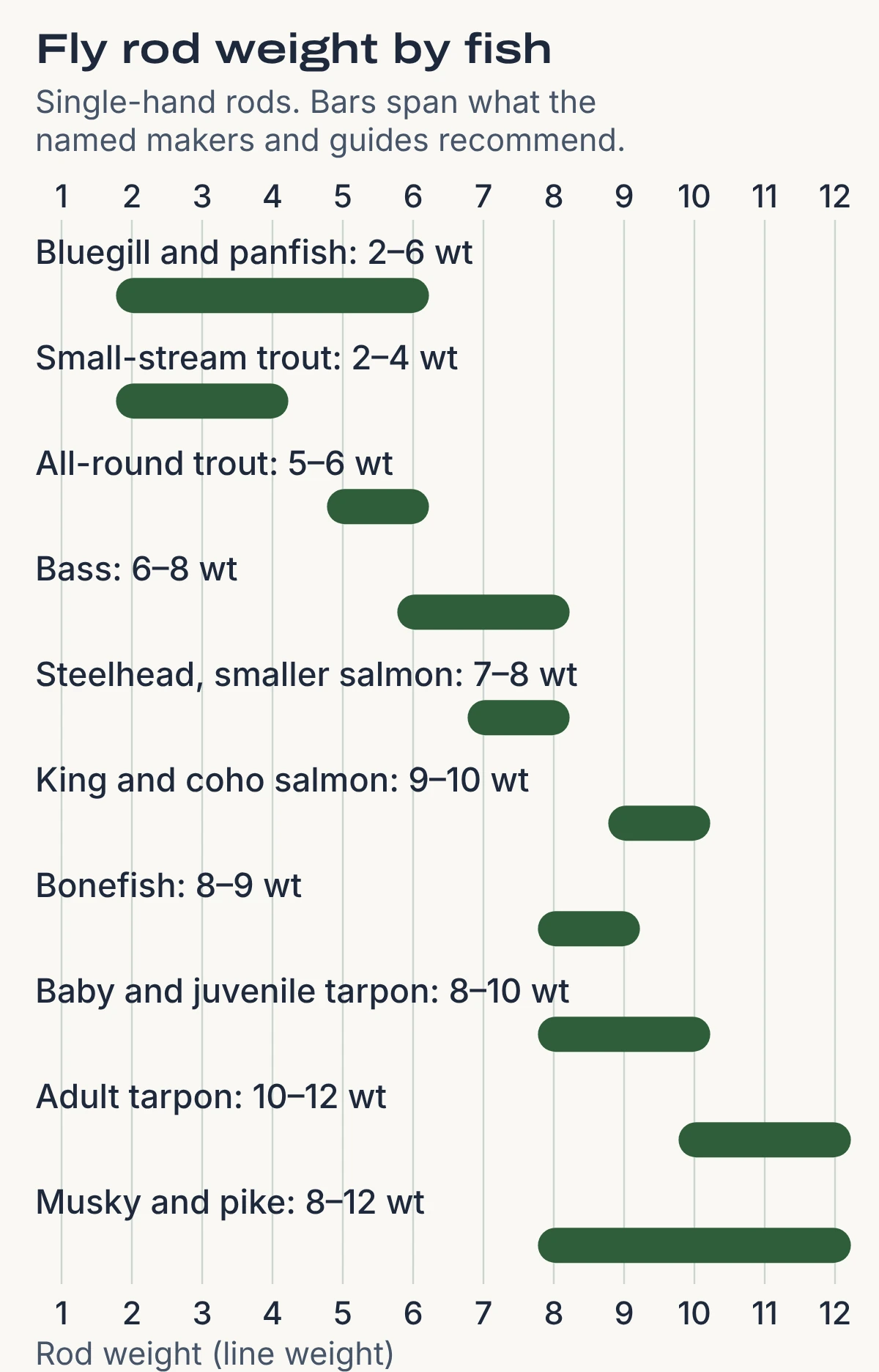
The basis of this chart is a set of named maker, magazine and guide charts, not one maker’s chart. Lamson says “many rods overlap categories depending on action and length,” and the table shows where sources differ.
| Fish and water | Rod weight | Who recommends what |
|---|---|---|
| Bluegill and other panfish | 2 to 6 | The Fisherman (a fishing magazine): 4, 5 or 6, and some anglers like 2 or 3. Wired2fish: 3 or 4 is ideal, a 5 works. |
| Trout, small streams | 2 to 4 | Orvis: 3 or 4 for small native trout in high mountain streams. Field & Stream: 2 or 3. San Juan Rodworks (a rod maker): a 3. |
| Trout, all-round rivers | 5 to 6 | Orvis, Lamson, Field & Stream and San Juan Rodworks: 5. Field & Stream: a 6 if big trout are present. |
| Bass | 6 to 8 | Field & Stream: 6. Lamson: 6 or 7. San Juan Rodworks: 7 or 8 on lakes. Orvis: 8 for largemouth and smallmouth, 6 or 7 for smallmouth alone. |
| Steelhead and smaller salmon | 7 to 8 | Orvis: 7 or 8 for smaller Atlantic salmon, a 7 for Great Lakes steelhead, “anything smaller than a 7-weight is probably too small” for Alaska salmon. Field & Stream and Lamson: 8. |
| King (Chinook) and coho salmon | 9 to 10 | Orvis: “a 9 or even a 10 weight.” Wooly Bugged (a fly-fishing blog, New York’s Salmon River): 9 or 10. |
| Bonefish | 8 to 9 | Orvis and Lamson: 8. Orvis (for windy flats) and San Juan Rodworks: 8 or 9. |
| Baby and juvenile tarpon | 8 to 10 | Fishwest (a fly shop): 8 for 5 to 15 lb, 10 for 15 to 60 lb. Orvis: 9 or 10 for small tarpon. |
| Adult tarpon | 10 to 12 | Orvis: 12. Fishwest: 12 for 60 to 140 lb. Trident Fly Fishing (a fly shop): 10, 11 or 12. |
| Musky and pike | 8 to 12 | Orvis: 8 to 10, with 9 the most popular. Epic Waters Angling (a lodge): 9 for small flies, 10 minimum for bigger ones. Hatch Magazine reviewer Tom Hazelton: 10 to 12, with 11 for big flies. Lamson: 9 to 12. |
Where the sources split, the reason is usually the fly, not the fish:
- Bass. Orvis puts largemouth on “probably an eight weight” because of big, air-resistant bugs, while Field & Stream names a 6 as the best bass weight. Orvis adds that it is “not really determined by the size of the fish. It’s more the size of fly.”
- Steelhead. Lamson lists “light steelhead” with its 6- and 7-weights (the 6 sits below this chart’s range), while Orvis calls anything under a 7 “probably too small” for Alaska salmon and large rainbows. Field & Stream says an 8 “will not be too much for smaller steelhead and salmon, and might be just barely enough for bigger ones.”
- Tarpon. Trident Fly Fishing quotes Florida Keys guide Capt. Eric Wallace: “The 11 has become the rod of choice in the keys.” Orvis and Fishwest still name a 12 for adult fish.
- Musky. Hatch Magazine reviewer Tom Hazelton says of his 10- to 14-inch flies, “It really takes an 11-weight rod to cast these,” while Epic Waters says that for flies 6 inches and smaller “a 9wt will do just fine.”
Note
This chart is for single-hand rods. Two-handed spey rods for salmon and steelhead are rated differently: Field & Stream says they come “in line weights that would be closer to 12 if the rod were meant for single-hand use.”
Fly rod length by water
Length depends on where you stand and how much room you have to cast, more than on the fish. Orvis’s Learning Center sums it up: “If you remember nothing else, remember 9-footer,” because “9-foot is typically the standard trout rod, 9-foot is typically the standard saltwater rod.”
| Where you fish | Length | Source |
|---|---|---|
| Tight, brushy creeks | 7 ft or shorter | Orvis |
| Small mountain trout streams | 7½ to 8½ ft | Orvis; San Juan Rodworks (7½ to 8 ft) |
| Medium streams, 40 to 50 ft wide | 8½ ft | Orvis |
| Most trout rivers, bass water and saltwater flats | 9 ft | Orvis; Field & Stream (bass: at least 9 ft) |
| Big rivers, lakes from a boat or float tube, steelhead and salmon | 9½ to 10 ft | Orvis; Thomas & Thomas (9 ft 6 in or 10 ft for salmon and steelhead) |
Orvis says “The only time you want to go to a 7-foot rod and below is when you have a really tight, brushy stream,” and that “Even really small, tiny mountain trout streams I think are best fished with a 7-and-a-half to an 8-and-a-half-foot rod.” Rods of 11 feet and longer are mostly two-handed switch and spey rods, which this guide does not size.
Two fit points depend on the angler, not the water:
- Children. Orvis warns that “a 5- and a 6-foot fly rod is a very difficult thing to cast” and advises “Put an adult rod in their hands”: casting is easier with an 8- to 9-foot rod.
- Deep wading. Thomas & Thomas, a rod maker, notes that wading deeper lowers your line. A 7-foot rod may work knee deep, but waist deep “It takes a nine foot rod to make up the difference.” A longer rod does not make deep wading safe. The National Park Service’s fishing safety list says “Be aware of unseen water hazards – use caution when walking or wading in the water,” “Assess swift water before entering or crossing,” “Check the water temperature; get out of the water if you get cold,” and “Always wear your U.S. Coast Guard approved life jacket when you are on, in, or near the water.”
How to size a fly rod for your fishing
Name the fish you will catch most often
Pick one fish and one water, not every trip you might take. Orvis’s rod guide says to decide on size by the species you are most likely to fish for. Find that row in the chart above.
Name your biggest flies
Thomas & Thomas argues “the essential relationship is that of the line weight to the size (or better, the weight) of the fly.” Small dry flies sit at the light end of a row; poppers and streamers push you to the heavy end. Field & Stream: “Casting a big streamer a hundred times is a lot less work with a 6-weight than it is with a 4.”
Allow for wind and distance
Lamson describes its 9- to 12-weights as “Built for casting big flies in wind,” and Orvis’s bonefish example picks “an 8- or 9-weight” partly because you will “contend with wind.”
Pick the length from the water table
If you are not sure, start at 9 feet, the length Orvis calls standard for both trout and saltwater.
Cast it before you buy, with glasses on
A shop’s casting area or a friend’s rod will tell you more than the label. Wear sunglasses or clear safety glasses whenever a fly is on the line: Orvis says “there’s always a risk of hooking yourself or a buddy in the eye” and that “sunglasses should be mandatory for anglers and anyone nearby.” Georgia Wild Trout, a fishing-guide service, says to “make extra sure to check for any obstructions within your back cast radius,” so look behind you before each back cast.
If the fish you named is bass or walleye on lures, a fly rod may be the wrong tool. Thomas & Thomas puts it bluntly: “if you want to cast a rock on a piece of string, get out the spinning rod!” Our roundup of spinning rods under $100 compares spinning rods for that kind of fishing, and our spinning reel size guide covers sizing the reel to match. For more fishing gear guides, browse our fishing gear section.
Before your first trip, check your license: most states require a fishing license for anglers over a set age, and the age varies by state. The Washington Department of Fish and Wildlife, for example, says “All fishers age 16 and older need a fishing license.” Check your state’s wildlife agency before you go.
Between two sizes
Most anglers end up between two weights, such as a 5 and a 6 for trout or a 7 and an 8 for steelhead. These rules from the sources settle most cases:
- Go up for heavy flies, wind and big water. San Juan Rodworks advises moving toward the heavier side of its ranges for streamers and poppers and the lighter side for dry flies and small nymphs.
- Go up if the fish could outlast the rod. Fishwest quotes the Bonefish & Tarpon Trust: “The first goal is to match the tackle to the fish.” With a rod that is too light, “if the rod holds up the fight time will be prolonged and the fish will be exhausted.” The Trust makes that point about tarpon.
- Go down for small water and small flies. Orvis recommends “a 3- or 4-weight” over a 5 for small native trout in high mountain streams.
- Do not fix the gap with the wrong line. Match the line to the rod’s number. Lamson says “Lining down (e.g., 4wt line on a 5wt rod) usually prevents the rod from loading properly and makes casting harder.”
If you are buying one rod for trout and the occasional bass pond, the trout and bass rows meet at a 6, and Field & Stream says a 6 “is also reasonable for trout, especially if you know there are big ones present.” If trout are the main fish, Orvis says “a 5-weight is a good choice to start with.” Beginners who also want bass tips can start with our bass fishing tips for beginners.
Frequently Asked Questions
Q. What size fly rod should a beginner get?
For trout, a 9-foot 5-weight is the starting rod that Orvis, Field & Stream and San Juan Rodworks name, and Lamson calls the 5-weight the “Ideal starting rod for most trout anglers.” Choose a heavier rod from the chart only if your main fish is bass, salmon or saltwater species.
Q. What size fish can a 5-weight fly rod handle?
Field & Stream says a 9-foot 5-weight is “heavy enough to handle trout into the 20-inch range.” Bigger, stronger fish such as salmon and tarpon call for heavier rods, mainly for the fight and the flies.
Q. Should I get a 3-weight or a 4-weight?
Both suit small streams; Orvis names “a 3- or 4-weight” for small native trout. For bluegill, Wired2fish calls a 3 or 4 ideal. The author of the Panfish on the Fly blog settled on 4-weights because lighter rods “are often too light to handle some of the larger, less aerodynamic flies.”
Q. Is a 9-foot or 10-foot fly rod better?
A 9-footer is the Orvis standard for most trout and saltwater fishing. Orvis says 9½- or 10-foot rods “are fairly standard lengths for bigger rivers,” and anglers fishing low from boats and float tubes like them too.
Q. What is a 7-weight fly rod good for?
In the chart above, a 7 falls in the bass row (Lamson, Orvis for smallmouth, San Juan Rodworks) and the steelhead and smaller salmon row (Orvis). For adult tarpon or big musky flies, the sources go heavier.
Q. What is a 7-foot fly rod good for?
Tight, brushy creeks. Orvis says to go to 7 feet or shorter only “when you have a really tight, brushy stream,” and otherwise prefers 7½ to 8½ feet even on tiny streams.
Sources (22)
- Panfish on the Fly, The perfect fly rod for panfish
- Field & Stream, Fly Rod Weights: a Species-by-Species Guide
- Orvis, Choosing a Fly Fishing Rod (Jim Lepage and Marshall Cutchin)
- Orvis Learning Center, How To Pick The Right Rod Length
- Orvis Learning Center, Fly Rod Tackle for Fishing Bass
- Orvis Learning Center, Single-Handed Rods for Salmon and Steelhead
- Orvis Learning Center, Rods and Other Equipment for Salt Water
- Orvis Learning Center, Pike Fly Rods
- Orvis, Choosing the Best Sunglasses for Sight Fishing
- Lamson, How to Choose the Right Fly Rod
- Thomas & Thomas, My Take: Choosing a rod, length and line weight decisions
- San Juan Rodworks, How to Choose the Right Size Fly Rod
- The Fisherman, Fly Fishing: Targeting Bluegills
- Wired2fish, Flyfishing for Bluegills
- Fishwest, Fly Fishing for Tarpon: A 101 Guide
- Trident Fly Fishing, 10 vs 11 vs 12 Weight: How to Choose a Fly Rod for Tarpon
- Epic Waters Angling, Musky on the Fly
- Hatch Magazine, Review: Orvis Clearwater 11-weight pike/musky fly rod
- Wooly Bugged, Fly Fishing The Salmon River In New York: Part 2
- National Park Service, Fishing Safety
- Georgia Wild Trout, Fly Fishing For Beginners
- Washington Department of Fish and Wildlife, Fishing licenses