The short answer
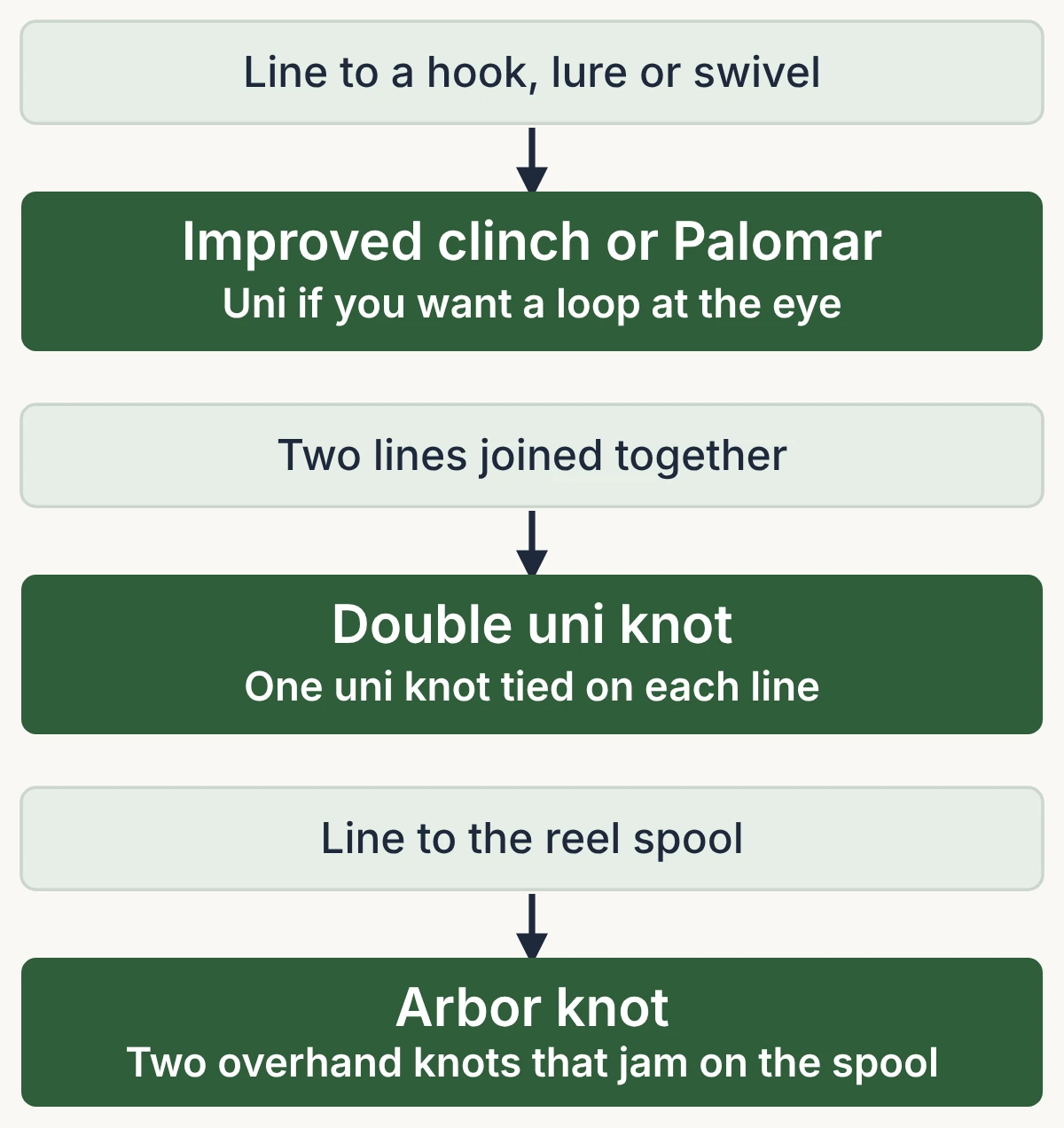
Learn four knots. The improved clinch or the Palomar ties line to a hook, lure or swivel, the double uni knot joins two lines, and the arbor knot ties line to the reel spool. Utah’s wildlife agency says a few versatile knots beat a dozen poorly tied ones.
The Illinois Department of Natural Resources puts the stakes plainly in its knot leaflet: “the knot you tie is the weakest point in your line.” The same leaflet says “a good knot will retain more than 90 percent of the line strength” and that “improper knots have less than half of the line strength.”
Below are five knots from state wildlife agencies and tackle makers: two ways to tie on a hook, an adjustable-loop knot, a line-to-line join and a reel knot. Where sources disagree, the text says so.
Related guide: How to Tie a Fishing Lure to Your Line: Snug Knots, Loop Knots and Snaps
The few knots that cover most fishing
Utah’s Division of Wildlife Resources says anglers do not need every knot: “Narrowing your focus and taking the time to master a few versatile knots is going to be far more beneficial than knowing how to mediocrely tie a dozen different knots.” Its outreach manager, who wrote the post, names the improved clinch, uni and Palomar among his go-to knots. The arbor knot and a line-to-line knot fill the two jobs those three leave open.
Makers and agencies do not agree on every line type, so the table names who says what.
| Knot | Best job | Line types, by source | How hard |
|---|---|---|---|
| Improved clinch | Hook, lure or swivel | Mono and fluorocarbon (Lowe Boats); Utah DWR says it works on all types, braid included. Not recommended over 30-pound test (Animated Knots, Berkley) | “Arguably the easiest fishing knot to tie” (Lowe Boats) |
| Palomar | Hook, lure or swivel; large hooks | Braid (Animated Knots, Utah DWR, Lowe Boats); Sports Illustrated: mono and braid, but not recommended for fluorocarbon | Simple, but the hook must pass through a loop (Animated Knots) |
| Uni | Hook, lure or swivel, with an adjustable loop | Mono and fluorocarbon (Utah DWR, Lowe Boats); mono and braid (Animated Knots) | “A little more difficult to tie, but easily mastered” (Lowe Boats) |
| Double uni | Joining two lines | Lines of similar diameter; mono or fluorocarbon leader to braid (Berkley) | Two uni knots, one on each line |
| Arbor | Line to the reel spool | Spinning, baitcasting and spincast reels (Sports Illustrated) | Two overhand knots |
Note
Animated Knots says the improved clinch is “commonly used to fasten the leader to the fly.” For the rest of a fly setup, see our guide to tying a fly rod rig and our walkthrough of tying a leader to fly line.
How to tie a hook, lure or swivel to your line
Either knot below answers how to tie a hook on fishing line. The U.S. Fish & Wildlife Service’s beginner pamphlet teaches the Palomar or the improved clinch for exactly this. Start with the improved clinch, which Lowe Boats calls arguably the easiest. Utah DWR says the Palomar works especially well on large hooks and braided line.
Related guide: How to Use Topwater Lures: When They Work and How to Work Each Type
Improved clinch knot
Thread the line through the eye
Pass the end through the eye of the hook, lure or swivel and leave at least 6 inches (15 cm) of tag end, as the Illinois DNR leaflet says. The U.S. Fish & Wildlife Service’s pamphlet reminds beginners: “Be careful when handling sharp hooks.”
Wrap the tag end around the standing line
Illinois DNR gives turns by line weight: “six turns with light (2-6 lb.), five turns with medium (8-12 lb.) or four turns with heavy (14-20 lb.) line” (roughly 1-3, 4-5 and 6-9 kg). Berkley suggests five to seven twists.
Pass the tag end through the small loop beside the eye
This is the loop formed right at the eye, between the eye and your first wrap.
Then pass it through the big loop
Take the tag end back through the larger loop the first pass created. Berkley says to be careful that the coils do not overlap. This second tuck is what makes the knot “improved,” per Animated Knots.
Moisten, tighten and trim
Wet the knot, hold the tag end between thumb and finger and draw it down slowly while pulling the main line, so the coils seat against the eye, as the USFWS pamphlet describes. Trim the tag end.
Animated Knots and Berkley both say the improved clinch is not recommended over 30-pound test (about 14 kg) because it gets hard to tie. Animated Knots adds that turns may drop to four on heavier line.
Palomar knot
Double the line and pass it through the eye
Fold 4 to 6 inches (10 to 15 cm) of line (the USFWS pamphlet starts with 4 inches, Berkley with about 6) and push the loop through the eye. Animated Knots warns the loop must be large enough for the hook to pass through it.
Tie a loose overhand knot in the doubled line
Let the hook hang free. The USFWS pamphlet says not to twist or tighten the line yet, and Berkley also says to avoid twisting.
Pass the loop over the whole hook
Hold the hook carefully, as the USFWS pamphlet puts it, and bring the loop completely over the hook or lure and beyond the eye.
Moisten, pull slowly and trim
Wet the line, then pull the loose end and the standing line slowly while holding the hook carefully, as the USFWS pamphlet says. Clip the tag end.
Animated Knots notes that this leaves the hook free to rotate in the knot. Sports Illustrated says the Palomar is not recommended for fluorocarbon line, while Utah DWR and Lowe Boats do not mention that limit, so check your line maker’s advice if you fish fluorocarbon.
Uni knot: an adjustable loop at the eye
The uni knot also ties line to a hook, lure or swivel. Its extra feature is that you can slide it down to leave a loop at the eye. Lowe Boats says that loop allows better lure action.
Run the line through the eye and double it back
Pass the end through the eye and lay it back alongside the main line, forming a circle. Lowe Boats starts with about 8 inches (20 cm) of line through the eye. The U.S. Fish & Wildlife Service’s pamphlet says: “Be careful when handling sharp hooks.”
Wrap the tag end through the circle
Wrap the free end around the doubled line and through the loop. Utah DWR and Berkley count six turns, Animated Knots shows five.
Moisten and pull the tag end
Wet the knot, then pull the free end to snug the wraps.
Slide the knot to the eye
Pull the main line so the knot slides to the eye, or stop sooner to leave a loop. Trim the tag end.
Animated Knots reports a test arranged by Mack Martin in which the uni knot “showed 82% of line strength.”
Join two lines with a double uni knot
Utah DWR points to the double uni knot for line-to-line and line-to-leader connections. Berkley’s version, which it calls the Uni to Uni, suits lines of similar diameter, such as a fluorocarbon or monofilament leader on a braided main line. For lines of very different thickness Berkley says “consider the Albright Knot,” and it lists the surgeon’s knot for lines of different diameters.
Overlap the two lines
Lay the end of the leader and the end of the main line side by side for about 6 inches (15 cm).
Form a loop with the main line’s tag end
Bring the tag end back toward the middle, forming a loop.
Make the turns
Make 6 to 8 turns through the loop with the same tag end, per Berkley, wrapping around both the leader and the main line inside the loop, as Animated Knots shows for the uni knot. Tug the tag end to snug it.
Repeat with the leader
Tie the same knot with the leader’s tag end, so each knot is tied around the other line’s standing end, as Animated Knots describes for joining two lines.
Moisten and pull the lines apart
Wet both knots, then pull the two standing lines in opposite directions so the knots slide together. Trim both tag ends.
Strength figures differ by source. Berkley claims “preserving up to 90% of line strength,” while Animated Knots says that when two lines are joined this way “a breaking strain around 75% is more likely.”
Tie line to the reel with an arbor knot
Sports Illustrated says the arbor knot works for spinning, baitcasting and spincast reels. It fastens the line to the spool.
Wrap the line around the spool
Leave a tag end of 3 to 4 inches (8 to 10 cm), per Sports Illustrated.
Tie a loose overhand knot around the main line
Tie it around the standing line, not just the spool, and leave it loose for now.
Tie a second overhand knot in the tag end
Cinch this one down tight. Animated Knots calls the second knot essential: “when the Arbor Knot is tightened the Second Overhand Knot snugs down against the Arbor.”
Tighten and trim
Snug the first overhand, then pull the main line so the knots slide together and jam on the spool. Trim the tag end. Animated Knots adds that if you tie a slip knot by mistake, it will simply pull undone.
Setting up a new reel is also the time to choose its line. Our beginner fishing reel roundup covers reels, and the trout roundup below covers line.
Ready to buy?
If you are choosing the line itself, our roundup of the best trout fishing lines compares monofilament, fluorocarbon and braid picks.
Habits that make any knot hold
- Moisten the knot before pulling it tight. Utah DWR says moisture helps the knot seat fully and “reduces friction heat that can cause the fishing line to stretch and weaken.”
- Count the turns. The Illinois DNR leaflet gives turn counts by line weight, and Animated Knots says heavier line may need fewer.
- Keep wraps neat. Animated Knots says to wind the loops in a neat spiral, and Berkley says to check that the coils do not overlap.
- Go slowly. Utah DWR says taking your time improves the quality of the knot and reduces the chance of it failing.
- Practice before you fish. Utah DWR’s advice is to “practice, practice, practice”; the USFWS pamphlet has beginners tie a rubber-covered casting plug on with the Palomar or improved clinch and practise casting before tying on a hook.
Note
Depending on where and how old you are, you may need a licence to fish. The U.S. Fish & Wildlife Service’s pamphlet says: “Depending on your age and your state, you may need one to fish legally.” It also suggests picking up a copy of your state’s fishing regulations.
Frequently Asked Questions
Q. What is the easiest knot for fishing?
Lowe Boats calls the improved clinch arguably the easiest, and Utah DWR notes it is often one of the first knots an angler learns. Sports Illustrated calls the Palomar nearly as easy.
Q. What are the 3 best fishing knots?
Lists differ. Lowe Boats names the improved clinch, uni and Palomar; Sports Illustrated names the improved clinch, Palomar and arbor. This guide adds the double uni because joining two lines is a separate job.
Q. How do I tie two pieces of fishing line together?
Use a double uni knot for lines of similar diameter, following Berkley’s steps above. For lines of different thickness, Berkley points to the surgeon’s knot, or the Albright knot when the difference is large.
Q. Which knot works with braided line?
Animated Knots, Utah DWR and Lowe Boats all point to the Palomar for braid. Animated Knots also says the uni works with braid, and Berkley rates it for superline-to-leader connections. Berkley also describes its own braid knot, with eight wraps, on its knots page.
Q. What is the strongest fishing knot?
Sources do not agree on one winner. Animated Knots calls the Palomar “one of the strongest and most reliable fishing knots,” and Lowe Boats says it is slightly stronger than the clinch and uni. How well you tie it also matters: Illinois DNR says a good knot keeps over 90 percent of line strength and a poor one less than half.
Q. How do I tie a weight on fishing line?
The USFWS beginner pamphlet says to attach one or two sinkers to the line 6 to 12 inches (15 to 30 cm) above the hook, and uses the Palomar or improved clinch to tie on a casting plug. For the hook itself, use the steps above.
Sources (10)
- Utah Division of Wildlife Resources, Learn to fish: tying the knot
- Illinois Department of Natural Resources, Knot-Tying Guide
- U.S. Fish & Wildlife Service, Fishing is fun for everyone: it’s easy to learn how
- Berkley, Fishing Knots 101
- Animated Knots, Palomar Knot
- Animated Knots, Improved Clinch Knot
- Animated Knots, Uni Knot
- Animated Knots, Arbor Knot
- Lowe Boats, Types of Fishing Knots and How to Tie Them
- Sports Illustrated, How to Tie the 3 Fishing Knots Every Angler Needs
