The short answer
Follow your tent maker, and check the CDC’s list of who should not clean mold first. MSR, a tent maker, says washing a tent does not remove mold; Gear Aid, a gear-care maker, starts nylon with a gentle wash, then an odor-eliminator soak. Kodiak Canvas names Iosso on canvas. Follow each label, then dry the tent completely.
Mold on a tent is two problems: a health one for whoever cleans it, and a materials one, because makers warn that some cleaners damage a tent’s waterproof coating. Nylon and polyester tents and cotton canvas tents have different coatings, so makers give different instructions, and they sometimes disagree. This guide sorts out which advice applies to which tent.
Related guide: How to Fix a Tent
It does not repeat general washing. For the basic wash, see our guide to cleaning a tent without stripping its waterproofing; this one covers what to do when mold or mildew is already growing.
Which path is your tent on?
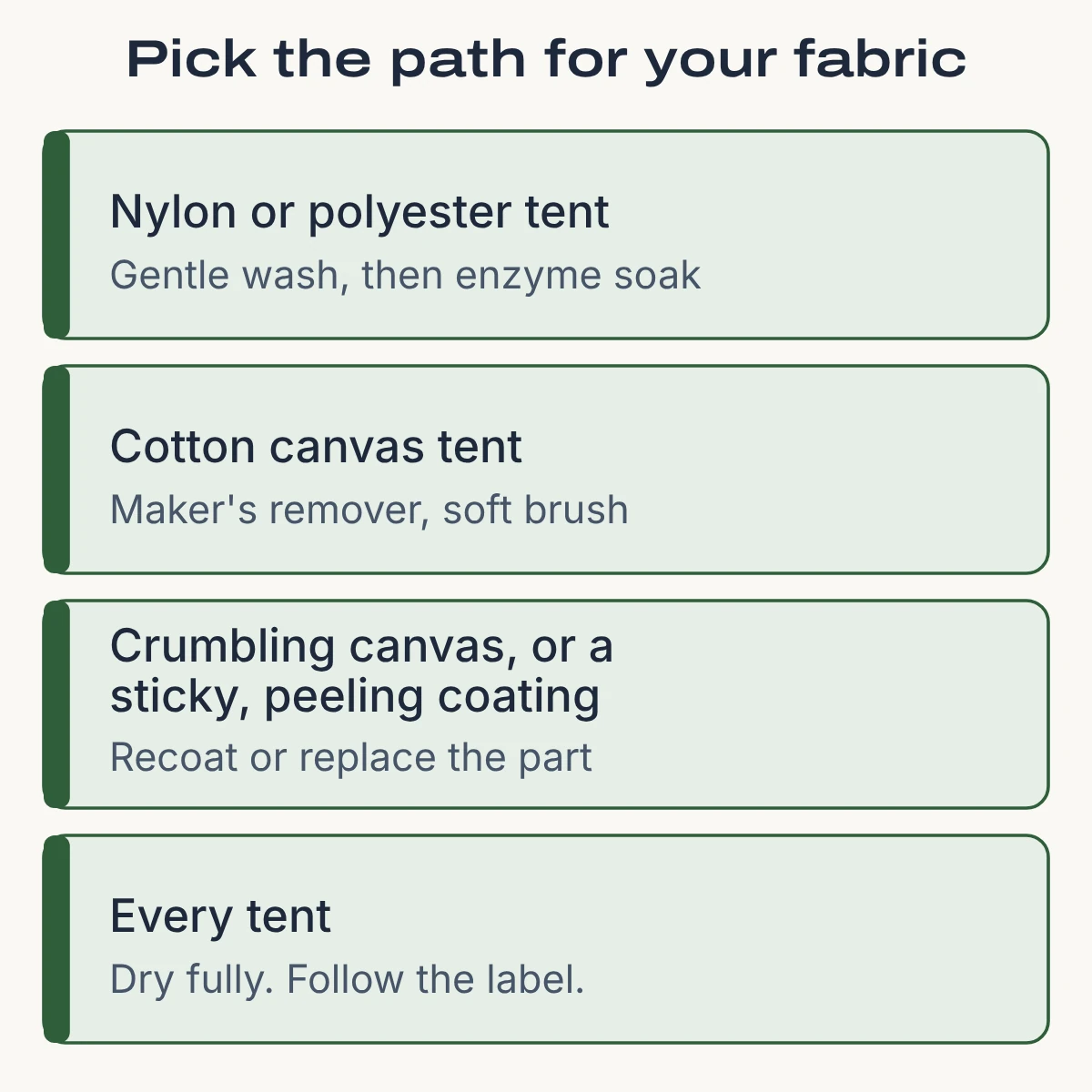
| Tent | Mold step the makers name | Makers warn against |
|---|---|---|
| Nylon or polyester | Gentle wash, then an odor-eliminator soak (Gear Aid) | Bleach (MSR, Big Agnes), machine wash (all three), dryer (MSR, NEMO) |
| Cotton canvas | Iosso (Kodiak, Montana Canvas); vinegar after it (Montana Canvas) or first for mild cases (White Duck) | Pressure washer (Montana Canvas), soaps (Kodiak) |
| Crumbling canvas | Replace the tent body (Kodiak) | Storing it damp |
| Sticky or peeling coating | Recoat (Gear Aid, MSR) or replace the fly (MSR) | Storing it damp |
Montana Canvas and Kodiak are canvas-tent makers. Gear Aid makes cleaners and repair products rather than tents. Not sure which fabric you have? Our guide to which tent material is best explains the difference.
Remove the mold step by step
Decide whether you should be the one to clean it
The CDC’s mold clean-up page says: “Some people are at risk of significant and even severe health effects from mold exposure. These individuals should not take part in cleaning up:” and lists “People with allergies, who may be more sensitive to molds”; “People with immune suppression or underlying lung disease, who are at higher risk of fungal infections”; and “Individuals with chronic respiratory diseases like asthma or chronic obstructive pulmonary disease (COPD), who may have trouble breathing when exposed to mold”. The CDC page is written for mold in homes and buildings, and a tent is a different object, but the people at risk are the same. If you are on that list, hand the tent to someone else.
Put on the protective gear before you touch the tent
The CDC says: “Take steps to protect your mouth, nose, skin, and eyes when cleaning up mold.” For the mouth and nose: “wear at least a NIOSH Approved N95 respirator. If you plan to spend a lot of time removing moldy belongings or doing work like ripping out moldy drywall, wear a half-face or full-face respirator.” For skin: “Wear protective gloves (non-latex, vinyl, nitrile, or rubber). Do not touch mold or moldy items with bare hands.” For eyes: “Wear goggles that provide complete eye protection. Choose goggles designed to keep out dust and small particles. Safety glasses or goggles that have open vent holes will not protect you against dust and small particles.” These are the CDC’s words for cleaning mold in general; check the label of any cleaner for its own protective-gear lines as well. The CDC also says: “You should never mix bleach with ammonia or any other cleanser.” So use one product at a time, as its label directs, and keep bleach out of it altogether (see What not to do).
Pitch the tent outdoors and let it dry
MSR sets the tent up to wash it, and a pitched tent is easier to reach on every panel. SectionHiker, a gear publication, says to stop mildew spreading by moving the gear “to a dry location and expose it to sunlight,” and warns not to leave it too long in bright sun “because the UV can also degrade or bleach colored fabric over time.” Kodiak, a canvas maker, says that if you must break camp wet, “set your tent up ASAP and let it dry out” when you get home.
Nylon or polyester: wash gently first
Gear Aid says “you may be able to remove mold with just hot and soapy water” depending on how deep it is, but its own steps use warm water: spot clean with a sponge, then fill a tub with warm water and add 2 fl oz (59 ml) of its Pro Cleaner. Big Agnes says “Never use hot water,” so use warm. Gear Aid warns: “Do not scrub the underside of the tent fly as you may damage or remove the polyurethane (PU) waterproof coating.” Then “Rinse with water until the soapy residue is gone” and “Allow to air dry completely.” Do not put the tent in a washing machine: NEMO says “Do not wash your tent in washing machines” because the fabrics and mesh will likely tear, MSR says never to machine wash it, and Big Agnes says “Do not dry clean or machine-wash.” The makers also disagree on soap. Gear Aid lists mild dish soap, while Big Agnes says never to use dishwashing liquids and MSR says to avoid dishwashing liquid, detergent and bleach. MSR also says plainly: “Unfortunately, washing a tent does not remove mold.” Use your own maker’s soap rule and follow the label on any tech wash.
Nylon or polyester: soak it in an enzyme odor eliminator, as the label says
Gear Aid’s mold guide uses Revivex Odor Eliminator (sold earlier as Mirazyme): fill a tub with just enough water to submerge the tent, add “1 fl oz of Revivex Odor Eliminator for every gallon of water,” unzip everything, and soak “for a maximum of 5 minutes.” The limit matters for a PU-coated tent: Gear Aid says the coating can break down and delaminate, “more likely if a tent is damp or has been soaking in water for longer than five minutes.” Then “Do not rinse the tent” and let it “air dry completely and away from sunlight/heat.” Gear Aid explains that heat kills the microbes and rinsing washes them away. Gear Aid’s two pages differ on method: its usage-tips page says fabrics “should soak for approximately 5 minutes” and lists tents among items that “should not be soaked but need preventative maintenance” with a spray mix instead, giving a stronger spray mix for mold or mildew smells. Follow the label on your bottle. SectionHiker’s 15-minute soak comes from a general gear walkthrough, not a PU-tent rule. Gear Aid’s tips page cautions that the product “does not guarantee the complete elimination of mold itself,” so it is a deodorizer first. It prints one more warning, “Odor Eliminator may darken leather; please patch test before use,” which matters if your tent has leather trim.
Cotton canvas: use the maker’s remover and a soft brush
Kodiak says “If you catch mold in the early stages you can save your tent,” suggests Iosso Mold Mildew Stain Remover, and says to “Follow the instructions on the label.” Montana Canvas, another canvas maker, also recommends Iosso Mold and Mildew Stain Remover, says to “Follow the directions for mixing the Iosso solution” and to scrub lightly with a soft bristle brush so as not to damage the canvas fibers or coating. Iosso does not post its label directions online, but its product page says “It is non-chlorine” and “4 oz. makes 1 gallon”; read the container for its warnings. Montana Canvas adds that “High pressure washers are NOT recommended.”
Cotton canvas: vinegar and Iosso, in your maker’s order
The canvas makers differ on order. Montana Canvas uses Iosso first and then, if mold is still present: “Use ½ cup of cleaning vinegar for every gallon of water,” scrub lightly, “Let stand for about ten minutes and rinse well,” and repeat once dry if needed; it says “We recommend doing this on a warm sunny day!” White Duck suggests spraying mild cases first with distilled white vinegar and keeping a commercial mold remover such as Iosso for the toughest jobs. Kodiak names only Iosso. White Duck says “Soap and other detergents can harm the fabric and leave deposits,” and Kodiak likewise says “Soaps and detergents can damage the water-repellant treatment of the canvas,” while Montana Canvas suggests mild laundry detergent for surface dirt. Follow your tent’s maker, and do not combine products in one bucket.
Dry it completely, in the open
Kodiak says “Storing a wet or damp tent, even for a short time, can ruin it and void the warranty.” Never machine dry a nylon tent: NEMO says “Do not machine dry your tent either, as heat can melt the technical fabrics,” and MSR says never to machine dry. For nylon tents, NEMO says to lay the tent flat or line-dry it in indirect sunlight because “Direct sunlight can damage tent fabrics if left for long periods of time.” Canvas makers lean the other way: Montana Canvas cleans on a sunny day and White Duck dries canvas in the sun. After an odor-eliminator soak, follow Gear Aid and dry away from sunlight and heat. Dry it the way your maker says.
Restore water repellency where the maker says to
Kodiak says mold and Iosso “will degrade some of the canvas water repellency” and to retreat the affected area with a silicone-based water repellent; it warns that other treatments can clog the canvas pores. Montana Canvas suggests a reconditioner called Canvak and says it does not recommend other coating products because they “can negatively react with the original treatments on the canvas.” On nylon, MSR suggests Nikwax and Gear Aid products for waterproofing repairs. If seam tape lifted during cleaning, see our guide to sealing tent seams.
Ready to buy?
If your tent is past saving, our roundup of tents for winter compares eight picks, including a canvas cabin and a lightweight 3-4 season tent. Our roundup of two-person backpacking tents covers lighter nylon options.
What not to do
- Bleach. Big Agnes says “Never use hot water, bleach, liquid detergents, or dishwashing liquids.” MSR says to avoid “dishwashing liquid, detergent, bleach and similarly concentrated solutions.” The two tent makers cited here both say no. Gear Aid’s odor-eliminator tips page remarks, about fabric in general, “Other times, you may need something more powerful like bleach,” but that is not a tent-maker instruction. Montana Canvas goes the other way: it calls its vinegar solution “less abrasive than bleach” on canvas fibers. The CDC adds a chemical warning: “You should never mix bleach with ammonia or any other cleanser.” Do not mix bleach with the soap, vinegar or remover from steps 4 to 7, and follow your tent maker’s rule.
- Washing machine. NEMO says “Do not wash your tent in washing machines” because the fabrics and mesh will likely tear; MSR says never to machine wash it; Big Agnes says “Do not dry clean or machine-wash.”
- Dryer. NEMO says “Do not machine dry your tent either, as heat can melt the technical fabrics,” and MSR says never to machine dry.
- Pressure washer, on canvas. Montana Canvas says high pressure washers can damage the fibers and the coating.
- Storing it damp. Kodiak, MSR and Gear Aid all say so (“Do not store tents that are damp or wet.”).
- Long soaks on a PU-coated tent. Gear Aid says the PU coating is more likely to break down “if a tent is damp or has been soaking in water for longer than five minutes.”
Stains and smell that stay
Some marks stay. MSR says mildew “can cause it to stain and smell,” and SectionHiker says a mildew stain “can be difficult to remove.” Montana Canvas says its wax-coated canvas takes on the colors of its environment and not to try to get it back to a natural clean color, because you can damage the canvas and coatings; it also says that if you see pinkish colorations in the canvas you most likely have active mold spores that need to be taken care of. For smell, Gear Aid says odor is reduced once the tent has air dried completely, and “If any lingering odors persist, reapply.”
When the tent is past saving
Makers describe the limits plainly. Kodiak says: “If your tent is covered in black mold, and the canvas is falling apart there is not much you can do at that point,” and that the tent body should be replaced. MSR says prolonged moisture can leave the waterproof coating “soft, sticky and no longer waterproof.” Big Agnes says damp storage can leave a tent smelly, leaking or delaminating. Gear Aid says the PU coating “can break down and delaminate” after years, with a foul odor, and gives a repair that strips the failing coating and applies a new one with its Seam Grip TF; follow that product’s label and allow the 24 hours it gives to air dry. For a leaking fly, MSR recommends Nikwax and Gear Aid products to complete repairs at home, and says another option is to replace the rainfly or canopy, in particular “if the rainfly still leaks more than you would expect.” MSR and Big Agnes both say mildew damage is not covered by their warranties, and Kodiak says damp storage voids its warranty. Montana Canvas adds that in extreme wet and humid environments a canvas tent may not be the best option.
Keep it from coming back
MSR says mildew can start in as few as 24 hours on a wet, crumpled tent. Dry it before packing. For storage, NEMO says to store it loosely in a breathable sack, not the stuff sack, in a cool, dry, dark place. Kodiak’s advice for a canvas tent left pitched in a humid area is daily direct sunlight and airing the inside out at least daily. If you cannot dry it at camp, White Duck says to roll it up and open it to dry at the next opportunity.
Frequently Asked Questions
Q. Is it possible to remove mold from a tent?
Sometimes. Kodiak says you can save a tent if you catch mold early; MSR says plain washing does not remove it, and Gear Aid says its odor eliminator does not guarantee complete mold removal.
Q. Can a moldy tent be saved?
Often, if you catch it early (Kodiak says so for canvas). On a nylon tent, Gear Aid’s odor eliminator works on the smell but does not guarantee the mold itself is gone. Once the canvas is falling apart, Kodiak says to replace the tent body; for a sticky or peeling coating, MSR and Gear Aid give recoating first, and MSR also offers replacing the fly or canopy.
Q. What is the best mold cleaner for tents?
No maker names one cleaner for all tents. Kodiak and Montana Canvas name Iosso for canvas; Gear Aid names its Revivex Odor Eliminator for nylon tent odors. Follow the label.
Q. Does Dawn and vinegar kill mold on a tent?
The makers cited here do not endorse that mix. Gear Aid lists mild dish soap for a first wash, but Big Agnes and MSR say not to use dishwashing liquid on a nylon tent, and the vinegar instructions come from canvas makers.
Q. Is tent mold dangerous?
The CDC says cleaning up mold can present health and injury risks, and it lists who should not clean it (step 1) and what to wear (step 2).
Q. Can I use my washing machine?
None of the makers cited here allows it for a tent body. NEMO, MSR and Big Agnes all say not to.
Sources (13)
- CDC, Mold Clean Up Guidelines and Recommendations
- MSR (Cascade Designs), How do I keep my MSR tent clean and dry?
- MSR, How to Wash a Tent
- MSR, How can I remove old, flaking or damaged seam tape?
- NEMO, Cleaning, Repairing, and Storing Your Tent
- Big Agnes, Tent and Footprint Cleaning and Care Instructions
- Gear Aid, How to Remove Mold, Mildew and Tent Odors
- Gear Aid, Tips for Using Revivex Odor Eliminator
- Kodiak Canvas, Proper Tent Care
- Kodiak Canvas, Frequently Asked Questions
- Montana Canvas via RMEF, How to Clean and Remove Mold on a Tent (sponsored content)
- White Duck, How to Clean Mold from your Cotton Canvas Tent
- SectionHiker, How to Remove Mildew from Camping and Backpacking Gear
