The short answer
A reel holds your line, lets it out for a cast, winds it back when you turn the handle, and slips under strain so a fish can pull line without snapping it. Spinning and spincast reels keep the spool still during a cast. Baitcasting reels let it turn, so they need brakes and your thumb.
The parts have different names on each type of reel, but the three jobs are the same: line out, line in, and give under load. What differs is what moves while each job happens, and that decides how easy a reel is to cast and what can go wrong.
Below: how line leaves and returns on each type, what gear ratio means in inches of line, how drag and anti-reverse fit together, and which type suits a beginner.
How line leaves each reel type
The sketch compares the cast. It shows only what the spool does, not the whole reel.
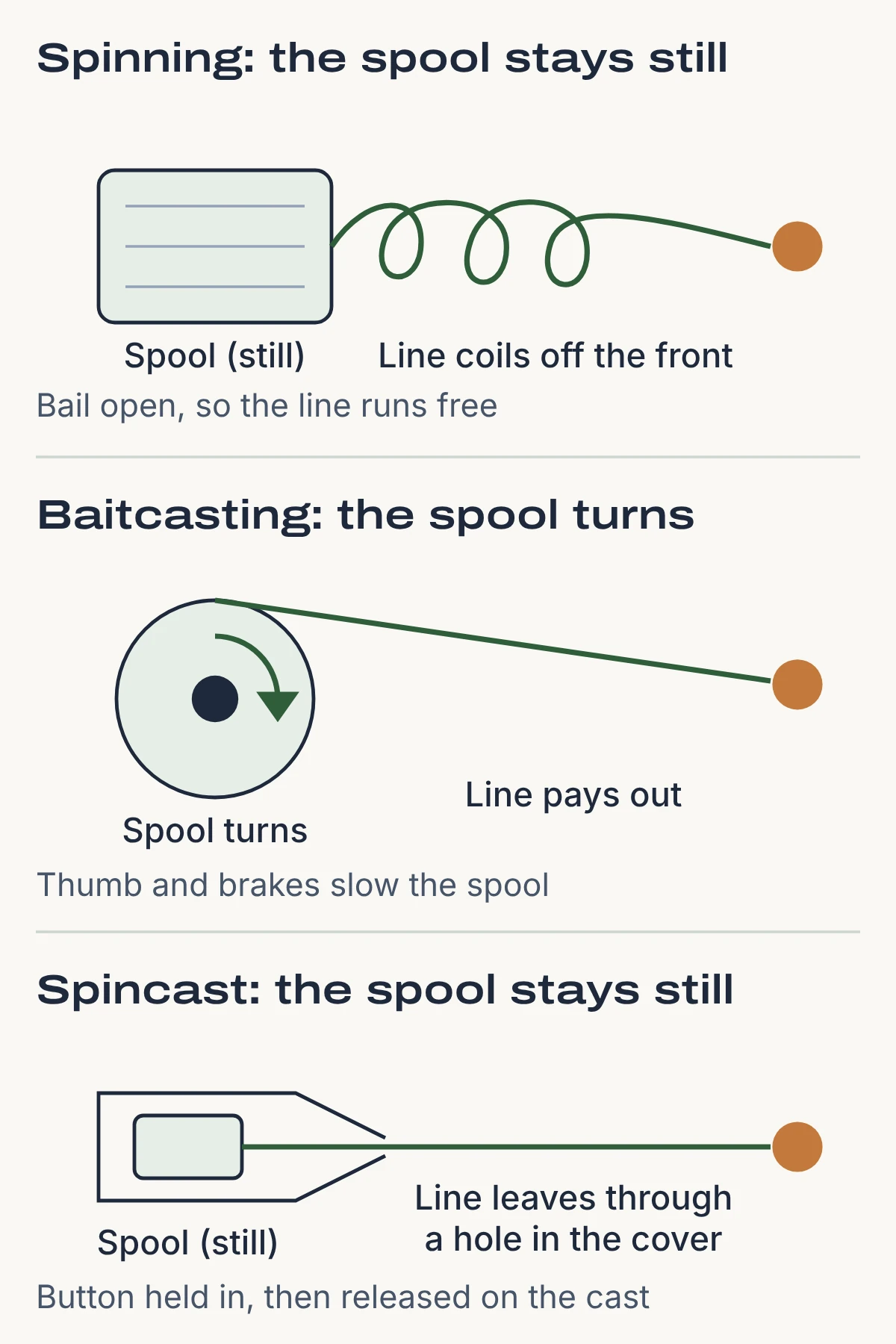
Wikipedia, an encyclopedia, states the fixed-spool rule plainly: “With all fixed-spool reels, the line is released in coils or loops from the leading edge of the non-rotating spool.” That covers spinning and spincast. Baitcasting is the exception, as the table shows.
| Type | Spool in a cast | Line wound on by | Cast is controlled by | Drag control |
|---|---|---|---|---|
| Spinning | Still | Bail and line roller | Open bail, finger | Knob on the spool |
| Baitcasting | Turns | Handle, with a level wind | Thumb, brakes | Star wheel by the handle |
| Spincast | Still, in a cover | Pickup pin | Push button | Wheel or dial, varies |
Spinning reels: a still spool and a bail that does the winding
Okuma, a reel maker, describes the layout in its spinning-reel anatomy post: “the spool stays stationary as the rotor revolves around it adding line as you turn the handle.” The bail arm is the gate. In Okuma’s words, “When the bail arm is closed, you can turn the reel and gain line on to your reel,” and “When the bail arm is in the open position, line is free to come off the reel.”
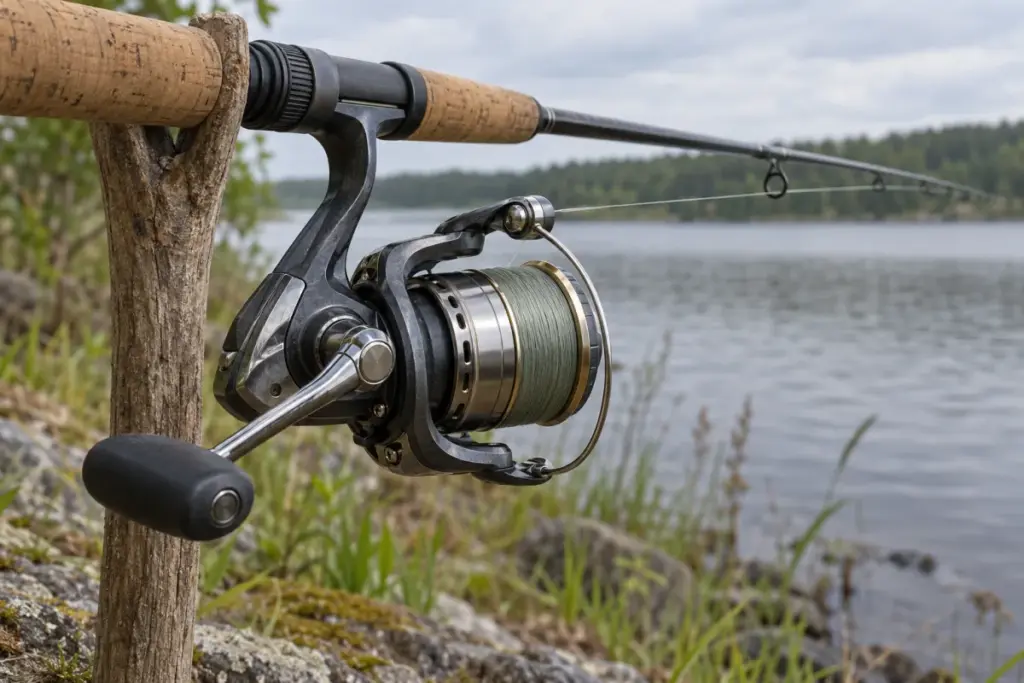
The line roller is where the line turns onto the spool. Daiwa’s Australian site explains in a reels guide by Robert Thornton that “As the line roller spins, the spool oscillates to evenly spread the line across it.” Oscillation is that back-and-forth travel, and it spreads the line across the spool instead of piling it in one spot. Okuma describes the same motion from the line’s side, saying that as you turn the handle the rotor “will go up, then down,” adding line evenly. Two descriptions, one result: line laid back and forth across the spool.
The U.S. Fish and Wildlife Service, a federal agency, adds how the cast is timed on an open-bail reel: “Line is released using your index finger.” It also says the spinning reel is mounted under the rod handle, while a spincast reel sits on top.
Baitcasting reels: a spool that turns, with brakes and your thumb
A baitcasting reel has no bail. Its spool turns as line leaves. Lew’s, a reel maker, says in a casting guide by Mark Hicks to push down the thumbar to disengage the spool, then thumb the spool through the cast: “Ride the spool lightly with your thumb as the lure sails to the target.” and “Increase thumb pressure to snub the spool at the end of the cast.”
The reason is overrun. Daiwa’s Australian site says backlashes “occur when the spool keeps spinning after the cast is completed.” Two adjustments fight it:
- Brakes. Lew’s technical help page says magnetic brakes “are designed to give a constant resistance (braking) on the spool throughout the entire cast,” and that turning the dial “moves the magnets closer or further from the spool.” Lew’s centrifugal brakes work early in the cast. The same page says they are “designed to provide initial braking at the beginning of the cast to prevent backlash.” Lew’s multi-setting brake combines the two.
- Spool tension knob. Lew’s says the knob behind the handle “puts pressure on the end of the spool’s main shaft” and warns about both ends of the range: “If the pressure is too light, backlashes are inevitable.” and “If it is too tight, your casting distance will be greatly reduced.”
On the way back, a level wind guides the line. Mike’s Reel Repair, a Canadian reel-parts and repair shop, explains that “As the angler cranks the handle, the line guide traverses the front of the spool, guiding the incoming line to lay neatly and uniformly.” The drag on these reels is a star wheel: Lew’s casting guide places it at “the star drag under the handle.”
Daiwa’s Australian site names the payoff: the line goes straight onto the spool, “unlike spinning reels where the line goes through a line roller before turning 90 degrees onto the spool,” which it ties to more sensitivity and feel through the rod. The same page says baitcasters “have a reputation that can deter people from trying them.”
Spincast reels: a closed face and a push button
A spincast reel hides the spool under a nose cone. Zebco, a reel maker, describes its beginner combos as having the reel “enclosed in a nose cone that protects the line and spool,” and says you cast “by pressing a thumb button and release it on the forward stroke to send the bait.”
Inside, a patent assigned to Zebco Holdings describes a typical spincast reel. A shaft carries a spinner head that winds line onto the spool, and the head holds the line with notches or, as the patent also describes, “a spring-loaded pick-up pin or pins that project laterally through a sidewall of the spinner head.” The patent walks through a cast. Holding the button down moves the shaft and spinner head forward, so “the spinner head clamps the fishing line against the tapered forward wall of the front cover.” Releasing the button lets a spring pull them back, and then “the line flows freely over the forward end of the line spool and through a line opening provided in the forward end of the front cover.”
Wikipedia says that cranking the handle makes the pickup pin re-engage the line, and that spincast reels do without the spinning reel’s bail and line roller. The Fish and Wildlife Service calls this type “the easiest rod and reel for beginners.” Our roundup of Zebco 33 reels compares models of Zebco’s long-running spincast.
Electric reels, briefly
An electric reel swaps the muscle for a motor. Daiwa’s Tanacom 1200 power-assist reel, says Daiwa’s product page, “has the motor and new gearing hidden inside the spool itself,” and lets the angler fight a fish by hand or “let the 12-volt power variable-speed assist do the heavy hauling.” Penn describes its Fathom Electric as cordless, with a replaceable lithium-ion battery pack, brushless motors rated for 30 to 40 pounds of winding power depending on size, and a digital line counter that powers an auto-stop.
Power is the main safety point. Daiwa’s operating manual says its reels are “available in direct current (DC) 12 to 16.8V, 12 to 24V, and 24V only, depending on the model,” and that “Unspecified power sources (for example, 120V AC for household use) cannot be used.” It warns that a source above the specified voltage “will damage the electronic circuits of the electric reel and cause loss of motor control. This can lead to smoke and fire.” On connecting, it says: “Do not connect the power supply while your hands are wet with freshwater or seawater. Attempting to do so may result in electric shock. If you connect it during rain, wear rubber gloves before connecting it.” Follow the maker’s manual for your model. Daiwa’s Australian site says electric reels are not “in the realm of beginners.”
Gear ratio: what the number means in inches of line
Gear ratio counts how many times the line-winding part turns for one turn of the handle. Daiwa’s Scandinavian tips page puts it for spinning reels: “Gear ratio describes how many times the rotor spins around the spool for each turn of the handle.” On a baitcasting reel, Wired2Fish, a fishing publication, says the same count applies to the spool: a 6.4:1 reel’s spool “turns exactly 6.4 times” per handle turn.
The number alone does not tell you how much line you gain. Daiwa says “What really matters in practice is how much line the reel retrieves per turn of the handle,” and that “A larger spool retrieves more line per turn, even with the same gear ratio.” Wired2Fish calls this measure inches per turn, or IPT. The table lists maker figures. Daiwa prints centimeters per crank; the inches are converted here (worked out: centimeters divided by 2.54).
| Reel | Gear ratio | Line per handle turn |
|---|---|---|
| Daiwa Fuego LT 1000D | 5.2:1 | 64 cm (about 25 in) |
| Daiwa Fuego LT 5000D-C | 5.2:1 | 87 cm (about 34 in) |
| Daiwa Fuego LT 2500-XH | 6.2:1 | 87 cm (about 34 in) |
| Shimano Curado 300 | 4.7:1 | 25 in |
| Shimano Curado 300HG | 6.6:1 | 35 in |
Daiwa’s figures come from its Fuego LT spec table, which lists “5.2:1/64cm” for the 1000D and “5.2:1/87cm” for the 5000D-C. The Shimano figures come from a Bassmaster news item on the Curado 300 series, which says the Curado 300 “cranks in 25 inches of line per turn” and the 300HG “rip in 35 inches of line per turn.” These two numbers rest on Bassmaster’s report of Shimano’s announcement.
Read the table row by row. Two Daiwa reels with a 5.2:1 ratio pick up 64 and 87 centimeters per turn, and Daiwa’s spec table gives the 5000D-C the bigger spool (54 mm lip against 40 mm). A 5.2:1 and a 6.2:1 reel pick up the same 87. Only the Shimano pair moves with the ratio.
Worked out from those Shimano figures: 25 divided by 4.7 and 35 divided by 6.6 both come to about 5.3 inches per spool turn, which is consistent with one spool size on both models (Shimano’s report does not say so). Worked out another way, 30 feet of line is 360 inches, so it takes about 14 turns at 25 inches per turn and about 10 turns at 35.
What to do with that: Daiwa recommends “starting with a standard gear ratio, not a high-speed model,” and its rule of thumb is that it is “easier to speed up your retrieve than to slow it down.” Its model names usually show the type: no letter is standard, H is high speed, XH is extra high, and “P stands for Power, indicating a slower gear ratio with more torque.” For bass casting reels, Wired2Fish writer Walker Smith, a tournament angler, puts big pulling lures such as deep crankbaits on low ratios (5.1:1 to 5.4:1) and slack-making lures such as topwaters on high ones (7.1:1 to 8.1:1). That is one angler’s guide to casting reels, not every maker’s and not a rating for spinning reels. Because size changes the line per turn, our spinning reel size guide is worth a look before you compare ratios.
Drag and anti-reverse: how a reel gives line to a fish
Drag is a friction brake on the spool or the gears. Okuma explains the knob: “What the drag knob does is adjusts the tension and pressure put on the drag washers,” and “The drag is what slows down line being pulled off of the spool by a fish.” Daiwa adds that it lets the line “slip in a controlled way” instead of breaking. Setting it, and when to change it in a fight, is a separate job.
Anti-reverse is the stop on the handle. The Zebco patent lists “an anti-reverse mechanism in communication with the crankshaft for preventing reverse rotation of the crank handle and crankshaft.” It then says the two parts meet when a fish pulls: “the drag system counteracts the anti-reverse mechanism of the reel to payout a sufficient amount of additional fishing line to prevent the line from breaking.” In short, the handle will not spin backward, so a fish takes line by overcoming the drag, not by spinning the handle.
Some spinning reels have a switch for it. Zebco’s spinning-reel manual lists anti-reverse for some models only and says to flip the switch on if the rotor turns freely in both directions around the spool. Wikipedia describes the newer instant version as usually a one-way clutch bearing on the handle shaft. Check your own model’s manual for how yours works.
Choosing a reel type from how each one works
Robert Thornton of Daiwa’s Australian site gives beginners a plain recommendation: “95% of the time a spin reel will do the job just fine.” Zebco calls a spincast combo “the most beginner-friendly fishing setup there is,” and the Fish and Wildlife Service rates the push-button type easiest. Baitcasting asks you to learn thumb control and brake settings first.
If you are shopping, the mechanics boil down to two questions. Do you want a still spool (spinning, spincast) or a turning one (baitcasting)? And is the ratio standard, which Daiwa suggests for a first reel?
Ready to buy?
Our roundup of the best beginner fishing reels compares eight picks, spinning and spincast among them.
Frequently Asked Questions
Q. How does a fishing reel work step by step?
In a cast, line comes off the spool once you open the bail, press the thumbar or release the push button. Turning the handle winds it back on. If a fish pulls hard enough, the drag slips so the line does not break.
Q. How does a spincast reel work?
A thumb button moves a spinner head forward to clamp the line, then releases it on the cast so line flows out through the hole in the front cover. Turning the handle puts a pickup pin back on the line to wind it onto the spool.
Q. How does a baitcaster work?
The spool turns as the lure pulls line out. Brakes and the spool tension knob slow it, and your thumb does the final stop. On the retrieve, a level wind guide lays the line across the spool.
Q. How do electric fishing reels work?
A motor turns the spool from a battery. Daiwa’s Tanacom has a line counter, and Penn’s Fathom Electric adds an auto-stop run by its counter. Daiwa says its reels need the specified direct-current power.
Q. What does the anti-reverse switch do?
It stops the handle turning backward, so a pulling fish takes line against the drag and not by spinning the handle. Some reels have a switch, so check the manual.
Q. Why is the bail open on a spinning reel?
Okuma describes the bail as a gate: closed, the reel gains line as you turn the handle; open, line is free to come off the reel.
Sources (16)
- Okuma, Tune-Up Tuesday: Anatomy of a Spinning Reel
- Daiwa Scandinavia, How to choose the right spinning reel
- Daiwa Scandinavia, 23 Fuego LT product specifications
- Daiwa Australia, Fishing Reels Explained
- Daiwa US, Tanacom 1200
- Daiwa, Electric reel operating manual
- Lew’s, How to Adjust and Cast a Lew’s Baitcaster
- Lew’s, Braking Systems (technical assistance)
- Zebco, How to Set Up Your Spincast Combo
- Zebco Holdings, US patent 10939674: Bearing supported pick-up pin for spincast reel
- Penn, Fathom Electric (new product preview)
- Wired2Fish, Choosing the Right Gear Ratio Fishing Reel
- Bassmaster, Shimano introduces Curado 300 for big and heavy lures
- Mike’s Reel Repair, The Levelwind System in Baitcasting Reels
- U.S. Fish and Wildlife Service, A guide to fishing for the first time
- Wikipedia, Fishing reel
