The short answer
A rainfly is the waterproof outer layer of a double-wall tent. It goes over the breathable inner tent to keep rain out, while the air gap between the two lets moisture escape. MSR, a tent maker, calls the fly waterproof but not breathable, and the inner tent breathable but not waterproof.
You will see it spelled “rainfly” (MSR, Switchback Travel) and “rain fly” (Big Agnes, NEMO), and Big Agnes also says just “fly”. These are names for the same part, and “tent fly” means it too.
Related guide: Pop-Up Tent vs Dome Tent: Which One Fits How You Camp
How the fly and the inner tent share the work
MSR’s tent designer Terry Breaux explains the idea this way: “A double-wall tent is constructed of two walls—typically the tent body and a rainfly.” He adds that “The rainfly is 100% waterproof but not breathable. The inner tent is 100% breathable but not waterproof.” Section Hiker, a hiking blog, says the separate inner tent and fly help “prevent internal condensation transfer”.
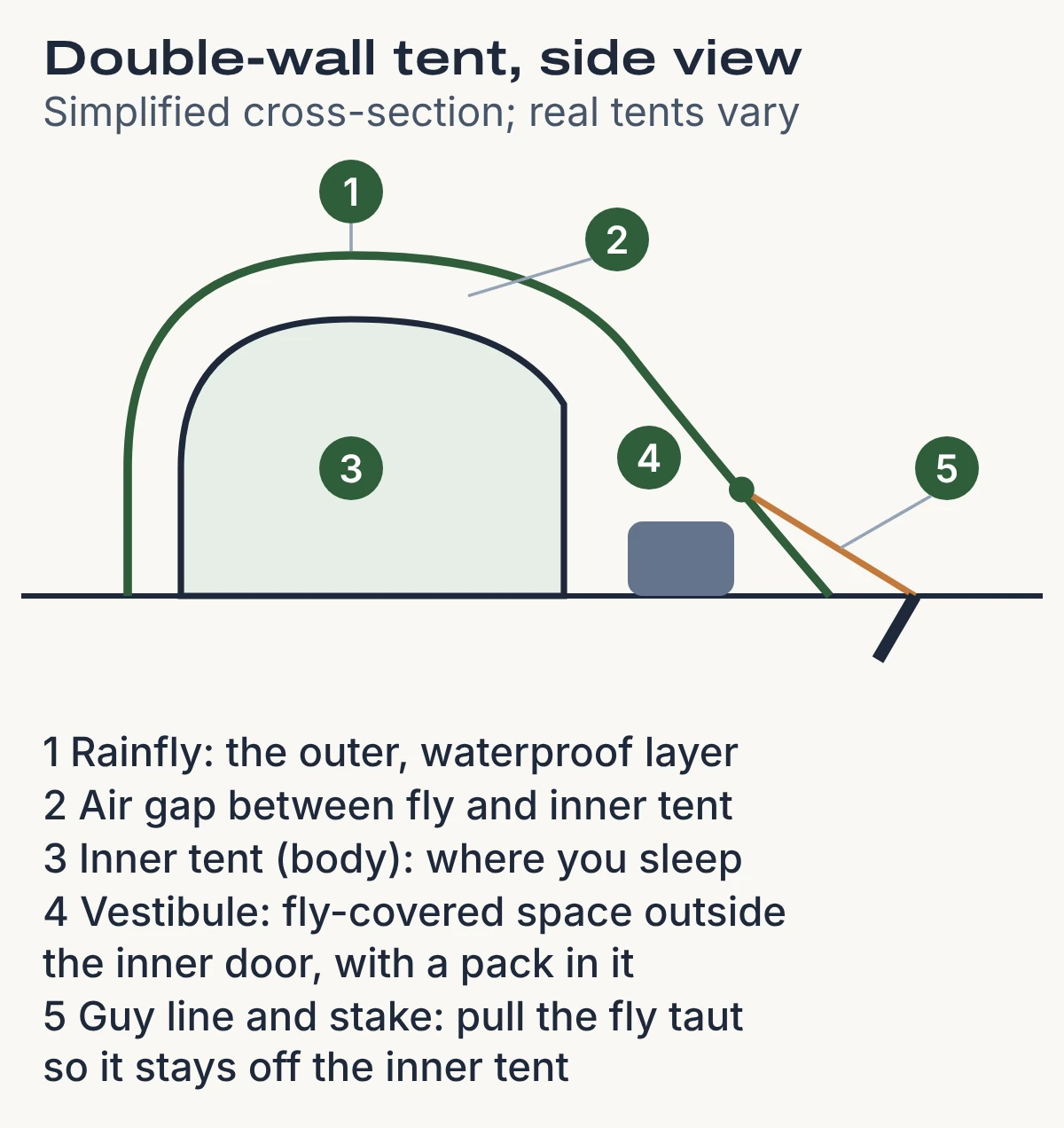
| Part | What it does | Source |
|---|---|---|
| Rainfly | Covers the exposed tent body “to increase resistance to precipitation, wind, and cold” | Switchback Travel, a gear review site |
| Inner tent (body) | The breathable layer you sleep in; MSR describes it as “usually the mesh body” | MSR |
| Air gap | Big Agnes says to “Keep a healthy distance between your rain fly and tent body for maximum ventilation” | Big Agnes |
| Vestibule | Covered gear storage in poor weather, formed by the fly beyond the inner door | Section Hiker, MSR |
| Fly vents | Roof vents that “can be deployed even in the rain”; NEMO adds a vent strut on the fly zipper of many of its tents | Switchback Travel, NEMO |
| Guy lines and stake-out points | Pull the fly tight so it does not touch the inner tent | Big Agnes |
Full-coverage or partial fly: where sources differ
Not every fly reaches the ground. Switchback Travel’s testers say: “We almost always recommend a full-coverage rainfly”, though some tents, such as the NEMO Hornet Elite, “have impressive weather resistance even with some sections protected only by the tent body.” Its caption of a Nemo Hornet says the “cutout rainfly saves weight and adds breathability”.
The same site notes the cost of a shortened fly. On the MSR FreeLite 2, “MSR used a shortened rainfly at the head end” to shave weight and made that end of the inner tent from water-resistant fabric instead of mesh, but “We did find this wets out faster than a rainfly that extends all the way to the ground, though.” An answer on the Outdoors Stack Exchange forum, from a user who prefers full coverage, says a full-coverage fly “will not only keep you drier, but warmer, especially if it is windy”, and lists the downsides as “added weight and volume in the pack”. Core Equipment’s own shop page for its full-rainfly tents says they “provide full-coverage protection from rain, wind, and colder temperatures.”
Our roundup of two-person backpacking tents gives each pick’s fly and floor waterproof ratings and what makers or testers say about fly coverage; most makers do not state it.
Do you have to use it?
The maker’s manual has the last word. What the sources describe:
- Fly off in heat. Switchback Travel says: “Leave the rainfly off, and the tent will be even more comfortable in hot temperatures, so long as the sun isn’t hitting you directly.” It adds that you can roll back half of it for ventilation, and “if you feel a couple of raindrops during the night, it only takes a few seconds to roll the rainfly back down.”
- Fly only. Big Agnes describes a “fast fly” setup: “Clip your fly and poleset directly into your staked out footprint. Guy out your fly and you are ready to go.”
- No separate fly at all. MSR says its four-season single-wall tents, such as the Advance Pro 2, are built differently: “Rather than a fly and body, they have a single, solid waterproof/breathable wall.” Its Tents 101 guide adds that some makers now use “coated, nonbreathable fabrics on single-wall backpacking tents.” MSR also describes its Thru-Hiker Mesh House shelters as “essentially tent bodies, sold without a rainfly”.
Putting the fly on and keeping it off the inner tent
Makers’ own tips for the usual fly that clips over the poles:
Stake the floor tight and wrinkle-free first
MSR says this “ensures that the poles will be in the correct position to help keep the rainfly from touching the tent body.”
Clip the fly to one corner before you lift it
Big Agnes advises attaching it to one corner of the body before you throw it over the poles, “This will prevent your tent from turning into a kite.” Switchback Travel calls the fly “often the trickiest part” of pitching.
Stake out the vestibules
MSR says: “In addition to staking the tent body, the vestibules must be staked out securely.”
Use the guy lines as you set up
MSR: “it is best to use guy cords as you set the tent up”. Big Agnes says guy lines “will help pull the rain fly tight and keep it from touching the tent body.” Your tent’s manual shows which loops to use.
Re-check tension after the fly gets wet
MSR says “tent rainfly fabrics, particularly nylons, tend to stretch a little when damp or wet, requiring re-tensioning of the rainfly.”
Common fly problems
| Problem | What makers say | Source |
|---|---|---|
| Moisture inside on a still night | “Even with your best effort to vent your tent, condensation will occur.” Big Agnes advises “getting a nice taut pitch on your tent and leaving it as open to cross ventilation as possible” | Big Agnes |
| Fly sags in rain | “It is normal for your tent fly to get saggy during a rain storm.” Re-stake, shake off excess water and tighten the guy line | Big Agnes |
| Inner tent damp when pitched in rain | Section Hiker says some double-wall tents “can be pitched fly first to keep the inner tent dry” | Section Hiker |
NEMO puts breath alone at “1–2 pints per night”, and Big Agnes counts “up to a liter per night” (about 2 pints) from sweat and exhalation. For a leak that is not condensation, see our guide to how to seal tent seams, and our comparison of tent fabrics and materials for what the fly is made of.
Which setup for which trip
| Situation | What the sources point to | Source |
|---|---|---|
| Rainy, humid trips with gear to keep dry | Double-wall tent with a fly: “Double-wall models really shine when it’s raining and humid and where extra gear storage is necessary.” | MSR |
| Dry, cold alpine trips | Single-wall: “Single-wall tents work best in alpine environments that are typically dry and cold.” | MSR |
| Warm night, no rain expected | Fly off, or half rolled back, out of direct sun; roll it down if rain starts | Switchback Travel |
| Weight first | A shortened or cutout fly saves weight (Switchback’s ultralight pick, the Hornet Elite, has one), but Switchback “almost always” recommends full coverage and says a shortened fly “wets out faster” | Switchback Travel |
| Prolonged storms | A fly that reaches the ground; Switchback Travel says the MSR FreeLite 2’s shortened fly “left us vulnerable during prolonged storms” | Switchback Travel |
Our comparison of a backpacking tent versus a camping tent covers which kind suits your trips.
Ready to buy?
Our roundup of the best 2-person backpacking tents compares eight tents on floor space, weight and the maker’s waterproof rating for the fly and floor, with what is known about each fly’s coverage.
Frequently Asked Questions
Q. Do I need to put the rainfly on my tent?
Not always. Switchback Travel says you can leave it off in hot, dry weather, and Big Agnes describes a fly-only “fast fly” pitch for a quick shelter or more ventilation. If rain is possible, MSR describes the fly as the waterproof layer, so keep it with you.
Q. Do all tents have a rainfly?
No. Single-wall tents have one wall in place of a fly and body (MSR). On some it is waterproof and breathable; on many lighter ones it is coated and not breathable. Some mesh shelters are also sold without a fly.
Q. Can I use a tarp as a rainfly?
Chicago Canvas & Supply, a tarp retailer, says you can turn a tarp into a rainfly and recommends “waterproof tarps over water-resistant ones”. A maker’s fly is cut for its own tent, so check your manual.
Q. Is a full rainfly worth it?
It depends on the trade. Switchback Travel “almost always” recommends full coverage, while makers of lighter tents choose shorter flies for weight and airflow, as the table above shows.
Q. What is the rainfly on a tent called?
Makers write “rainfly”, “rain fly” or just “fly”. Many tents use the fly to cover a vestibule, a sheltered gear-storage area outside the inner door.
Q. Where do I get a replacement rainfly?
Ask the tent’s maker. Flies are cut for a specific model, so the maker’s support page for your tent is the place to start.
Sources (9)
- MSR (Cascade Designs), Tents 101: Single-Wall vs. Double-Wall Tents
- MSR (Cascade Designs), How to Choose the Best Backpacking Tent
- Big Agnes, Tips: Tents
- NEMO Equipment, Minimizing and Preventing Condensation in Your NEMO Tent
- Switchback Travel, Best Backpacking Tents
- Section Hiker, Ultralight Backpacking Double Wall Tent Guide
- Outdoors Stack Exchange, Pros and Cons of a Full-coverage Rainfly
- Core Equipment, Full Rainfly Tents
- Chicago Canvas & Supply, How to Use a Tarp as a Rainfly