The short answer
Start with the rod tip low and about 30 feet of line straight out in front. Accelerate smoothly to a firm stop beside your ear, pause while the line unrolls behind you, then accelerate forward to a stop at about eye level and lower the tip. Wear sunglasses, because the fly is a hook.
A fly cast feels odd at first because you are throwing the line, not the fly. Fly Fishers International (FFI), a nonprofit fly-fishing organization, puts it this way: fly anglers are “casting a long, weighted line instead of a simple weight, bait or lure as used in spin or bait casting.” The line’s weight carries the fly, so the rod has to bend under that weight and then stop.
You do not need a long cast to catch fish. TFO, a rod maker, writes that “If you can cast 20 or 30 feet and maintain good line control, you can catch freshwater species consistently.” Everything below is for the single-handed overhead cast that gets you there, plus the roll cast for tight spots.
What you need
- A fly rod, reel and floating line, set up and strung. Colorado Parks and Wildlife (CPW), a state wildlife agency, calls “A 9-foot, 5-weight rod” a good general-purpose rod for Colorado and says entry-level kits with everything included run “all for around $150.” That is CPW’s figure for its state, so treat it as a rough guide. Setting up the rod is its own job. For gear, see the fishing gear hub.
- A practice fly with no hook. Orvis, a fly-fishing maker and retailer, suggests tying on a piece of yarn: “Just tie a piece of yarn to the end to serve as a practice fly.” Use yarn for every drill on the lawn.
- Sunglasses or safety glasses. See step 1.
- Open space at least 30 feet long with nothing behind you: no people, no trees, no fence.
- A fishing license, once you take it to the water. Most states require a fishing license above a set age, and the age varies by state; check your state’s wildlife agency before you go. Florida’s wildlife commission is blunt about it: “If you cast a line or catch and release, you need a fishing license.” Colorado says “Youth under the age of 16 fish for free.” Those are two states’ rules, not a national one.
The overhead cast, step by step
Put on eye protection and check behind you
Orvis News lists “Eye protection” as one of the jobs of fly-fishing sunglasses, and a guide writing for Gink and Gasoline wears them “to protect my eyes from projectiles of the fly kind.” The back cast sends the line behind you, so turn and confirm no person, tree or fence is in its path before the first cast. On the water, the fly can reach anyone near you, including you.
Take a relaxed grip, thumb on top
Orvis’s casting lesson says “You want that thumb on top and a nice, relaxed grip, and that rod relatively in line with your forearm.” TFO adds that the thumb sits on the cork “aligned with the guides,” and tells casters to “keep your elbow on a shelf,” that is, close to your side.
Lay out the starting position
FFI starts casters with “about 30 ft. of line laying out straight in front of you and the rod tip low, no more than 1 ft. from the ground, and pointing at the line.” Slack here robs the whole cast, so straighten the line first.
Lift the line slowly to 10:30
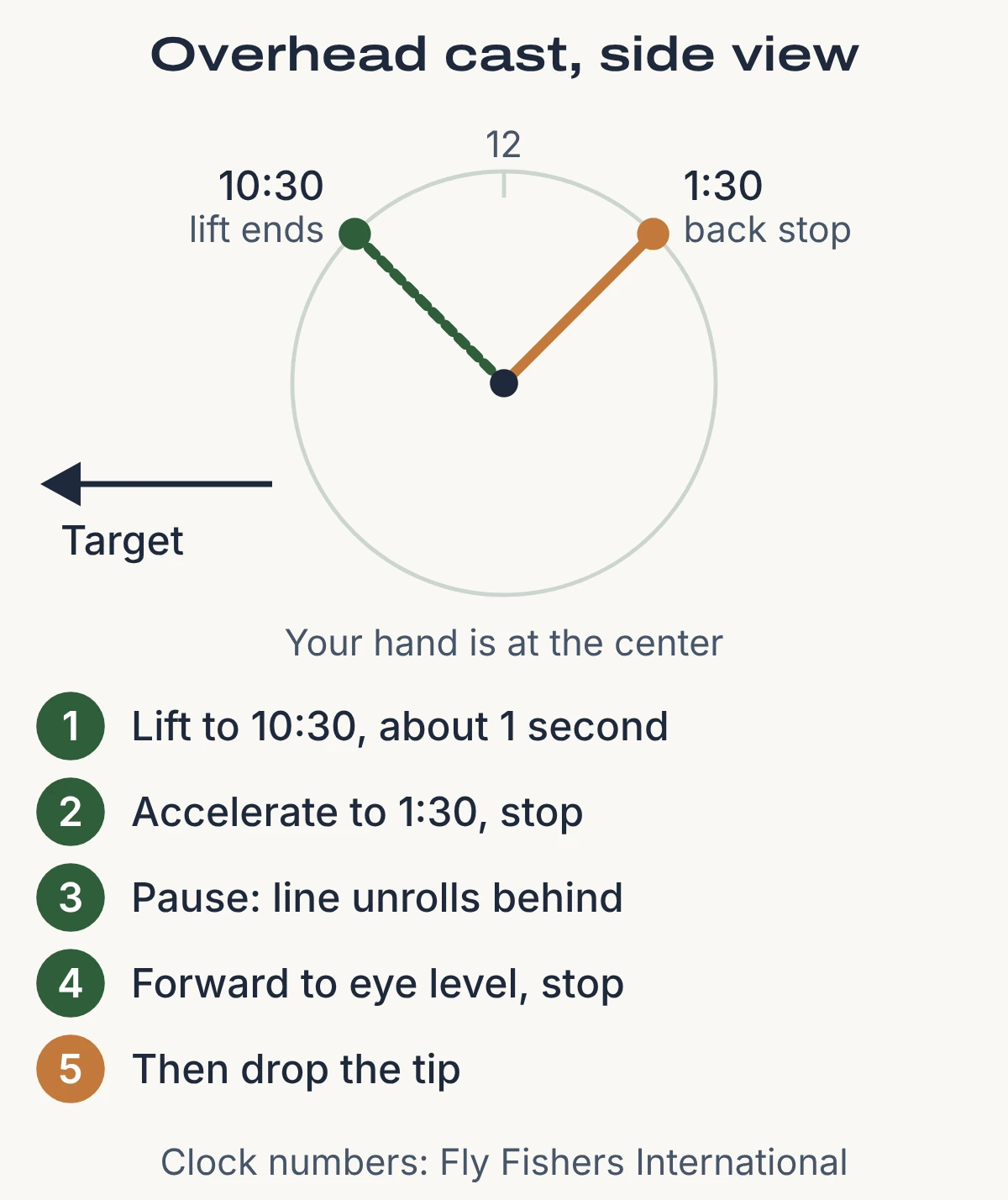
In FFI’s clock numbers (12 is straight up, as drawn in the diagram below), you “raise the rod tip to about 10:30.” The lift “will take about 1 second” and drags the line along the grass or water without lifting it off.
Accelerate back and stop
From 10:30, FFI says to “quickly accelerate the rod to 1:30 and stop it there.” Orvis calls this “pop to a stop,” ending “across from our shoulder or across from our ear.” Do not swing farther: Orvis warns that if you come back too far, “that usually sends that line down and back, and it’s going to end up getting stuck in the trees or in the bushes.” Trout Unlimited’s Kirk Deeter passes on a tip from the late guide Dan Stein: “keep the thumb on the grip of your rod where you can track it.” Deeter says a thumb pointing at your shoulder has dropped out of sight, and that means a broken wrist, which “drops the rod tip and takes all the line energy out of the fly-casting stroke.”
Pause and let the line unroll behind you
Orvis’s casting lesson says “we pause in between those two casts and let that line roll out behind us,” and starts forward “Just as that leader is about to straighten out.” Orvis News writer Zach Matthews, an FFI-certified casting instructor, suggests standing slightly open “so you can turn your head and look behind you” and waiting for the line to finish unrolling. Keep your hand where it stopped; drifting forward early is called creep (see the fault table).
Accelerate forward and stop at about eye level
TFO says to start “the forward cast ending at roughly eye level before coming to a quick, complete stop.” Matthews adds that you should rotate the wrist into the stroke, “pointing the thumb a few feet above the target.” Keep the power even, with the greatest power applied “right before the rod comes to a stop.”
Stop, then drop
Orvis’s rule is “think stop, then drop” and “Stop the rod first.” The line unrolls and straightens in the air; only then lower the tip to the water. Deeter is blunt about it: “Don’t you dare drop your hand to waist level.” Dropping early gives what Deeter calls a “slushy, often splashy mess.”
Safety
Practice with yarn until the loops look right, and only then tie on a fly. Look behind you before every cast on the water. If a hook is stuck in someone, get medical help. For a hook in the eye, MedlinePlus (National Library of Medicine) says: “Leave the object in place. Do not try to remove the object. Do not touch it or apply any pressure to it.” and “Get medical help right away. Do not delay.”
The roll cast, for when there is no room behind you
Use it when a tree, rock, bush or “maybe another angler” blocks the back cast, in Orvis’s words. It works on water, because “We need some line touching the water” to anchor it.
Start with the line out on the water in front of you
The part touching the water is the anchor.
Draw the rod back slowly
Lift and bring the rod back, dragging the line toward you, and “stop right across our ear.” The loop of line hanging behind your hand is called the D loop.
Flick forward to a stop
Orvis describes “a nice flick to a stop” at “around eye level, and that’s going to get that line to roll right out.” Check who is near you before the forward flick, and keep the fly pointed away from people.
False casts, and how to make a longer cast
A false cast is the back-and-forth motion you see before the fly lands. FFI says it “allows us to change cast distance, change direction, and dry a wet fly.” Pete Kutzer, an Orvis fly-fishing instructor, says to start the next back cast “Just before that line straightens out” and adds “don’t false cast too much.”
For distance, start with shooting line, which means letting the weight of the line pull extra running line out through the guides as the cast unrolls forward. Matthews says it makes you more accurate and leaves you less tired. He adds that “the double haul is the key to both control on windy days and to true distance casts over eighty feet.” The double haul is a skill for after the basic cast feels easy. TFO also warns that “the longer the stroke the more that can go wrong,” so keep the stroke short and let line speed do the work.
Why your cast goes wrong
The faults below come from Orvis News and Trout Unlimited, and each has a fix. Matthews says anglers pretty much make the same mistakes, so yours has probably been tackled before.
| What you see | Likely cause | Fix |
|---|---|---|
| Line tangles or crosses itself (“wind knots”) | A tailing loop, from punching the rod forward or creeping forward before the back cast unrolls | Apply power evenly with “the greatest power applied right before the rod comes to a stop”; wait for the back cast to unroll |
| Fly kicks sideways; leader lands bent | Front and back casts out of plane: “a 90-degree bend in your leader” | Turn your head and pick a spot directly behind you, opposite the target |
| Line lands in a “slushy, often splashy mess” | Hand dropped at the end of the forward cast | Stop the rod, then drop |
| Line snags behind you or the back cast falls | Back cast went too far, or the wrist broke, which “drops the rod tip and takes all the line energy out of the fly-casting stroke” | Stop near your ear and keep your thumb where you can see it |
| Slack on the back cast | A flick that sends the line downward, which “creates too much slack to make a solid forward cast” | Accelerate smoothly to a firm stop |
| Cast crashes before the fly turns over | “the cast lacks sufficient power to turn over the fly,” or the shooting line overruns a bulky fly | Check the faults above; a light rod may be too little rod for a big fly |
A friend with a phone helps. TFO’s advice is “Get someone to take footage of your casting,” and Matthews says creeping anglers rarely believe they are doing anything wrong until they see it.
Casting in wind
Orvis News reports that Capt. Chris Myers makes the point that “the best way to beat the wind is to cast directly into it as much as possible,” aiming for “a tight loop, straight into the wind.” Orvis News also lists “casting under the wind” among the old wives’ tales to avoid. Deeter agrees that “The key to wind casting is forming tight loops,” and that comes from stopping the rod at the moment of delivery.
Why a tight loop? Orvis Learning Center writer Jim Lepage, writing about saltwater trips, puts it this way: “A big loop catches wind, a small loop exposes little of the line to the wind and casts farther, more accurately.” He also says to practice in the conditions you will fish: “Practice on windy days, and cast with the wind in your face and from odd angles.”
Practice that builds the cast
- Split the cast in two. Kutzer says to work on casts of 20 to 30 feet and “cast at a side-arm angle” so the forward and back cast are separate. Make a forward cast and let it land, then a back cast at the same angle and watch the loop unroll. “Only after these two pieces feel pretty good and are landing nicely, link them together.”
- Use a grass line. An old fly line cleaned after each session, with a yarn fly, is Matthews’s suggestion.
- Set a target such as a hoop on the lawn, and vary the distance and the wind angle, as Lepage advises.
- Film yourself from the side and compare it with the numbers in the diagram.
Fly fishing with a spinning rod
Yes, in one way: a bubble rig. Riverbum, an online fly-fishing retailer, writes that “Fishing with a fly on a bubble involves using a spinning rod and reel to cast a fly that would typically be used in fly fishing.” The clear float gives the weight to cast a light fly, and Riverbum recommends “A spinning rod and reel (light to medium-light action is best).” Riverbum is the only source here for the setup, so treat the details as one retailer’s advice. It is not fly casting, so none of the steps above apply.
Related guide: How to Set Up a Tenkara Rod: Line, Tippet and Fly, Step by Step
Related guide: How to Cast a Baitcaster Reel Without Backlash, Step by Step
If you are buying for it, our roundup of trout spinning rods covers light rods, and our spinning rods under $100 roundup covers budget options. Neither roundup covers bubble rigs; both compare the rods for ordinary spinning use. If you are starting with no gear at all, see our beginner spinning and spincast rod-and-reel combos.
Frequently Asked Questions
Q. How far should I be able to cast before I go fishing?
TFO says 20 or 30 feet with good line control catches freshwater fish consistently. Its rule of thumb for saltwater is 50 feet with only a couple of false casts.
Q. How do I cast a fly rod farther?
Keep the stroke short, stop the rod firmly, and shoot line. Learn the double haul once the basic cast is smooth; Orvis News ties it to casts over eighty feet.
Q. What rod weight should I learn on?
CPW suggests a 9-foot, 5-weight as a general-purpose rod for Colorado. Choosing a rod for other fish or water is a separate decision.
Q. Can I cast without a fly while practicing?
Yes, and you should. Use a piece of yarn as the practice fly so no hook is in play.
Q. Do I need to buy a special rod to cast in wind?
Not to start. Lepage says a tip-flex rod keeps a tighter loop on windy days, but he is writing about saltwater trips, and Deeter ties tight loops to a crisp stop of the rod.
Q. How do I fish a fly rod once I can cast?
Casting is the first half; managing the line, setting the hook and landing fish are a separate skill, so this guide stops at the cast.
Sources (18)
- Fly Fishers International, False Casting
- Orvis Fly Fishing Learning Center, Overhead Cast: The Grip In Fly Casting And Rod Tip Position
- Orvis Fly Fishing Learning Center, Overhead Cast: Importance Of The Pause And Rod Angles
- Orvis Fly Fishing Learning Center, The Roll Cast
- Orvis Fly Fishing Learning Center, False Casting
- Orvis Fly Fishing Learning Center, Cast Better Into the Wind
- Orvis News, Top 5 Fly-Casting Mistakes and How to Correct Them
- Orvis News, How to Fly Fish: The Basic Back Cast
- Orvis News, Pro Tips: How to Practice at Home for Fishing
- Orvis News, Video: How to Cast in the Wind
- Orvis News, Why Sunglasses are so Important for Anglers
- Trout Unlimited, Three of my favorite fly-casting tips
- TFO, Part V: How to Get Started in Fly Casting
- Gink and Gasoline, Sunglasses: Don’t Leave Home Without ‘Em
- Colorado Parks and Wildlife, Fly Fishing
- MedlinePlus, Eye emergencies
- Florida Fish and Wildlife, Do I need a license or permit?
- Riverbum, Mastering Fly Fishing with a Bubble