The short answer
A medium-light rod is one its maker labels one power step below medium and one above light. It bends fairly easily and, in the same-maker rows below, tops out at lighter lures than that maker’s medium. Spinning makers print about 4 to 15 pound line and 1/16 to 3/4 ounce lures, and the ranges differ.
Medium-light, often printed “ML”, is a label each maker applies to its own rods, not a measured unit. The Fairfax County Park Authority’s rod guide says “There is no standard for any of these ratings. One company’s medium power can be another company’s heavy power.”
Related guide: What Does Medium Heavy Mean on a Fishing Rod?
So this page shows what several makers print for medium-light spinning and casting rods, how power differs from action, and how medium-light sits between light and medium.
What “medium-light” power means
MeatEater’s guide to conventional rods lists the power steps as ultra-light, light, medium-light, medium, medium-heavy, heavy and extra heavy. Medium-light is the third of the seven steps, one above light and one below medium. MeatEater says power “refers to the pressure needed to bend the rod”, so a medium-light blank is stiffer than a light one and softer than a medium.
Kentucky Afield, a column from the Kentucky Department of Fish & Wildlife Resources, puts it as a printed rating: “The power rating is simply the manufacturer’s recommended line and lure weight.” It adds that this information is usually printed near the handle. The two views meet on the label: a power word plus a line range in pounds and a lure range in ounces.
For medium-light, the Fairfax guide says it “is for casting smaller-sized lures, has limited ability to pull fish”. The same guide says medium-light is best used for lighter lures and for areas with little to no snags. MeatEater adds a caution about all of these labels: “rod power and action are not scientific measurements”.
Power is not action
Kentucky Afield says anglers sometimes talk about a “medium action rod”, but “there really is no such thing”. What they are likely describing, the column says, is a medium-power rod with a fast action. The same mix-up happens with “medium-light action”. Power is how much force it takes to bend the rod. Action is where the bend sits.
Makers print both, and medium-light comes in different actions. St. Croix’s Premier medium-light spinning rods are Fast, Pflueger’s President XT medium-light is Extra Fast, and St. Croix’s Mojo Bass medium-light casting rod is Moderate Fast. The ML tells you nothing about which one you are getting.
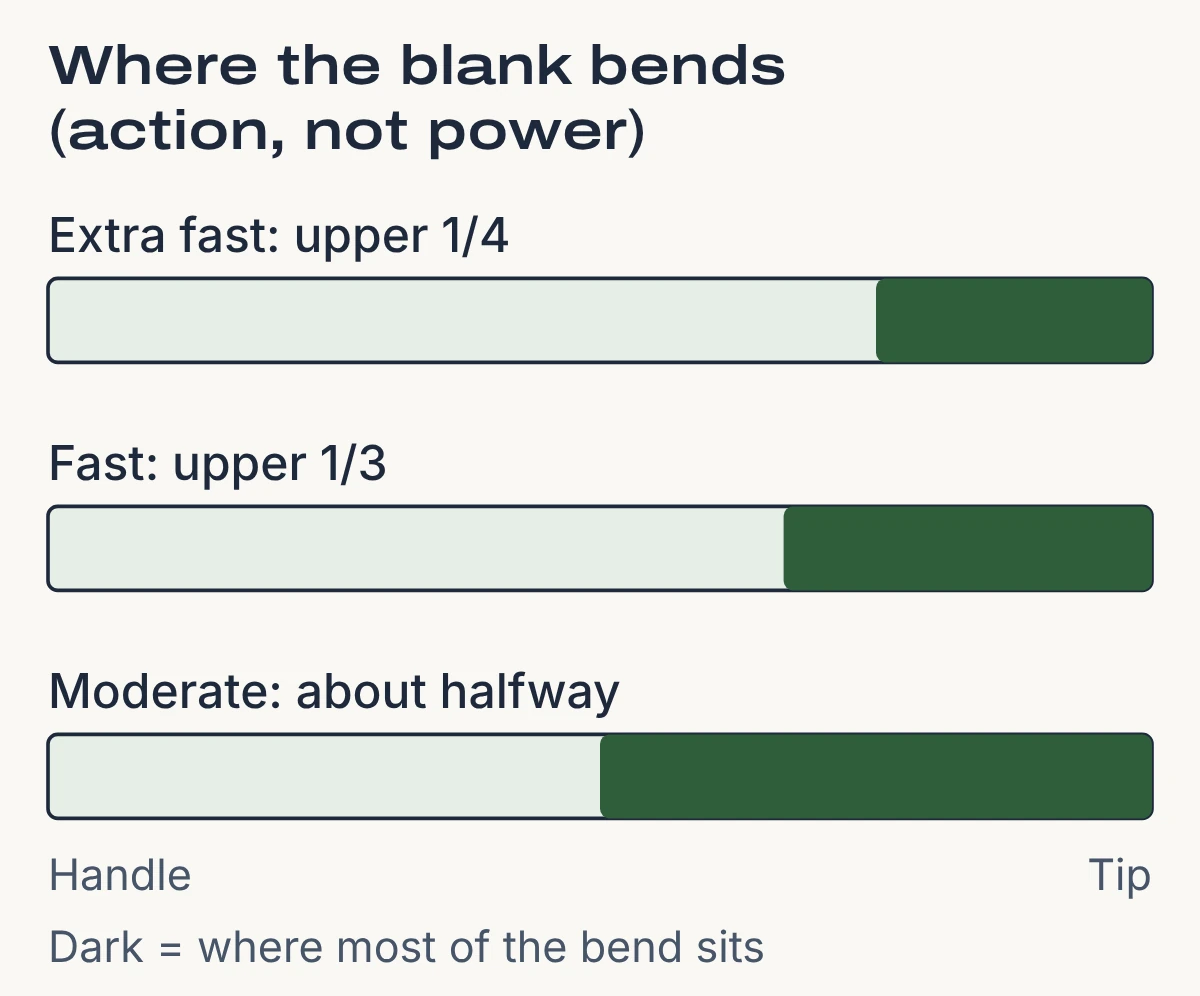
Sources do disagree on the fractions. The Fairfax guide puts an extra-fast action in the upper 1/4 of the rod, a fast action in the upper 1/3 and a moderate action about halfway. Kentucky Afield says fast action rods bend “mainly in the upper one-quarter”, and MeatEater says a fast-action rod bends most “in the upper third of the rod blank”. Use the words as a rough order from tip-bending to deep-bending, not as measurements.
Kentucky Afield recommends a fast or moderate-fast action for its example of medium-light use, kayak fishing in streams and small lakes, because it “grants the needed forgiveness” in moving water or wind.
What makers print for a medium-light spinning rod
The table lists one medium-light spinning model from each of six makers or brands, with the figures each prints. They are examples, not a definition.
| Maker (source type) | Medium-light model | Line rating | Lure rating | Action |
|---|---|---|---|---|
| St. Croix Premier (maker) | 6’6″ SCPS66MLF | 4-10 lb (1.8-4.5 kg) | 1/8-1/2 oz (3.5-14 g) | Fast |
| St. Croix Avid (maker) | 6’6″ ASFS66MLF | 4-8 lb (1.8-3.6 kg) | 1/8-3/8 oz (3.5-11 g) | Fast |
| Shimano Convergence (maker’s shop page) | 7′ CVS70ML4D | 6-10 lb mono (2.7-4.5 kg) | 3/16-3/8 oz (5.3-11 g) | Fast |
| Daiwa Tatula XT (maker) | 7′ TATULAXT701MLFS | 6-12 lb (2.7-5.4 kg) | 1/8-3/8 oz (3.5-11 g) | Fast |
| Pflueger President XT (maker) | 6’6″ PFLPXT66ML-XFS2 | 4-10 lb (1.8-4.5 kg) | 1/16-3/8 oz (1.8-11 g) | Extra Fast |
| PENN Squadron IV Inshore (maker) | 7′ SQDINIV815S70 | 8-15 lb (3.6-6.8 kg) | 1/8-3/4 oz (3.5-21 g) | Extra Fast |
Five things stand out.
- The line floor moves. St. Croix’s Premier and Avid and Pflueger start at 4 pounds, Shimano and Daiwa at 6, PENN at 8.
- The line ceiling moves more. It runs from 8 pounds on the one-piece Avid up to 15 on the PENN. Even inside one St. Croix Avid length, the one-piece 6’6″ medium-light is rated 4-8 lb and the two-piece 4-10 lb.
- The lure ceiling mostly sits at 3/8 ounce. Avid, Shimano, Daiwa and Pflueger stop there, Premier at 1/2 ounce and the PENN inshore rod at 3/4 ounce. The floor runs from 1/16 ounce (Pflueger) to 3/16 ounce (Shimano).
- Braid is rated separately. Shimano lists 8-15 lb Power Pro braid beside the 6-10 lb mono figure. FishUSA, a tackle retailer, says line ratings are typically based on mono or fluoro and “Braid runs higher”.
- Makers describe the rods’ jobs in their own words. Pflueger calls the President XT family, which includes the rod in the table, “perfect for a wide variety of species; Bass, Walleye, Panfish, Trout and Steelhead”. PENN says its Squadron IV Inshore rods are “designed for anglers seeking a high-performance, durable rod for inshore fishing”.
Some lines skip medium-light
A medium-light is not offered in every series. Ugly Stik’s GX2 spinning page lists ultra light, light, medium, medium heavy and heavy, with the Light models at 4-10 lb and the Medium ones at 6-15 lb (4-20 lb on its 9-foot). Fenwick’s HMG Trout & Panfish spinning page offers ultra light and light only. G. Loomis’s IMX-PRO Bass SJR table lists Light and Medium models, where the Medium ones are rated 6-12 lb and 1/8 to 3/8 ounce. Check the maker’s table for the power you want.
Medium-light casting rods
Kentucky Afield says spinning rods have more power ratings than baitcasting rods, and the casting tables here bear that out in part. On St. Croix’s site, the casting tabs for its Premier, Triumph and Avid series list nothing lighter than medium, and the casting rods in those tabs are rated 10-17 lb at medium. Ugly Stik’s GX2 shows how a power word shifts between platforms: its 7-foot two-piece Medium spinning rod is rated 6-15 lb and its 7-foot two-piece Medium casting rod 8-20 lb.
Some casting medium-lights do exist.
| Maker (source type) | Medium-light casting model | Line rating | Lure rating | Action |
|---|---|---|---|---|
| St. Croix Mojo Bass (maker) | 6’10” JOC610MLMF | 6-20 lb (2.7-9.1 kg) | 1/8-7/16 oz (3.5-12 g) | Moderate Fast |
| Ugly Stik GX2 (brand owner Pure Fishing) | 7′ USGXCA702ML | 8-20 lb (3.6-9.1 kg) | not listed | not listed |
| Ugly Stik GX2 (brand owner Pure Fishing) | 7’6″ USGXCA761ML | 6-17 lb (2.7-7.7 kg) | not listed | not listed |
St. Croix lists the technique for the Mojo Bass rod as “BFS Trebble Lite”. The two Ugly Stik rods are the same power and same maker with different line ratings, 8-20 lb at 7 feet and 6-17 lb at 7’6″.
Platform advice leaves a medium-light casting rating in the overlap. Kentucky Afield’s rule of thumb is that any situation needing 10-pound line or lighter and 3/8-ounce or lighter lures “should be cast on spinning gear”, while lures of 1/2 ounce or more go on baitcasting gear. FishUSA says an average lure weight under 1/4 ounce points to spinning and 3/8 ounce and up to casting. A 1/8 to 7/16 ounce rating sits between those lines, so the lure you throw most should decide the platform, not the letters ML.
Medium-light next to light and medium
The table compares three powers from one maker at one length, so the differences are the maker’s own. A dash means the maker’s page lists no rod at that power.
| Maker and length | Light | Medium-light | Medium |
|---|---|---|---|
| St. Croix Premier 6’6″ spinning | 4-8 lb (1.8-3.6 kg), 1/16-5/16 oz (1.8-8.9 g) | 4-10 lb (1.8-4.5 kg), 1/8-1/2 oz (3.5-14 g) | 6-12 lb (2.7-5.4 kg), 1/4-5/8 oz (7.1-18 g) |
| Shimano Convergence 6’6″ spinning | 6-10 lb (2.7-4.5 kg), 3/16-3/8 oz (5.3-11 g) | 8-12 lb (3.6-5.4 kg), 1/4-1/2 oz (7.1-14 g) | |
| Daiwa Tatula XT 7′ spinning | 6-12 lb (2.7-5.4 kg), 1/8-3/8 oz (3.5-11 g) | 6-14 lb (2.7-6.4 kg), 1/8-3/4 oz (3.5-21 g) | |
| Ugly Stik GX2 6’6″ spinning | 4-10 lb (1.8-4.5 kg), no lure rating | 6-15 lb (2.7-6.8 kg), no lure rating |
Reading across:
- Medium-light against medium. In all three makers’ rows that list both, the medium-light tops out lower than the medium: 10 against 12 lb and 1/2 against 5/8 ounce at St. Croix, 10 against 12 lb and 3/8 against 1/2 ounce at Shimano, 12 against 14 lb and 3/8 against 3/4 ounce at Daiwa. The lures at the low end overlap, and Daiwa’s two rods share the same 1/8 ounce floor.
- Medium-light against light. At St. Croix both start at 4 pounds, and the medium-light reaches 10 pounds and 1/2 ounce against the light’s 8 pounds and 5/16 ounce. Kentucky Afield says light power spinning rods “are not utilized as much as they should”, because many anglers go up to a medium light or medium.
- In the maker’s own words. Salt Strong, a saltwater fishing site, wrote about the Slam Stick rods it features that the medium light “shines when throwing smaller, lighter lures with more finesse”, with a softer tip that helps “with casting distance and feel on subtle presentations”, while the medium “offers a bit more power for larger lures and heavier weedless setups”. That describes one rod line on one site and is not a test.
- Use the lure rating. FishUSA’s advice is “Use the lure weight rating as your consistent reference — not the power letter.” Its own chart, a retailer’s and not any maker’s, gives medium-light as 4-10 lb mono and 1/8 to 1/2 ounce, against 4-8 lb and 1/32 to 1/4 ounce for light and 6-12 lb and 1/4 to 3/4 ounce for medium.
What a medium-light rod is good for
The sources cited here point to smaller lures, finesse presentations and open water.
- Jigs and soft plastics on spinning gear. Kentucky Afield says a medium light power spinning rod of 6½ to 7½ feet “makes an excellent choice for kayak fishing in streams and small lakes”, and that it casts 1/8- to 5/16-ounce jigs and soft plastic lures well. FishUSA lists “Walleye jigs, Ned, finesse rigs” for medium-light and says “A medium-light spinning rod covers finesse bass, walleye jigs, and panfish from the same platform.”
- Walleye. MeatEater says that for soft plastics along the bottom, where you need to detect subtle strikes, “you’ll want a medium-light or medium-power rod that can cast larger lures and set big hooks but still has some sensitivity” and that is its example for walleye fishing.
- Bass, finesse. In a r/Fishing_Gear thread, one owner (scavenger313) writes “The ned rig and dropshot are both setups that work better with ML because you can feel the bait so much better than you can with a medium.” Our roundup of spinning rods for bass includes a 7-foot medium-light fast finesse rod, the Dobyns Champion XP.
- Trout and steelhead. Pflueger names trout and steelhead among the species for the President XT family, which has medium-light models, and our trout spinning rod roundup lists the 6’6″ medium-light. FishUSA’s technique chart pairs a long medium-light or medium rod with steelhead float and drift fishing.
- Inshore salt. PENN builds its Squadron IV Inshore line, including a 7-foot medium-light, for inshore fishing. Salt Strong’s Slam Stick article is about inshore rods.
Limits, and the “big fish” question
The Fairfax guide says medium-light “has limited ability to pull fish”. Owners on the same Reddit thread give mixed pictures of what that means in practice, and they are single reports, not tests:
- RiggsyDiggsy writes “I’ve caught a 4# smallmouth and a catfish that was probably 4-5# and it handled them, but I wouldn’t want to fight anything much larger than that on either one.”
- RightHyah writes “Caught a 7 lb bowfin on my medium light spinning rod this weekend” and adds “A medium light is a great rod unless you’re fishing around logs and docks”.
- scavenger313 says “the main thing to consider isn’t the fish you are catching, but rather the structure that you are fishing”, and uses a medium instead of a medium-light around fallen trees.
None of the maker or agency sources sets a fish-size limit. What they print is the line and lure range, and the Fairfax guide warns that “the chances increase of a rod breaking, before your line, with every pound test size you go over the lines rating.”
How to read a medium-light label
Quick check
On the rod or in the maker’s table, read the power (Medium Light or ML), the action (Fast, Moderate Fast), the line in pounds and the lure in ounces. Match the lure you throw most to the middle of the lure range, and keep your line inside the line range, rather than trusting the letters ML.
- Aim for the middle of the lure range. The Fairfax guide’s author says “lures on the low and high ends often do not cast as well as the lures in the middle of the range”, and calls it a general guideline.
- Stay inside the line rating. The same guide warns about going over it, as quoted above.
- Match the reel. Our spinning reel size guide shows how to read a reel’s line rating next to the rod’s.
Ready to buy?
Our roundup of spinning rods under $100 includes two medium-light rods, the 7-foot Shimano Convergence D travel rod and the 7-foot PENN Squadron IV Inshore, next to its medium and light picks, and each review gives the line and lure ratings where its maker prints them.
Frequently Asked Questions
Q. What is a medium-light rod best for?
Smaller lures and finesse presentations: jigs and soft plastics for bass and walleye, per FishUSA, MeatEater and Kentucky Afield. Pflueger also lists trout, panfish and steelhead for its President XT family. The Fairfax guide says medium-light is best for lighter lures and areas with few snags.
Q. Can you catch big fish on a medium-light rod?
Owners report both ways: one says a medium-light handled a 4 pound smallmouth and a catfish of about 4-5 pounds but he would not fight much larger, another reports a 7 pound bowfin. The Fairfax guide says medium-light “has limited ability to pull fish”, and no maker source here sets a fish-size limit, so work from the printed line rating.
Q. How much can a medium-light rod handle?
Whatever its label says. The spinning rods in the table above are rated for 4 to 15 pound line and 1/16 to 3/4 ounce lures, and casting medium-lights from 6 to 20 pound line. The ranges differ by maker, so read your rod’s own line and lure ratings.
Q. Should I choose medium or medium-light for bass or walleye?
It depends on lure weight and cover. FishUSA’s chart pairs walleye jigs with medium-light to medium, and finesse rigs such as Ned and drop-shot with medium-light. Owners on Reddit say to go to a medium around timber and logs.
Q. Is “medium-light action” the same as “medium-light power”?
Usually people mean power. Kentucky Afield says there is no such thing as a “medium action” rod: medium is a power, and action is where the rod bends, so a medium-light rod can be fast, extra fast or moderate fast.
Q. What is the difference between a medium-light and a light rod?
In St. Croix’s Premier 6’6″ rods the medium-light is rated for 4-10 lb and 1/8 to 1/2 ounce, the light for 4-8 lb and 1/16 to 5/16 ounce. The makers’ ranges overlap, so compare the printed lure ranges.
Sources (20)
- Fairfax County Park Authority, Fishing Equipment Definitions and Usage: Fishing Rods
- Kentucky Department of Fish & Wildlife Resources, Kentucky Afield Outdoors – Power vs Action
- MeatEater, Conventional Fishing Rod Action and Power Explained
- FishUSA, Fishing Rod Power Vs Action
- Salt Strong, Medium Light vs Medium vs Medium Heavy: Which One Should You Fish?
- St. Croix Rod, Premier spinning and casting rods
- St. Croix Rod, Avid Series
- St. Croix Rod, Triumph
- St. Croix Rod, Mojo Bass
- Shimano, Convergence Spinning
- Daiwa, Tatula XT
- Pflueger, President XT Spinning Rod
- PENN, Squadron IV Inshore Spinning Rod
- Pure Fishing, PENN Squadron IV Inshore Spinning Rod
- Pure Fishing, Ugly Stik GX2 Spinning Rod
- Pure Fishing, Ugly Stik GX2 Casting Rod
- Fenwick, HMG Trout & Panfish Spinning Rod
- G. Loomis, IMX-PRO BASS SJR
- Reddit r/Fishing_Gear, Medium vs Medium Light?
- Outgearly, Best Spinning Rods Under $100 (the roundup this article supports)