The short answer
Pitch on level, sheltered ground, then build your bed from the ground up: a sleeping pad with enough R-value for the night’s cold, a sleeping bag rated for that night, and a pillow. Ventilate the tent, drink water and use the bathroom before bed, and never run a fuel-burning heater inside the tent.
Most bad nights in a tent come from a few fixable things: a slope, a cold floor, a bag that is too thin, damp air or noise. This guide fixes them in the order you meet them, from picking the spot to the middle-of-the-night bathroom trip.
Related guide: How to Choose a Canvas Tent Size
Cold-weather insulation is its own subject, so for freezing nights read our guide to insulating a tent for winter after this one.
What you need
- A tent with working vents and enough floor for you and your gear.
- A sleeping pad with a stated R-value, and optionally a closed-cell foam pad to go under it.
- A sleeping bag or quilt rated for the coldest night you expect.
- A pillow made for camping, or a soft stuff sack.
- Sleep-only clothes, socks and a hat.
- A headlamp, water and toilet paper, all within arm’s reach.
How to sleep comfortably in a tent, step by step
The first two steps are about where you pitch.
Pick a level, sheltered spot, away from fire and falling hazards, on a durable surface
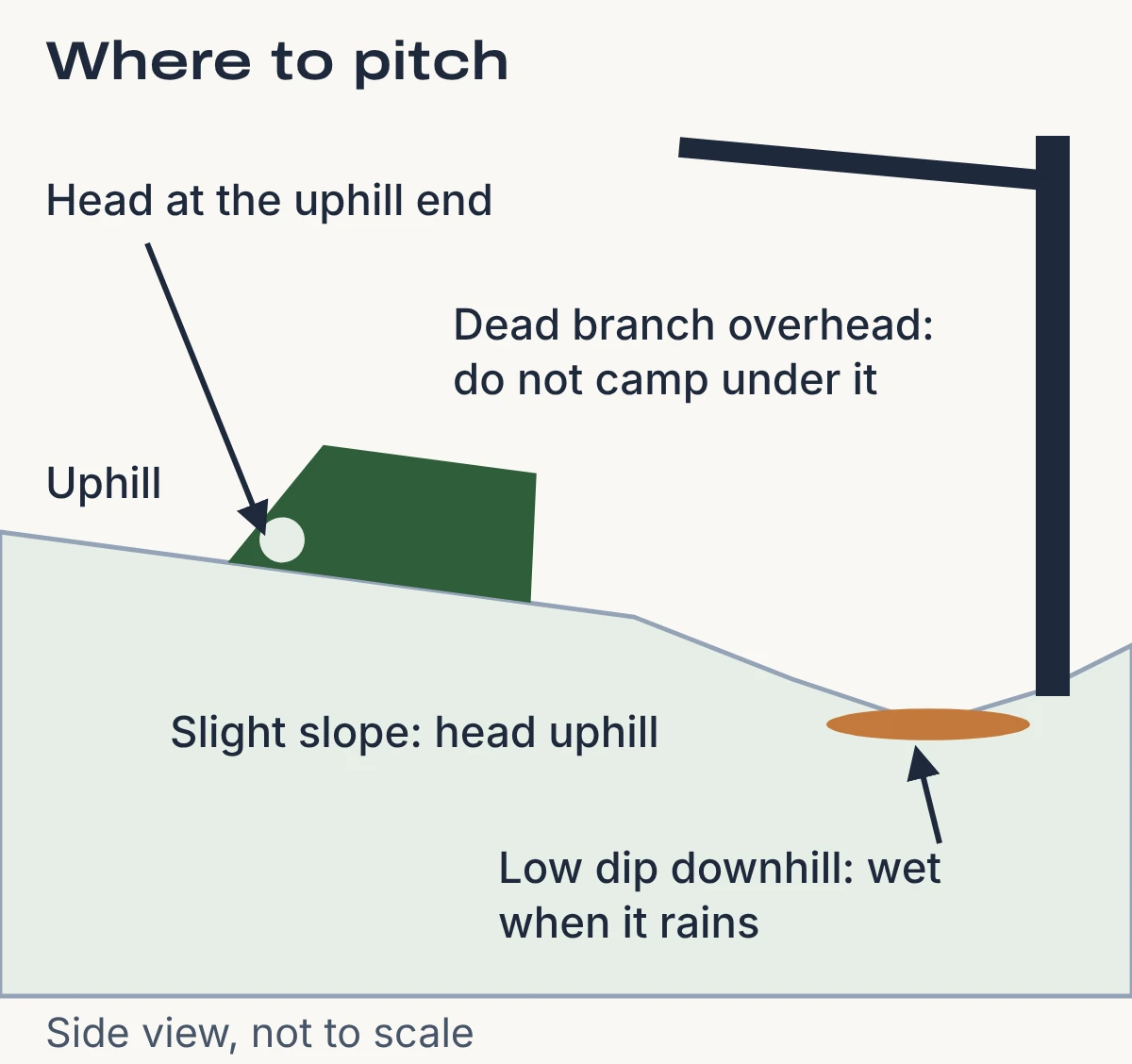
The National Park Service (NPS) says “An ideal location for your tent is on level ground, but not a low place, and a safe distance from your fire ring and cooking area. Sparks from your fire could melt holes in your tent (or ignite it altogether)”. Its list of places to avoid: “Sheltered and away from the middle of a field if there is a lightning storm and from the edge of cliffs.”, “Away from dead trees that might fall.” and “Away from ravines that might flood.” It also says “Look up; if you see dead branches overhead, you should not camp under them.” NPS’s Leave No Trace principles add “Durable surfaces include maintained trails and designated campsites, rock, gravel, sand, dry grasses or snow” and “Protect riparian areas by camping at least 200 feet from lakes and streams.” (200 feet is about 61 m).
Clear the ground and point your head uphill
NPS says “Find a large, flat place to put your tent, and remove any sticks, rocks, pinecones, or other debris from the area.” It warns against low spots, because “they can become extremely wet when it rains”, and says “Orient the tent so that your head will be on the uphill side while you are sleeping.” Kristen Bor of Bearfoot Theory, an outdoor blog, checks a spot with a transparent water bottle: “Place the mostly-filled water bottle on your desired camping spot horizontally.” If the bubble stays mostly in the middle, she says the spot is flat; that is her method, not an agency test.
Choose a pad with enough R-value for the night
R-value is a measure of how well the pad resists heat flowing from you to the ground. NEMO, a tent and pad maker, puts the rule this way: “The lower the temperature, choose a higher R-Value. The higher the temperature, choose a lower R-Value.” The table below gives Big Agnes’s bands. Check that the number comes from the ASTM F3340-18 test: Therm-a-Rest says that standard lets campers “directly compare the R-value of each” pad, and says most air pads made before 2000 had R-values below 2. Our sleeping pad vs air mattress comparison covers the trade-offs, and for a car-camping bed see our roundup of the best air mattresses for camping.
Stack a foam pad under it if the pad alone is not enough
NEMO says “R-Value is additive, which means that you can use two pads and add their R-Values together.” Therm-a-Rest’s example puts an air pad rated R-Value of 4.2 on a foam pad rated R-Value 2.6, giving a “cumulative R-Value of 6.8”. Big Agnes pairs its three-season air pads with a foam pad for a combined R-value of 5 or more. NEMO says “even with a very warm bag, you can still be cold if your pad is not warm enough”.
Pick a bag rated for the night, and the right length
Many makers rate bags with a lab test. Rab says “We use the EN ISO 23537 standard to rate most of our sleeping bags”, and the test uses a thermal mannequin: “A thermal mannequin is placed into the sleeping bag being tested, on a standard foam roll mat.” So the rating assumes a pad under you. Bearfoot Theory’s Bor adds “the temperature rating of a sleeping bag is an estimate” and suggests a bag “rated at least 10-20 degrees lower than you expect the outside temperatures to reach”. If you toss and turn, she says “A quilt is just as warm and gives you more freedom to move around.” Rab says its quilts “fall outside the scope of the EN standard”, so a quilt’s rating may be the maker’s own method. Size matters too: “Too long and your feet will be cold.”
Use a real pillow
Big Agnes says “resting your head on a comfortable pillow as opposed to a balled-up jacket, your arm, or nothing at all, can make a big difference in your sleep quality”. Bor describes inflatable pillows as “super packable, ultralight, and easily adjustable”, and says “compressible camping pillows are usually soft, cozy, and supportive”, though they are bulkier.
Dress for bed, not for the day
Bor’s advice is “Designate a set of clothes solely for sleeping.” NEMO says “Clothes are layers, too.” If your feet run cold, Bor says to “stash your down jacket down by your feet inside your sleeping bag”, and “Beanies work double duty by keeping you warm and drowning out some of the stimuli.” For colder nights add insulation, not heat: see the winter guide linked above and our roundup of tents for winter.
Never heat the tent with fuel
The Consumer Product Safety Commission (CPSC) says: “People die every year from carbon monoxide poisoning from the use of portable camping heaters, lanterns, or stoves inside tents, campers, and vehicles.” Its rules: “Do not use portable heaters or lanterns while sleeping in enclosed areas such as tents, campers, and other vehicles. This is especially important at high altitudes, where the risk of carbon monoxide poisoning is increased.” Its safety guide adds “Never use fuel-burning portable heaters or lanterns while sleeping in enclosed areas such as tents, campers and vehicles.” The symptoms are “headache, dizziness, weakness, nausea, vomiting, sleepiness, and confusion”. CPSC also says: “See a doctor if you or a member of your family develops cold or flu-like symptoms while camping. Carbon monoxide poisoning, which can easily be mistaken for a cold or flu, is often detected too late.”
Keep the vents open to limit condensation
MSR, a tent maker, says “While no tent design can eliminate condensation, the key to reducing it is ventilation.” Its advice is “Make sure to leave at least two vents open if possible”, and it lists “Wet ground or wet gear stored inside the tent.” as one of the three sources of moisture. MSR puts the moisture you add at “about 1 – 2 pints of moisture per night through breathing and skin evaporation” (roughly 0.5 to 0.9 L, our conversion); Terra Nova, another tent maker, says “A person can produce more than one litre of perspiration in a single night”. The two figures differ, so treat both as rough.
Plan for noise and light
NPS notes you can choose to be “farther away, where it’s quieter and darker” from the bathroom or shower house. Bor suggests “try finding a nice quiet dispersed site” if big campgrounds are loud. For light, she recommends a headlamp that “emits softer light, like yellow, orange, or red wavelengths.” If you use white noise, she suggests “keeping the volume low” so you can still hear anything you need to.
Drink enough, and use the bathroom before you lie down
Bor writes “Before you settle in your tent for the night, make sure you go to the bathroom.” and says “Dehydration can contribute to poor sleep” (a single-practitioner source). If you camp in bear country, NPS says “Always store food at least 200 feet from your sleeping space.” and “Keep 200 feet between a cooking space and sleeping space.” (200 feet is about 61 m), and “Check park regulations for proper food storage; many parks require a bear box or bag.” It also says “Do not sleep in clothes used during cooking.” For toilets, NPS’s Leave No Trace principles say “Utilize toilet facilities whenever possible”, and for solid waste, “catholes dug 6 to 8 inches deep, at least 200 feet from water, camp and trails” (15 to 20 cm; 61 m).
Set up for the night trip before dark
NPS says “Make camp before dark.” and “If you have to leave camp after dark, stay in areas you have seen in daylight, go with a companion, and use a headlamp.” Bor says her usual spot for a night bathroom trip is “within eyeshot of my tent”, and “Holding it will only disrupt your sleep in the long run.” Her list for a smooth night is “getting organized before dark with all of your essentials in reach”: headlamp, extra layers, water and toilet paper.
Choosing a pad: R-value and type
Check the pad’s R-value first. Big Agnes calls the pad “the only barrier between you and the cold, hard ground.”
| Season | Pad R-value (Big Agnes) |
|---|---|
| Summer, very warm weather | 2 or lower |
| Spring through fall | 4 to 4.8 |
| Winter | 5 or higher |
These are Big Agnes’s bands for its own pads, quoted as “Summer/Very Warm Weather (R-Value 2 or lower)”, “Spring through Fall (R-Value 4 – 4.8)” and “Winter (R-Value 5+)”. The maker gives no band for 2 to 4, and it adds “Conventional wisdom says to select a pad with an R-value of 5 or higher when sleeping on snow or frozen ground.” Therm-a-Rest says “Consider not just the seasons, but at what altitude and latitude too”, and adds that its pad guide treats warm and cold sleepers differently, so a number in the table is a starting point.
A worked-out example (our arithmetic): Big Agnes’s three-season bands run 4 to 4.8, and its BioFoam pad is “(R-Value 1.7)”, so the two together come to about 5.7 to 6.5, above the 5 it lists for winter. The sum rests on NEMO’s statement that R-values add.
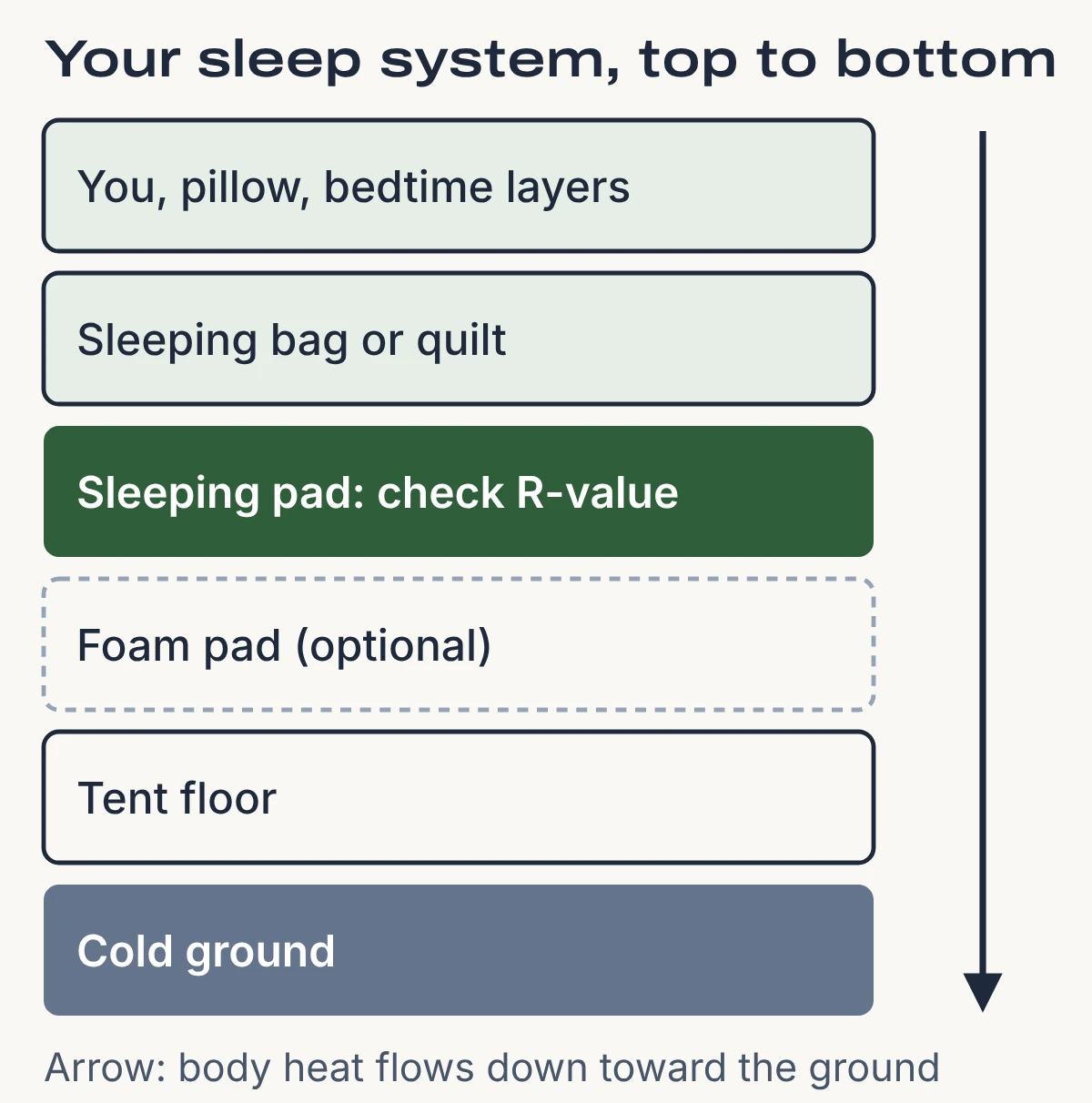
Why the pad and not a thicker bag? NEMO explains: “The insulation on the bottom surface of a sleeping bag is crushed under the weight of the sleeper, significantly limiting the effectiveness of the insulation.” and “Sleeping pads are most suited to insulating your bottom surface.”
| Pad type | Thickness (Big Agnes pads) | Maker note |
|---|---|---|
| Air pad | 2.5 to 4.25 in (6-11 cm) | Most compact |
| Self-inflating | 1.5 to 5 in (4-13 cm) | Foam inside |
| Closed-cell foam | Not stated | Durable; adds R-value |
The thickness figures are Big Agnes’s: air pads are “ranging from 2.5 – 4.25 inches thick” and self-inflating pads “range from 1.5 – 5 inches thick”. Therm-a-Rest says “Air pads provide the best option for people seeking the most compact solution in a sleeping pad”, that self-inflating pads are “offering some level of insulation at any inflation level”, and that its closed-cell RidgeRest pads “remain one of the most popular” first mattresses for their value. If money is tight, a foam pad is the value route; for a year-round setup, Therm-a-Rest suggests “using a closed cell pad under it to add extra insulation when the temperature drops”.
Reading a sleeping bag’s rating
Rab, which rates bags to EN ISO 23537, describes three limits:
- Comfort rating: “indicates the minimum temperature where an individual can sleep in a relaxed position”.
- Limit of Comfort: “is the lowest temperature where a person sleeping in a curled position and fighting against the cold can still sleep through the night”.
- Extreme rating: an emergency figure, and Rab warns “frostbite at these temperatures is very possible.”
Rab says “This is the rating we use in the names of our sleeping bags”, the Limit of Comfort. Other makers may print a different one of the three, so find which number is on your bag’s tag. Bearfoot Theory’s advice to choose a bag rated 10 to 20 degrees colder than the forecast is one practitioner’s cushion, not a standard.
Related guide: How to Use Tent Guy Lines
Common problems and fixes
| Problem | Likely cause | Fix |
|---|---|---|
| Cold from below | Pad R-value too low | Add a foam pad (step 4) |
| Sliding or rolling | Not level | Re-pitch (steps 1-2) |
| Damp tent ceiling | Condensation | Open vents (step 9) |
| Cold feet | Bag too long, or no layers | Right-size bag, jacket at feet |
| Waking to noise | Busy site, or light sleeper | Quiet site, beanie (steps 7, 10) |
| Cramped | Tent barely fits you | Bigger tent |
The last row has a source: Bor says “consider a 3-person tent rather than just a 2-person tent” when sharing a tent with another person, because a tent claiming to fit two may not be comfortable for two.
Related guide: How to Use Tent Stakes
Ready to buy?
If your tent is the weak link, see our two-person backpacking tent roundup, which compares sizes and weights. A two-person tent also gives a solo camper extra room.
When shivering is more than discomfort
The CDC’s National Institute for Occupational Safety and Health (NIOSH) says “Hypothermia is dangerous because a person may not know it is happening or be able to do anything about it.” It lists early symptoms that include shivering, fatigue, loss of coordination, and confusion and disorientation. It lists late symptoms as no shivering, blue skin, dilated pupils, slowed pulse and breathing, and loss of consciousness, so stopping shivering is not a sign of warming up. Its page is written for workers, and its first-aid steps begin with a call to “request medical assistance”. Read the NIOSH page on cold-related illnesses before a cold trip and follow it; this article does not improvise treatment.
Frequently Asked Questions
Q. What is the most comfortable way to sleep in a tent?
Level ground, a sleeping pad with an R-value that fits the night, a bag rated for it, and a pillow. The pad matters as much as the bag: Therm-a-Rest says its warmth is “every bit as important as the type of bag or quilt that you pair it with”, and NEMO says the bag’s insulation underneath you is crushed under your weight.
Q. How do I get a good night’s sleep in a tent?
Use the steps above: level site, pad, bag, vents open, and water and a bathroom trip before bed. Bor also suggests a soft headlamp and, if you like it, low-volume white noise.
Q. How do I pee at night when camping?
Go before bed, and pick the spot you will use ahead of time. Bor chooses one “within eyeshot of my tent”. Use toilet facilities when you can; for solid waste, NPS’s Leave No Trace principles say to use catholes “dug 6 to 8 inches deep, at least 200 feet from water, camp and trails”.
Q. What should I sleep on when camping in a tent?
A sleeping pad: air, self-inflating or closed-cell foam. See the pad table above; foam is the value route Therm-a-Rest describes, and this guide gives no prices.
Q. Is it safe to use a heater in a tent?
No. CPSC says “Never use fuel-burning portable heaters or lanterns while sleeping in enclosed areas such as tents, campers and vehicles.” and “Do not use portable heaters or lanterns while sleeping in enclosed areas such as tents, campers, and other vehicles.”
Sources (12)
- National Park Service, Finding and Setting Up a Campsite
- National Park Service, Leave No Trace: The Seven Principles
- CPSC, Portable Heaters & Camping Equipment
- CDC NIOSH, Cold-related Illnesses in Workers
- Therm-a-Rest (Cascade Designs), How warm is my sleeping pad and what is R-Value?
- Therm-a-Rest (Cascade Designs), How do I choose a sleeping pad?
- NEMO Equipment, New Standardized R-Value
- Big Agnes, Finding the Right Sleeping Pad
- Rab, Sleeping Bag Temperature Ratings Explained
- MSR (Cascade Designs), How do I prevent or reduce tent condensation?
- Terra Nova, How to Avoid Tent Condensation
- Bearfoot Theory, 18 Tips For Sleeping In A Tent Comfortably