The short answer
A backpacking tent is built to be carried: popular two-person models weigh about 3 pounds (1.4 kg) and you sit up inside. A camping tent rides in the car: about 9 pounds (4 kg) for a small dome to 20-plus (9 kg) for six people, and large ones stand about 6 feet tall. Choose by carry distance.
In this comparison, a camping tent means a car-camping or family tent, and a backpacking tent means one built to carry in a pack, from ultralight shelters to budget models.
Related guide: 3-Season vs 4-Season Tent: What Changes and Which One You Need
The figures below come from two test publications, Switchback Travel and OutdoorGearLab, plus makers’ own numbers, so you can see how big the gap is in numbers, not adjectives.
The differences side by side
| Backpacking tent (2-person) | Camping tent (4-6 person) | |
|---|---|---|
| Weight | 1 lb 3.5 oz to 3 lb for popular models; budget models about 5.5 lb | About 9 lb for a budget 4-person dome; 16 lb for a budget 6-person dome; many 6-8 person tents top 20 lb |
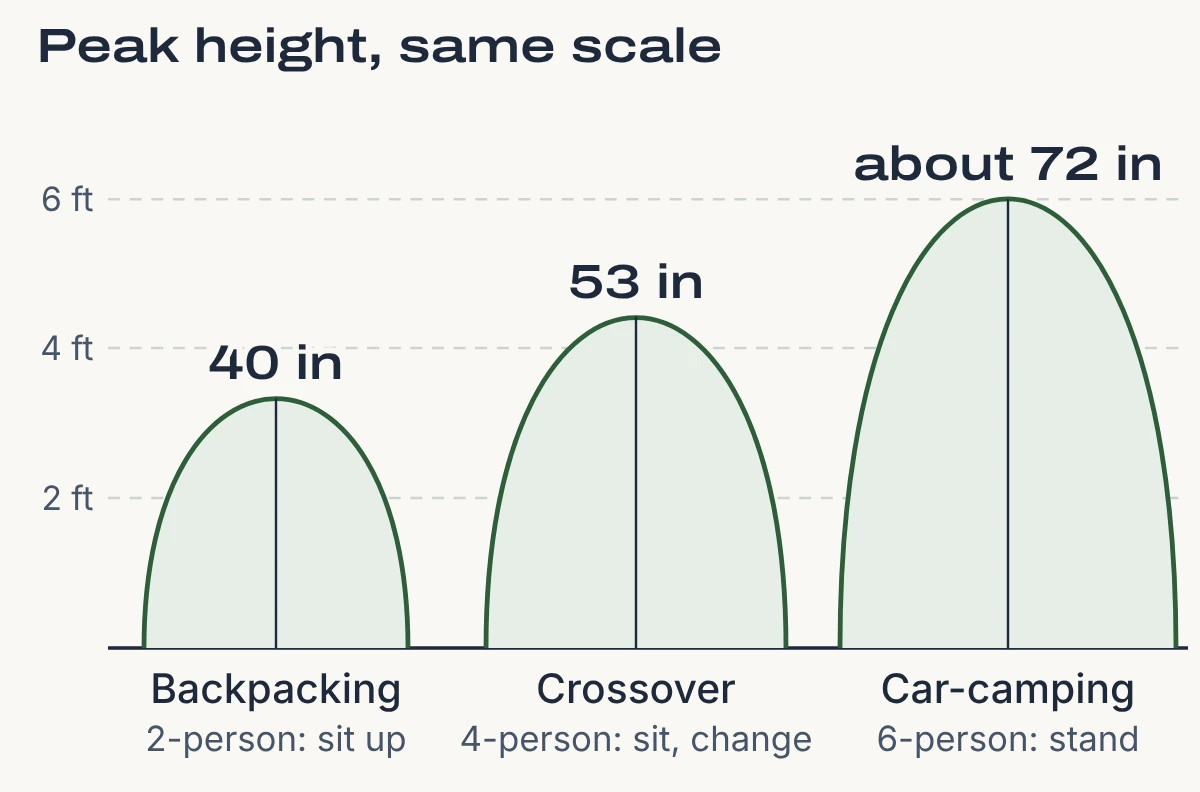
| Peak height | 39 to 48 in: room to sit up | About 48-59 in on small budget domes (sit); around 72 in on most large tents (stand) |
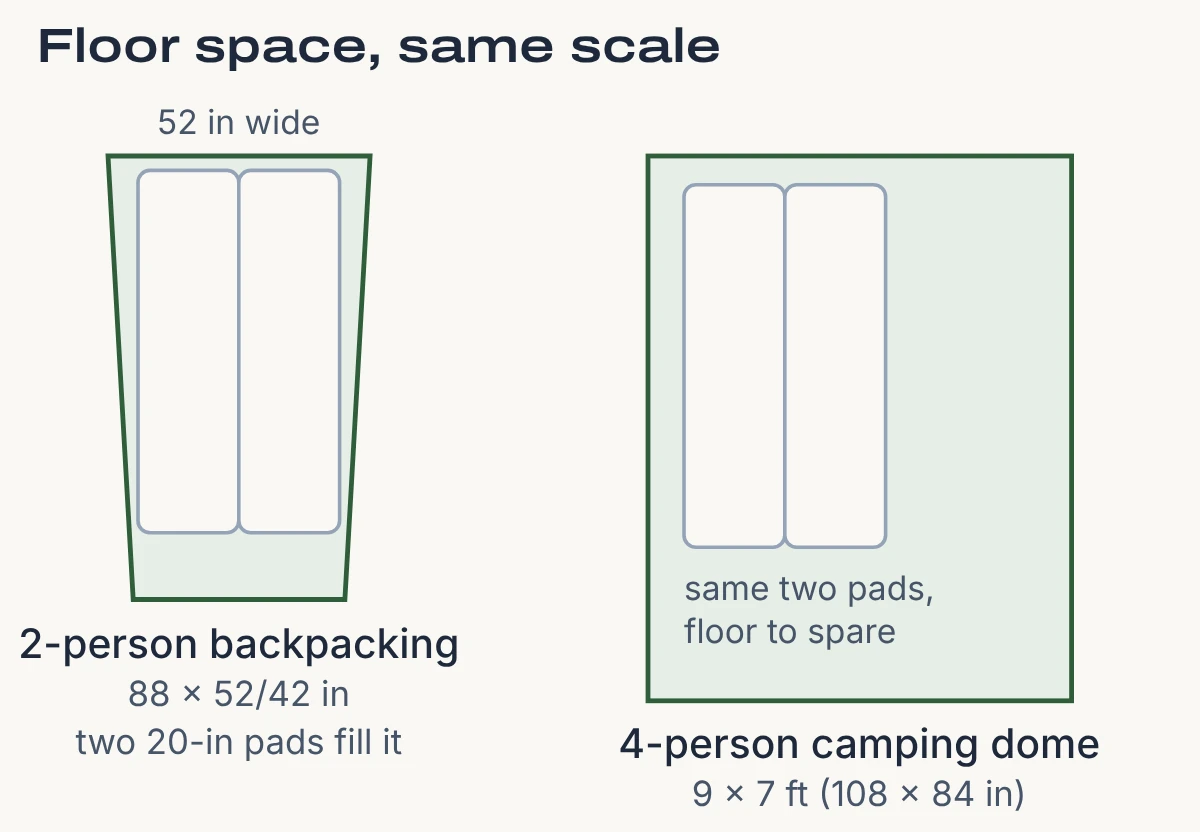
| Floor | About 88 x 52 in: two 20-in pads side by side | 63 sq ft (4-person dome) to 85 sq ft (6-person dome) |
| Floor fabric | Often 15D to 20D; 75D on budget models | 150D to 300D on the tougher models |
| Price (list) | Budget models mostly under $350; all-around picks about $550 to $700 | About $190 for a budget 6-person dome; $500 to $650 for premium picks |
| Setup and site | A few minutes for most; fits small backcountry sites | 10 minutes or more, best with a partner; big ones can overhang a tent pad |
Backpacking figures are from Switchback Travel’s backpacking tent review, camping figures from its camping tent review (the Coleman Skydome 6P is the 16 lb, 85 sq ft, $190 example) and the 4-person dome figures from the Coleman Sundome 4 and Amazon Basics 4-Person Dome in our festival tent roundup. Prices are list prices of the tents in Switchback’s guides, not deals. Fabric figures are Switchback’s and OutdoorGearLab’s.
Weight: the number that decides most choices
Switchback Travel’s two-person backpacking picks “range from 1 pound 3.5 ounces for the non-freestanding Zpacks Duplex Pro to 3 pounds for popular models like the MSR Hubba Hubba LT and Big Agnes Copper Spur UL2.” It also notes “you can expect budget tents to be the heaviest”: its budget-category pick, the Big Agnes Blacktail 2, weighs 5 lb 8 oz (2.5 kg). Split between two packs, even that is under 3 pounds each.
Camping tents sit in a different weight class. Switchback says “many large six- or eight-person camping models easily break 20 pounds” (9 kg), and calls most of its camping picks “heavy enough that you won’t be carrying them more than a few steps from your vehicle.” Even its budget six-person dome, the Coleman Skydome 6P, weighs 16 lb (7.3 kg).
When you compare weights, check which one the maker lists:
- Packaged weight is everything in the box: tent body, rainfly, poles, stakes, guylines, stuff sacks and the footprint, if one is included.
- Trail (minimum) weight is lower. Switchback defines it this way: “The trail weight, on the other hand, only includes the tent body, rainfly, and poles.”
Switchback adds that “a footprint can tack on 7 ounces or more” (200 g), so compare packaged weight to packaged weight.
Tip
Within one model line, a bigger tent can beat two small ones. Switchback notes that “one four-person tent could be lighter than two two-person tents”: “the Marmot Tungsten 4-person tent weighs 9 pounds 3.8 ounces, while the two-person version weighs 5 pounds 11 ounces.” Across models it flips: two 3 lb all-around two-person tents (Switchback’s category for the Copper Spur UL2 and Hubba Hubba LT) weigh 6 lb together, less than the Tungsten 4P, so compare the weight each person carries.
Headroom and floor space
This is what you buy back with the extra weight. Switchback reports that two-person backpacking tents’ peak height varies “from 39 inches for a design like the Big Agnes Tiger Wall UL2 up to 48 inches for the Zpacks Duplex Pro” (99-122 cm). That is sitting-up height, and only near the peak. For camping tents, Switchback says “most car camping-style tents have a peak height of around 72 inches” (183 cm), which lets most adults stand at the center.
Floors tell the same story. Switchback’s recommended two-person backpacking tents have “floor plans that accommodate two 20-inch sleeping pads side by side,” and some taper at the feet: the Copper Spur’s floor is 88 x 52/42 in (224 x 132/107 cm). If you or your partner sleep on 25-inch-wide pads, check the floor width before you buy.
The space matters most if you plan to sleep on cots. One owner on r/CampingandHiking warns that in a backpacking tent “cots, and other big items don’t fit or might damage that backpacking tent.” OutdoorGearLab points cot users to heavier floors: “For anyone hoping to set up something with feet inside the tent (like a cot or small table) without puncturing the floor, the Marmot Limestone 4 and Coleman Instant Setup both feature 150D polyester floors.”
Toughness and weather: the label does not decide it
Thin fabric is how backpacking tents save weight. Switchback’s rule is simple: “The higher the denier of the floor, canopy, and rainfly, the more durable the tent.” Its lighter two-person picks use 15D to 20D floors, while the budget Blacktail 2 uses 75D. Among family tents, OutdoorGearLab singles out the Marmot Limestone 4 and Coleman Instant Setup for 150D polyester floors, and the Snow Peak Alpha Breeze for a 300D floor. With a thin backpacking floor, Switchback recommends a footprint and checking the site for sharp sticks or rocks.
Related guide: What Is a Rainfly on a Tent?
Weather resistance is less clear-cut than many comparisons suggest. A camping tent is not automatically stormproof:
- Pole quality. Switchback warns that “the poles and pole systems on budget tents are likely to bow during strong winds.” Its camping guide makes the same point for family tents (“aluminum is better than fiberglass”), and OutdoorGearLab says “Poles and mesh are where budget tents fall short.”
- Light weight. MSR says “the lightest weight models are not great for extended periods of harsh weather”, so the lightest backpacking tents have limits too.
- Conditions. MSR’s advice for choosing between three-season and four-season tents is that it “depends on the environment and conditions in which you’ll be camping, rather than the season.”
Most backpacking and family tents are three-season designs, of which MSR says “Most can handle pounding rain and light dustings of snow.” For heavy snow and exposed winter sites, four-season (mountaineering) tents are the separate category: “They feature rigid shapes and pole geometries that allow them to bear substantial snow loads and powerful winds.”
Safety
A roomy camping tent invites a heater on cold nights. The U.S. Consumer Product Safety Commission warns: “Never use fuel-burning portable heaters or lanterns while sleeping in enclosed areas such as tents, campers and vehicles.” CPSC also reports deaths from “portable camping heaters, lanterns, or stoves inside tents”, so cook outside the tent, not in it or its vestibule, with either type.
Where each one pitches
Many drive-in campsites have a raised or leveled tent pad. Switchback notes that “It’s not uncommon for a raised camping pad to be 10 or 11 feet long” (3-3.4 m), and that with a big six- or eight-person tent plus vestibule “there’s a strong likelihood that it will extend beyond the size of the raised pads at some national parks or campgrounds.” Switchback adds that most locations have larger pads available, so it does not recommend downsizing your tent for this reason; instead, check the dimensions of the campsites you plan to visit and book a bigger site if you can.
In the backcountry, small is the point. Leave No Trace asks campers to “Keep campsites small” and to “Protect riparian areas by camping at least 200 feet from lakes and streams” (61 m). A two-person backpacking tent fits the small, durable patches that guidance points to; a six-person camping tent does not. Camping rules and permits vary by park and forest, so check the land agency’s page for where you’re going.
Setup scales with size too. Switchback says of camping tents that “you can expect it to take 10 minutes or more to deploy,” adding “we recommend setting up a car camping tent with a partner.” It also advises a test run at home, which is worth doing with either type.
Can one tent do both?
Yes, but you pick which job it does badly. There are three routes:
- A backpacking tent for both. It works at a campground, just with less space. Remember the cot warning above.
- A crossover tent. Switchback’s crossover pick, the Marmot Tungsten 4P, “has a peak height of 53 inches, which is enough for sitting up, changing, or playing cards.” At 9 lb 3.8 oz (4.2 kg), Switchback calls it “an acceptable amount of weight for casual weekend or overnight backpacking trips”, best split between two people.
- Two tents. Several owners in the r/CampingGear and r/CampingandHiking threads pair a cheap, roomy camping tent with a lighter backpacking tent. A scout leader on r/CampingGear explains: “Let the cheaper heavier roomier tent take more regular abuse while my more expensive, smaller backpacking tent gets used less.”
Two examples from our roundups show the gap in practice. The Big Agnes Copper Spur UL2 weighs 3 lb total with a 40-inch peak; it is compared with seven other tents in our roundup of two-person backpacking tents. The Coleman Sundome 4-Person weighs 9.2 lb on Coleman’s listing, with a 4 ft 11 in peak on a 9 x 7 ft floor; it appears in our festival tent roundup. Budget four-person domes like this one weigh far less than the six-person figures above, but at 59 inches you sit rather than stand: check the peak height, not the camping label.
| # | Preview | Product | Price | Link |
|---|---|---|---|---|
| 1 |  | Big Agnes Copper Spur UL – Backpacking Tent, Tangelo, 2…Backpacking tent example | $599.95 | Check on Amazon |
| 2 |  | Coleman Sundome Camping Tent with Rainfly, 2/3/4/6 Person…Camping tent example | Check on Amazon |
For a family that camps by car, our waterproof family tent roundup compares family tents on rain protection. If you are still deciding on shape, our guide to tent types and shapes covers domes, tunnels and cabins.
Choose a backpacking tent if… / a camping tent if…
Choose a backpacking tent if:
- you will carry the tent more than a short walk from the car: trails, canoe portages, hike-in sites;
- you camp as one or two people and mostly sleep in the tent rather than live in it;
- you want one tent that can still do car camping, and can live with sitting headroom.
Choose a camping tent if:
- you park at the site, as at most drive-in campgrounds;
- you camp with kids, a dog or three or more adults, or you want to stand up, dress and wait out rain inside;
- you sleep on cots or air mattresses, or keep chairs and gear inside;
- you want a tent with thicker fabric that copes with kids, dogs and rough use, and weight does not matter.
Ready to buy?
If you will carry it, start with our roundup of two-person backpacking tents, which compares eight tents on weight, floor size, peak height and rain ratings.
Packing for a drive-in trip? Our prioritized camping packing checklist covers the rest of the kit.
Frequently Asked Questions
Q. Can you use a bivy instead of a tent?
Yes, for solo trips where weight matters most. In Advnture’s words, “basically a bivy is a waterproof, breathable bag to go over your sleeping bag,” so there is little or no room to sit up or store gear inside.
Q. Is a tarp better than a tent?
A tarp is lighter and can cover more sitting space, but it has no floor and no bug netting. Many lightweight hikers pair one with a bivy to fill those gaps.
Q. Is a mountaineering tent the same as a backpacking tent?
No. MSR describes four-season tents as built for snow loads and strong wind, with sturdier pole structures, more durable fabrics and much less mesh than a three-season backpacking tent. MSR frames the choice by conditions, not by the calendar.
Q. What makes a bikepacking tent different from a backpacking tent?
Mainly shorter poles so the tent fits on a bike. BikeRadar notes that “Big Agnes uses a 12in Shortstik Poleset on its bikepacking tents” and that “The resulting difference in pack size between the bikepacking and standard variants of the Copper Spur HV UL2 is 15cm / 6in.”
Q. Is a dome tent a backpacking tent or a camping tent?
Either. Dome is a shape, not a category: many backpacking tents are small domes, and many budget family tents, such as the Coleman Skydome, are big ones. Check the weight and peak height, not the shape.
Q. Can you take a camping tent backpacking?
Only for short hike-in trips. A 16- to 20-pound tent is a heavy load for one person, though splitting the body, fly and poles between several hikers helps.
Sources (10)
- Switchback Travel, Best Backpacking Tents
- Switchback Travel, Best Camping Tents
- OutdoorGearLab, Best Camping Tents
- MSR (Cascade Designs), What are some of the differences between three and four season tents?
- U.S. Consumer Product Safety Commission, Portable Heaters and Camping Equipment
- Leave No Trace Center for Outdoor Ethics, Travel and Camp on Durable Surfaces
- BikeRadar, Bikepacking tents explained
- Advnture, One-person tent vs bivy sack
- r/CampingandHiking, Backpacking/Car Camping Tent Decisions (forum thread)
- r/CampingGear, Separate backpacking and camping tents, or multi-purpose (forum thread)
Product prices and availability are accurate as of the date/time indicated and are subject to change. Any price and availability information displayed on Amazon.com at the time of purchase will apply to the purchase of this product.
